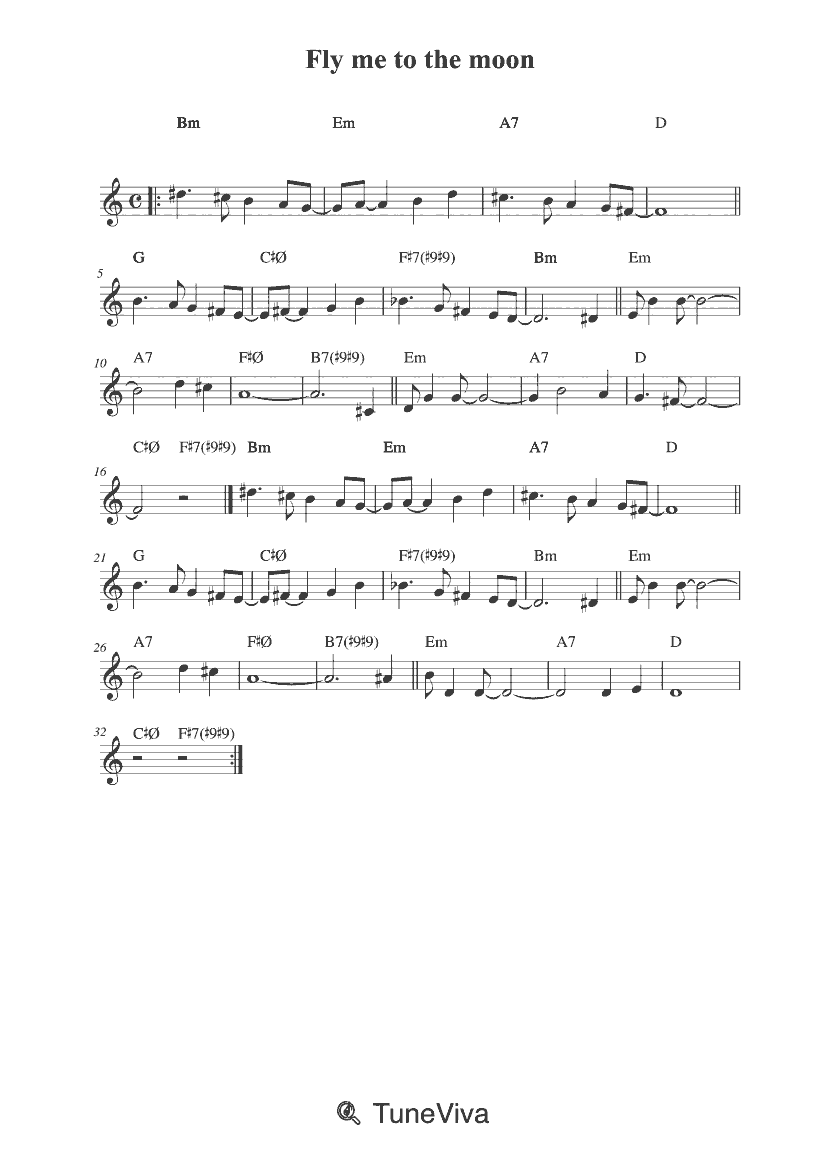
Fly me to the moon
Bart Howard
Tenor Saxophone · 2 min 7 sec
Open scoreCompare seven Bart Howard files for Fly Me to the Moon, including a lead sheet, flute feature and key-labeled versions. The catalog represents one main song.
Tenor Saxophone · 2 min 7 sec
One file for Howard’s song, listed with a MIDI playback program; check the score for actual scoring.
Other editions:
The title identifies a lead sheet, a useful starting point for melody and chord symbols.
Compare the instrument and arrangement details below, then open a score to check the notation. Different entries may be arrangements or editions of the same work; available playback tools are shown on each score page.
Bart Howard
Tenor Saxophone · 2 min 7 sec
Open score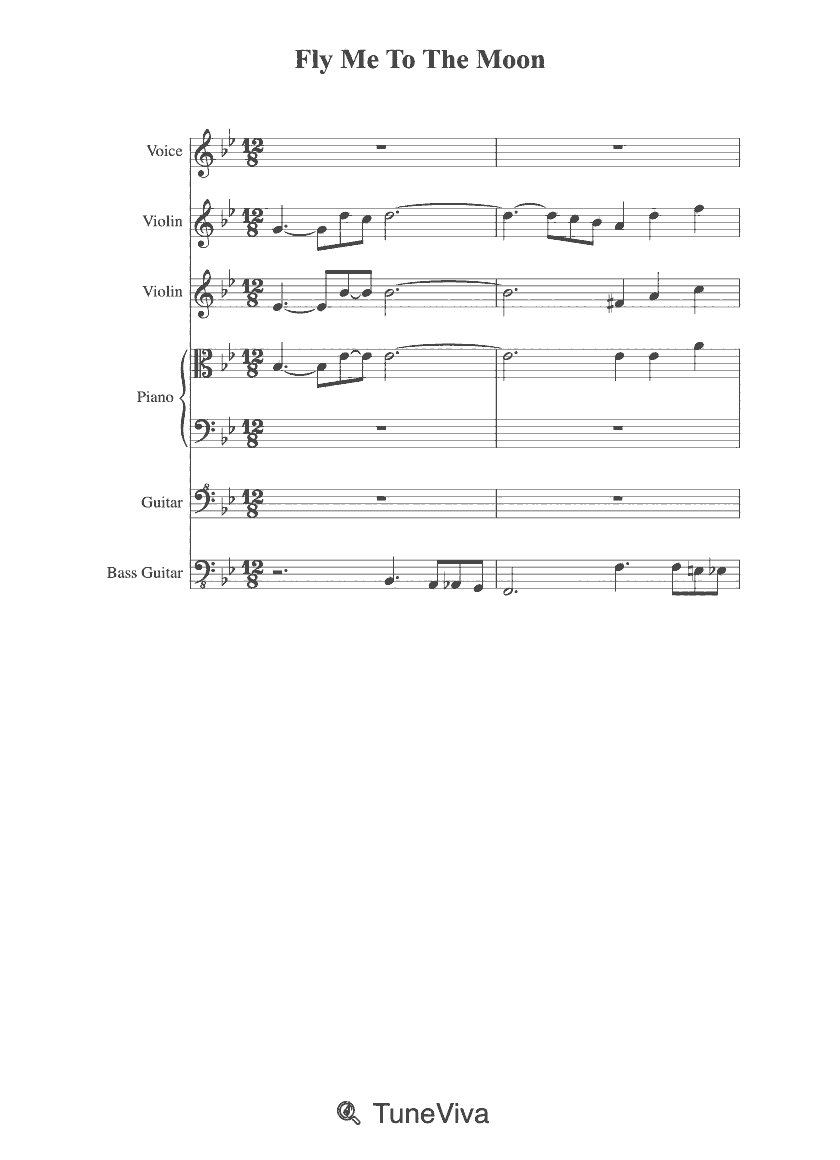
Bart Howard
Evangelion Ending
Voice; Violin; Piano +2 parts · 1 min 21 sec
Open score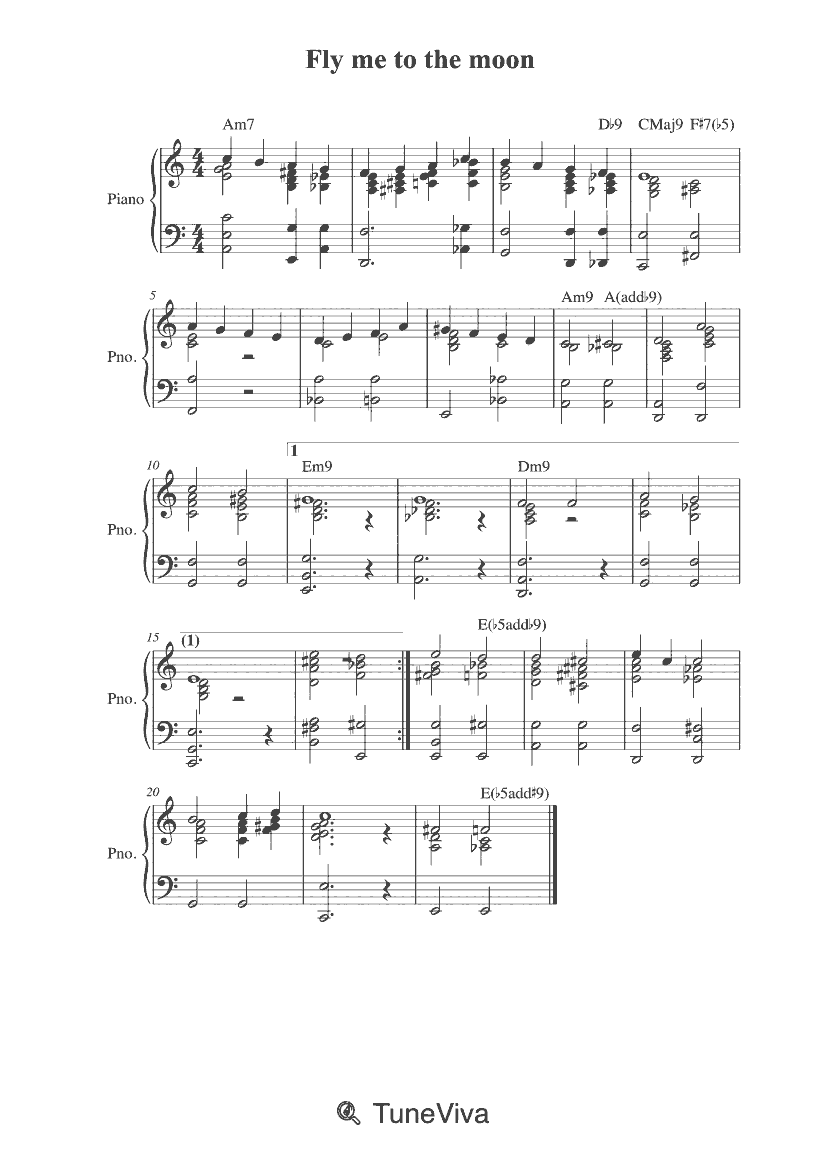
Bart Howard
Piano · 2 min 32 sec
Open score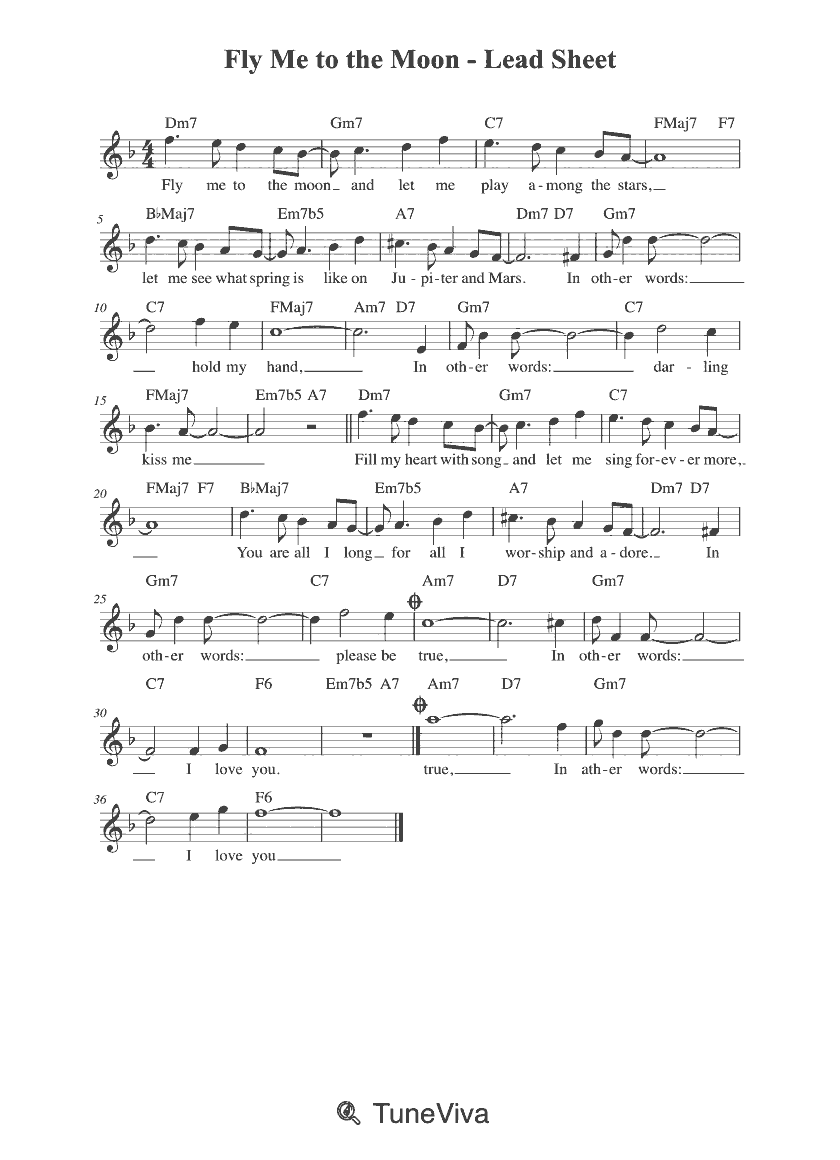
Bart Howard
Voice · 1 min 16 sec
Open score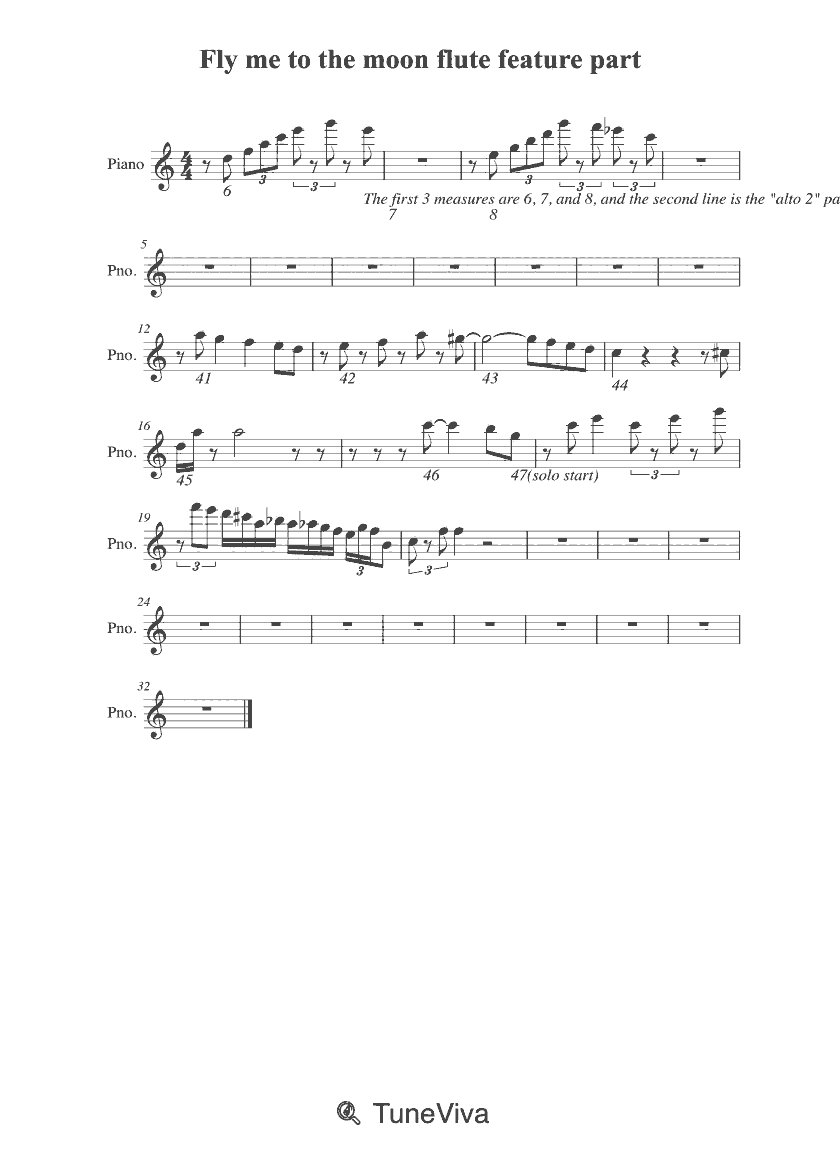
Bart Howard
Flute Solos
Piano · 1 min 0 sec
Open score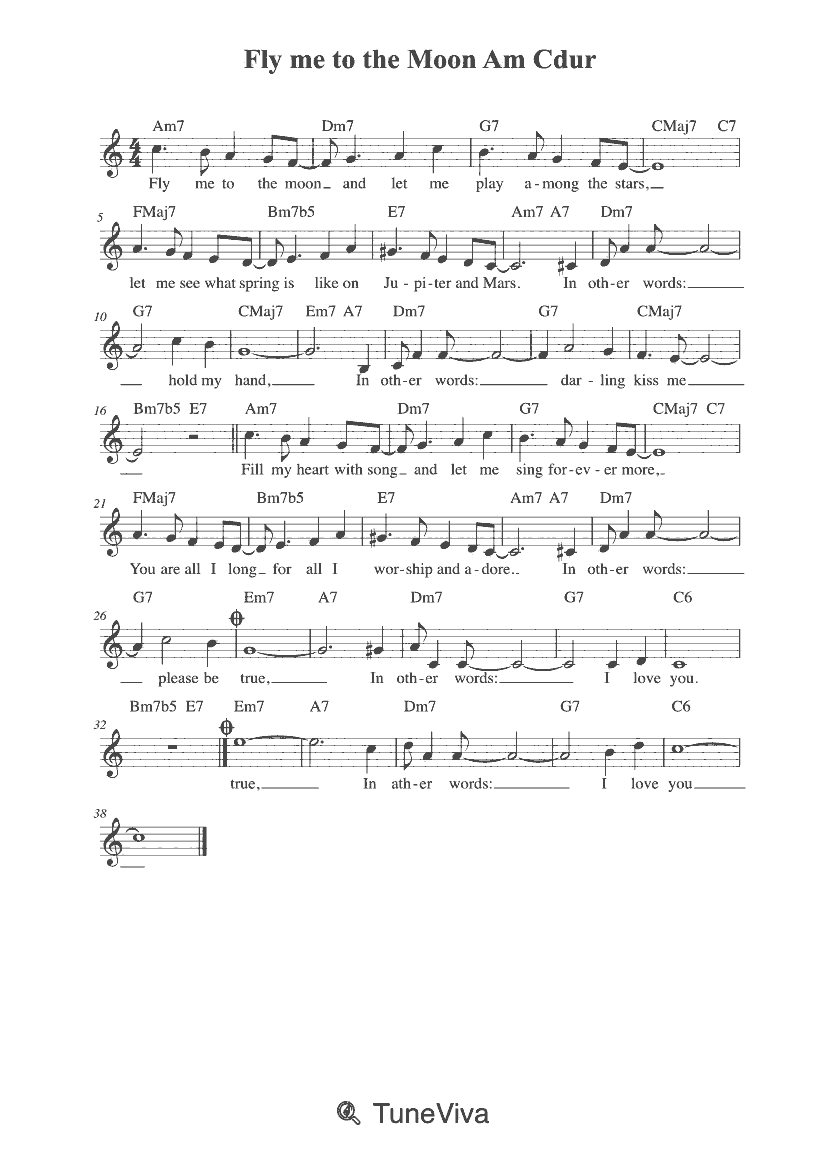
Bart Howard
Voice · 1 min 16 sec
Open score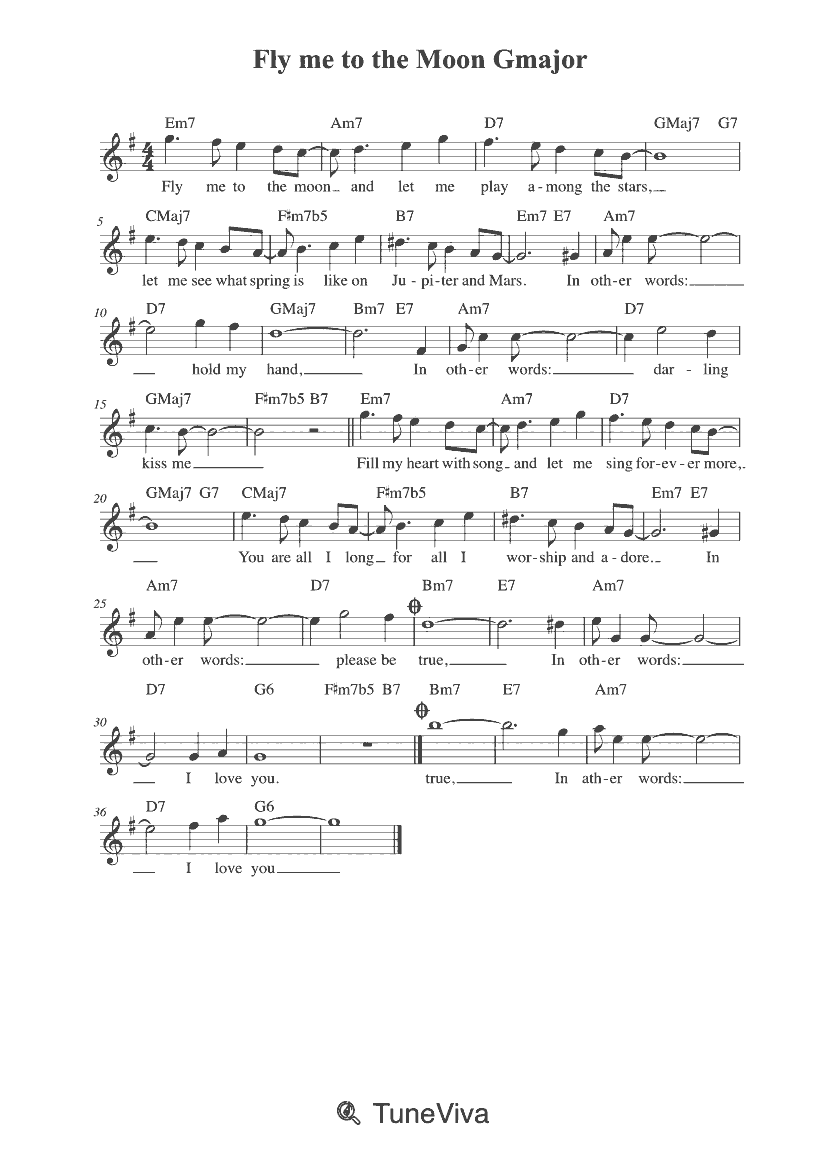
Bart Howard
Voice · 1 min 16 sec
Open scoreBart Howard wrote “In Other Words,” the song that became known as “Fly Me to the Moon.” The Library of Congress’s National Recording Registry identifies Bart Howard as its writer, describes Kaye Ballard’s 1954 recording and explains that the later title came from the opening line. TuneViva’s seven files all center on this song, with titles suggesting a lead sheet, a flute feature, multiple keys and other arrangements. That is seven score files for one main composition, not seven independent works. Check each notation file to confirm its actual parts, accompaniment and key before choosing a version. Bart Howard’s name appears as composer or artist on every score in this collection, and all seven files center on “Fly Me to the Moon.” The versions range from a lead sheet and a flute feature to a six-part arrangement for voice, violin, piano, guitar and bass guitar, plus single-part scores for piano, tenor saxophone and voice. Titles point to different keys, but the score pages are the place to confirm written key, instrumentation and whether accompaniment is included. These are alternative scores of one song, not seven separate compositions.
Howard’s song began as “In Other Words.” The Library of Congress’s registry history connects Howard’s authorship with Kaye Ballard’s 1954 recording and notes how “Fly Me to the Moon” replaced the original title. That history is useful when the TuneViva entries use inconsistent capitalization: they are versions of a single song with two familiar titles.
All seven catalog files center on that composition. Their labels point to different practical uses: a lead sheet, a flute-feature part, and copies named for A minor/C major or G major. Several files may therefore be transpositions or arrangements; the seven records should not be counted as seven works. One file credits a different uploader in its artist field, so its authorship label deserves a check against the score’s own credit line.
For a direct comparison, begin with the lead sheet and note the melody range and chord symbols. Compare its key with the files labeled A minor/C major and G major; the score pages can establish whether they are transpositions or other edits. Then check whether the flute-feature download supplies accompaniment or only a part. Listening to Ballard’s early recording offers historical context, while a later performance can show how the song’s flexible phrasing invites different settings.
Start with the lead sheet: The score titled “Fly Me to the Moon - Lead Sheet” is the clearest vocal starting point in this collection. Its listing shows one Voice part, a one-flat opening key signature and 4/4 time. Open the score to confirm that chord symbols, lyrics and a suitable melody range are present; a lead-sheet title alone does not guarantee those details.
Read the key labels carefully: The files carry different opening key signatures: one flat, no sharps or flats, and two flats. The title “Am Cdur” points to A minor or C major, which share a key signature with no sharps or flats, so the label alone cannot establish the tonic. Compare the melody and harmony in the score before treating one file as a transposition of another.
Check parts and accompaniment: Part listings vary widely. The lead sheet and the Am/Cdur version list Voice; another file lists Piano; one lists Tenor Saxophone; a six-track arrangement lists Voice, Violin, Piano, Guitar and Bass Guitar; and the flute feature file lists Piano. Because the flute title and the listed part do not obviously match, verify whether the download contains a separate flute line and piano accompaniment before rehearsing.
Match the arrangement to your forces: For a solo reading, the single-part scores for voice, piano or tenor saxophone are the simplest to assess. For a small ensemble, the six-track arrangement with voice, violin, piano, guitar and bass guitar offers the fullest listed instrumentation, although its 12/8 opening differs from the 4/4 single-part files. Check the full score for condensed or missing parts before committing a group to it.
No. The Library of Congress describes “In Other Words” as the original title and notes that the familiar title came from its opening line.
They all center on the same song, with different files or arrangements rather than seven separate compositions.
The catalog includes titles labeled Am/C major and G major. Check each score’s key signature to confirm its contents.
The collection lists seven score files connected to “Fly Me to the Moon.” Titles identify a lead sheet, a flute feature part, an arrangement labeled Am/Cdur, and several other versions. The scores differ in scoring, key signature, time signature and length, but they center on one song rather than seven separate works.
The Bart Howard score titled “Fly Me to the Moon - Lead Sheet” is the clearest vocal starting point in this collection. Its listing shows one Voice part, a one-flat opening key signature and 4/4 time. Check the score itself for chord symbols, lyrics and a comfortable melody range before using it in performance.
The Fly Me to the Moon files open with different key signatures: one flat, no sharps or flats, and two flats. Those differences mean the scores are not all written in the same key. The “Am/Cdur” title can refer to A minor or C major because both share a signature with no sharps or flats, so inspect the melody and harmony rather than relying on the title alone.
The file titled “Fly Me to the Moon flute feature part” lists Piano as its score part. That listing does not confirm a separate flute line, so open the score to see whether a flute part is present and whether piano accompaniment is included.
One six-track arrangement lists Voice, Violin, Piano, Guitar and Bass Guitar as its score parts. It opens with a two-flat key signature and 12/8 time, unlike the 4/4 single-part files. Check the full score for condensed or missing parts before assigning it to an ensemble.
All seven Bart Howard entries use the title “Fly Me to the Moon” and present versions or arrangements of that song. Differences in scoring, key signature, time signature and length identify alternative scores, not separate compositions.