classical
2 tracks
Lelia Naylor Morris published most of her hymns as "Mrs. C. H. Morris", the credit that still appears on thousands of gospel-song pages. A Methodist Episcopal churchgoer from Morgan County, Ohio, she wrote words and tunes at the kitchen table and kept composing after her sight failed in 1913. TuneViva holds 163 scores under her various catalog names, 68 with lyrics. The collection runs from simple choruses to four-part settings of her better-known hymns, and searches for either her real name or her married name lead back to the same body of work.
Morris was born on 15 April 1862 in Pennsville, Morgan County, Ohio, and grew up near Malta on the Muskingum River. She ran a millinery shop in McConnelsville with her mother and sister, and in 1881 married Charles H. Morris. Both were active in the Methodist Episcopal Church and attended camp meetings at Sebring and Mount Vernon, the setting in which much American holiness hymnody of the period was tested and sung.
She began writing hymns in the 1890s. Sources credit her with more than a thousand texts and tunes, much of it written while she kept house. Her sight failed in 1913, when she was fifty-one; her son built a blackboard twenty-eight feet long with oversized staff lines so she could continue to compose. Her best-known hymns include "Nearer, Still Nearer" (1898), "Let Jesus Come into Your Heart" and "Sweeter as the Years Go By" (1912).
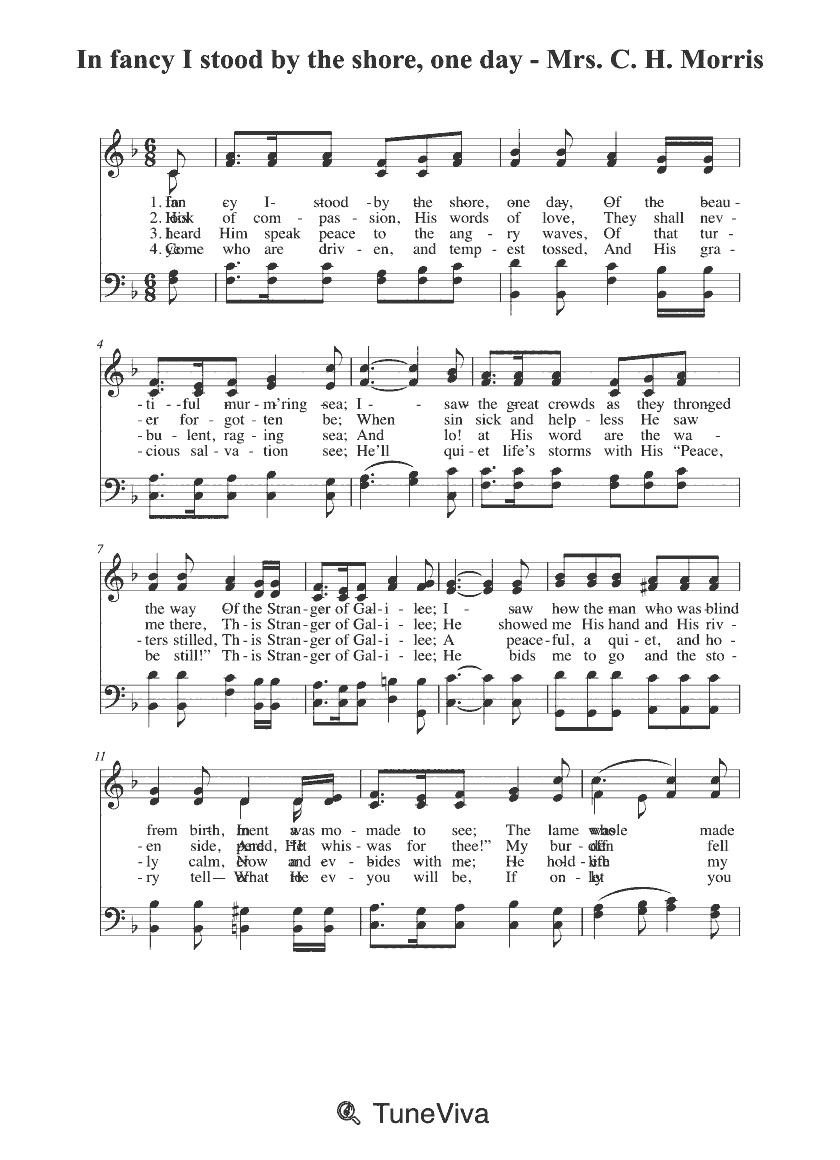
The catalog holds 163 scores, 68 with lyrics, about 103 minutes in all. Only nineteen sit at the easiest level; most are moderately difficult, which fits a repertoire built on part-writing and refrain choruses rather than unison song. "The stranger of galilee" is by far the most-viewed title, followed by "Nothing but the blood of Jesus in my soul" and "I am standing now on the promises of God". Morris moved to Auburn, New York, around 1928 and died there on 23 July 1929.
Expect gospel-song harmony rather than hymnbook plainness: repeated choruses, chromatic inner parts and a strong sense of a text being dramatised. The Pentecost and holiness titles often build to a refrain over a rising bass line. Singers should check the catalog's key choices, since these settings were pitched for congregational comfort rather than for a trained choir. Pianists can treat the printed accompaniment as an outline and add the passing chords and fill-ins that the period's songbooks assumed.
Her most-viewed catalog title, a narrative gospel song that follows Christ through the Gospel of John.
A holiness chorus that locates assurance in the cleansing blood rather than in religious feeling.
A faith-standing chorus built on the list of divine promises.
A reflective narrative hymn that looks back to the early days of faith.
A revival march that casts the Christian life as military enlistment.
A Pentecost hymn linking the church's founding outpouring to present-day revival.
A prayer for usefulness, set in the modest four-part idiom she used for choir and congregation.
A pilgrimage hymn built on Hebrews 13:14, its text setting the believer's journey against a heavenly home.
A revival hymn claiming the Acts 2 experience for the present congregation.
A consecration hymn in which the singer yields every part of life to God.
Yes. She was Lelia Naylor Morris (1862-1929), an American Methodist hymn writer who published under her husband's name after marrying Charles H. Morris.
Most modern references use Lelia, matching her obituary and grave marker; Leila also appears widely, including in some library catalogs.
She wrote both, and sources credit her with more than a thousand hymns and tunes, many composed after she lost her sight.
The scores were uploaded with credits ranging from "Mrs. C. H. Morris" to "Lelia N. Morris" and "C. H. Morris", and the catalog had not merged them before this page.
Catalog editions and arrangements attributed to Mrs. C. H. Morris.