

classical
3 tracks
Thirty-nine scores carry Cristóbal de Morales's name, about 338 minutes of music and 48,618 notated notes. All 39 carry lyrics and all are filed as classical, which suits a composer who wrote almost nothing but vocal polyphony. The heading also absorbs the accent-free spelling cristobal-de-morales, so searches without accents land here.
Puer natus est is the most-viewed entry by a wide margin, with 651 views; the Easter sequence Victimae paschali laudes follows at 154. Much of the rest of the page is the four-voice Requiem, split into separate movements, alongside motets, a Magnificat and a setting of the Emendemus text.
Morales was born in Seville around 1500 and trained there before holding posts at Ávila and Plasencia. By 1535 he was in Rome, singing in the papal choir under Paul III; he stayed until 1545, then returned to Spain, where he worked at Toledo and, from 1551, as maestro de capilla at Málaga Cathedral. He died in 1553, probably at Marchena, between 4 September and 7 October; the exact date is not recorded.
His surviving output is almost entirely sacred: 22 masses, more than 100 motets, 18 Magnificats and at least five Lamentations. The two books of Masses appeared in Rome in 1544, and the second includes the five-voice Missa pro defunctis. A four-voice Requiem Mass also survives, written for the Count of Ureña and distinct from the early four-voice Officium defunctorum copied around 1526-28; its Dies irae is set polyphonically rather than left to plainchant, which was unusual for the period.
The catalogue reflects the sacred side only. Its 39 entries are all vocal and all at complexity index 0, and the Requiem appears movement by movement rather than as one file. Puer natus est is a three-voice Christmas motet printed in Venice by Gardano in 1551, while the Magnificat Primi Toni belongs to the 18-setting cycle that did most for his reputation.
These are vocal scores, so the first decision is forces: one voice to a part for the motets, a larger choir for the Requiem. Morales writes long, interlocking lines that rarely move by leap, and the tuning problems come from chains of suspensions. Let the imitative entries settle before adding weight, and keep the text audible, since the files include lyrics. In the Requiem movements, resist a Romantic funeral pace; the counterpoint needs forward motion.
The most-viewed score on the page: a three-voice Christmas motet, printed in Venice by Antonio Gardano in 1551.
A setting of the Easter sequence, the second most-viewed entry in the collection.
The opening Introit of the four-voice Requiem, filed as its own score rather than as part of a complete Mass.
The Kyrie of the same Requiem; the numeral in the title records its position in the file set, not a catalogue number.
The final movement of the Requiem as the catalogue orders it, numbered VI.
A short Advent motet; the catalogue gives no publication source for it.
A motet on the 'Circumdederunt me' text, one of the few pieces here that is not part of a Mass.
One of the 18 Magnificat settings, in the first tone, with the opening words 'Anima mea' supplied in the title.
A motet for the Nativity of John the Baptist, built on the Gospel text 'among those born of women'.
A motet on the Holy Cross text; it sits near the bottom of the view counts but adds a non-Marian feast to the page.
Thirty-nine, running to about 338 minutes and 48,618 notated notes. Every entry includes lyrics and every entry is filed as classical.
The titles on this page give the Introit, Kyrie, Gradual, Offertory, Sanctus and Agnus Dei as separate files. They are not presented as one work, and no separate Dies irae is listed among them, so check the movement files before assembling a performance.
The canonical slug was built from an unaccented spelling, cristbal-de-morales. The variant cristobal-de-morales is merged into the same page.
The three-voice Christmas motet, not a Christmas Mass by another composer. RISM records a 1551 Venice printing by Antonio Gardano.
Catalog editions and arrangements attributed to Cristóbal de Morales.


de la Missa Pro Defunctis

de la Missa Pro Defunctis

de la Missa Pro Defunctis


de la Missa Pro Defunctis


de la Missa Pro Defunctis


de la Missa Pro Defunctis


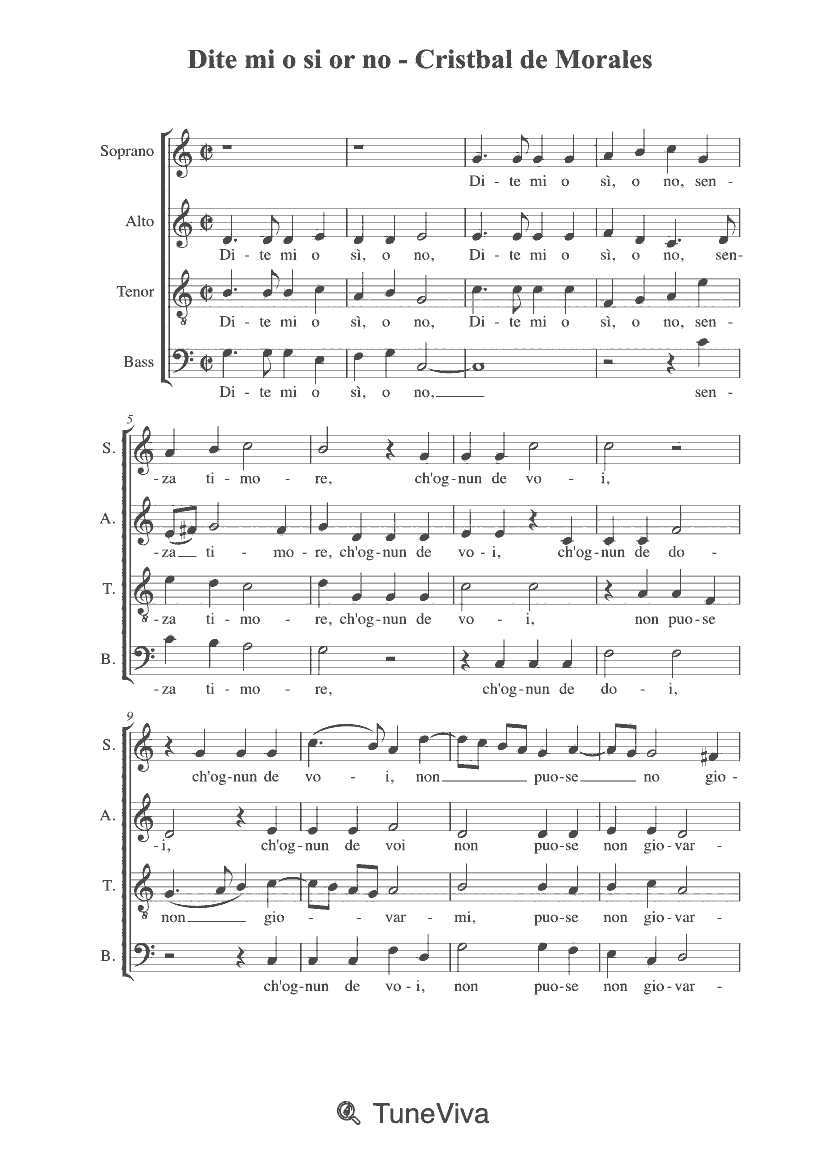
Four part madrigal