classical
2 tracks
Asola's catalogue is small in scale but wide in liturgical range: 41 scores, about 101 minutes and 11,911 notated notes, with lyrics on every entry. The most-viewed is the two-voice canon Cantan fra rami gli augelletti vaghi, followed by Quest' amoroso caldo and the hymn Veni Creator. Hymns, madrigals and alternatim settings of Iste Confessor and Ave maris stella share the page, and two Iste Confessor entries divide the odd and even verses between chant and polyphony. All 41 sit at complexity index 0, so the index is no help in choosing between a short hymn verse and a longer madrigal.
Giammateo Asola was born in Verona, probably in 1532 or a little earlier, and entered the congregation of secular canons at San Giorgio in Alga in 1546. He may have studied with Vincenzo Ruffo, and he was ordained a secular priest in 1569. After a spell as maestro di cappella at Treviso Cathedral in 1577, he moved to Vicenza in 1578 and then to Venice in 1582, where he remained, apart from a short return to Verona around 1590-91, until his death on 1 October 1609. He served as one of the chaplains at San Severo and was never attached to St Mark's.
His music is conservative for Venice: mostly in the Roman, Palestrina-like idiom, with the polychoral writing of his 1588 eight-voice masses as the main Venetian feature. He wrote masses, including a Requiem, psalm settings, lamentations, hymns, antiphons and several books of madrigals, and he may have been among the first composers to write a basso continuo part.
The catalogue reflects the sacred side more than the secular. Its 41 entries are all vocal and all at complexity index 0; the average length is about two and a half minutes, and the notation is sparse even by Renaissance standards. The 1587 Madrigali a due voci, a book of two-voice canons, is represented by one of its two-voice canons.
Asola's polyphony moves mostly by step, so the difficulty is in tuning long chains of suspensions rather than in leaps. Keep the texture light and let each voice remain audible; a heavy blend obscures the imitation. In the alternatim hymns, the chant verses set the pitch and tempo, so the polyphony must be tuned to the choir's plainchant rather than to equal temperament. The two-voice canons need a steady pulse, since any acceleration in the leader is passed straight to the follower.
A two-voice canon from the 1587 Madrigali a due voci, on Ariosto's Orlando furioso (canto XXXV, ottave 50-51).
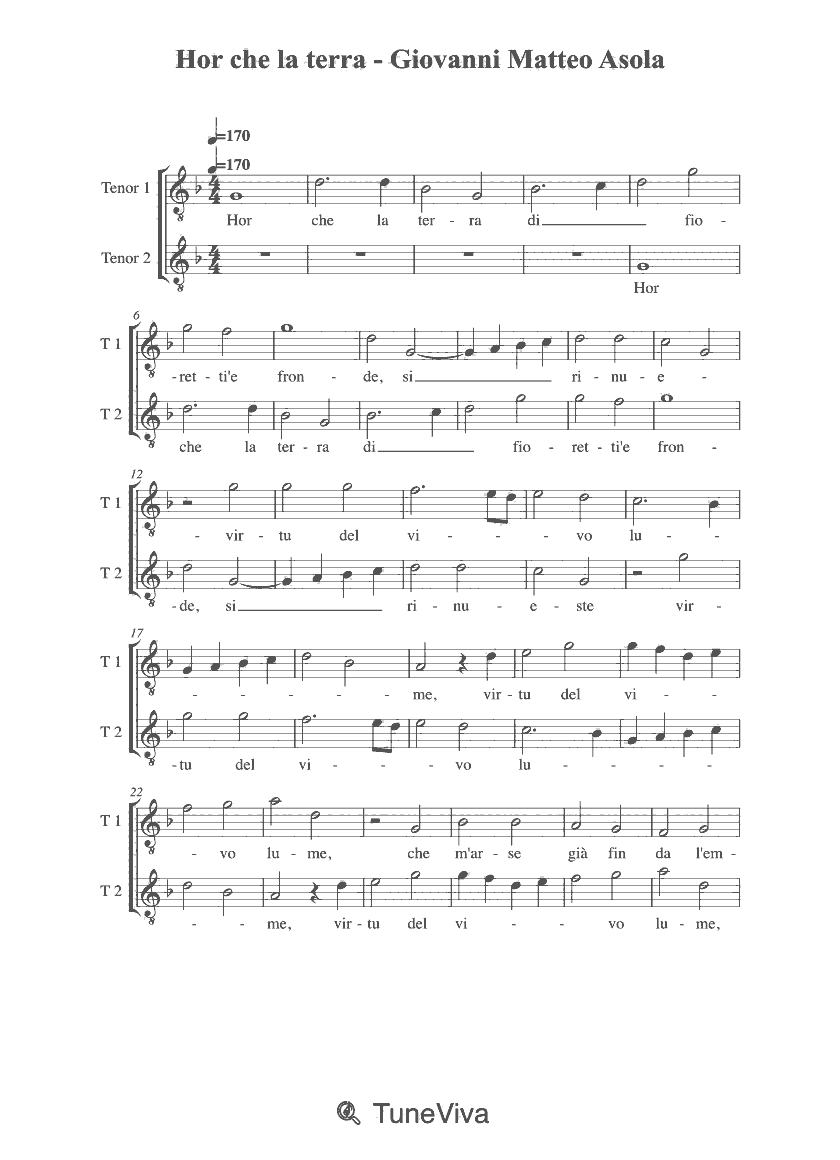
A secular madrigal; the catalogue does not record its source collection.
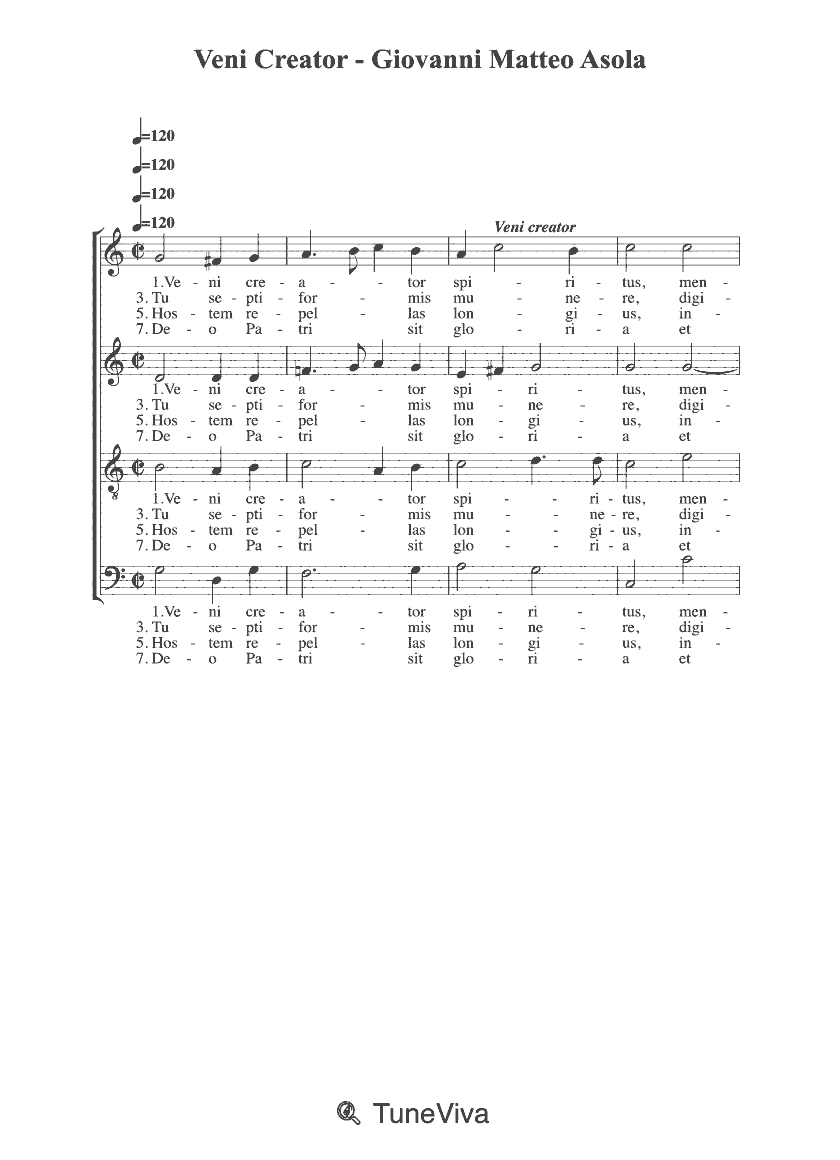
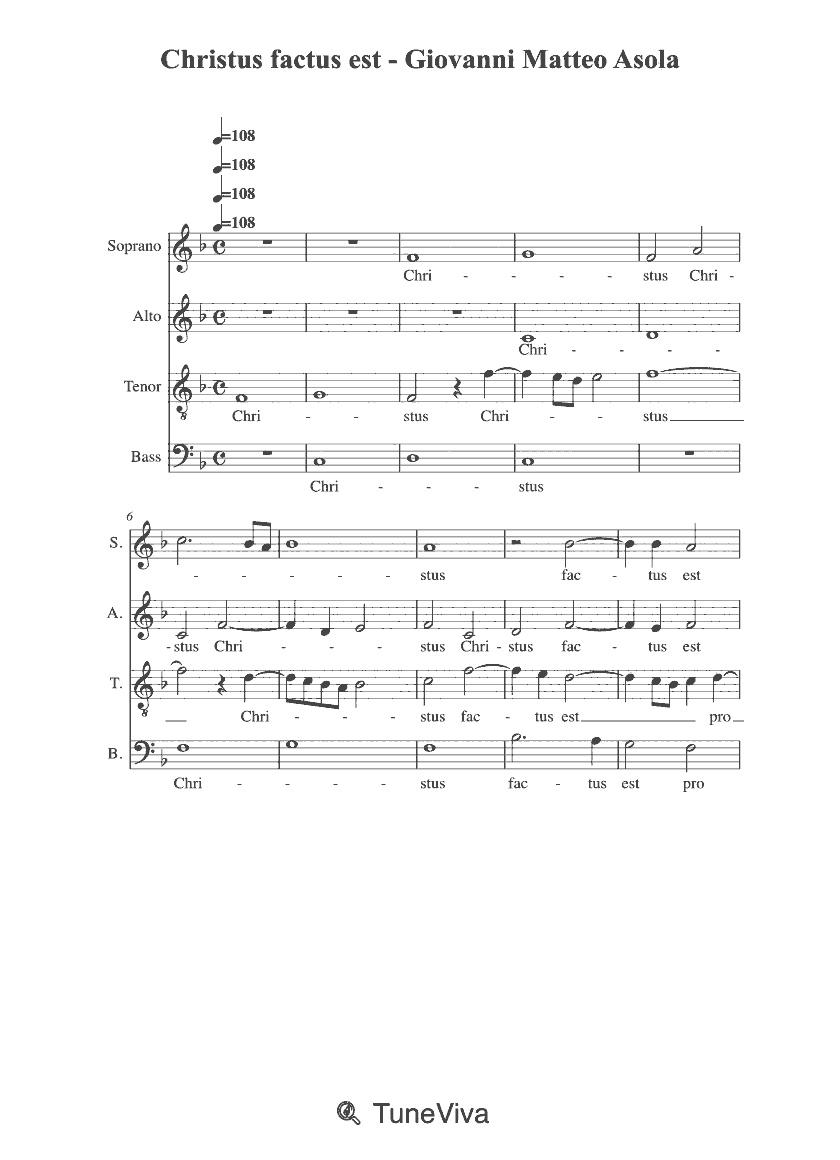
A four-part setting of the Pentecost hymn Veni Creator Spiritus, among the most-viewed sacred pieces on the page.
A madrigal; the source book is not given on the file.
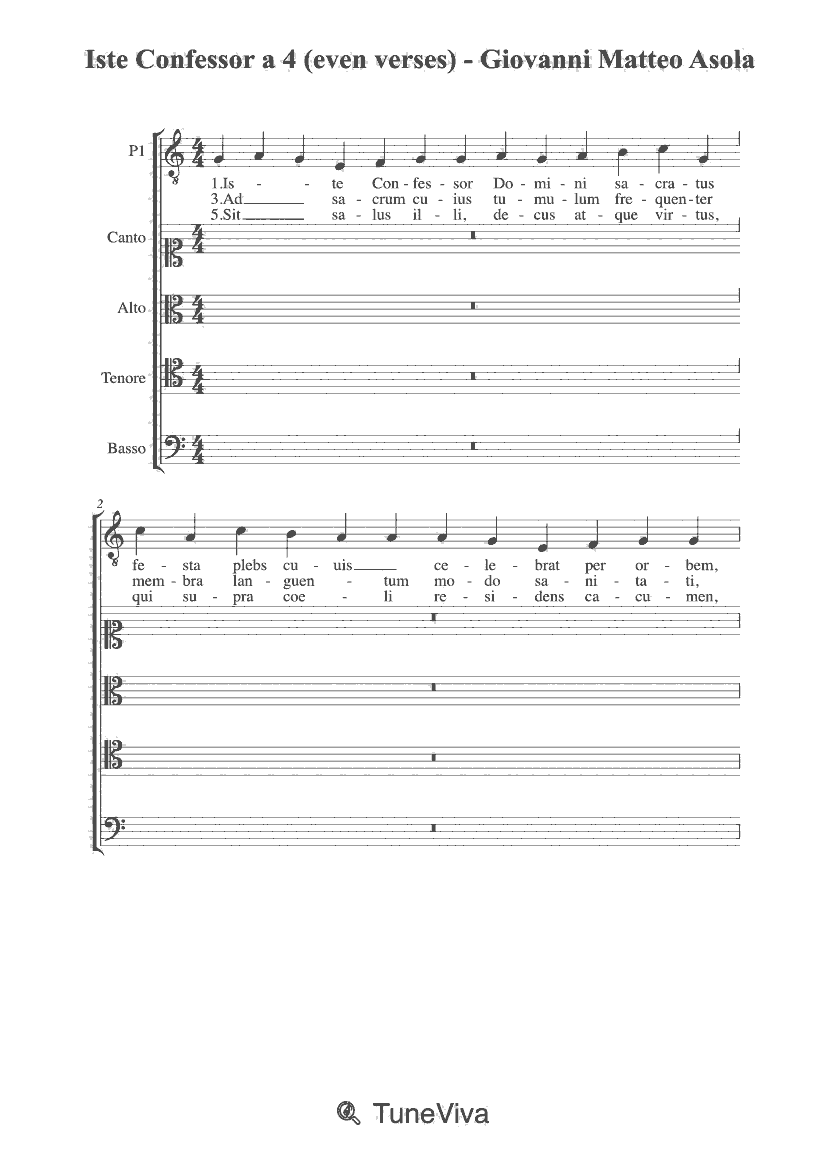
The even-numbered verses of the hymn for confessors, set in four-part polyphony to alternate with plainchant.
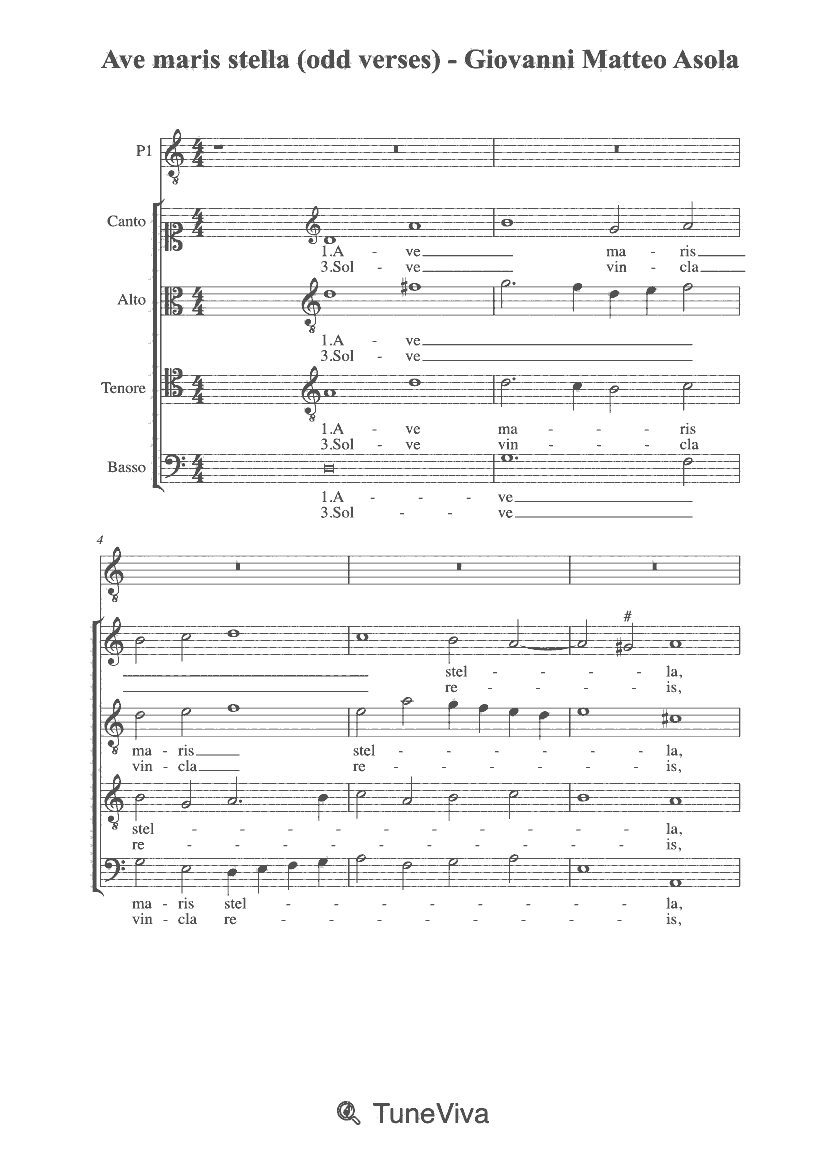
The odd verses of the Marian hymn, in an alternatim setting for four voices.
A madrigal; the catalogue gives no poet or publication.
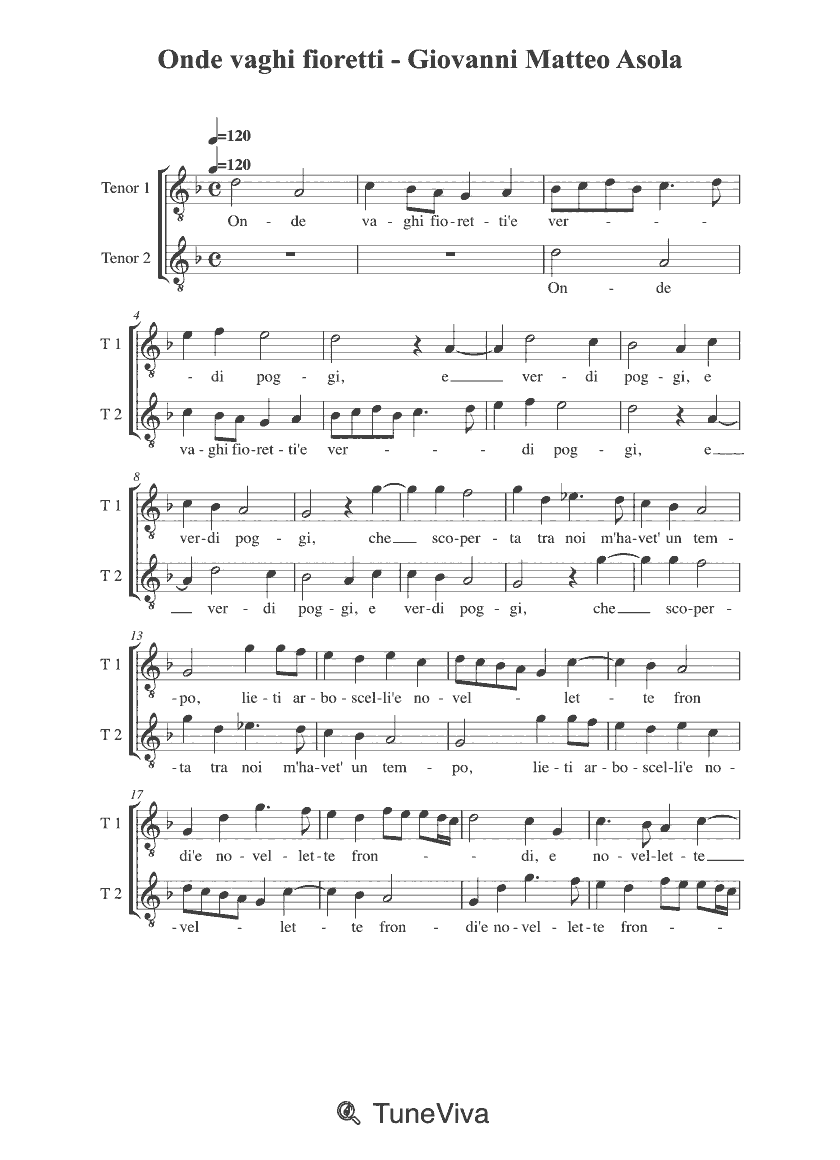
A madrigal whose title evokes scattered flowers; the source is not recorded.
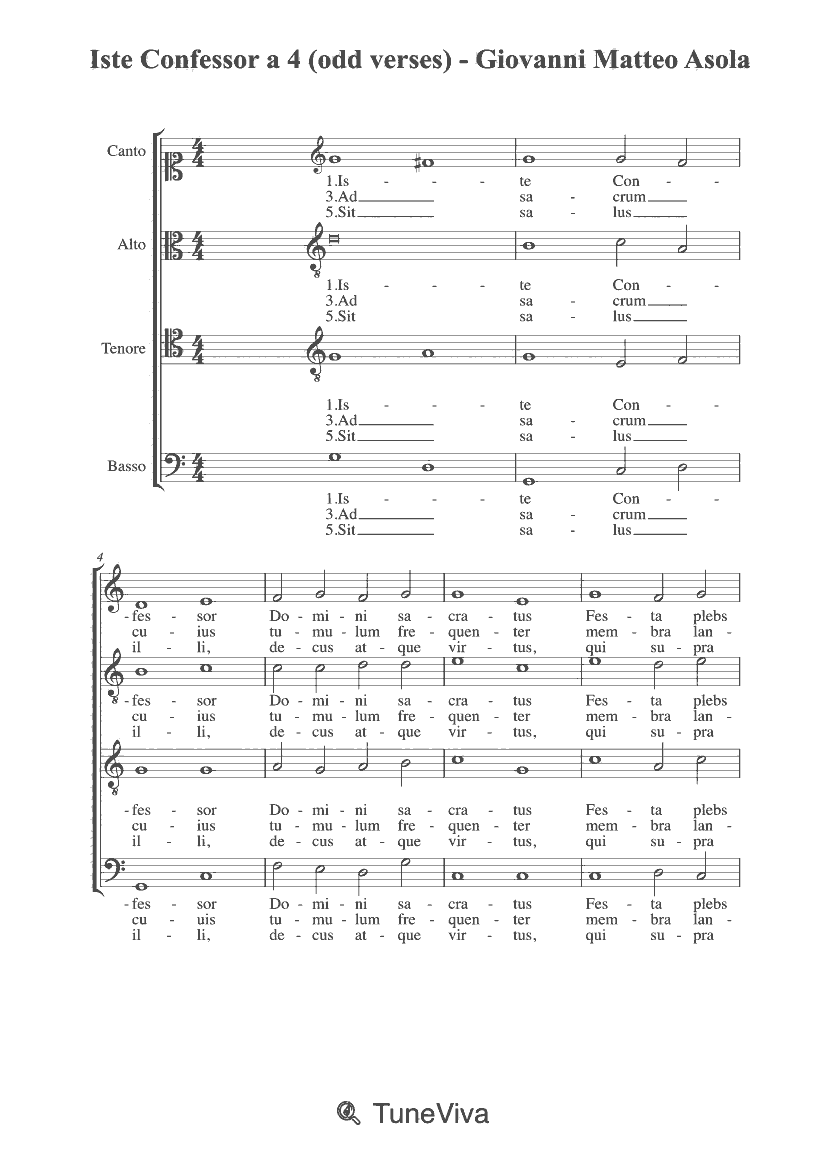
The companion to the even-verse setting, supplying polyphony for the odd verses of the same hymn.
The title means 'sweet peace'; the catalogue files it as vocal but does not say whether the text is sacred or secular.
There are 41, running to about 101 minutes of music and 11,911 notated notes. All 41 carry lyrics.
A Veronese priest and composer of the late Renaissance who worked mainly in Venice from 1582 and died there in 1609; his music follows the Roman rather than the Venetian style.
Chant and polyphony alternate verse by verse. The Iste Confessor and Ave maris stella entries here are divided in exactly that way.
One sets the odd verses and one the even, so they are complementary halves of the same hymn rather than duplicate settings.
Catalog editions and arrangements attributed to Giammateo Asola.