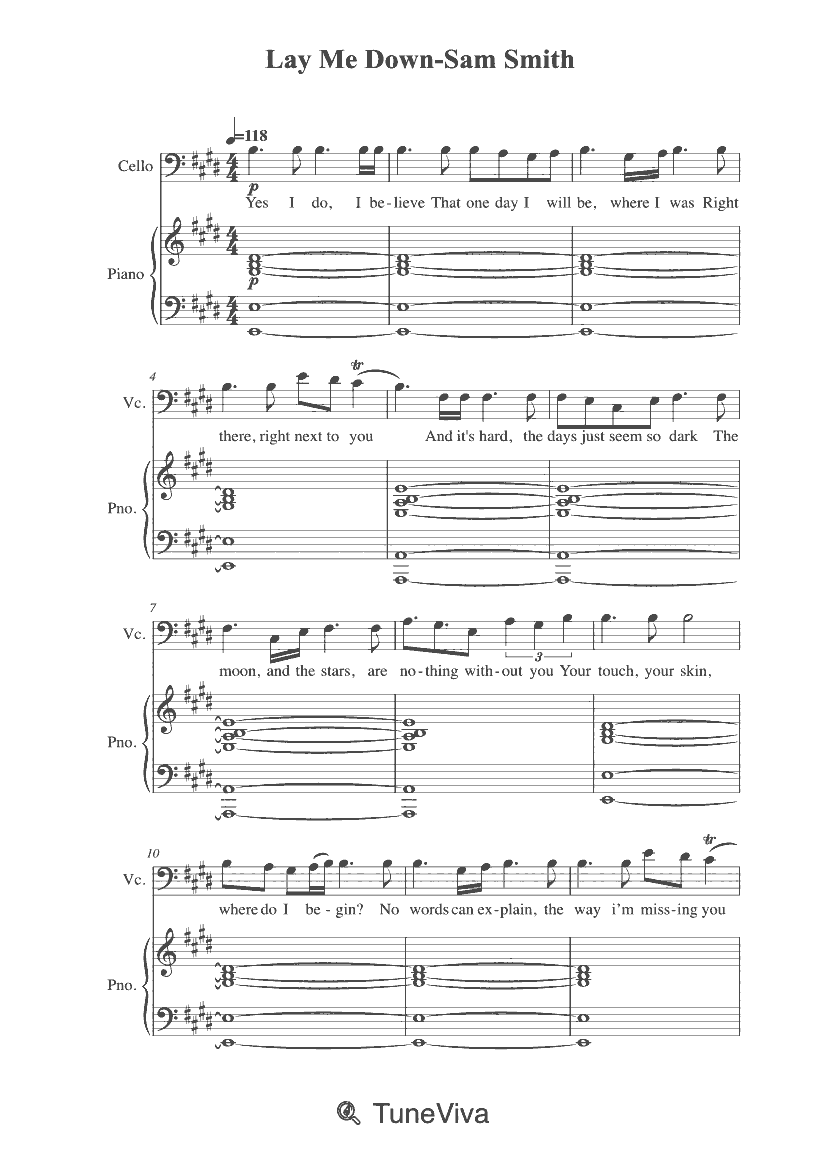
Lay Me Down-Sam Smith
Sam Smith
Cello; Piano · 3 min 34 sec
Open scoreBrowse 6 Sam Smith catalogue scores, including Lay Me Down and Writing’s On The Wall. Compare the listed versions and inspect each score before printing.
The largest-viewed file in this group. Published song credits name Smith with co-writers; check this file itself for its particular scoring.
An accompaniment file associated with Smith as artist; its catalog record does not name a composer.
A separate catalogue file; composer credit is blank, so the title and artist association do not establish its arrangement source.
A catalogue score for the Spectre theme co-written by Smith and James Napier; inspect the file to identify the arrangement.
Compare the instrument and arrangement details below, then open a score to check the notation. Different entries may be arrangements or editions of the same work; available playback tools are shown on each score page.
Sam Smith
Cello; Piano · 3 min 34 sec
Open score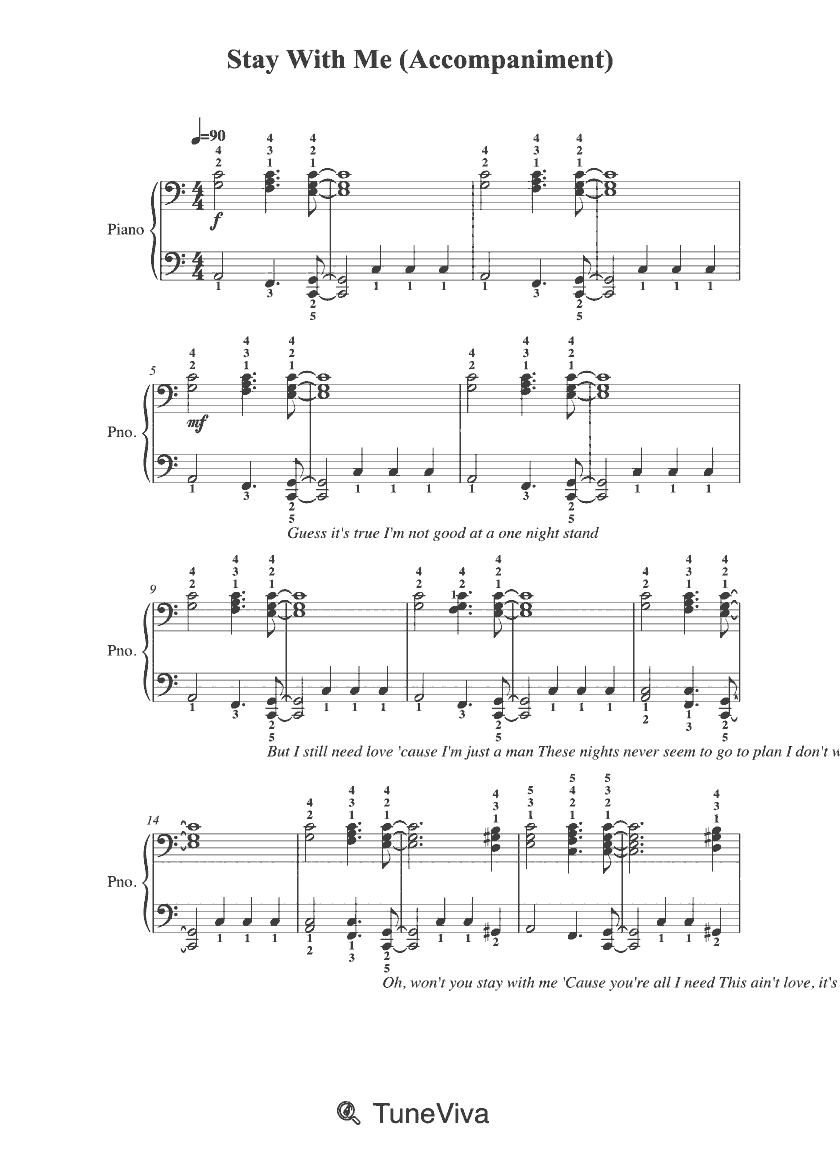
Sam Smith
Based on Anri Pok's version
Piano · 2 min 40 sec
Open score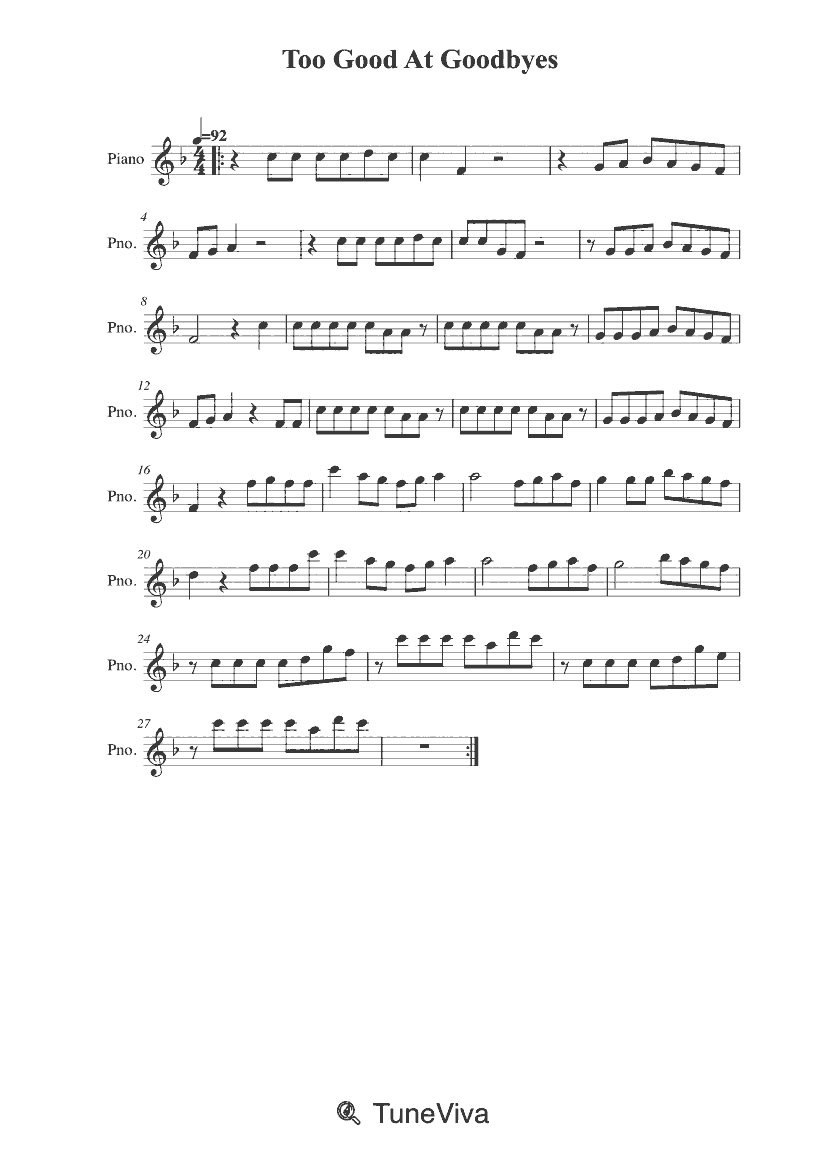
Sam Smith
Sam Smith
Piano · 2 min 25 sec
Open score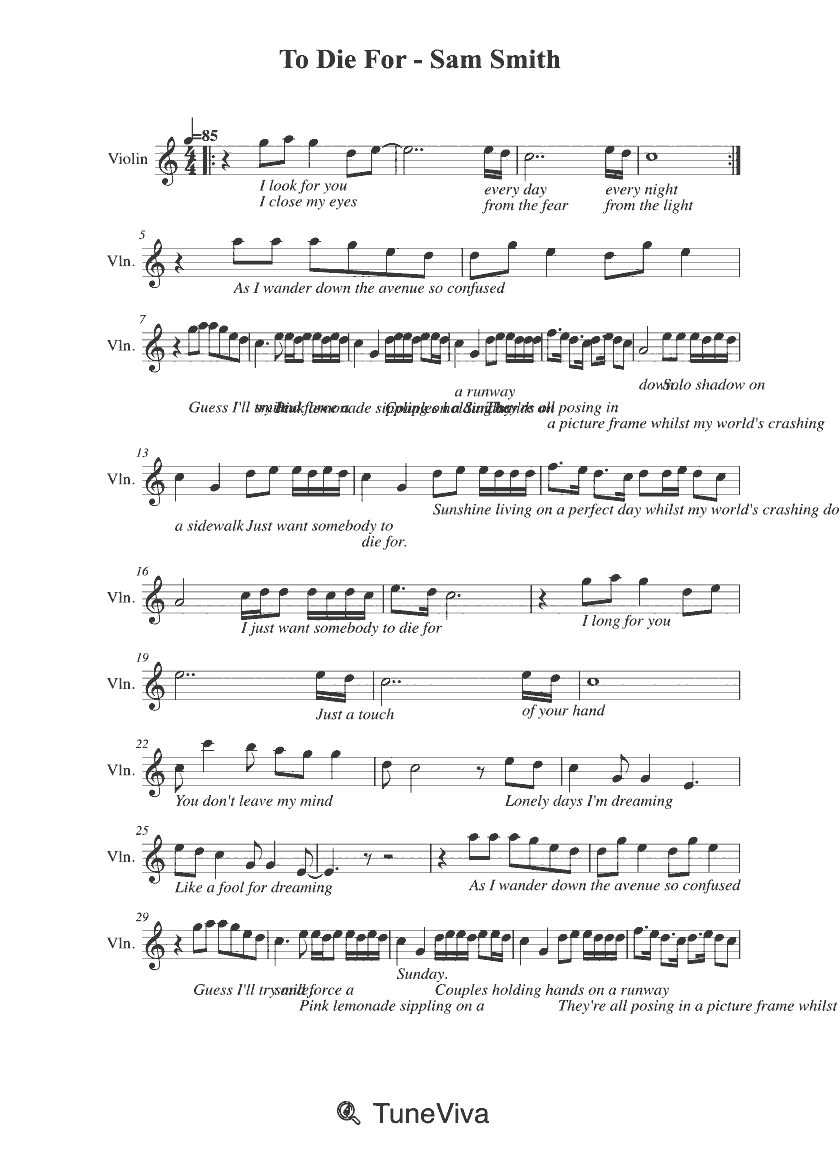
Sam Smith
Sam Smith
Violin · 2 min 1 sec
Open score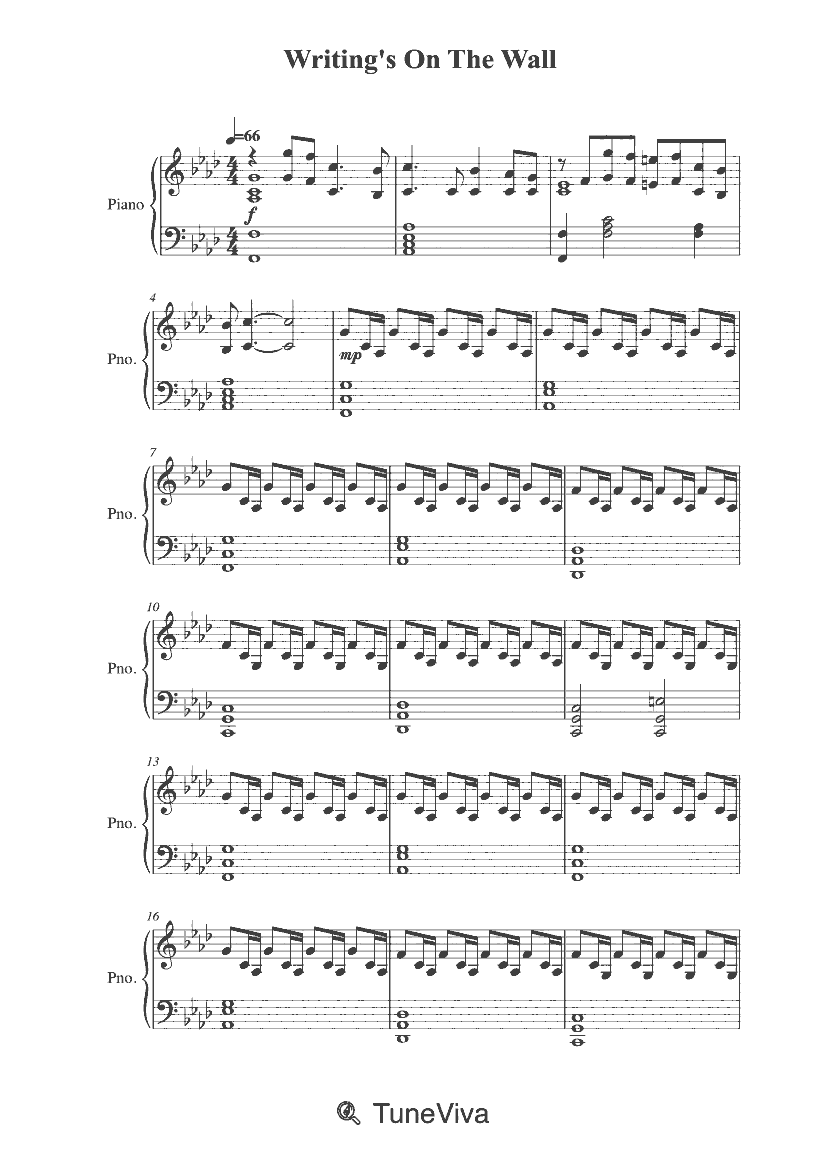
Sam Smith
Piano
Piano · 4 min 22 sec
Open score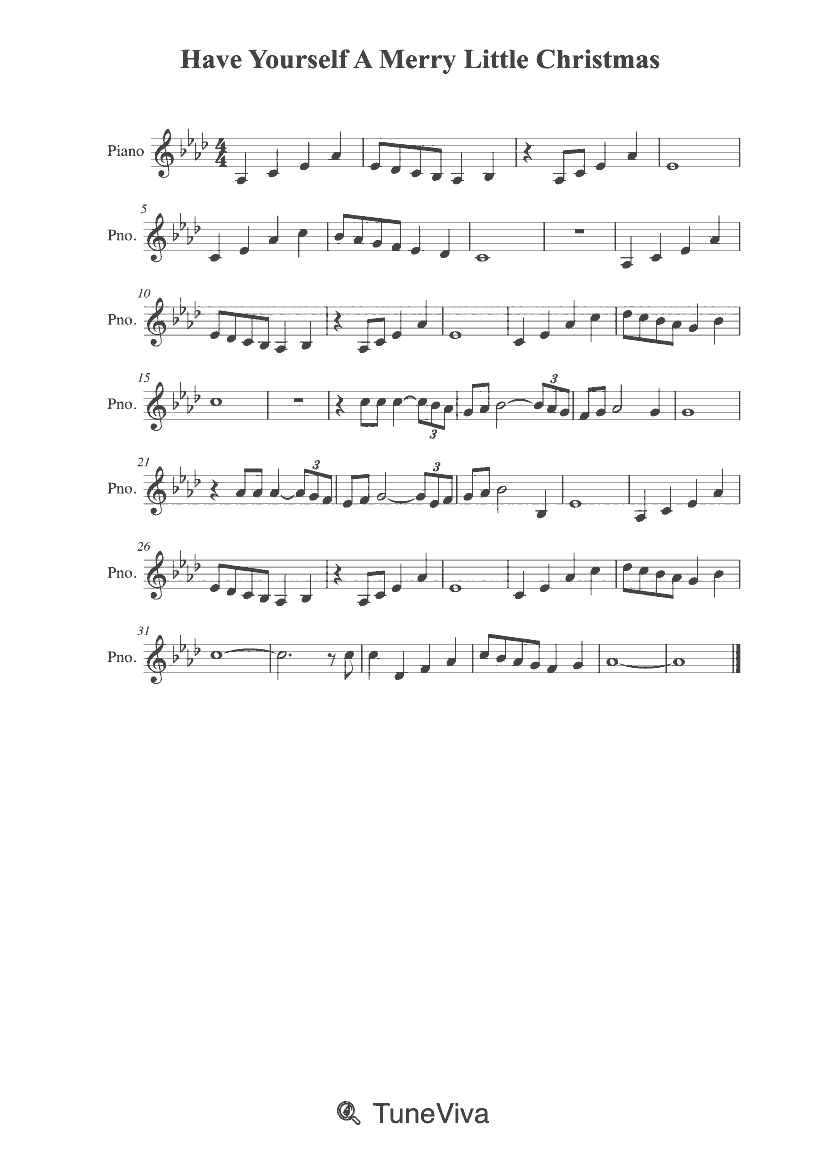
Attribution under review
Piano · 1 min 12 sec
Open scoreThe TuneViva catalogue groups six files under Sam Smith, with six different song titles: “Lay Me Down,” “Stay With Me,” “Too Good at Goodbyes,” “To Die For,” “Writing’s On The Wall,” and “Have Yourself a Merry Little Christmas.” The records do not all assign roles the same way: some name Smith as composer, others as artist, and some leave the composer field blank. “Stay With Me (Accompaniment)” describes a particular accompaniment file. The Christmas entry lists Judy Garland as artist while its composer field names Smith, a discrepancy that calls for care rather than an assumption about who performed or wrote this particular score. Sam Smith sheet music here is organised around individual songs rather than a single album or songbook. The detailed listings cover “Lay Me Down,” “Writing’s On The Wall,” “Too Good at Goodbyes,” and “Stay With Me (Accompaniment),” and the page also names “To Die For” and “Have Yourself a Merry Little Christmas.” Several records describe piano parts, while “Lay Me Down” also lists cello. Because edition and arrangement sources are not identified, use the listed key, tempo and parts to compare versions, then check the notation for the vocal line, accompaniment, key and layout.
Sam Smith is a British singer and songwriter whose official site lists albums including In the Lonely Hour. In the TuneViva group, six distinct titles cover a small portion of the catalog rather than a comprehensive songbook. A performer or artist credit identifies an association with the song or recording; it does not by itself confirm composition or arrangement. For “Lay Me Down,” published credits name Smith with James Napier and Elvin Smith as songwriters. “Writing’s On The Wall” is credited to Smith and James Napier. Those songwriting roles should be kept separate from recording performers, producers, and arrangers. The Stay With Me file is explicitly labeled as an accompaniment, while its catalog composer field is blank. The Christmas title has Smith in the composer field and Judy Garland in the artist field; those metadata do not establish the nature or source of the uploaded score.
Use the exact file title to choose among the six songs, then review the notation itself for vocal line, accompaniment, key, and layout. Catalog metadata does not identify the edition or confirm the intended forces. The list below keeps each exact database title and adds a concise display label. The Lay Me Down file is the clear starting point for the best-documented songwriter credit; the other records should be read according to their own fields and score headings. This distinction is useful when comparing versions or deciding whether a file fits a singer, accompanist, or instrumental player.
Start with the song, then the playing situation: Choose the exact song title first, then decide whether you need a vocal line with piano, a piano part for rehearsal, or an accompaniment. “Stay With Me (Accompaniment)” is explicitly named as an accompaniment in the listing, so inspect it for how the piano supports a singer. The other Sam Smith scores should be checked on the page for the presence of a separate vocal line and for whether the piano writing is a full arrangement or a reduction.
Compare listed keys, tempos and parts: The detailed listings give useful starting points. “Lay Me Down” names Cello and Piano, opens with four sharps in 4/4 at 118 BPM; “Writing’s On The Wall” lists Piano, four flats in 4/4 at 66 BPM; “Too Good at Goodbyes” lists Piano, one flat in 4/4 at 92 BPM; and “Stay With Me (Accompaniment)” lists Piano, no sharps or flats in 4/4 at 90 BPM. These are opening indications for individual scores, not a full description of form, vocal range or arrangement.
Read credits and titles carefully: The records are not consistent. “Lay Me Down” names Sam Smith in both composer and artist fields, while “Writing’s On The Wall,” “Too Good at Goodbyes” and “Stay With Me (Accompaniment)” leave the composer field blank and name Smith as artist. An artist credit shows an association with the song or recording; it does not by itself confirm who composed or arranged that particular score. Check the score’s own title page and credit lines before relying on a listing.
What to verify in the score before use: Before choosing a Sam Smith arrangement for performance or practice, confirm the printed instrumentation, the presence or absence of a vocal line, the starting key and tempo, and whether the piano part matches your role. The listings do not identify an edition or arrangement source, so do not assume that a score is the original published version or a specific live arrangement. Page turns, layout and any additional parts should be checked in the notation itself.
The group has six files with six different song titles, from Lay Me Down to Have Yourself a Merry Little Christmas.
No. Artist and composer are separate catalog fields. Published credits name co-writers for Lay Me Down and Writing’s On The Wall; check each entry separately.
It is the file’s catalog title and signals an accompaniment entry. The record does not name a composer, so check the notation before relying on its scoring or source.
Detailed listings are supplied for “Lay Me Down,” “Writing’s On The Wall,” “Too Good at Goodbyes,” and “Stay With Me (Accompaniment).” The page also names “To Die For” and “Have Yourself a Merry Little Christmas,” but those two do not have the same score details in the supplied information, so check their individual listings before choosing.
The “Lay Me Down” listing names Cello and Piano among its score parts, with an opening key signature of four sharps, 4/4 time and 118 BPM. Those details describe that particular score; confirm the printed parts and key on the notation itself, since the record does not identify the arrangement’s edition.
Both listings name Piano as the score part. “Writing’s On The Wall” opens with four flats at 66 BPM, while “Too Good at Goodbyes” opens with one flat at 92 BPM; both are in 4/4. The tempo and key differences can help you shortlist a version, but the listings do not establish the full arrangement or edition.
The “Stay With Me (Accompaniment)” listing describes a piano part with no sharps or flats, 4/4 time and an opening tempo of 90 BPM. Because the title signals an accompaniment, inspect the score for a separate vocal line, the piano writing, and whether the key suits the singer; the listing alone does not confirm those details.
The detailed listings are not uniform: “Lay Me Down” names Sam Smith as composer and artist, while “Writing’s On The Wall,” “Too Good at Goodbyes” and “Stay With Me (Accompaniment)” leave the composer field blank and name Smith as artist. An artist credit shows an association with the song or recording, not proof of who composed or arranged that score. Check the score’s own credit lines.