classical
2 tracks
Perkins spent forty years supplying American churches and Sunday schools with tunes, and the catalogue holds the result: 69 scores, about 37 minutes of music and 17,390 notated notes, with lyrics on 44 of them.
The most-viewed entry is Jesus of Nazareth passeth by, a hymn that turns up twice on the page under two different first lines. Sitting at the feet of Jesus and There is a green hill far away follow. Difficulty sits low, with 38 entries at index 0 and 30 at index 1, and only one at index 2.
Theodore Edson Perkins was born at Poughkeepsie, New York, on 21 July 1831, the son of a Baptist minister. He taught music at Madison University, later Colgate, and at the Female Seminary in Hamilton, New York, from 1851; in the summer of 1856 he studied at the Normal Academy of Music at North Reading, Massachusetts, under Lowell Mason and George F. Root, and in 1859 became co-principal with William Bradbury of the Normal Academy at Geneseo. He married Mary Frances Caskey, a soprano from Port Jervis, in April 1855, directed music in churches in Brooklyn and Philadelphia, and taught voice culture at Princeton, Lafayette, the Union Theological Seminary and Crozer Seminary.
His first collection, The Olive Branch, appeared in 1860 and sold a hundred thousand copies. Hallowed Songs followed in 1865, compiled with Philip Phillips, and by the end of his career he had edited some thirty-four books of church music.
The catalogue holds 69 scores, about 37 minutes of music and 17,390 notes, with lyrics on 44. Two entries are the same hymn: Jesus of Nazareth passeth by, Emma F. R. Campbell's 1864 text beginning 'What means this eager, anxious throng', which Perkins set in 1866. Sixty-seven entries are filed as classical and two as folk.
These are congregational tunes, so the test is whether a room of untrained singers can hold them. Keep the pulse firm and the harmony plain, and do not let the organ double the melody so heavily that the words disappear. In the longer hymns, breathe at the line ends rather than the bar lines. The parts are mostly homophonic, which means the tenor and bass carry the harmony and should be kept quieter than the tune.
Emma F. R. Campbell's 1864 text, set by Perkins in 1866; the most-viewed score on the page and the same hymn as the entry below.
A quiet devotional hymn, the kind of piece Perkins wrote for the Brooklyn churches where he directed music.
Cecil Frances Alexander's 1848 text for children, here in Perkins's own tune rather than the better-known setting.
Elizabeth Prentiss's text; the tune in widest use is W. H. Doane's, so this entry preserves a different setting of the same words.
A heaven hymn of the sort that filled nineteenth-century American hymnals, with the tune supplied by Perkins.
An evangelistic invitation hymn; the title's question is the whole argument of the text.
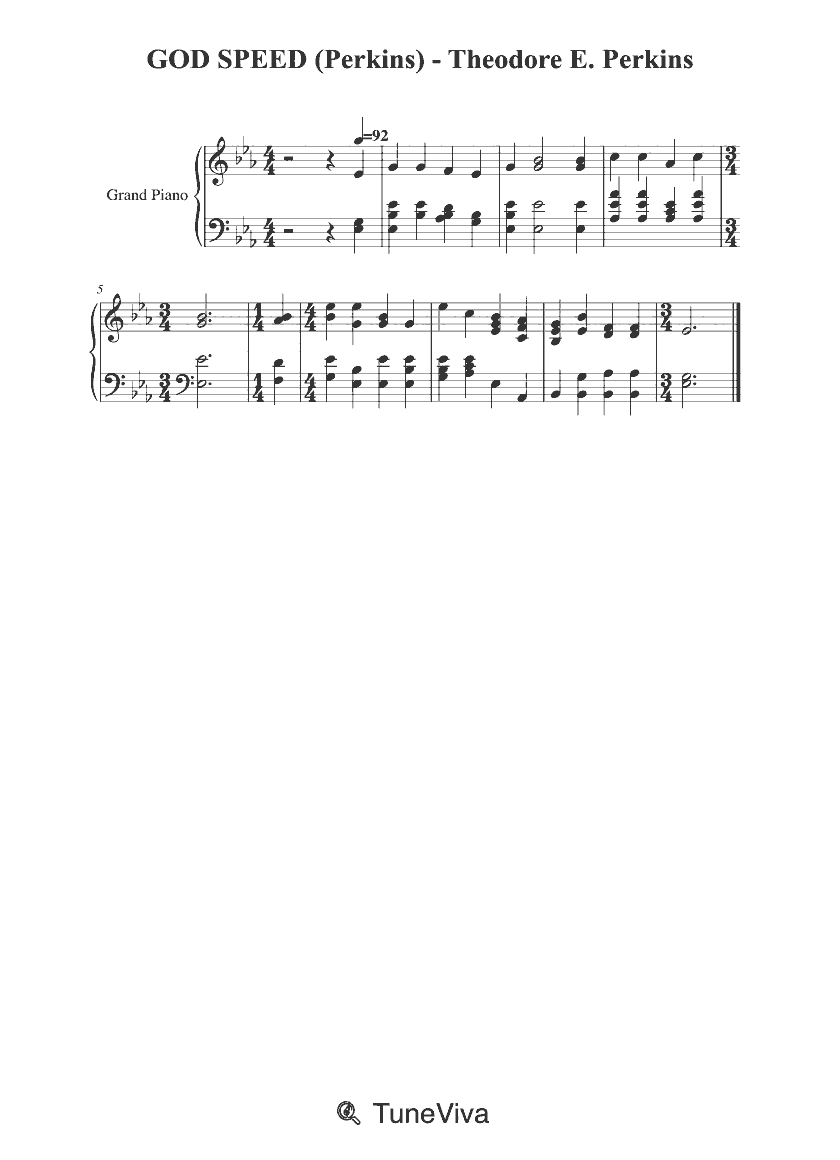
Printed in capitals in the catalogue; whether GOD SPEED is a tune name or the title of the piece cannot be told from the entry.
A short chorus on the rock of the Psalms, one of the pieces that carried Perkins's name into Sunday-school collections.
Fanny Crosby's text with Perkins's music, printed in Sacred Songs No. 1, the Sankey, McGranahan and Stebbins collection of 1896.
A hymn of resignation in which each earthly comfort is named and given up in turn.
There are 69, about 37 minutes of music and 17,390 notated notes. Forty-four of the entries carry lyrics.
The entries 'Jesus of nazareth passeth by' and 'What means this eager, anxious throng (Perkins)' are one hymn: Emma F. R. Campbell's 1864 text, known by its opening line and by its refrain line.
Among others, Emma F. R. Campbell's Jesus of Nazareth passeth by, Fanny Crosby's Keep Thou My Way, Cecil Frances Alexander's There Is a Green Hill Far Away and Elizabeth Prentiss's More Love to Thee.
Most hymnals give 1912, and the catalogue dates him 1831-1912. One standard biographical source gives 15 January 1917 at Chalfont, Pennsylvania, so the year is not settled.
Catalog editions and arrangements attributed to Theodore E. Perkins.