Pixar Medley for Saxophone Quartet
Listen & explore
Follow the score, hear the music, then make it your own.
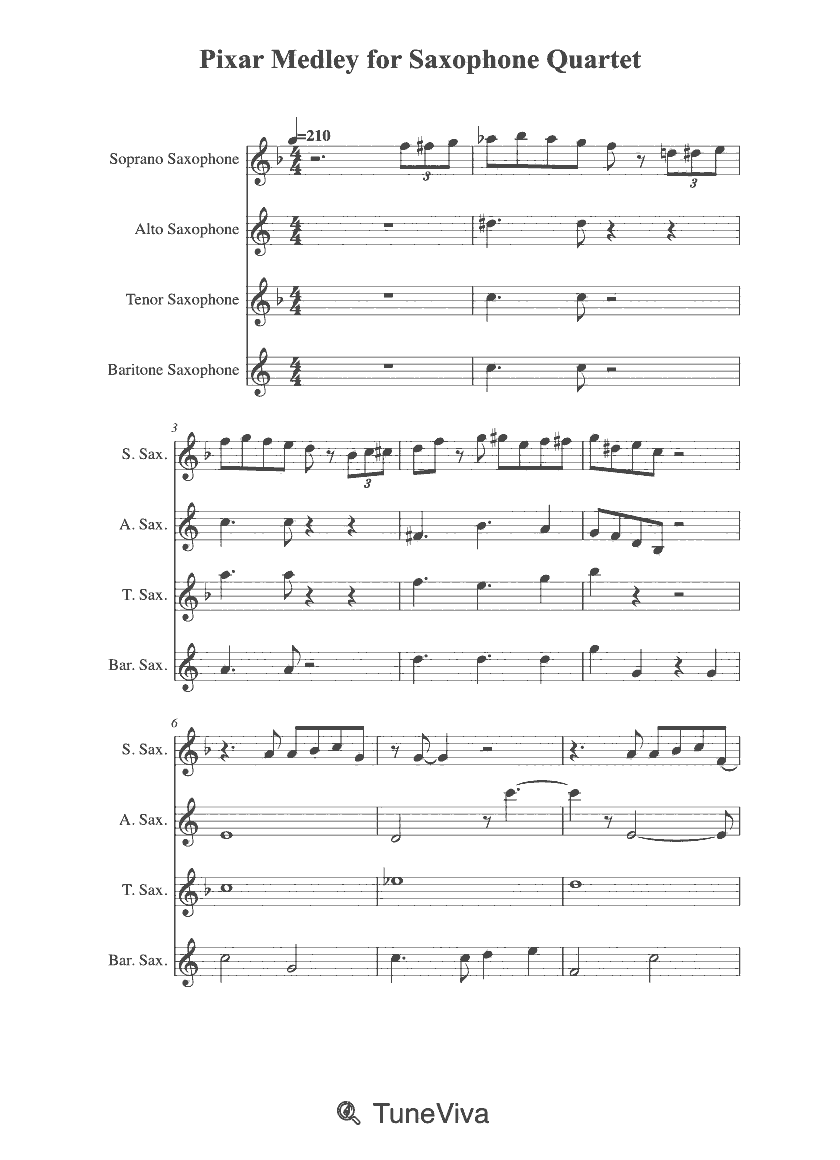
About this score
The Pixar Medley gathers film-score material under a credit to Michael Giacchino, the composer whose Pixar scores include The Incredibles and Up, and sets it for saxophone quartet: soprano, alto, tenor and baritone running two hundred and seventy-four bars. The notation is a journey, with key signatures changing repeatedly across the four parts, tempos swinging from 120 to 210 beats a minute, and printed directions moving from Calm to Brewing with Energy. The playback gives the whole medley about four and a half minutes.
Score parts: Soprano Saxophone; Alto Saxophone; Tenor Saxophone; Baritone Saxophone. Opening key signature: 1 flat; No sharps or flats. Opening time signature: 4/4. Opening tempo: 210 BPM. Estimated playback time: 4 min 34 sec. Listen while following the notation, adjust playback speed, or open this score in practice mode.
- Duration (approx.)
- 4 min 34 sec
- Score parts
- Soprano Saxophone; Alto Saxophone; Tenor Saxophone; Baritone Saxophone
- Opening key signature
- 1 flat; No sharps or flats
- Opening time signature
- 4/4
- Opening tempo
- 210 BPM
- Genre
- Electronic
One credit, many films
The credit names Giacchino, whose Pixar work is among the studio's defining scores, and a medley of this kind draws on that shared musical world without documenting each source on the page. The honest approach is to describe what is notated rather than guess the track list: the file moves through five tempo zones and repeated key changes across the quartet's four staves, with the character directions Calm, Brewing with Energy and several ritardandos marking the transitions. The quartet forces are stated plainly in the title, and the writing uses all four voices as equals, with the baritone carrying the most notes.
Reading a journey in four saxes
The numbers sketch the ride: two thousand and thirty-one eighth notes, one thousand and nineteen quarters, forty-nine crescendo wedges, one hundred and sixty-four accents and a scattering of scoops, fall-offs and a doit, the jazz-band effects. Key signatures shift from one flat to two flats to one sharp and back, which on saxophones means transpositions differ per part. The tempo map runs 210 at the start, drops to 120 for the Calm section, rises through 180 to 175 and returns to 210. The medley's three hundred and twenty-five accidentals are the sound of film harmony in miniature.
Rehearsing transitions
Mark the tempo zones first and rehearse each zone as its own piece before joining them; the transitions at the ritardandos are where quartets fall apart. Agree exactly where the rit. lands and how the new tempo enters, counting the join aloud together. The effects, scoops and the single doit, need decided shapes, rehearsed slowly until they are consistent. Balance the four saxes towards the melody line in each zone, and keep the baritone's eighth-note drive steady under every change. Loop the playback through each transition until the whole quartet moves as one instrument.
Practice tips
- Rehearse each tempo zone as its own piece before joining, and count the ritardando joins aloud together.
- Give the scoops and the doit decided shapes, rehearsed slowly until the quartet's versions match.
- Balance towards the melody line in each zone with the baritone's drive steady underneath.
- Loop the playback through every transition until the four saxes move as one instrument.
Questions about this score
Whose music does the medley credit?
Michael Giacchino, the composer of Pixar scores including The Incredibles and Up. The file names him as composer; the specific source themes are not itemised in the notation, so the page describes what is notated rather than guessing the track list.
What forces does it need?
A saxophone quartet: soprano, alto, tenor and baritone, with the baritone carrying the most notes. The title states the forces and the notation matches.
How do the key signatures behave?
The signatures shift repeatedly across the four parts, moving between one flat, two flats, one sharp and open signatures. On transposing saxophones, each part reads its own version.
How long does the playback run?
About four and a half minutes for the two hundred and seventy-four bars, covering all five tempo zones and the medley's transitions.