
The Four Seasons (Complete)
Antonio Vivaldi
Le Quattro Stagioni
Violin; Violins 1; Violins 2 +2 parts · 27 min 0 sec
Open scoreViola sheet music on this page means scores whose listed parts include a viola line. Selected examples range from a complete score of Vivaldi's The Four Seasons, with violins, viola and violoncello among its parts, to a quartet-style score of “Hopes and Dreams” and a large-ensemble “My Original Theme for the Mandalorian” that lists violas alongside winds, brass and percussion. Part lists and opening details describe each score; they do not by themselves prove the forces a work was first written for.
Scores 1–20 of 3,277
Antonio Vivaldi
Le Quattro Stagioni
Violin; Violins 1; Violins 2 +2 parts · 27 min 0 sec
Open score
Toby Fox
Undertale
Violin I; Violin II; Viola +1 parts · 3 min 27 sec
Open score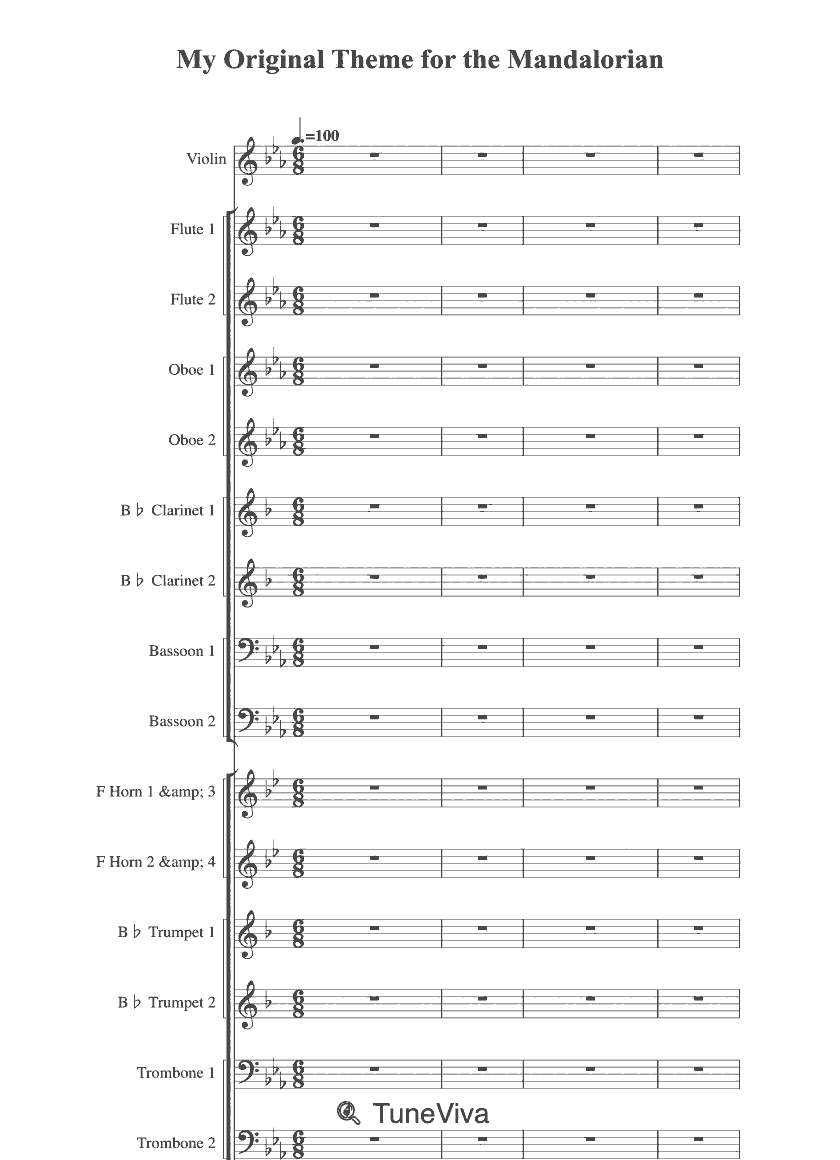
garrettn2001
Violin; Flute 1; Flute 2 +23 parts · 57 sec
Open score
Composed by Joe Hisaishi Transcribed and Arranged by Andrea Tam
Merry Go Round of Life for Orchestra
Piccolo; Flute; Oboe +16 parts · 4 min 54 sec
Open score
Johann Sebastian Bach
St Matthew Passion part II No. 39 (BWV 244)
Violin; Violins 1; Violins 2 +3 parts · 3 min 23 sec
Open score
Ben E. King
Violins; Viola; Violoncello +1 parts · 2 min 46 sec
Open score
Composed by: The Track Team Transcribed by: Elizabeth H.
From Avatar: The Last Airbender
Kalimba; Mandolin; Violin +8 parts · Arr. Elizabeth H. · 1 min 59 sec
Open score
Artist: LiSA
Kimetsu no Yaiba OP
Violin; Viola; Guitar +2 parts · 1 min 36 sec
Open score
Josh Groban
Violin; Viola; Double Bass · 4 min 21 sec
Open score
arr. Alec Pearl
Violin; Viola; Violoncello +1 parts · 4 min 16 sec
Open score
Edward Elgar
Viola · Arr. Tristan Svoboda · 3 min 28 sec
Open score
Arr. Tim Hudson
Medly
Violins 1; Violins 2; Viola +1 parts · 4 min 6 sec
Open score
Pyotr Ilyich Tchaikovsky
Flute I; Flute II; Flute III +23 parts · 2 min 27 sec
Open score
Richard Clayderman
Violin; Viola; Violoncello · 1 min 52 sec
Open score
Tommy Thomson
Piccolo; Flute; Oboe +12 parts · 1 min 44 sec
Open score
Johann Sebastian Bach
Viola · 2 min 29 sec
Open score
Ramin Djawadi
Based on the scores from HBO's hit series Game of Thrones
Violin; Viola; Violoncello +12 parts · 11 min 46 sec
Open score
Misc Computer Games
Soprano Recorder; Acoustic Guitar; Viola da gamba +1 parts · 52 sec
Open score
Matvei Blanter
Viola; Piano · 38 sec
Open score
Grant Woolard
Piccolo; Flute; Oboe +19 parts · 6 min 16 sec
Open scorePage 1 of 164
The most useful clue to whether a score suits your needs is its part list. The listed Four Seasons score names Violin, Violins 1, Violins 2, Viola and Violoncello. “Hopes and Dreams” names Violin I, Violin II, Viola and Violoncello. “My Original Theme for the Mandalorian” names 26 parts, including Violas. A score can include a viola line without being a solo viola piece, so read the full scoring before choosing.
“Hopes and Dreams” is set for a quartet-style grouping of two violins, viola and violoncello. The Mandalorian theme lists a much larger ensemble with woodwinds, brass, timpani, percussion, piano and strings, including a Violas part. The Four Seasons score includes violins, viola and violoncello among its parts. These different scorings affect how much ensemble coordination the viola line requires.
Opening key, time signature and tempo can help distinguish versions of the same title. The listed Four Seasons score opens with four sharps, 1/8 and 110 BPM; “Hopes and Dreams” opens with two flats, 4/4 and 170 BPM; the Mandalorian theme opens in 6/8 at 150 BPM and records several key signatures. These details belong to the individual score and should be checked against the music itself.
A title, artist name or composer name is not enough to identify an arranger or the original instrumentation. The Vivaldi entry names Antonio Vivaldi, while “Hopes and Dreams” names Toby Fox as artist and leaves the composer field blank. Use the part list, title and any credits on the score page together, and avoid assuming that a familiar title means the score is an original setting.
Score parts: Violin, Violins 1, Violins 2, Viola, Violoncello. Catalogue duration 27 min 0 sec. Opening key signature: 4 sharps. Opening time signature: 1/8. Opening tempo: 110 BPM.
Score parts: Violin I, Violin II, Viola, Violoncello. Catalogue duration 3 min 27 sec. Opening key signature: 2 flats. Opening time signature: 4/4. Opening tempo: 170 BPM.
Score parts: Violin, Flute 1, Flute 2, Oboe 1, Oboe 2, B♭ Clarinet 1, …. Catalogue duration 57 sec. Opening key signature: 3 flats; 1 flat; 2 flats; No sharps or flats. Opening time signature: 6/8. Opening tempo: 150 BPM.
TuneViva has 3,277 viola sheet music files whose imported part name includes viola. Open a score to preview the notation, play it, and download the files that score offers.
A file is included only when an imported part name contains viola. A title that mentions viola, or a playback sound, is not enough. Files whose import did not record a part name are not on this page. The part name describes that file. It is not proof the work was first written for viola.
Yes. Open a viola score to preview the notation and play it in the browser. Download the files that score offers after you have compared them.
Open the viola score first. The score page shows the files that score offers. TuneViva does not promise one file type for every score.
470 of the files on this page include lyric text. Lyric text does not by itself show a vocal part. The score page shows that text when the file has it.
Open a viola score and choose practise. Listen with Play, then play the matching keys on screen. Left and Right select the lower and upper staff, and you can change the playback tempo. Connect MIDI works in a compatible browser.
Use the work page for that catalogue name. This viola page lists every file whose part name matches, so one piece can appear more than once. A genre page uses the single genre label stored on the file.
The listed complete score of Vivaldi's The Four Seasons names Violin, Violins 1, Violins 2, Viola and Violoncello among its parts. Its opening is recorded as four sharps, 1/8 and 110 BPM. Those details describe this score and do not establish the forces of the work's original version.
The listed score of “Hopes and Dreams” names Violin I, Violin II, Viola and Violoncello, a quartet-style string lineup. The entry is associated with Toby Fox as artist, opens in two flats in 4/4 at 170 BPM, and has no composer value filled in. The part list describes this score rather than any earlier version.
“My Original Theme for the Mandalorian” lists 26 parts, including Violas alongside woodwinds, brass, timpani, percussion, piano and other strings. Its opening is recorded in 6/8 at 150 BPM with several key signatures. The part list describes the score's instrumentation and does not prove the theme's first performing forces.
Check the score's part list for a viola line. In this collection, a score is included when an imported part name contains “viola”; a title that mentions the instrument, or a playback sound, is not enough by itself. A score can list several parts, so the viola does not have to be the only one.
A viola part name shows that the score contains a viola line; it does not show that the work was first composed for viola. The listed Four Seasons score, for example, includes violins and violoncello as well as viola. Use the complete part list and any credited arranger to understand the version.
Compare the part lists and opening details. “Hopes and Dreams” uses two violins, viola and violoncello, while the Mandalorian theme lists a much larger ensemble; the Four Seasons score includes violins, viola and violoncello among its parts. Those differences shape what the viola player will be reading and how the ensemble is organised.
Composer and artist names do not necessarily identify an arranger. “Hopes and Dreams” names Toby Fox as artist and has no composer value, while the Vivaldi entry names Antonio Vivaldi. Treat the part list, title and credits as descriptions of the particular score, and check the score page for any arranger credit.