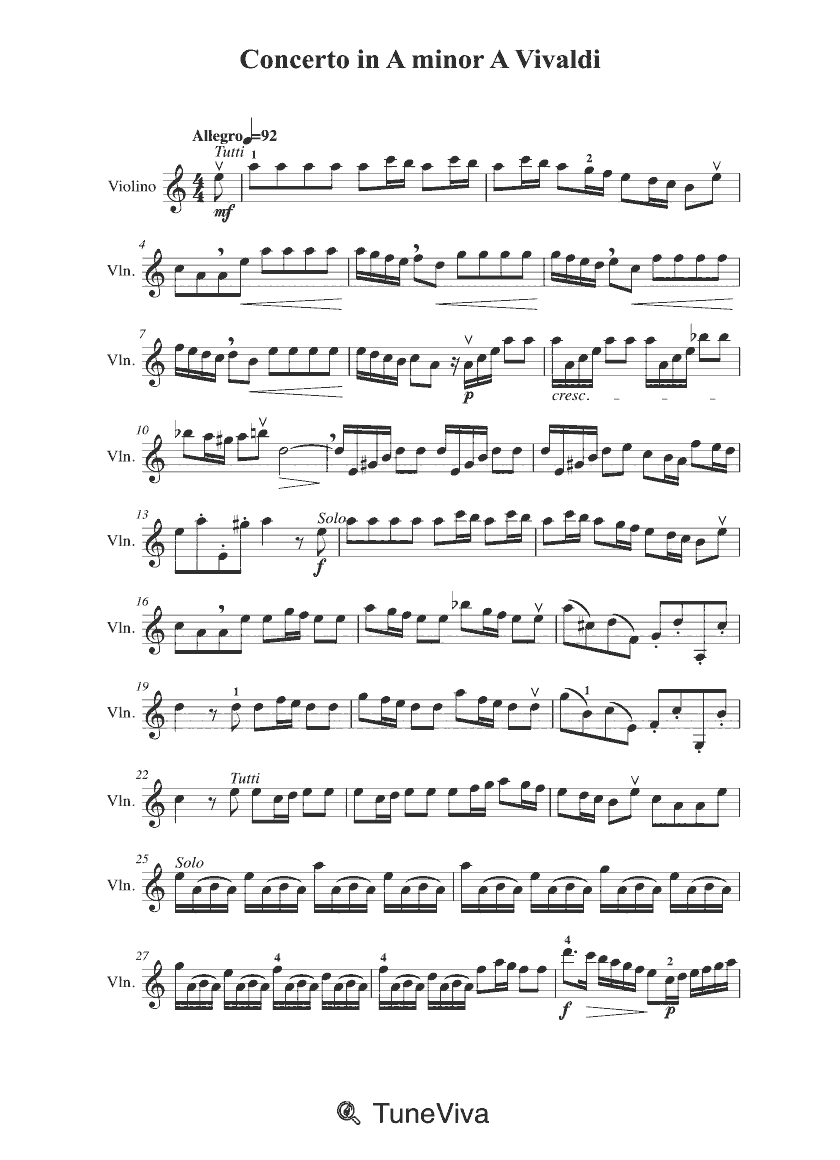
Concerto in A minor A Vivaldi
Antonio Vivaldi
1º Movimento
Violino · 7 min 14 sec
Open score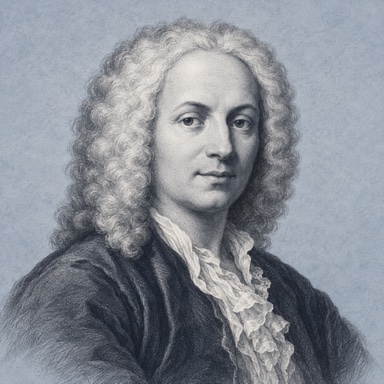
109 Vivaldi scores to preview: The Four Seasons, the A minor concerto, Gloria, Vedrò con mio diletto, mandolin and lute concertos, and the cello sonatas.
The complete set of four violin concertos published in 1725 as the first four of the twelve concertos in Il cimento dell'armonia e dell'inventione, Op. 8.
An A minor concerto listed without an RV number, and the second most-viewed title on this page.
The Presto finale of Summer in an arrangement credited to Rousseau.
An aria from Il Giustino, RV 717 (1724), sung by Anastasio in Act I.
A movement from Nisi Dominus, RV 608, a psalm setting for solo voice, strings and continuo.
The Largo from Winter, arranged as a solo for flute or violin.
The slow middle movement of the G major concerto for two mandolins.
Violin 1; Violin 2; Violin 3 +5 parts · Arr. Jonathan Reyes · 8 min 35 sec
The four-violin concerto from L'estro armonico, Op. 3, later transcribed by Bach as BWV 1065.
Other editions:
The opening chorus of the Gloria, RV 589, in a choral arrangement.
The fifth of the six cello sonatas, Op. 14, in E minor.
For The Four Seasons, identify the season and movement first. A violinist needs a readable solo line, while a rehearsal with piano calls for an accompaniment that matches that movement. A keyboard arrangement may combine the ritornello and solo writing for one player. Compare the first exchange between sections to see whether the arrangement preserves the contrast you want.
Compare the instrument and arrangement details below, then open a score to check the notation. Different entries may be arrangements or editions of the same work; available playback tools are shown on each score page.
Antonio Vivaldi
1º Movimento
Violino · 7 min 14 sec
Open score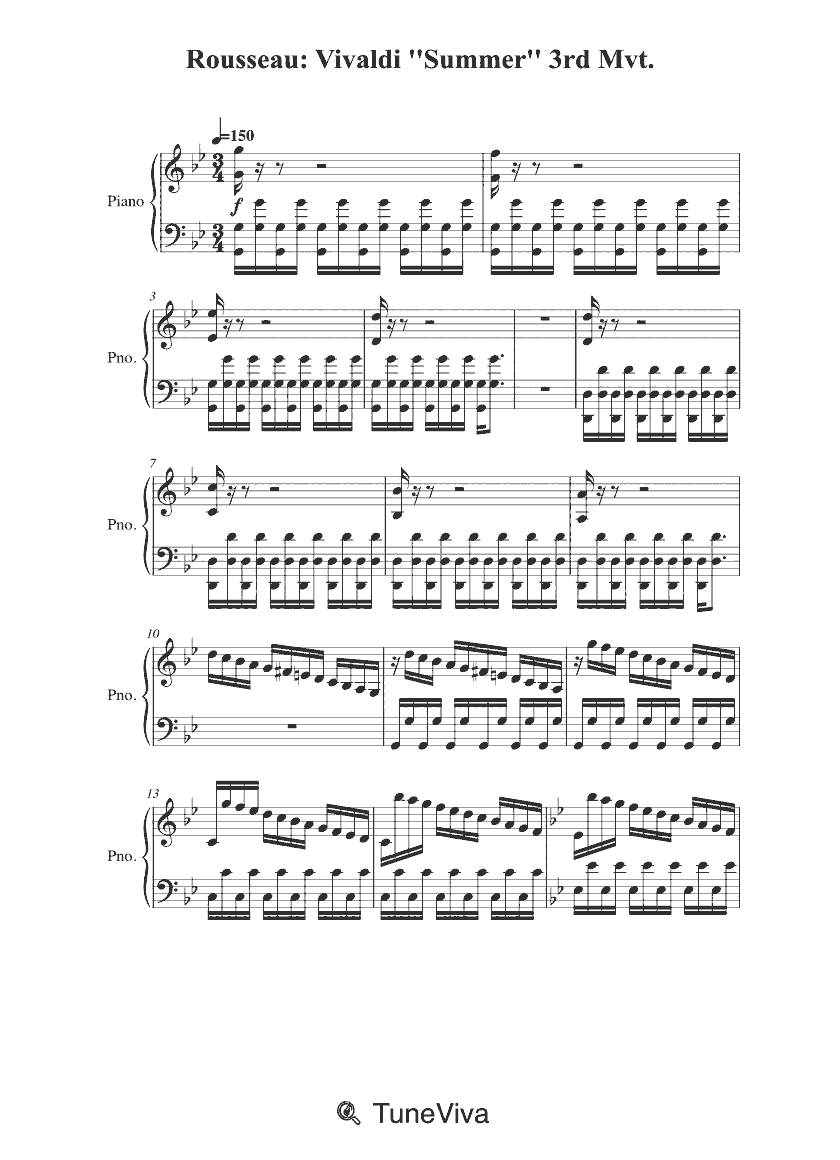
Antonio Vivaldi
Piano · 2 min 47 sec
Open score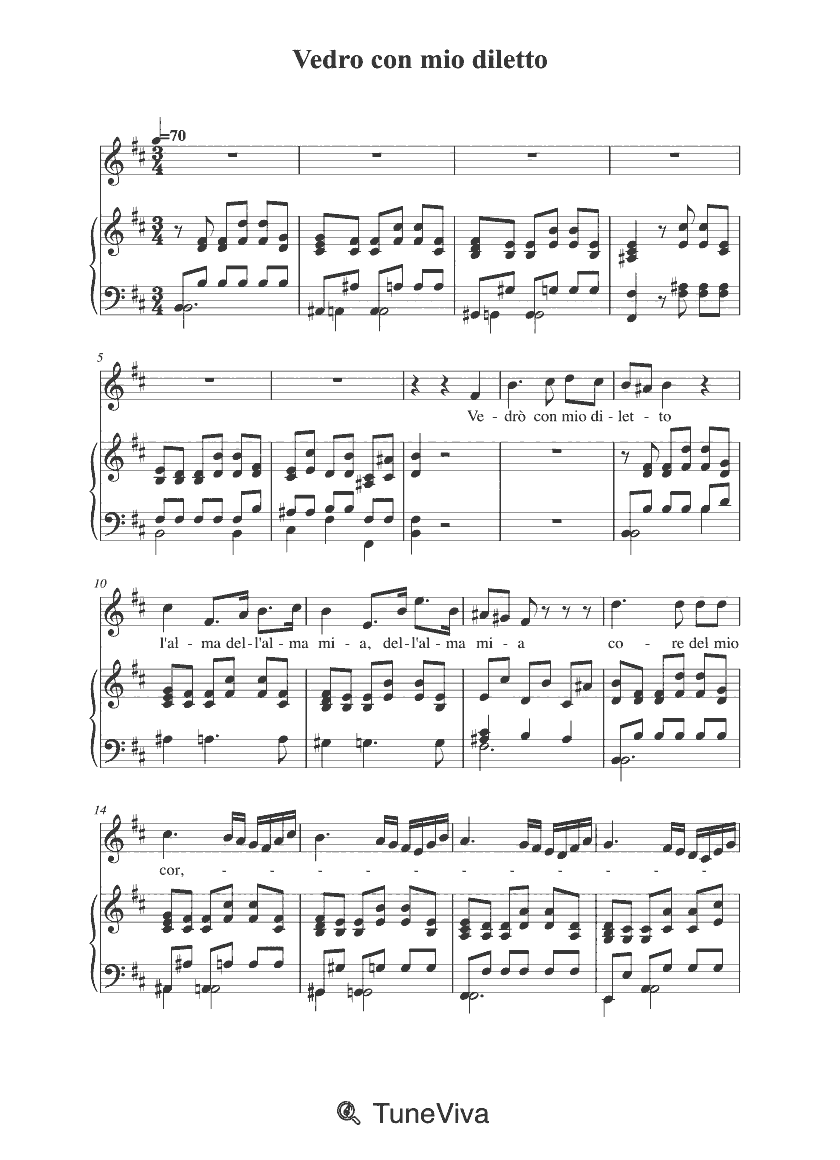
Antonio Vivaldi
Voice; Piano · 7 min 29 sec
Open score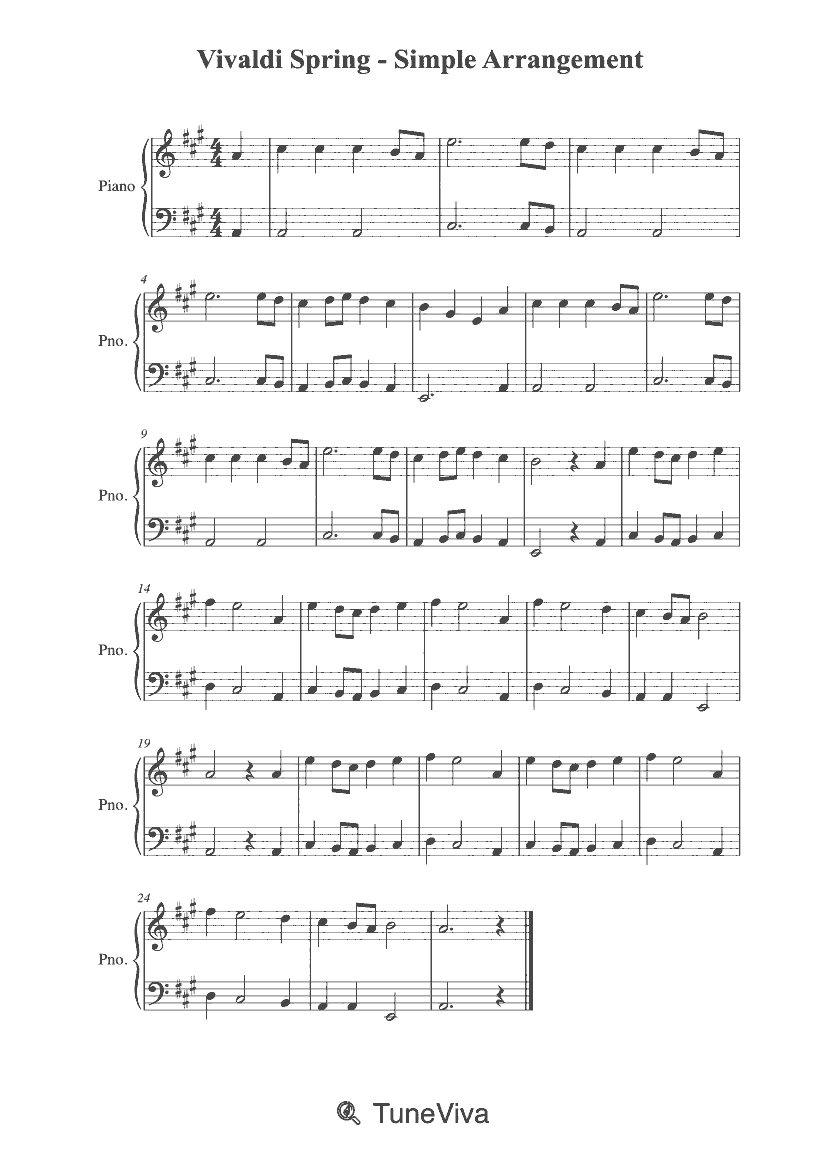
Antonio Vivaldi
Piano · 52 sec
Open score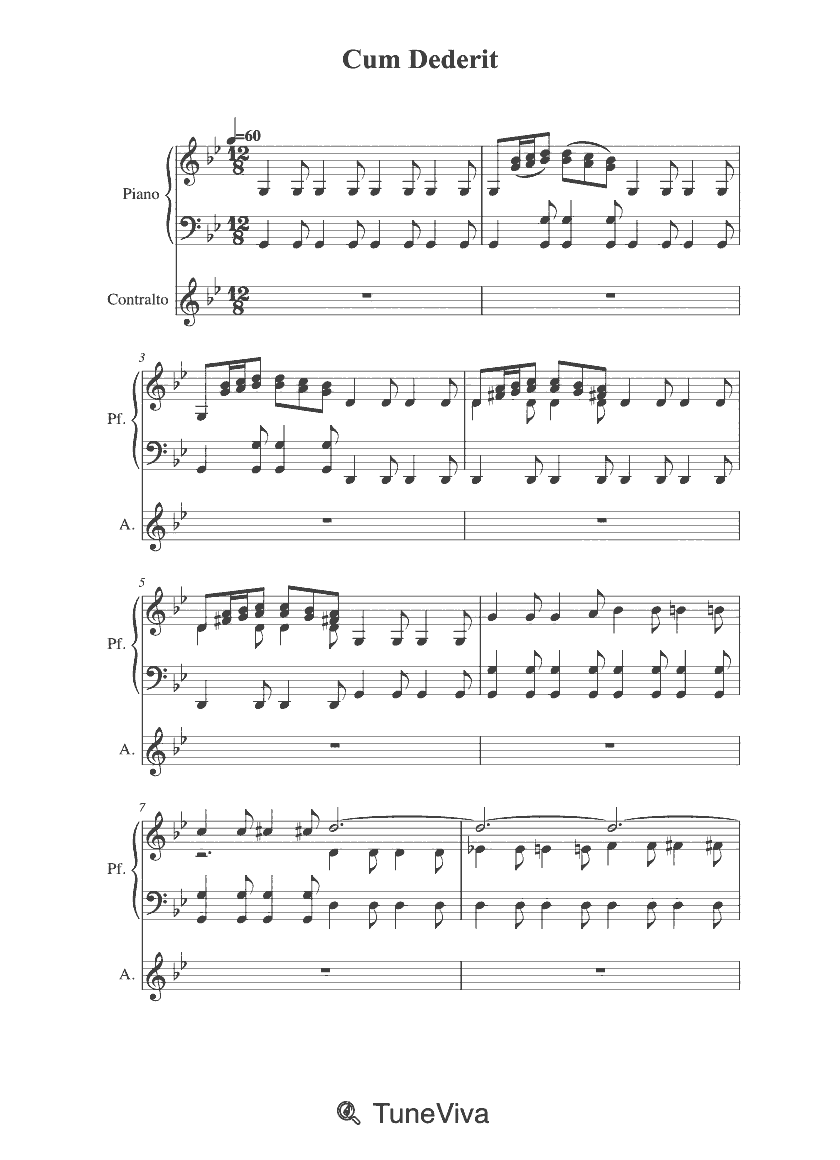
Antonio Vivaldi
Piano; Contralto · 2 min 53 sec
Open score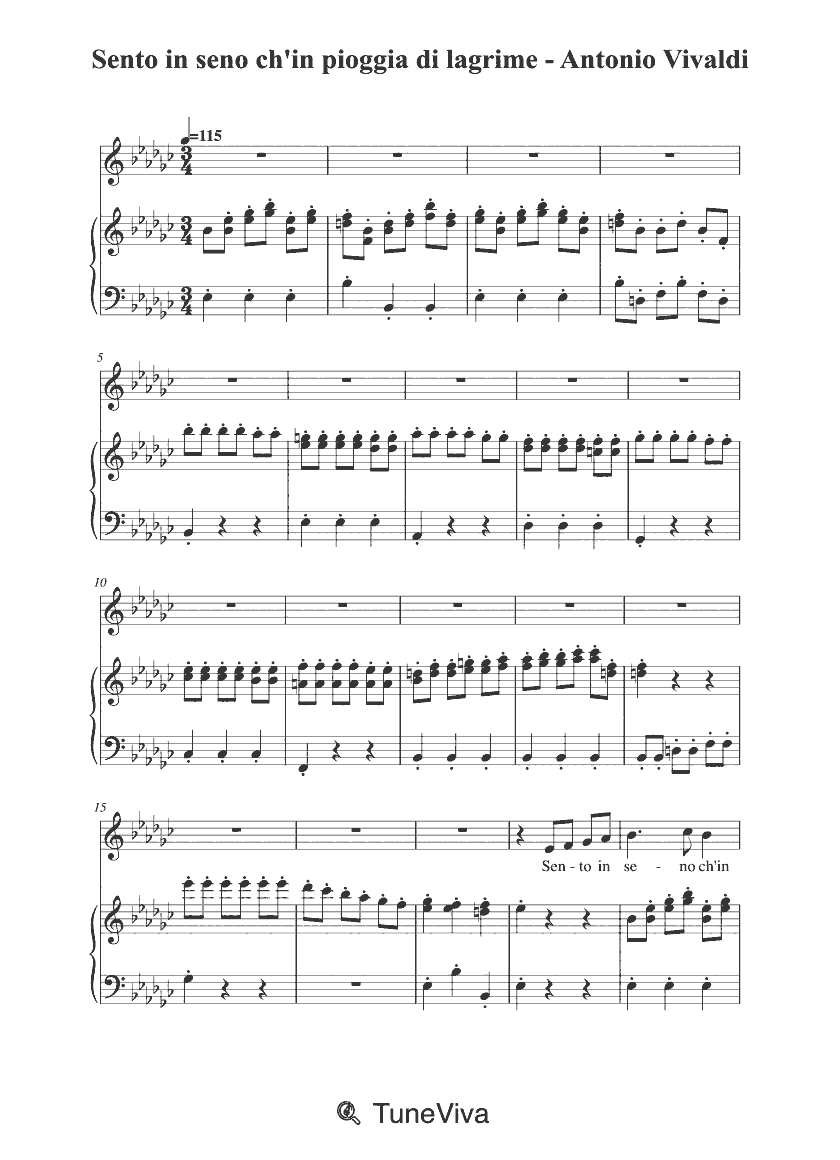
Antonio Vivaldi
Giustino (RV 717) Act 2 Scene 1
Voice; Harpsichord · 3 min 50 sec
Open score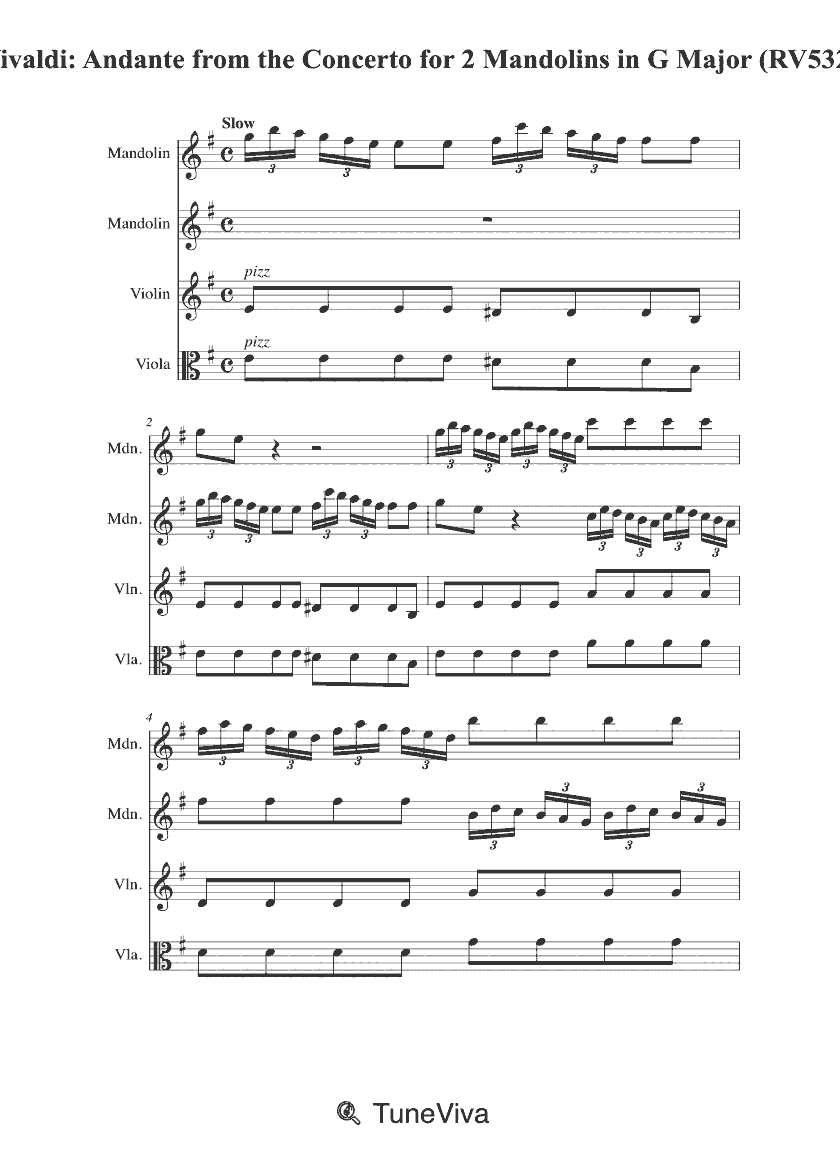
Antonio Vivaldi
Mandolin; Violin; Viola · 2 min 53 sec
Open score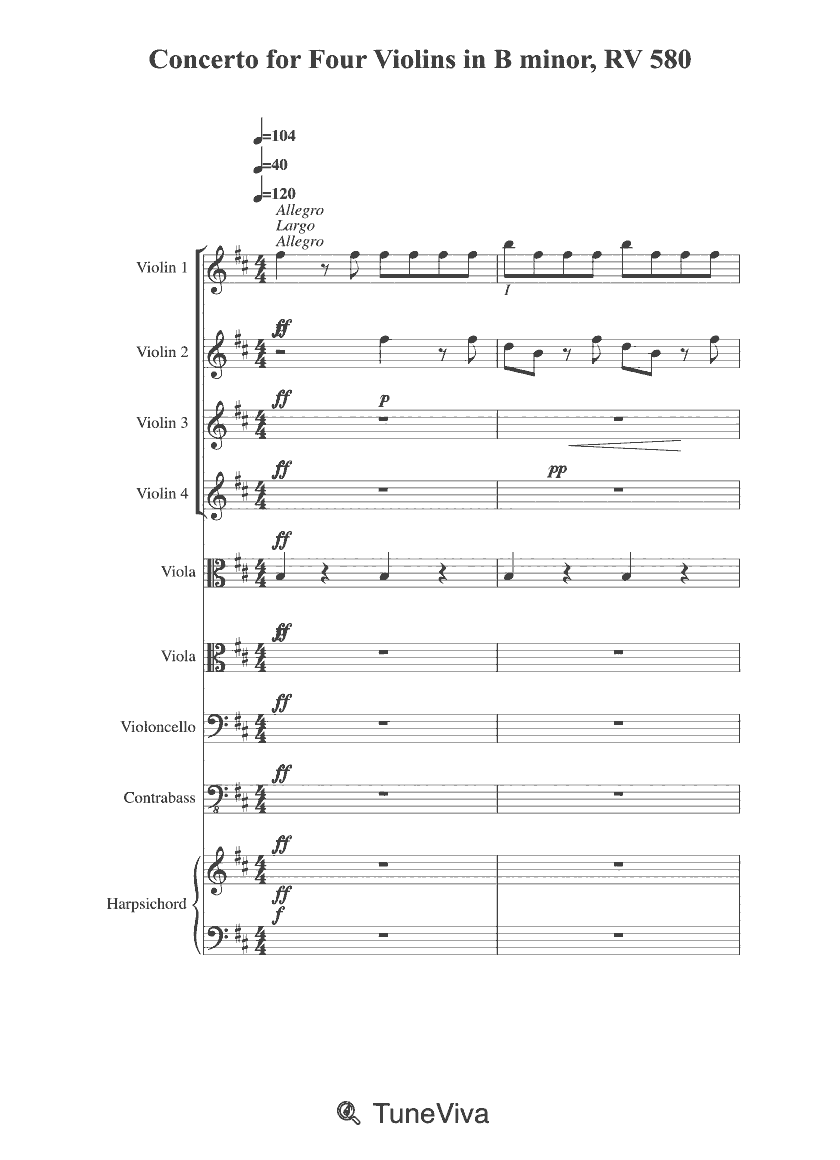
Antonio Vivaldi
From L'estro Armonico Op. 3 No. 10 RV 580
Violin 1; Violin 2; Violin 3 +5 parts · Arr. Jonathan Reyes · 8 min 35 sec
Open score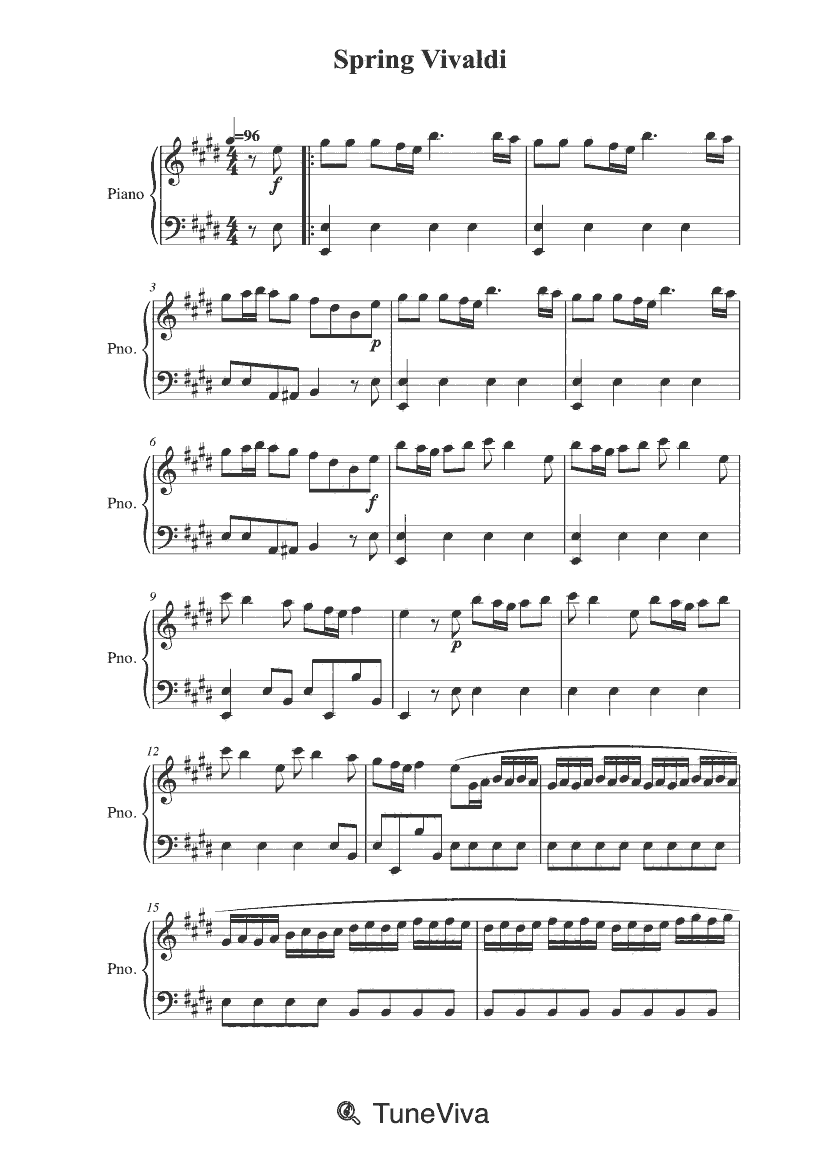
Antonio Vivaldi
Piano · 2 min 36 sec
Open score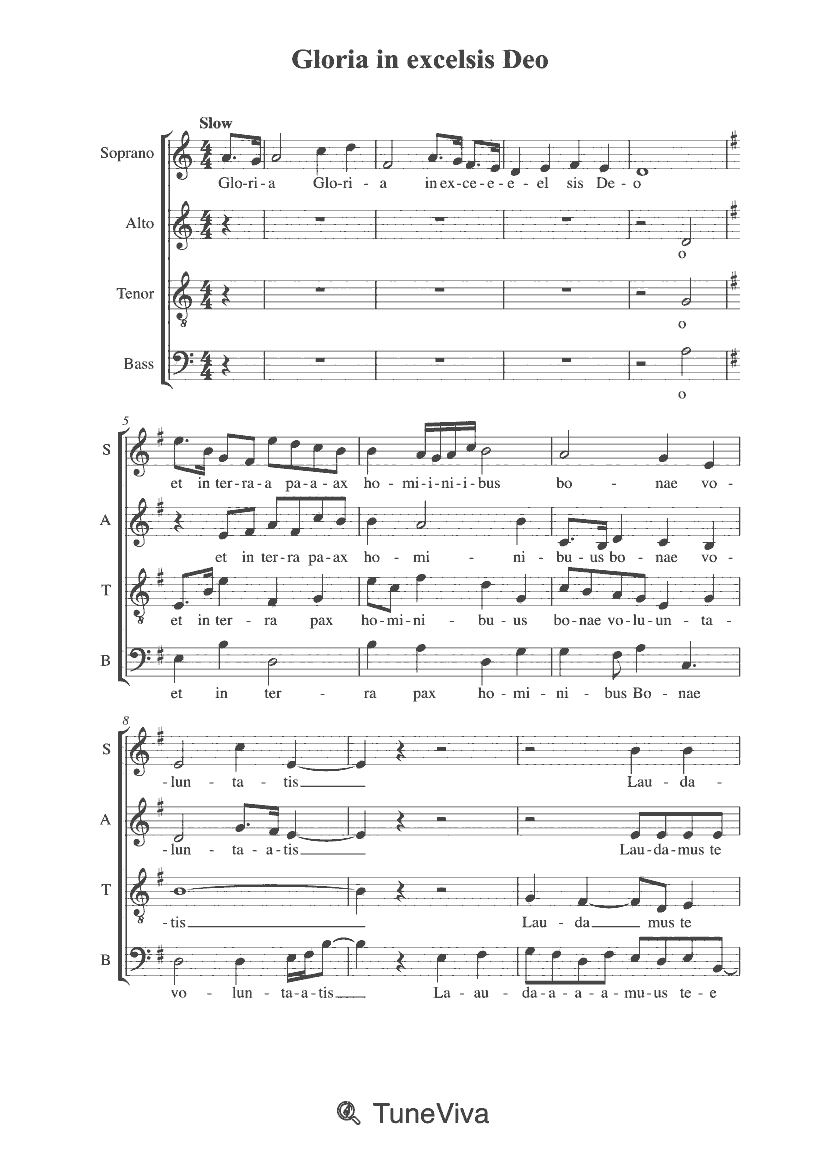
Antonio Vivaldi
Soprano; Alto; Tenor +1 parts · 2 min 7 sec
Open score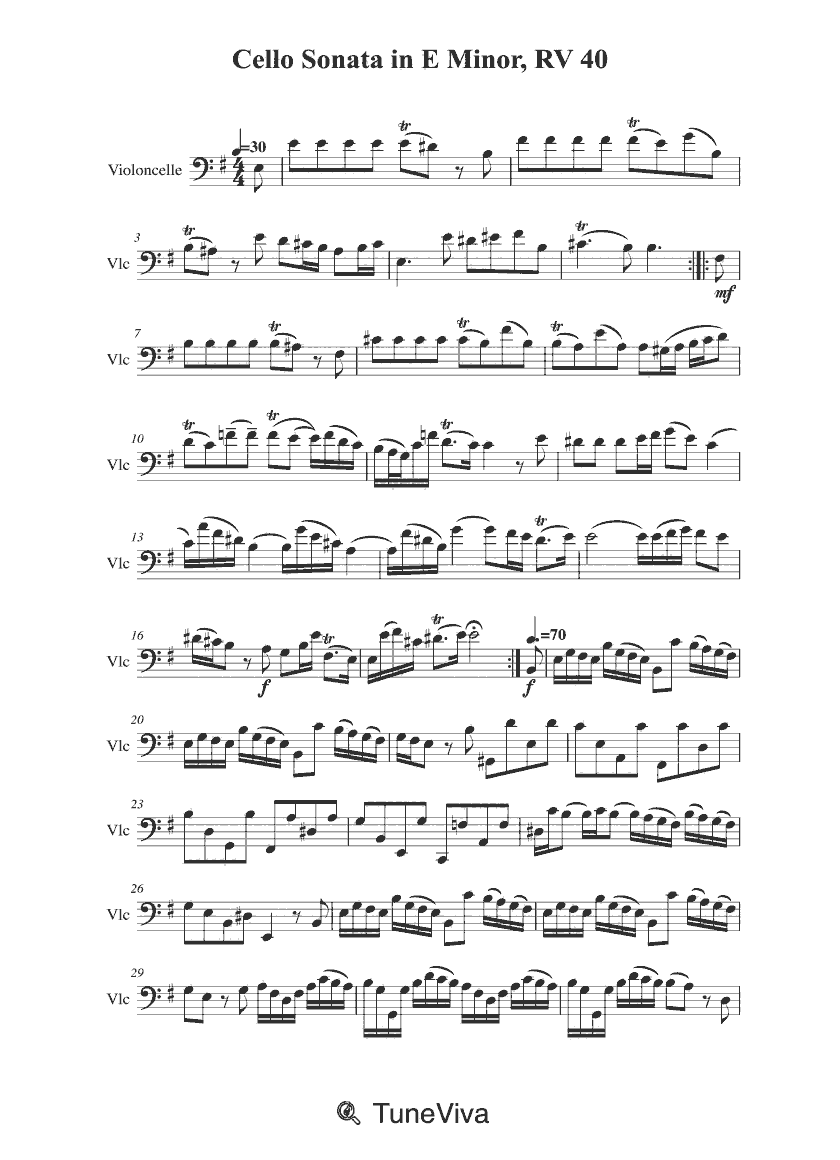
Antonio Vivaldi
Violoncelle · 6 min 6 sec
Open score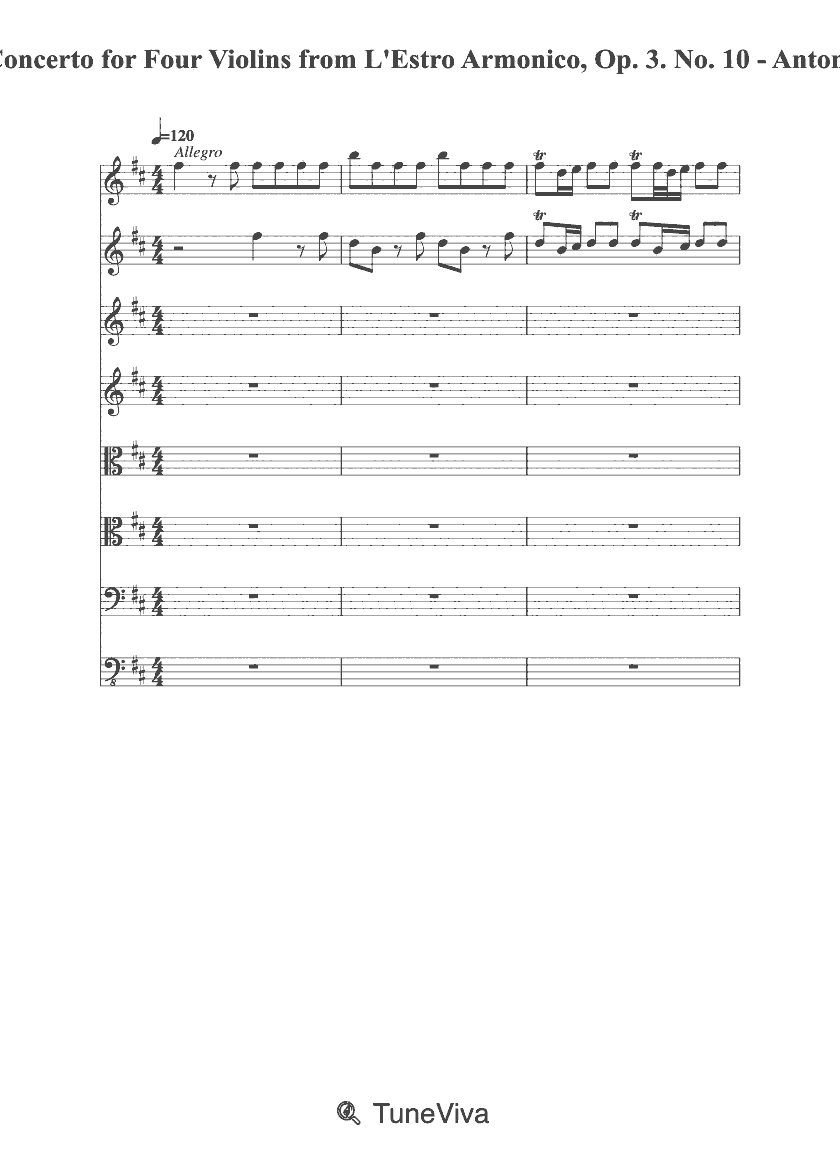
Antonio Vivaldi
Op. 3. No. 10
Violin; Viola; Violoncello +1 parts · 8 min 55 sec
Open score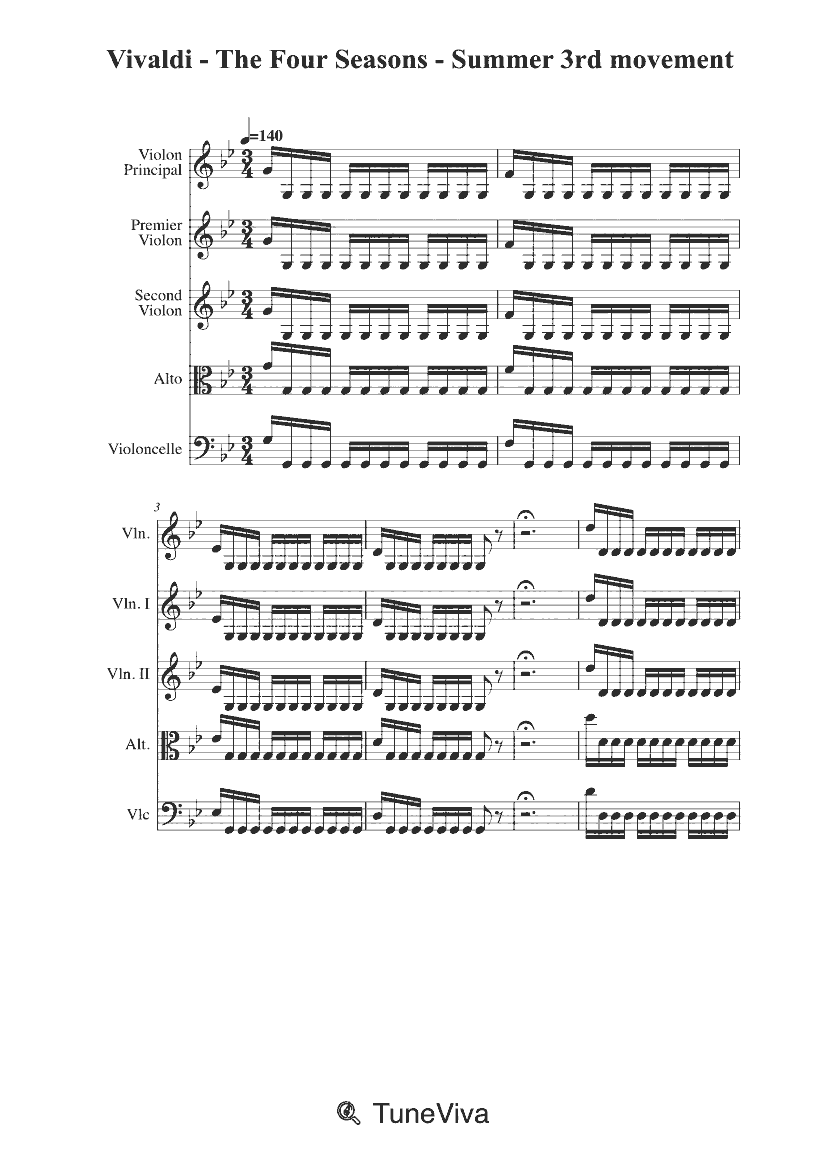
Antonio Vivaldi
Violon Principal; Premier Violon; Second Violon +2 parts · 2 min 47 sec
Open score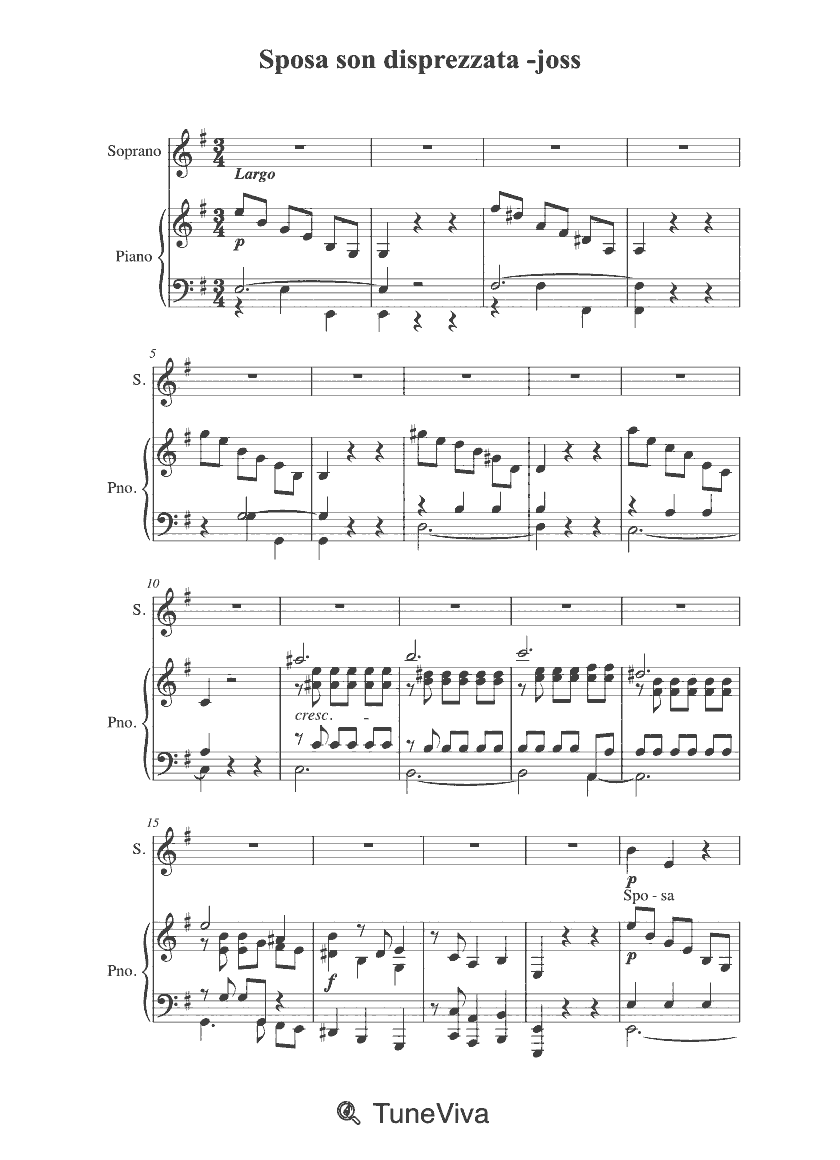
Antonio Vivaldi
Soprano; Piano · 2 min 16 sec
Open score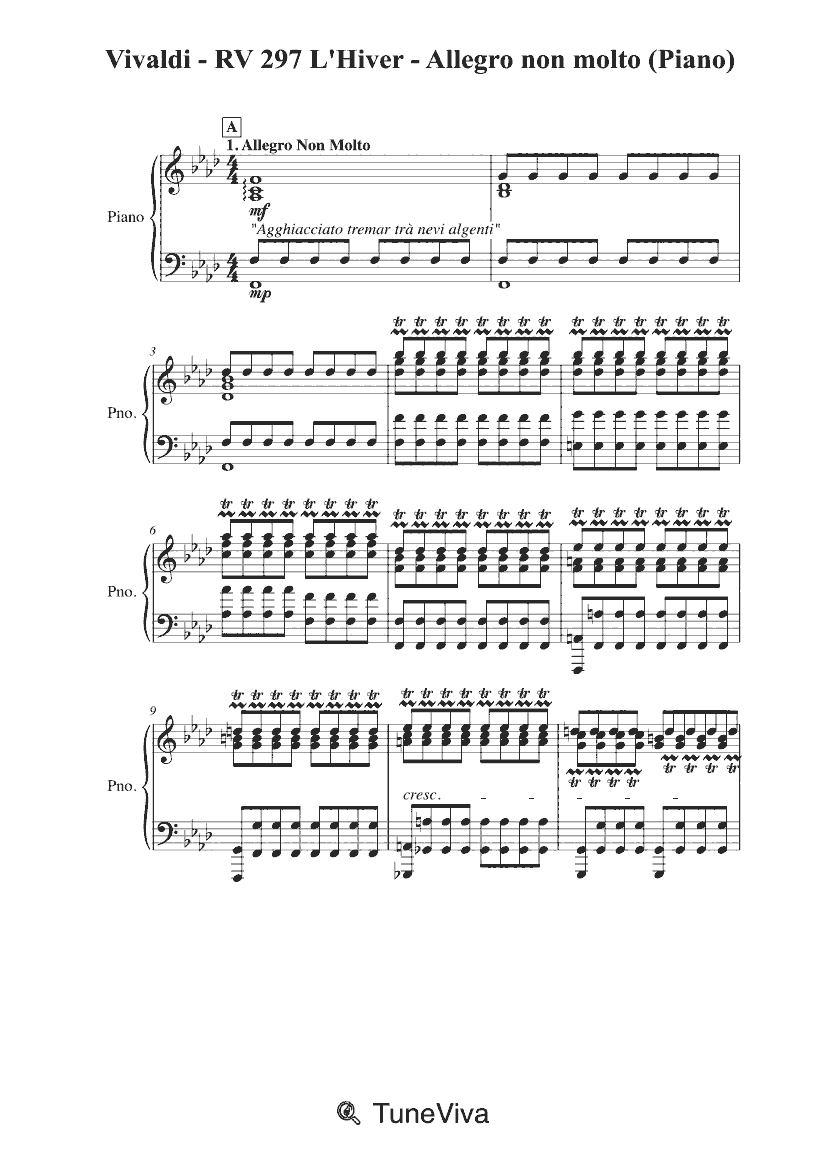
Antonio Vivaldi
L'Hiver
Piano · Arr. Benjamin Moucadeau · 4 min 55 sec
Open score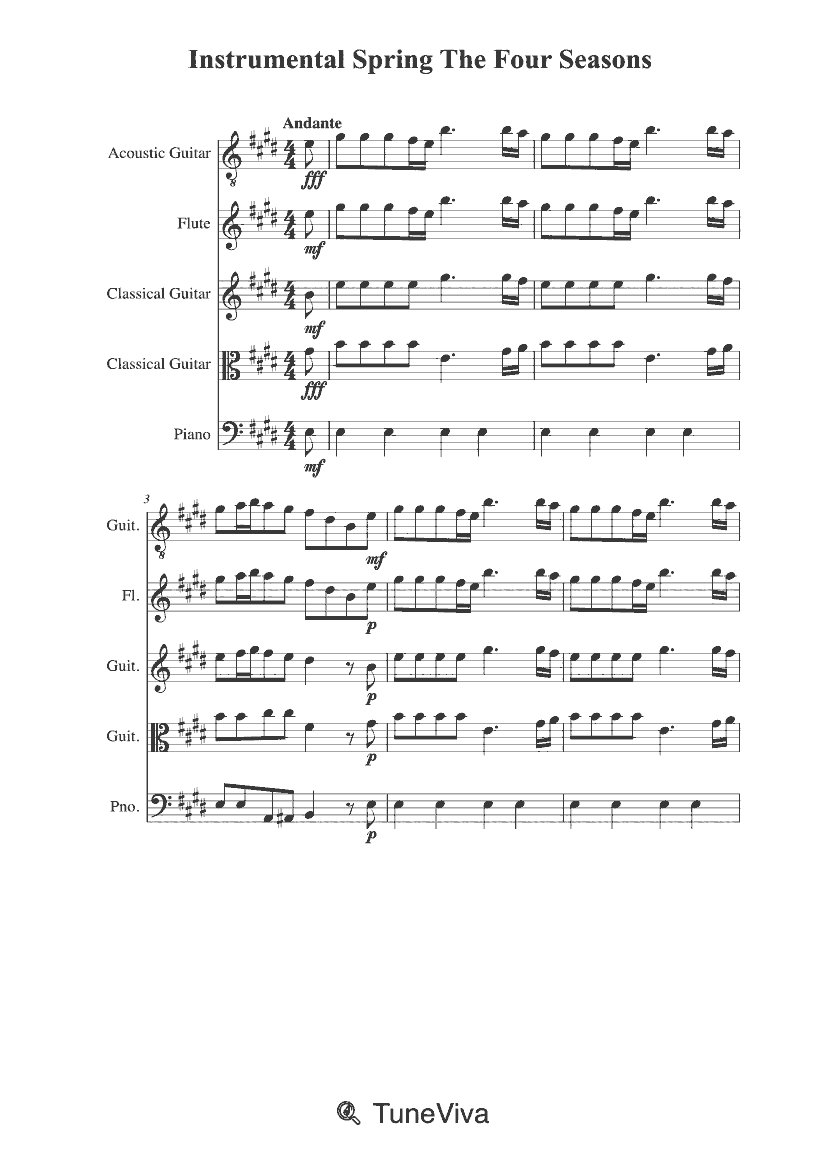
Antonio Vivaldi
instrumental testing
Acoustic Guitar; Flute; Classical Guitar +1 parts · 3 min 8 sec
Open score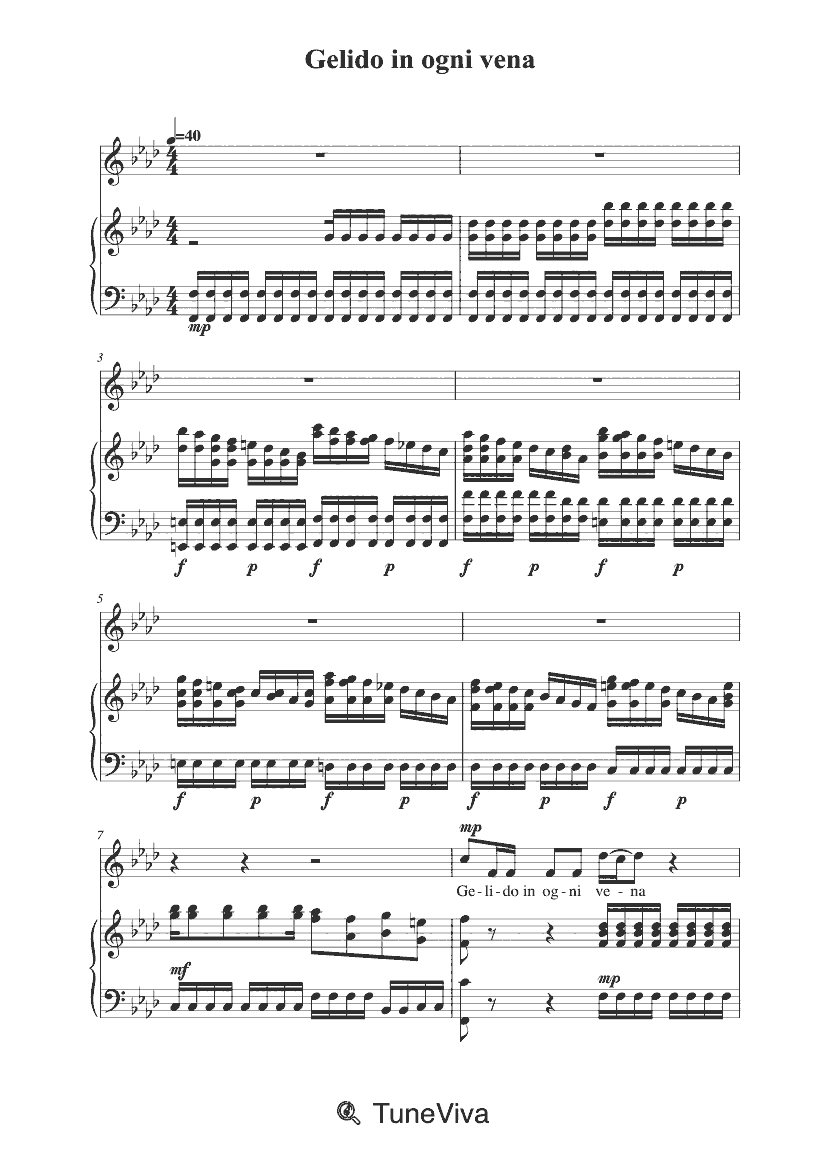
Antonio Vivaldi
Il Farnace
Voice; Piano · 7 min 24 sec
Open score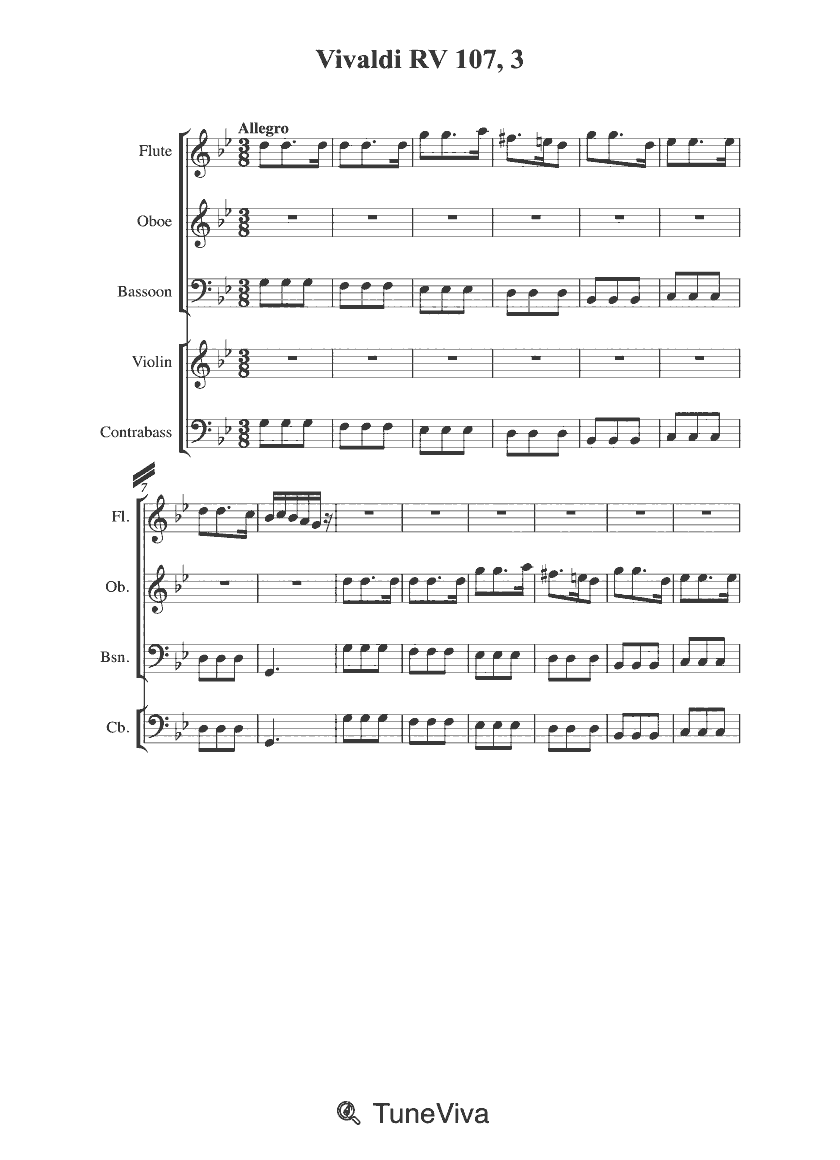
Antonio Vivaldi
Flute; Oboe; Bassoon +2 parts · 2 min 4 sec
Open score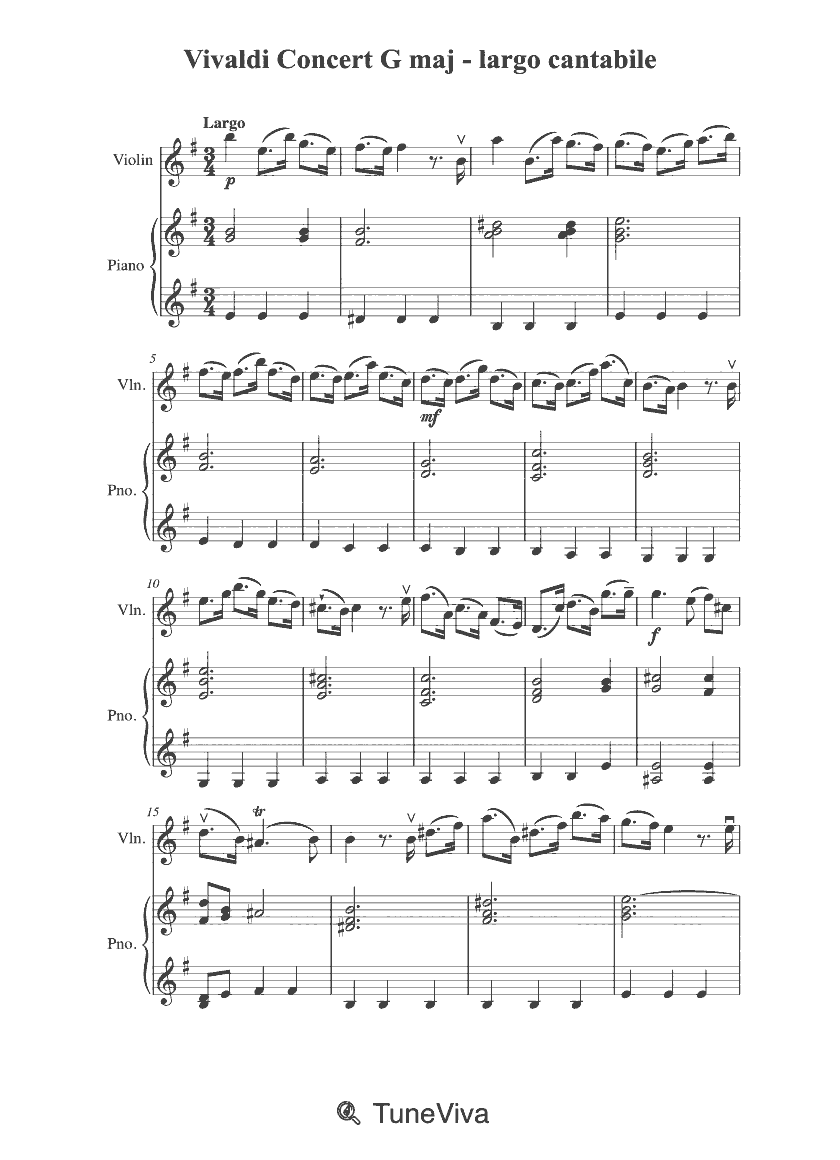
Antonio Vivaldi
op 7 no 2 rv 299
Violin; Piano · 1 min 15 sec
Open score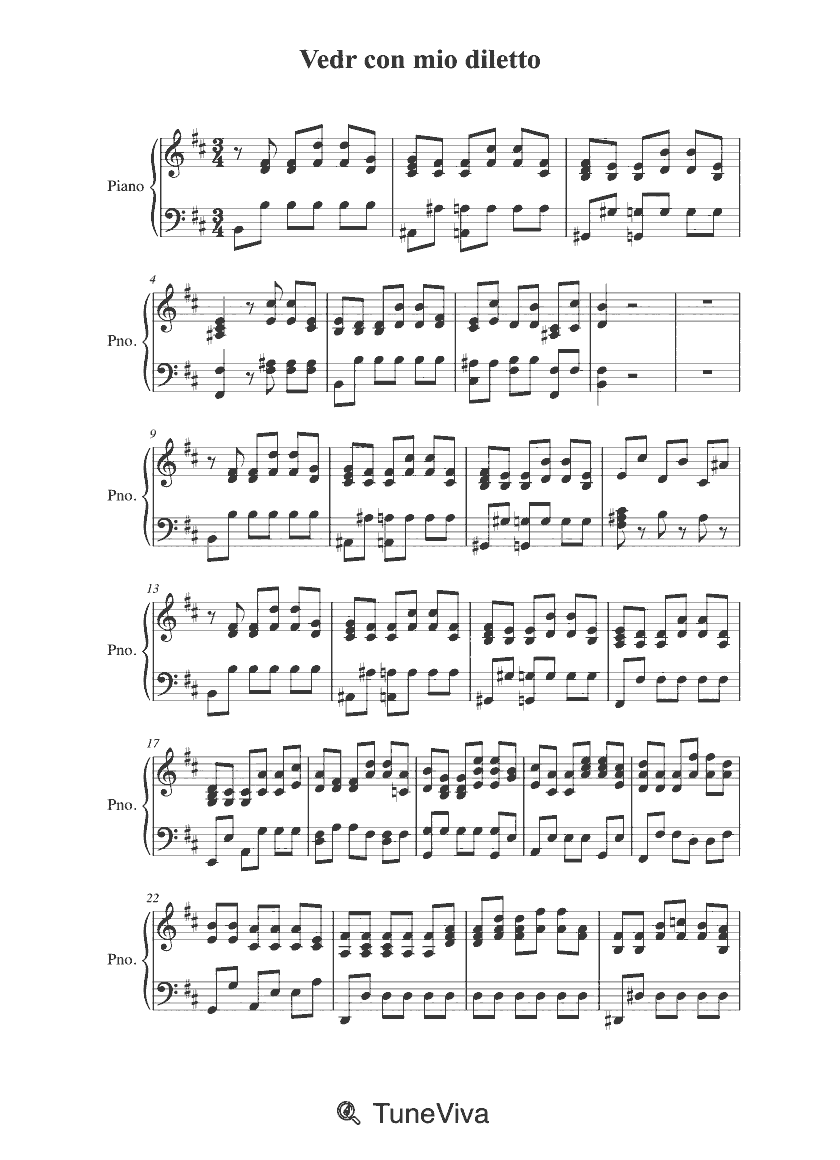
Antonio Vivaldi
Piano · 2 min 26 sec
Open scorePage 1 of 6
Vivaldi's Four Seasons is the most-viewed score here by a wide margin, and it sets the tone for a catalogue of 109 works running to about 510 minutes and 336,374 notated notes: concertos above all, with a handful of sacred choruses and opera arias. The Four Seasons appears complete, in separate movements and in simplified arrangements, alongside the A minor concerto, the Gloria and arias from Il Giustino. The titles lean heavily on the concertos, with sonatas and a few operatic numbers filling out the list. Antonio Vivaldi was an Italian Baroque composer, virtuoso violinist and impresario, best known for The Four Seasons and for a large output of concertos, sacred choral works and more than fifty operas. This page gathers Vivaldi sheet music across those areas, including a Four Seasons set, the Concerto for Four Violins RV 580, the Gloria RV 589, a cello sonata and an operatic aria. The selection mixes ensemble scoring with solo, piano and reduced arrangements, so the listed parts are worth checking before you choose a score.
Vivaldi was born in Venice on 4 March 1678, the son of a violinist. He trained for the priesthood, was ordained in 1703 and was soon nicknamed il Prete Rosso, the Red Priest, for his hair. In September 1703 he became maestro di violino at the Ospedale della Pietà, the Venetian orphanage whose all-female ensemble he supplied with concertos, motets and sacred music for most of his working life; in 1716 he was made maestro de' concerti.
His first published collections appeared in Venice and Amsterdam, and L'estro armonico, Op. 3 (1711) made his name across Europe. The Four Seasons were published in 1725 as the first four concertos of Il cimento dell'armonia e dell'inventione, Op. 8, each with a sonnet describing the scenes depicted. He also wrote more than fifty operas, including Il Giustino (1724), and a large body of sacred music: the Gloria, RV 589, Nisi Dominus, RV 608, and Stabat Mater, RV 621. Bach thought enough of the concerto for four violins, RV 580, to transcribe it for four harpsichords, BWV 1065.
The catalogue holds 109 Vivaldi scores, about 510 minutes of music and 336,374 notated notes. Only 19 entries carry lyrics, and 22 are untagged by genre, while many titles are arrangements for piano, flute or small ensemble rather than original orchestral parts.
Start with the concertos: Vivaldi consolidated the emerging concerto form, especially the solo concerto, and wrote many concertos for the violin and other instruments. The Four Seasons is the best-known set, but the page also includes the Concerto for Four Violins RV 580 and a concerto for two mandolins. String players should check whether a score gives a full ensemble set, separate parts or a reduction, because those choices change how the music is used in rehearsal and performance.
The Four Seasons as programme music: The Four Seasons is a group of four violin concertos, each giving musical expression to a season. Vivaldi published them in Amsterdam in 1725 with eight additional concertos as Il cimento dell'armonia e dell'inventione, and the publication included sonnets and instructions such as 'The barking dog' in the second movement of Spring. The concertos depict flowing creeks, birds, storms, frozen landscapes and other scenes, making them an early and detailed example of program music.
Sacred and operatic music: Vivaldi wrote sacred choral works and more than fifty operas alongside his instrumental music. At least three Gloria settings are known, of which RV 588 and RV 589 survive; RV 589 is the better-known setting and was probably written around the same time as RV 588 during Vivaldi's employment at the Pietà. The page also includes a voice-and-piano score associated with the opera Il Giustino, which gives singers a practical way into Vivaldi's operatic writing.
Choosing an arrangement: Vivaldi scores appear here in several forms: full ensemble scoring, piano reductions, and solo arrangements for flute, violin or voice with piano. Before choosing, check the movement, key, listed instruments and whether a continuo or piano part is included. A Winter Largo for flute or violin, for example, is a different practical proposition from a complete Four Seasons set or a piano arrangement of Summer's finale.
RV stands for Ryom-Verzeichnis, the catalogue compiled by Peter Ryom. It numbers works by their sources rather than by genre or date.
Often not. Many entries are piano reductions, solo arrangements or simplified versions, so check the scoring on the file.
The Spring concerto, the Largo from Winter or the A minor concerto are the usual entry points, and all three are among the most-viewed titles here.
The Four Seasons is a group of four violin concertos by Antonio Vivaldi, each giving musical expression to a season of the year. The concertos were published in Amsterdam in 1725 with eight additional concertos as Il cimento dell'armonia e dell'inventione. They are among the best-known examples of program music and are usually performed as a set of four concertos.
The Four Seasons is the best-known work by Antonio Vivaldi, according to the consulted source. It consists of four violin concertos, one for each season, and was published in 1725 as part of a larger collection of twelve concertos.
The Four Seasons is program music: instrumental music intended to evoke extra-musical scenes. Vivaldi represented flowing creeks, singing birds, storms, frozen landscapes and other images, and published the concertos with sonnets and instructions such as 'The barking dog' in the second movement of Spring. The set is therefore an early and detailed example of narrative instrumental music.
Antonio Vivaldi wrote at least three settings of the Gloria; two survive, RV 588 and RV 589, while RV 590 is mentioned in the Kreuzherren catalogue and presumed lost. RV 589 is the better-known setting and was probably written at about the same time as RV 588, possibly in 1715, during Vivaldi's employment at the Pietà.
Antonio Vivaldi composed many instrumental concertos for the violin and a variety of other instruments, as well as sacred choral works and more than fifty operas. Scores on this page include a concerto for two mandolins and a cello sonata, showing something of that range beyond the violin concertos.
Vivaldi scores can appear as full ensemble parts, piano reductions or solo arrangements. Check the listed scoring, movement, key and whether a continuo or piano part is included; the page lists, for example, a Winter Largo for flute or violin and a piano arrangement of Summer's third movement, which serve different purposes from a complete Four Seasons set.