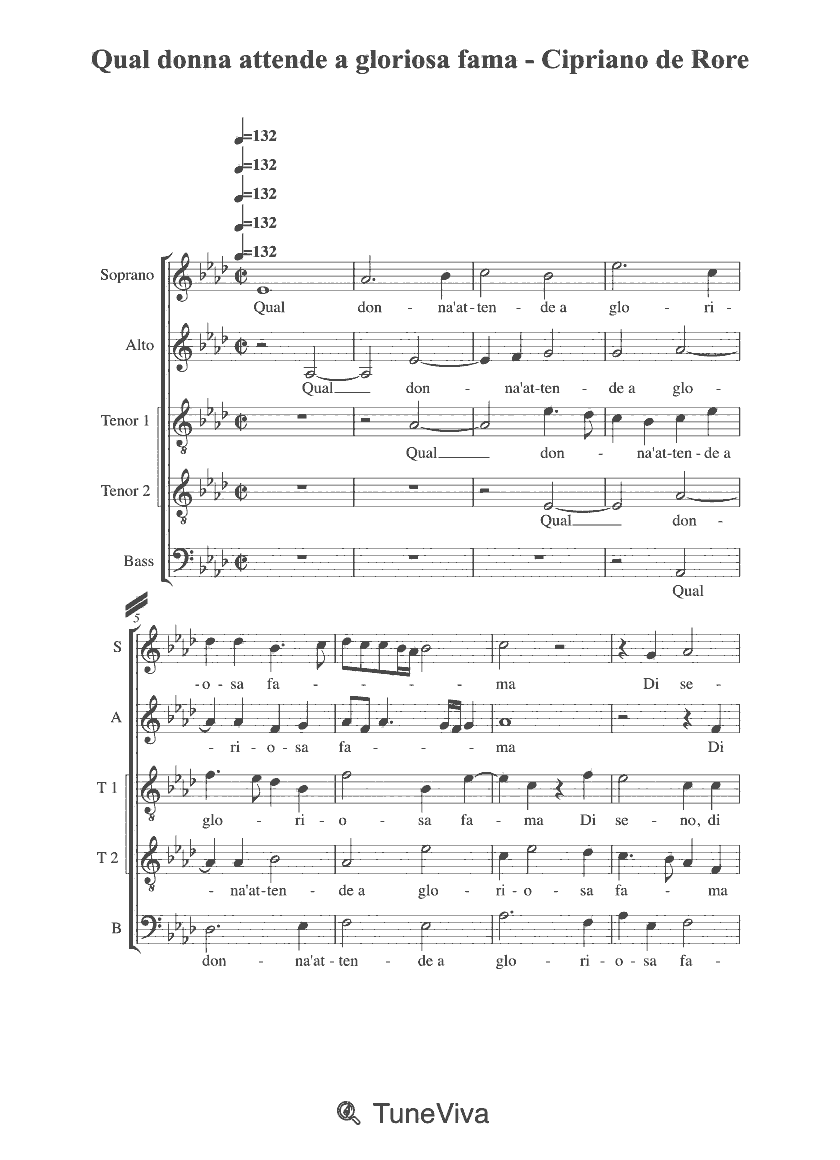
O sonno (Cipriano de Rore)
Il secondo libro di madrigali a quatro voci (Venice 1571)
classical
4 tracks
Rore wrote almost nothing but vocal music, and the catalogue reflects it: 22 scores, about 178 minutes and 24,739 notated notes. All 22 entries carry lyrics, and 20 are filed as classical while two have no genre.
The most-viewed piece is O sonno, a four-voice madrigal on a sonnet by Giovanni della Casa, followed by the motet Jubilate Deo omnis terra and two settings from the cycle on Petrarch's Vergine bella. Latin motets and Italian madrigals sit side by side, with a French chanson and an antiphon among them. Every entry is logged at complexity index 0, so the scale cannot separate a dense chromatic madrigal from a simple four-voice motet.
Rore was born in Ronse, in Flanders, in 1515 or 1516, and died at Parma between 11 and 20 September 1565, aged 49 according to his tombstone in the cathedral there. He may have gone to Italy in the household of Margaret of Parma, and he was certainly at Brescia between 1542 and 1545. From 6 May 1546 he was maestro di cappella at Ferrara in the service of Duke Ercole II d'Este, a post he held until 1559.
After leaving Ferrara he returned north to find Ronse devastated by war, then re-entered the service of the Farnese and settled at Parma in 1560. In 1563 he briefly became maestro di cappella at St Mark's in Venice after Willaert's death, but he left within a year, citing the disorder of the chapel and an insufficient salary, and returned to Parma. His first book of madrigals, printed in Venice in 1542, was recognised at the time as a landmark: it established five voices as the normal texture and brought the seriousness of the Netherlandish motet to the Italian secular form.
He left 107 madrigals that are securely attributed, 53 motets of which 51 survive, five masses, a setting of the St John Passion and some Magnificats. His chromatic and expressive madrigal style was a model for the late sixteenth century, and Alfred Einstein called him the key to the whole development of the Italian madrigal after 1550. The catalogue samples that range rather than presenting complete books: single madrigals, single motets and one French chanson, with no masses and no Passion.
Rore's counterpoint is continuous and the words are dense, so the first decision is tempo: fast enough to keep the text moving, slow enough for the chromatic inflections to sound intentional. In the madrigals, shape the line around the punctuation of the poem rather than around the barline, and do not sand down the cross-relations. The motets need a firmer, more even blend, with the imitative entries clearly spaced. Because every file here is vocal and unaccompanied in principle, tuning drift is the main risk; rehearse the cadences slowly before adding pace.
The most-viewed score here: a four-voice madrigal on Giovanni della Casa's sonnet to sleep, printed in Rore's second book of four-voice madrigals.
A five-voice motet on the psalm verse 'Jubilate Deo omnis terra'; it was first published in the posthumous Sacrae cantiones of 1595.
One of Rore's settings from Petrarch's Vergine bella canzone, a five-voice (SATTB) madrigal addressed to the Virgin.
A madrigal on Petrarch's sonnet about singing of love in a new way, from the period of Rore's first Venetian publications.
A motet on Psalm 51, the penitential text that begins 'Have mercy on me, O God'; the catalogue gives no source or publication date.
Another movement of the Vergine cycle, setting the stanza in which Petrarch counts the tears shed by the Virgin.
The Marian antiphon Regina caeli laetare, catalogued under a garbled spelling; sung at Compline in Eastertide.
A madrigal on a Petrarch text, in the serious vein that Rore preferred over the lighter madrigal of his predecessors.
A Latin motet whose text calls on all servants of God to give praise; the catalogue does not identify the source print.
A prayer for peace, 'Give peace, O Lord, in our days', set as a motet; one of the shortest entries on the page.
There are 22, running to about 178 minutes of music and 24,739 notated notes. All 22 include lyrics.
The index measures notational density. Rore's vocal counterpoint uses few notes per second compared with instrumental music, so all 22 scores land at index 0, which says nothing about the difficulty of tuning a chromatic madrigal.
A group of madrigals setting stanzas from Petrarch's canzone Vergine bella, che di sol vestita. Rore's settings were published as a set for five voices (SATTB), and the catalogue holds two of them, Vergine santa and Vergine quante lagrime.
No. The entry reads 'Regina cli ltare', which appears to be a damaged version of Regina caeli laetare. The file is the Marian antiphon, not a separate work.
Catalog editions and arrangements attributed to Cipriano de Rore.
Il secondo libro di madrigali a quatro voci (Venice 1571)

Psalm 99 (100)


Psalm 50 (51)