classical
4 tracks
Claudin de Sermisy spent his working life in the French royal chapel, and the 51 scores under his name are mostly secular chansons for four voices, with a handful of motets. The catalogue runs to about 150 minutes of music and 22,390 notated notes, and 49 entries carry lyrics; the two that do not are presumably instrumental intabulations. Difficulty is low: 44 scores sit at index 0 and seven at index 1.
The most-viewed piece is Au joli bois, followed by a Janequin chanson that the catalogue files under Sermisy. Tant que vivray, the Marot setting that anthologies of the Parisian chanson always print, comes fifth.
Sermisy was born around 1490, probably in Picardy, Burgundy or the Île-de-France — the surname matches place names in all three — and he was a singer in Louis XII's Royal Chapel by 1508. He went to Italy with Francis I in 1515 and was almost certainly among the singers at the Field of the Cloth of Gold in 1520, in an establishment directed by Jean Mouton. He held canonries at Notre-Dame-de-la-Rotonde in Rouen and then at Amiens before becoming music director of the Royal Chapel by 1532; in 1533 he added a canonry at the Sainte-Chapelle in Paris, where he was buried after his death on 13 October 1562. He left 12 masses, about 100 motets, two polyphonic Passions and some 175 chansons.
Most of the catalogue is that last group. Tant que vivray appeared in Attaingnant's first songbook, the Chansons nouvelles of 1528, set to Clément Marot's text; Dont vient cela, spelled D'o vient cela here, was printed by Attaingnant in the 37 Chansons musicales a quatre parties, and Antonio de Cabezón later used it for keyboard glosses. Gris et tenné me fault porter was printed by Attaingnant in 1530 and Pour ung plaisir in 1536. Le content est riche was among the most intabulated chansons of the century, which is why lute versions outnumber the vocal prints.
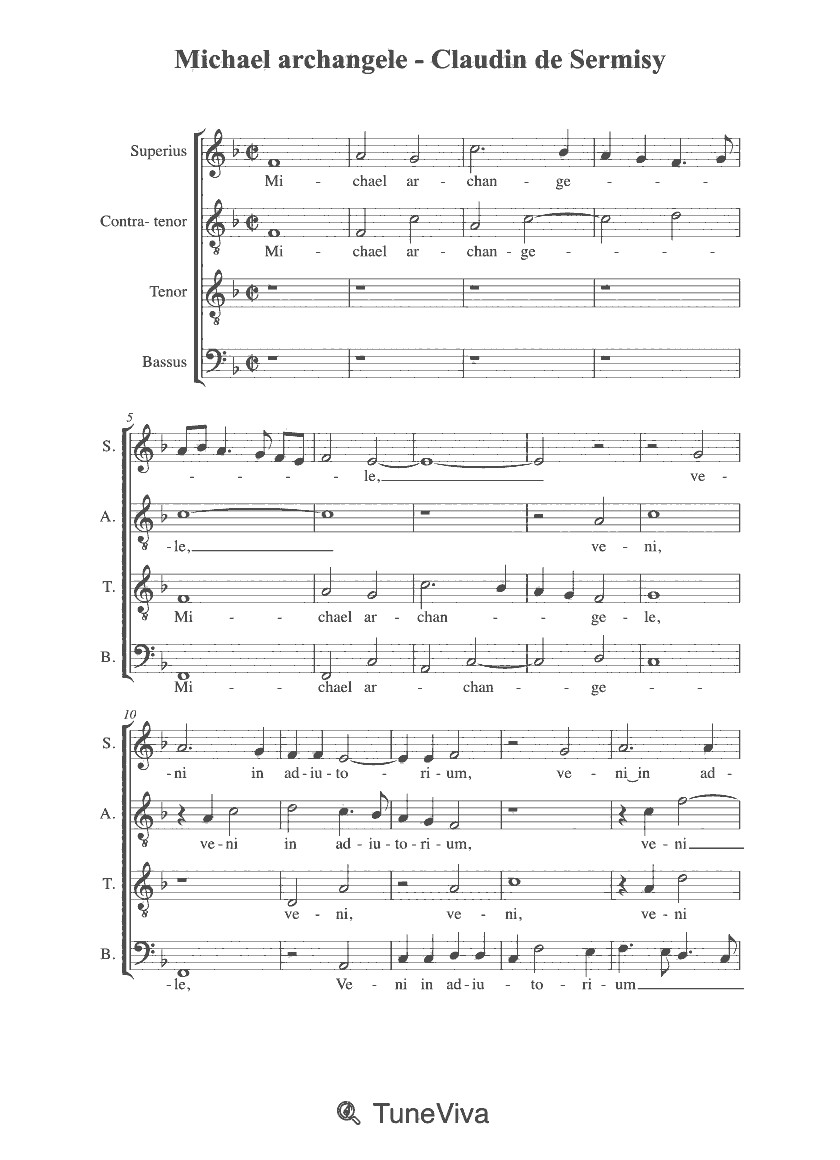
The sacred pieces are few but substantial: Benedic anima mea is a four-voice motet on Psalm 103, and Da pacem domine is a three-voice setting of the peace antiphon. The catalogue also carries five pieces by other composers — Janequin, Certon, Phinot, Compère and Schubert — because their files were tagged with Sermisy as composer. They are not his work, and the titles name their real authors.
Sermisy's chansons are syllabic and dance-like: one syllable to a note, short phrases, and a long-short-short figure that recurs constantly. Keep the texture light and let the text drive the tempo; a heavy, slow reading destroys the point. In the motets the imitation is plainer than in Gombert or Mouton, so tune the cadences carefully and do not smooth away the rests between phrases. The few intabulations need a lute or keyboard touch, not a choral one. Decide on French pronunciation before rehearsal.
The most-viewed piece: a four-voice chanson dated 1529 in modern editions and still sung in English as 'To Yon Fair Grove'.
The catalogue's spelling of 'Dont vient cela, belle, je vous supply', a four-voice chanson printed by Attaingnant in the 37 Chansons musicales a quatre parties.
A four-voice motet on Psalm 103, 'Bless the Lord, O my soul'; it circulates in modern choral editions as well as the sixteenth-century prints.
Marot's text set as a four-voice chanson, printed in Paris by Attaingnant in 1528 and anthologised ever since.
A chanson on 'Le content est riche en ce monde', preserved in numerous lute intabulations as well as vocal prints.
A four-voice setting of 'Pour ung plaisir qui si peu dure', printed by Attaingnant in 1536 and about 69 seconds long here.
A chanson on 'En esperant, espoir me désespère', included in modern anthologies of four-voice French chansons.
A three-voice motet on the peace antiphon, sometimes linked to the diplomatic meeting of 1532 and printed by Attaingnant in 1533.
Gris et tenné me fault porter, a chanson printed by Attaingnant in 1530; the catalogue shortens the incipit to two words.
51, running to about 150 minutes and 22,390 notated notes. 49 carry lyrics and every entry is filed as classical.
Because their files were tagged with Sermisy in the composer field; the catalogue keeps them in his bucket. The titles still name the real composer, so check the first page before assuming an attribution.
He was a cleric who held canonries at Rouen, Amiens and the Sainte-Chapelle, and he stayed Catholic all his life. Whether he was ordained is not recorded in the sources used here.
A four-voice setting of Clément Marot's poem, printed in Attaingnant's Chansons nouvelles in 1528. It became the model of the Parisian chanson and has never left the repertory.
Catalog editions and arrangements attributed to Claudin de Sermisy.