classical
1 tracks
Henry Playford inherited his father's music shop and, with it, The Dancing Master, the collection of English country dances that gave the family its place in music history. The catalogue holds 34 scores under his name, about 30 minutes of music and 4,458 notated notes. No entry carries lyrics, which is what a book of dance tunes would lead you to expect.
The titles are the dance names: "My Lord Byron's Maggot", "The French Ambassador", "Portsmouth", "Childgrove", "Mr Beveridge's Maggot". Most sit at complexity index 1, with six at index 0, and the pieces are short enough that the whole page runs to half an hour. Two titles appear twice, "Childgrove" and "My Lord Byron's Maggot", so check the file before choosing between duplicates.
Henry Playford was born in 1657, the younger son and only surviving child of John Playford, and entered the family business in the Temple in London. His father's health had been failing for years before his death around 1686, and Henry took over the shop near Temple Church, trading there until 1695, then at Temple Change until 1704 and at Middle Temple Gate in 1706.
His list was built on songs and instrumental pieces for the pleasure gardens and the theatre as much as on church music. He published Harmonia Sacra in 1688 and The Divine Companion in 1701, brought out Thomas d'Urfey's Wit and Mirth, and issued Purcell's Orpheus Britannicus. He also revised The Dancing Master, the manual his father had first printed in 1651; the eighth edition of 1690 is the first marked as published by Henry, and further editions followed in 1695, 1698, 1701 and 1703, with a second part from 1696.
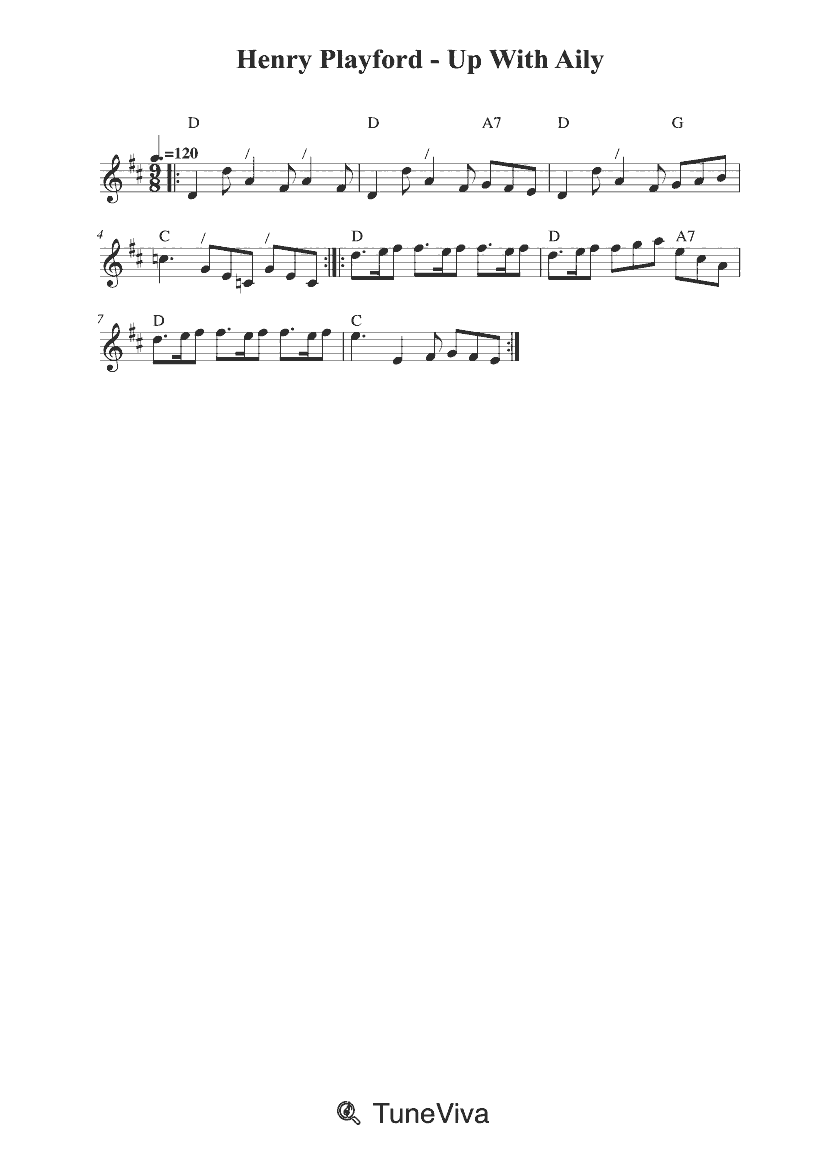
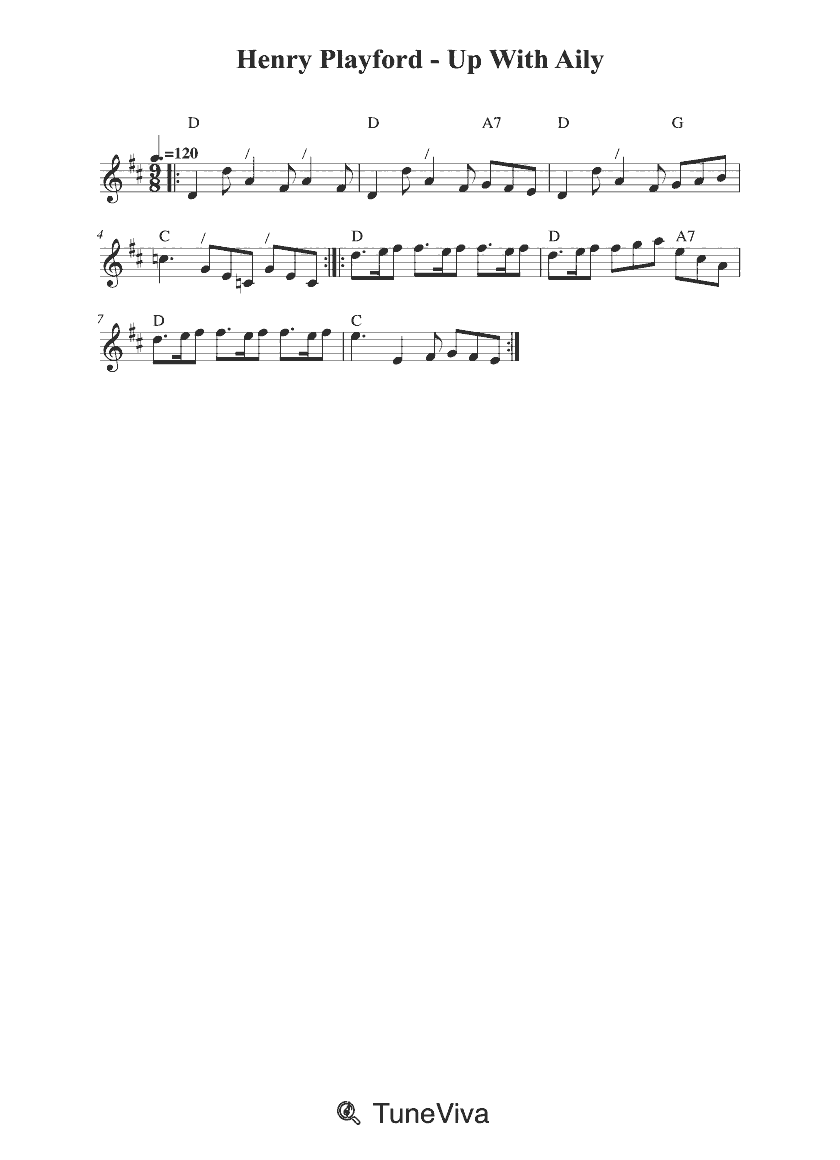
That book is the source of nearly everything here. The tunes were printed as single-line melodies with the dance steps beside them, and most are anonymous; the attribution to Playford reflects the publisher of the collection rather than a composer's autograph. "Childgrove" and "Portsmouth" come from the 1701 edition, "Mr Beveridge's Maggot" from 1695, and "Old Noll's Jig" from a 1702 supplement to the eleventh edition.
Playford tunes are dance music first, so the pulse matters more than the ornament. Most are in two strains of four or eight bars, each repeated, and the second strain usually climbs before it cadences; keep the repeats springy rather than slower. Ornament sparingly, and put the decoration at cadences. Because the printed source is a single melodic line, the accompaniment is an editorial choice, and the chords in these files may not match a facsimile exactly. Play at a tempo the dancers can walk to.
A duple-minor dance in D major from the 1701 edition; the catalogue holds a second copy under another id.
A triple-minor dance in B flat from 1701, one of the longer routines in the book.
A G major duple-minor dance from 1701, built on two repeated eight-bar strains.
A 1701 dance whose name echoes Purcell's semi-opera The Indian Queen of 1695; the tune itself is printed without an author.
A G minor triple-minor dance from 1701, named for the heath south-east of London.
A 1701 triple-minor dance in G minor; modern indexes spell the title "Wimbleton House" after the house in Wimbledon.
One of the newer dances added in the 1703 twelfth edition, in D major.
A D minor duple-minor dance from 1701 that stayed in the modern English country dance repertoire.
From the 1702 supplement to the eleventh edition; "Old Noll" was the nickname of Oliver Cromwell.
A G minor dance first printed in the 1695 ninth edition, and still one of the best-known Playford tunes.
There are 34, running to about 30 minutes of music and 4,458 notated notes. None of them includes lyrics.
He compiled and published them. The Dancing Master prints single-line melodies, and most are anonymous; crediting Playford is a convention that names the publisher of the collection.
"Childgrove" and "My Lord Byron's Maggot" each have two entries with different ids. The catalogue does not say whether they are different arrangements, transpositions or simple duplicates.
An archaic English word for a whim or fancy, used in the seventeenth and eighteenth centuries for a short instrumental piece or a dance.
Catalog editions and arrangements attributed to Henry Playford.