classical
1 tracks
James Hott Ruebush worked for the Ruebush-Kieffer publishing house in Virginia's Shenandoah Valley, and the catalogue holds 62 of his scores: about 37 minutes of music and 17,914 notated notes. Twenty-six entries carry lyrics.
The pieces are gospel songs and Sunday-school numbers rather than art hymns, and several standard texts appear in his own settings: "Rock of Ages", "When I survey the wondrous cross", "Come, Thou fount of every blessing", "Jesus, I my cross have taken". Difficulty is spread unusually wide for a collection this size, with two scores at index 0, forty at index 1 and twenty at index 2. "Rock of Ages" and "Fear not to trust Me in the storm" share the top of the page, a few views apart.
Ruebush was born in 1865 into a shape-note dynasty. His father, Ephraim Ruebush, had gone into partnership with Aldine S. Kieffer after the Civil War to revive the press of Kieffer's grandfather, the Mennonite singing master Joseph Funk, and the firm of Ruebush-Kieffer moved from Singers Glen to Dayton, Virginia, in 1880. It printed The Musical Million, a monthly journal of music, poetry and home literature, and more than fifty songbooks; its Temple Star was said to have sold over half a million copies.
James Hott Ruebush was associate editor of The Musical Million from 1886 until his retirement in 1936, and taught in the company's normal school, which trained singing-school teachers for the South. The house used the seven-shape note system, and its teachers and graduates included Anthony J. Showalter and, through Ephraim Hildebrand, James D. Vaughan. The other Ruebush on this page is William Howe Ruebush (1873-1956), born at Singers Glen, a vocal teacher who directed an army band in France during the First World War and later presided over the publishing company; several entries are credited to him as Will H. or W. H. Ruebush.
Every score is filed as classical in the catalogue, although the music belongs to the southern gospel-song tradition, and only 26 of the 62 carry lyrics. The texts range from Watts and Toplady to temperance and Sunday-school verse, and the settings are homophonic throughout, with a refrain after each verse.
Shape-note gospel songs were written to be read at sight by singers who had learned the seven shapes, so the tunes are square-cut and the phrases repeat. Take them at a walking pace and keep the refrain crisp; the harmony is mostly block chords, and the interest comes from the rhythmic push of the chorus rather than from counterpoint. Where the text is a standard hymn, sing the words you know and check the file for a refrain, since these settings often add one. A piano or organ doubling the voices is idiomatic.
Augustus Toplady's 1763 hymn in a gospel-song setting, and the most-viewed score on the page.
An invitation-style gospel song with no text author named on the file; it runs "Rock of Ages" close for views.
A Sunday-school song credited to Will H. Ruebush rather than to James Hott Ruebush.
Isaac Watts's hymn of 1707, given a four-part gospel setting with a repeated refrain.
Robert Robinson's 1758 text, one of several standard hymns re-set in the Ruebush house style.
A marching Sunday-school song, the kind of processional piece the normal school taught teachers to lead.
Henry Francis Lyte's hymn of discipleship in a straightforward chordal setting.
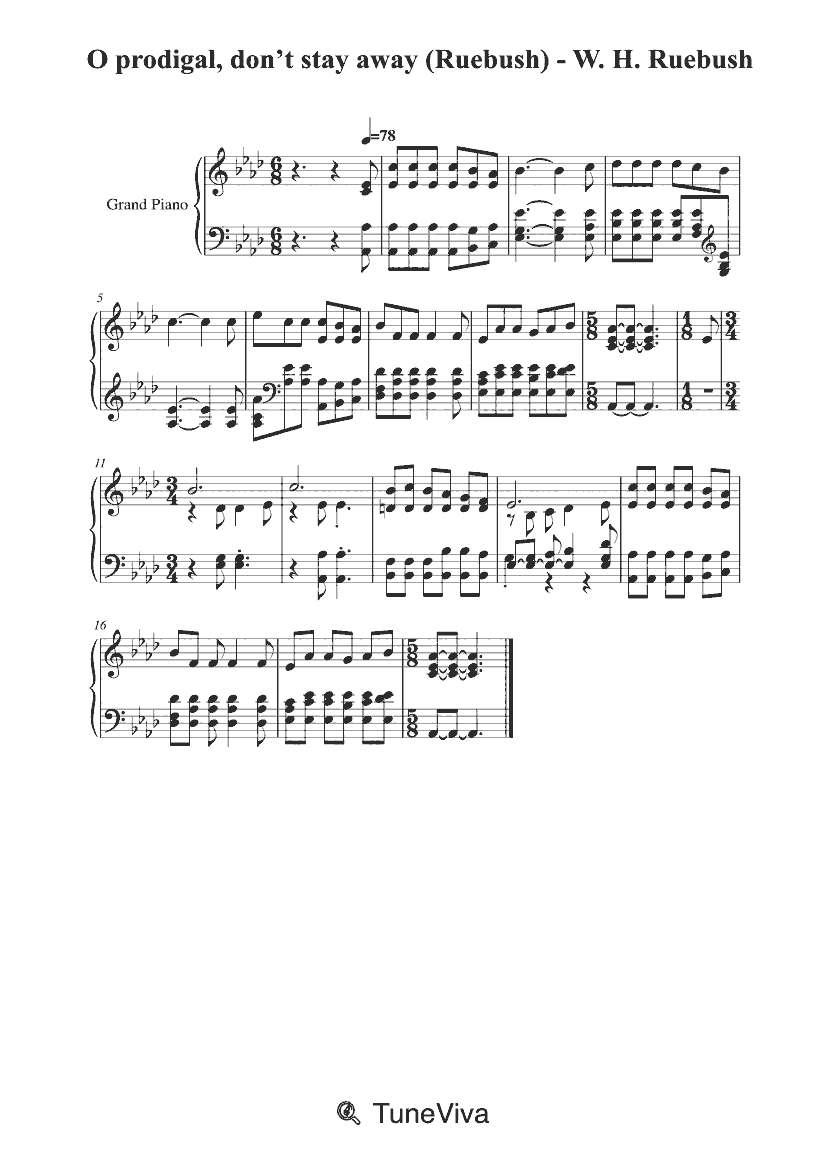
A pilgrimage song credited to Will H. Ruebush, with the refrain typical of the firm's tunebooks.
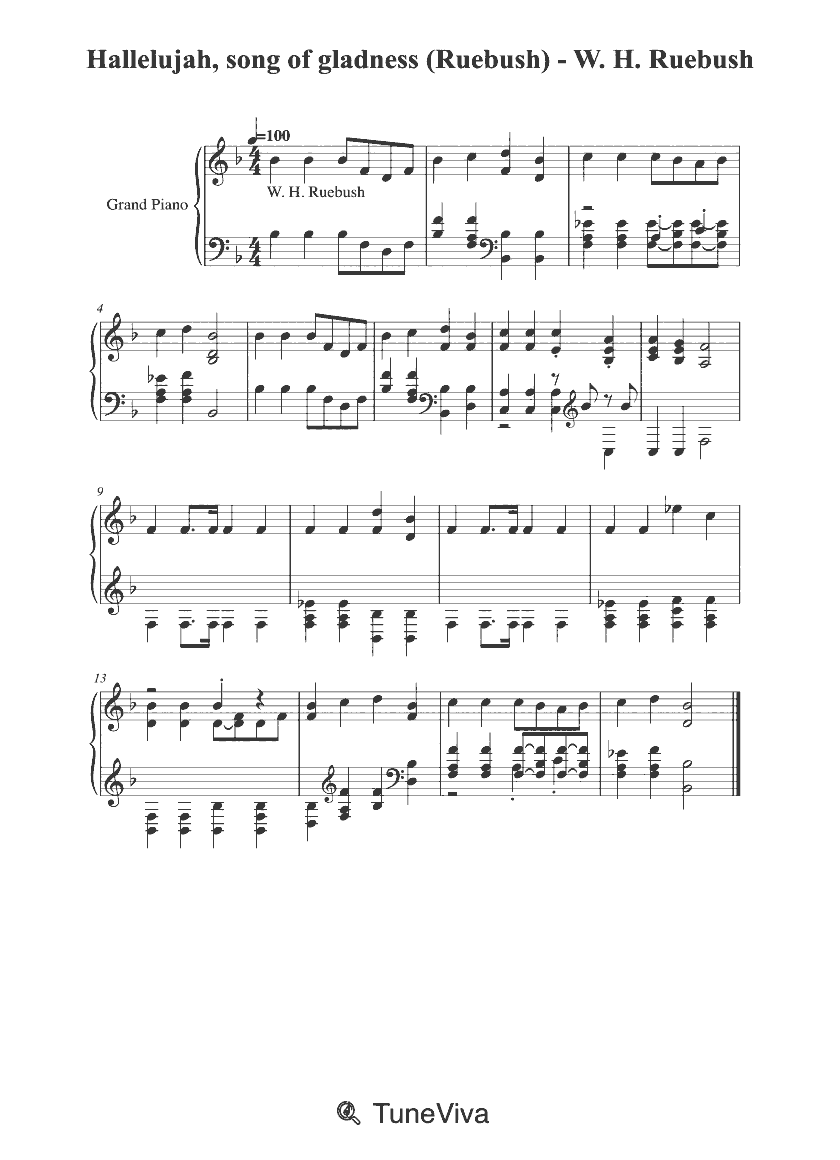
Credited to W. H. Ruebush, a bright choral piece rather than a solo gospel song.
There are 62, running to about 37 minutes of music and 17,914 notated notes. Twenty-six of them include lyrics.
No. J. H. Ruebush is James Hott Ruebush (1865-1948), the editor and composer. W. H. Ruebush is William Howe Ruebush (1873-1956), born at Singers Glen, who later led the family publishing company.
A hymnal printed in shape notes, where each degree of the scale has its own note shape, so that singers with little training can find the intervals. The Ruebush-Kieffer house used the seven-shape system.
The catalogue holds several settings of the same words, and the titles carry the composer's name in brackets to separate them. Compare the first page before choosing.
Catalog editions and arrangements attributed to J. H. Ruebush.