

1 tracks
John Bacchus Dykes wrote Nicaea, the tune most people know as Holy, Holy, Holy, while he was a minor canon and precentor of Durham Cathedral. He sent it to Hymns Ancient and Modern in 1860 among seven tunes, and the collection printed it in 1861. The catalogue holds 249 Dykes scores, about 117 minutes of music and 43,893 notated notes.
Seventy-one of those entries carry lyrics, and the difficulty is unusually uniform: 238 scores sit at complexity index 0, seven at 1 and four at 2. Most are four-part hymn settings a few dozen bars long, though a cello arrangement of Holy, Holy, Holy is the most-viewed item here.
Dykes was born in Kingston upon Hull on 10 March 1823 into a family of shipbuilders and clergymen. He was playing the organ at St John's, Myton, by the age of ten, and went up to Katharine Hall, Cambridge, in 1843, where he studied music under Thomas Attwood Walmisley. Ordained deacon at York Minster in 1848, he became a minor canon of Durham Cathedral the following year and precentor soon after. In 1862 he took the living of St Oswald's, Durham, and stayed until his health failed; he died on 22 January 1876, aged 52.
His tunes reached print through a speculative submission. In 1860 he sent seven to William Henry Monk, music editor of the new Hymns Ancient and Modern, and the collection carried them the next year: Nicaea for Reginald Heber's Holy, Holy, Holy, Melita for William Whiting's Eternal Father, Strong to Save, and Horbury for Nearer, My God, to Thee, named after a village near Wakefield. Lux Benigna, written for Newman's Lead, Kindly Light, followed in 1867, and Dominus Regit Me for Henry Williams Baker's The King of Love My Shepherd Is. He wrote more than 300 tunes; the 1895 Presbyterian Hymnal in America contained 43 of them.
The 249 scores here reflect that output rather than a concert catalogue. Seventy-one carry lyrics, and almost all sit at the easiest level of the index, which suits music meant to be read at sight by a congregation. Because each printing is filed separately, Nicaea appears as a cello part, as Holy, Holy, Holy: Nicaea, and under the plain first line. Check the scoring before printing: some entries are single instrumental lines rather than full four-part settings.
These are congregational tunes rather than recital pieces, and they work best at a walking pace with the soprano line clear and the inner parts quietly voiced. Dykes liked chromatic passing chords and the occasional modal cadence, so later verses can take more colour than the first. Keep the harmony under the melody instead of beside it, and resist slowing at every cadence; the words, not the tunes, carry most of the weight.
The most-viewed score on the page: a single cello line for Nicaea, useful for a string player joining an organ.
Christopher Wordsworth's hymn set to Dykes's tune Almsgiving, in an 8.8.8.4 metre.
Nicaea as printed in Hymns Ancient and Modern in 1861, written for Reginald Heber's Trinity hymn.
The 1866 tune St Agnes, sung to Edward Caswall's translation of Bernard of Clairvaux.
A storm-at-sea hymn whose title records both the first line and the tune, St Aelred.
The tune Dykes wrote in 1868 for Horatius Bonar's I Heard the Voice of Jesus Say; CMD means common metre doubled.
Lux Benigna, published in 1867 in David Thomas Barry's Psalms and Hymns for the Church, School, and Home.
Dominus Regit Me, written for Henry Williams Baker's paraphrase of Psalm 23.
A Whitsunday hymn; the catalogue credits Dykes with this 1875 setting of the Latin Veni Creator text.
A Christmas setting built on the medieval Latin hymn Puer natus in Bethlehem.
There are 249 public-domain Dykes scores, running to about 117 minutes of music and 43,893 notated notes.
Nicaea (Holy, Holy, Holy), Melita (Eternal Father, Strong to Save), Horbury (Nearer, My God, to Thee) and Lux Benigna (Lead, Kindly Light).
Almost always tunes. The texts in this catalogue come from writers such as Reginald Heber, John Henry Newman, Horatius Bonar and Henry Williams Baker.
Each printing and arrangement is catalogued separately, so the same tune turns up as a cello part, as Holy, Holy, Holy: Nicaea and under other title variants.
Catalog editions and arrangements attributed to John Bacchus Dykes.
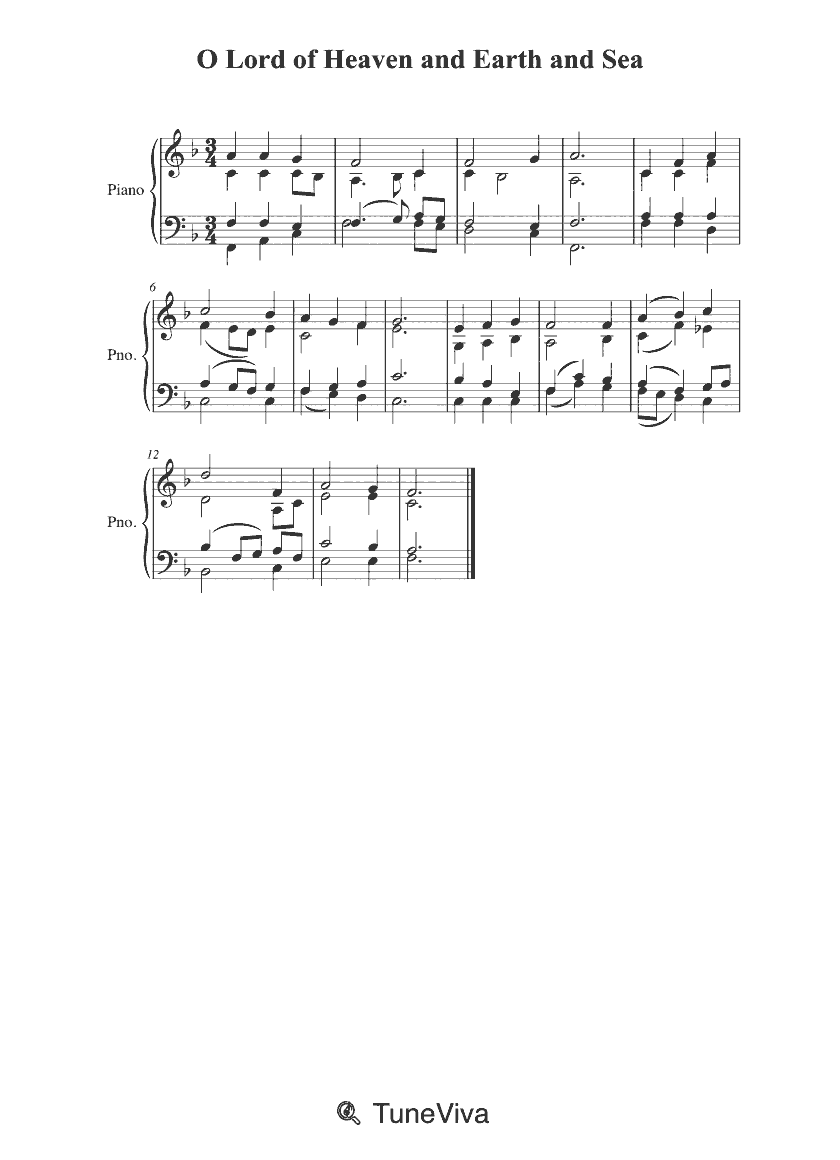


Tune: St. Aelred


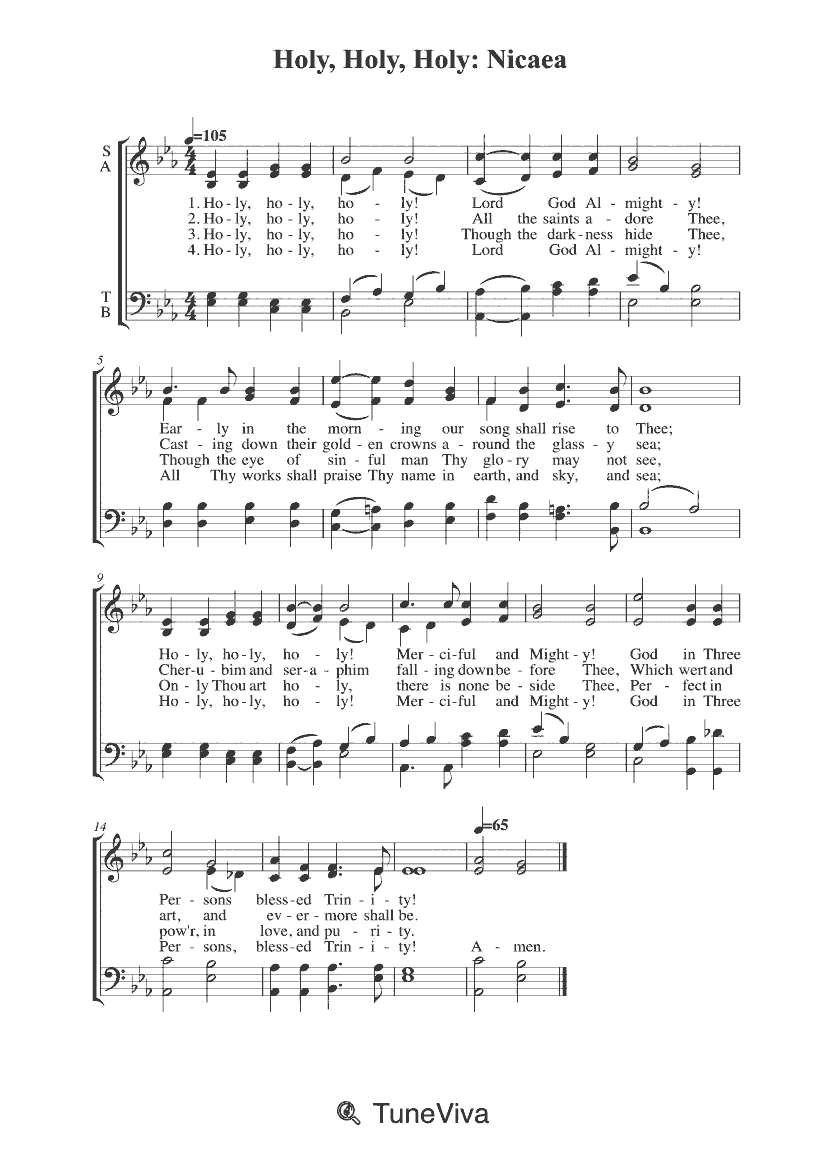
Tune: Nicaea


