4 tracks
Philip Paul Bliss wrote the tune Ville du Havre for Horatio Spafford's It Is Well with My Soul in 1876, the last year of his life, and it appeared in Gospel Hymns No. 2 that same year. The catalogue holds 172 Bliss scores, about 81 minutes of music and 45,415 notated notes.
Gospel songs dominate: 136 of the 172 entries carry lyrics, and 164 sit at complexity index 0. When Peace, Like a River leads with 496 views, followed by a second setting of It Is Well and by Dare to Be a Daniel, while Hold the Fort, Wonderful Words of Life and Almost Persuaded fill out the revival repertoire.
Bliss was born on 9 July 1838 in a log house in Huston Township, Clearfield County, Pennsylvania, and had little formal schooling. He worked farms and lumber camps before training as a teacher at the Susquehanna Collegiate Institute in Towanda, and at a musical convention in Rome, Pennsylvania, he met William B. Bradbury, who encouraged him towards music teaching. He married Lucy Young in 1859 and spent six weeks at a normal academy in Geneseo, New York, in 1860 learning notation and harmony.
He worked for the Chicago publishers Root & Cady from 1865 to 1873, running singing schools and conventions, and met Dwight L. Moody in 1869. In 1874 he gave up publishing for full-time evangelism with Daniel W. Whittle. With Ira D. Sankey he edited Gospel Hymns and Sacred Songs in 1875 and Gospel Hymns No. 2 in 1876. Hold the Fort came from a Civil War story Whittle told; Almost Persuaded followed in 1871, and Wonderful Words of Life and Hallelujah! What a Saviour in 1875. He died on 29 December 1876 when the Pacific Express went off the Ashtabula bridge in Ohio. His trunk survived with the manuscript of I Will Sing of My Redeemer, which James McGranahan later set.
The 172 scores here run to about 81 minutes, with 136 lyrics-bearing entries and only eight above complexity index 0. Several songs appear twice under different titles, since When Peace, Like a River and It Is Well with My Soul are the same hymn stored as separate printings.
Bliss writes verse and refrain, and the refrain is the point: it should lift rather than shout. The verses move in stepwise chords with a chromatic passing note or two, which is where the period flavour comes from; keep those inner lines audible and the tempo forward. It Is Well needs restraint until the final line, and Hold the Fort can take a march-like pulse. Most of these scores are short enough to play through twice, which is how they were used.
The most-viewed score on the page: a four-part setting of the hymn usually called It Is Well with My Soul.
Ville du Havre, written in 1876 for Horatio Spafford's text and published in Gospel Hymns No. 2.
Written in 1873 for his Sunday-school class at the First Congregational Church in Chicago.
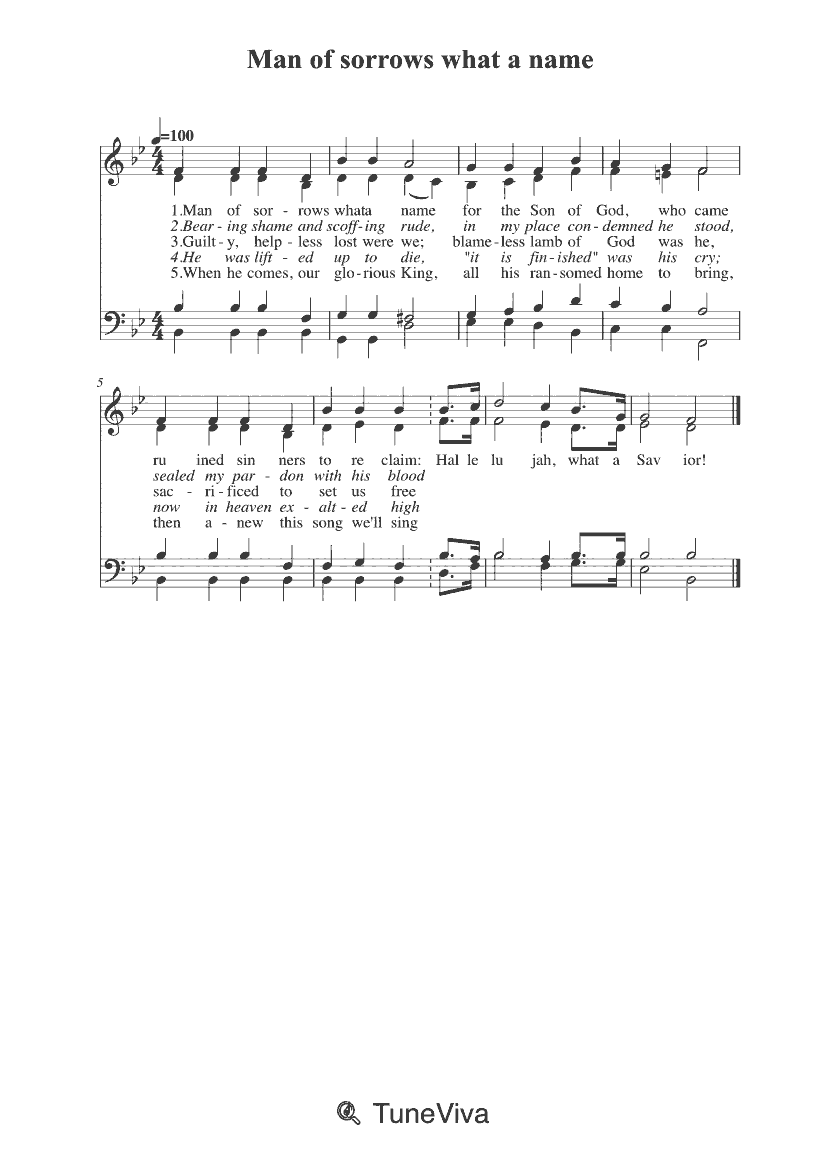
Horatius Bonar's text sung to the tune Bliss usually titled Hallelujah! What a Saviour.
An 1875 Sunday-school song, one of his most reprinted refrains.
The 1870 gospel song built on the Civil War signal message, Hold the fort, for I am coming, which Whittle retold.
A revival invitation with a rising refrain; the parenthetical name separates duplicate catalogue entries.
The 1875 tune most often paired with Bonar's Man of Sorrows, listed here under its refrain.
An 1871 warning to the undecided, its title taken from Agrippa's words to Paul in Acts 26.
An Easter song in the same verse-and-refrain shape as his other gospel numbers.
There are 172 public-domain Bliss scores, about 81 minutes of music and 45,415 notated notes.
No. Horatio Spafford wrote the text in 1873 after losing four daughters at sea; Bliss wrote the tune Ville du Havre in 1876.
He and his wife Lucy were killed on 29 December 1876 when the Pacific Express left the bridge at Ashtabula, Ohio, and the carriages caught fire.
When Peace, Like a River is the opening line of It Is Well with My Soul, and each printing and arrangement is catalogued separately.
Catalog editions and arrangements attributed to Philip Paul Bliss.