classical
1 tracks
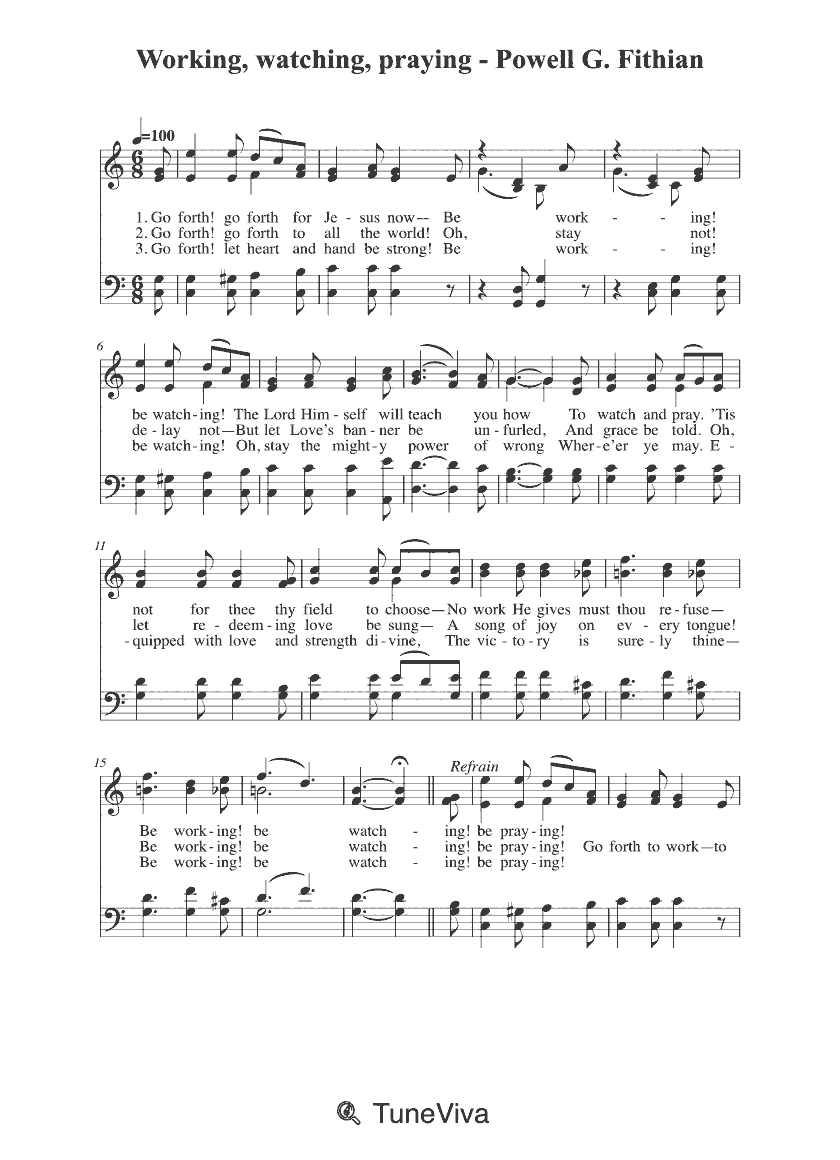
Powell G. Fithian wrote gospel songs for Sunday schools, revival meetings and young people's societies, and the catalogue stays inside that world: 58 scores, about 34 minutes of music and 18,775 notated notes, all filed as classical.
The pieces are short, built as a stanza and a refrain. More than half sit at complexity index 2, so this is not the easiest shelf in the catalogue even where the titles sound like children's songs. The most-viewed is Army of Salvation, to a text by Frank A. Breck, followed by the Christmas song Ring the Bells for the Royal Birth and I Will Follow Thee, My Jesus.
Fithian was born on 30 April 1861 at Greenwich Township, New Jersey, in the district now called Gibbstown, and made his career in Camden, where he was music director for the public schools. He was also a compiler of gospel songbooks, and that is where most of these pieces come from. With George C. Hugg he edited Songs of the Mercy Seat (Philadelphia, 1899); with Howard Entwisle and Adam Geibel, Songs for Work and Worship (Dayton, Ohio, 1900) and Heavenly Sunlight (Philadelphia, 1902); with Entwisle alone, Exalted Praise (Philadelphia, 1901). His Fithian Music Primer, a school method, was published in New York in 1915. Hymnary gives his dates as 1861–? and notes that his wife Julia appears alone in the 1930 census, which suggests he died during the 1920s.
The catalogue shows the shape of that work. Army of Salvation, to Frank A. Breck's text, was No. 98 in Songs for Work and Worship and survives in four hymnals; Ring the Bells for the Royal Birth is a Christmas number from Exalted Praise, No. 174; The Other Shore sets William H. Clark's 'When we have reached the heavenly plains'; Sing the Boundless Love of Jesus uses May Maurice's 'One and All'.
Fifty-eight scores amount to only about 34 minutes and 18,775 notes, an average of well under a minute each: single stanzas with refrains rather than extended anthems. Thirty-three carry lyrics, and the other twenty-five are presumably textless voice or keyboard versions, since the catalogue does not say. Difficulty is not concentrated at the easy end — 11 entries sit at index 0, 22 at index 1 and 25 at index 2.
These are four-part gospel songs, and the tune usually sits in the soprano while the refrain repeats in harmony. Keep the tempo brisker than the words suggest: a stanza-and-refrain shape only works if the refrain lifts. The keyboard part is mostly chords, so the interest has to come from the voices and from clean diction — the texts are narrative and moralising, and a blurred consonant loses the point. Where the catalogue offers only a textless file, play the soprano line and add the harmony from the refrain.
The most-viewed score here, with Frank A. Breck's text; it was No. 98 in Songs for Work and Worship (1900) and appears in four hymnals indexed by Hymnary.
A Christmas song from Exalted Praise (Philadelphia, 1901), where it is No. 174.
Hymnary dates this setting to 1899 and finds it in four hymnals, including the Evangelistic Edition of Heavenly Sunlight, No. 73.
Known in hymnals as 'Rest and Be Satisfied'; it was No. 84 in Songs for Work and Worship (1900).
A call to arms printed in Heavenly Sunlight (1902) and in Consecrated Hymns (1902), where it is No. 76.
Sets William H. Clark's 'When we have reached the heavenly plains'; the Cyber Hymnal carries it as No. 5376.
May Maurice's 'One and All', with the refrain 'Till across the silent river'; No. 80 in Songs for Work and Worship.
One of the rarer tunes in the index: Hymnary records a single hymnal appearance.
John L. Newkirk's text 'O precious love of Jesus, O matchless love divine', set here as a single-hymnal tune.
A hymn about answers deferred to another life, printed in hymnals under the title 'Not Now, But by and By'.
58, running to about 34 minutes and 18,775 notated notes. Thirty-three of them include lyrics, and all are filed as classical.
Usually not. Hymnary credits him as the composer of the tunes while the texts belong to other writers: Frank A. Breck for Army of Salvation, May Maurice for Sing the Boundless Love of Jesus, William H. Clark for The Other Shore and John L. Newkirk for O Precious Love of Jesus.
They are first lines. The catalogue takes the opening of each hymn rather than the shorter title used in the books, so 'Once I was far from the haven of rest' appears in hymnals as Rest and Be Satisfied and 'We know not why dark clouds overcast' as Not Now, But by and By.
A school music method published by the American Book Company in New York in 1915, the latest of his publications recorded by Hymnary, and a reminder that his working life was spent teaching in Camden.
Catalog editions and arrangements attributed to Powell G. Fithian.