

"Sí Bheag, Sí Mhór"
Arranged for Woodwind Duet by Mike Magatagan 2012
2 tracks
A blind harper on horseback, travelling from one patron's house to the next for nearly fifty years: that is the picture behind Turlough O'Carolan's tunes. Born in Nobber, County Meath, in 1670, he lost his sight to smallpox at eighteen, trained as a harper, and turned the households that hosted him into music.
TuneViva holds 651 O'Carolan scores, about 615 minutes and 125,736 notes; one carries lyric notation. The titles show the harper's world of patrons and places, with Planxty Hewlett, Planxty Burke, Eleanor Plunkett and Captain O'Kane alongside the programme piece Si Bheag, Si Mhor, the most-viewed entry here.
O'Carolan travelled for nearly fifty years, staying on the estates of patrons who commissioned tributes. He married Mary Maguire in 1720 and had seven children; she died in 1733. He died on 25 March 1738 and is buried at Kilronan, County Roscommon. Donal O'Sullivan's 1958 study identified 214 tunes, and about a third of the surviving music has Irish words. The planxty, a word Carolan seems to have used for a piece in honour of a patron, usually began as a tune, with words added later.
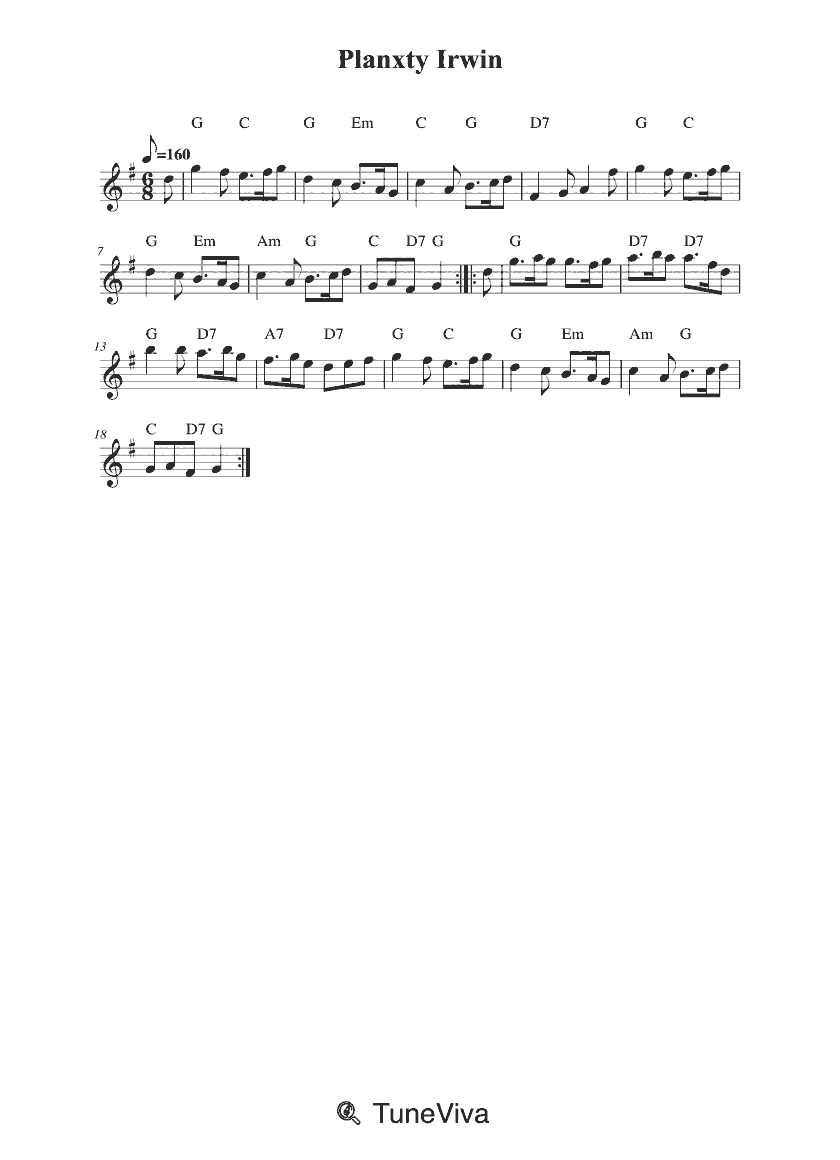
The catalogue reflects the range: planxties, airs, laments and marches. Si Bheag, Si Mhor is the best known and the most viewed; O'Carolan's Farewell to Music is often played as a valediction, and Morgan Megan and Carolan's Dream belong to the lyrical side of the output. Planxty Irwin and Planxty Burke show the dance-like planxty at its most direct.
One warning about attribution. Brian Boru s March, the second most-viewed title here, is a traditional Irish march whose earliest printed version appeared in Dublin in 1842, more than a century after Carolan's death, and Wikipedia classes it as having unknown songwriters. It is included under Carolan's name in this catalogue, but the attribution is not secure.
These are melody-first pieces. The harper's idiom depends on a clear tune and a bass that supports it without crowding; on piano or guitar, keep the melody singing and the accompaniment light. Many tunes are in binary form with repeats, so vary the repeats through ornament rather than tempo. Planxties often have a stately, dance-like lilt; the laments need space. Because the surviving sources are later collections, expect variant readings, and choose a version whose key suits your instrument.
The most-viewed Carolan title in the catalogue and one of his most frequently recorded pieces.
A traditional Irish march included under Carolan's name here; its earliest printed version dates from 1842 and the attribution is not secure.
A frequently recorded piece often treated as his valediction, reflecting an older Gaelic harping style.
A planxty, the tribute form Carolan used for patrons, and one of the collection's most-viewed entries.
A planxty for the Burke family and among the best-known examples of the form.
A song-tune named for a patron and often played as an instrumental air.
Also known as Colonel John Irwin, one of the planxties most often played by modern traditional musicians.
A tune for a patron named in O'Sullivan's catalogue of 214 pieces.
Yes. He lost his sight to smallpox at about eighteen and then trained as a harper, spending nearly fifty years travelling Ireland.
A term Carolan used for a piece in honour of a patron, usually a tune to which words might be added later. Planxty Irwin and Planxty Burke are well-known examples.
Not securely. It is a traditional Irish march first printed in Dublin in 1842, long after his death, and the O'Carolan attribution is not supported by the standard reference sources.
The originals belong to the Irish harp tradition, but the tunes are now standard repertoire for fiddle, flute, tin whistle, guitar and piano.
Catalog editions and arrangements attributed to Turlough O'Carolan.
Arranged for Woodwind Duet by Mike Magatagan 2012




Carolan's Welcome(Am)


