Oh when the Saints
Listen & explore
Follow the score, hear the music, then make it your own.
About this score
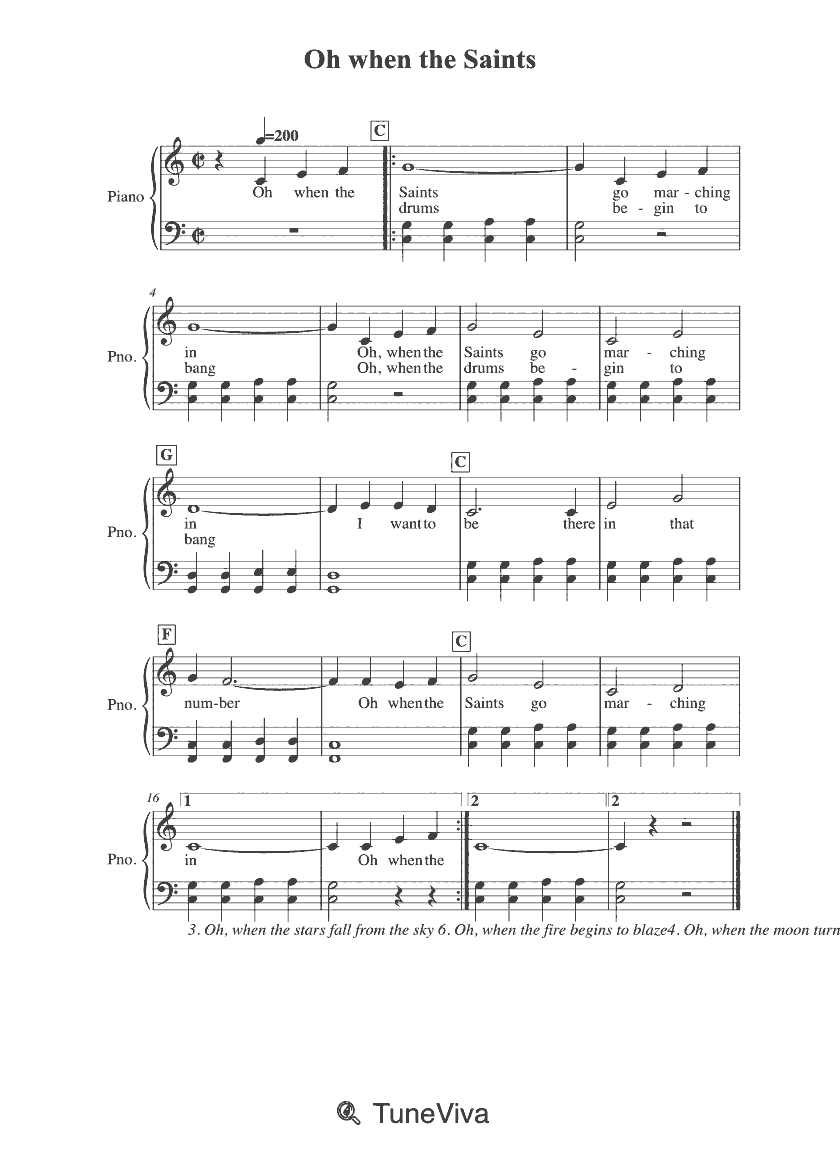
Few tunes travel further than When the Saints Go Marching In, and this piano edition keeps the journey simple. Nineteen bars in C major carry the melody with its lyrics attached, a written repeat doubles the strain, and verses three to seven are printed above the stave as text so the singing can continue past the first chorus. The file credits James Milton Black, whose name belongs to the song's 1896 ancestor, though the saints tune everyone actually sings is best described as traditional.
Score parts: Piano. Opening key signature: No sharps or flats. Opening time signature: 2/2. Opening tempo: 200 BPM. Estimated playback time: 1 min 23 sec. Listen while following the notation, adjust playback speed, or open this score in practice mode.
- Duration (approx.)
- 1 min 23 sec
- Score parts
- Piano
- Opening key signature
- No sharps or flats
- Opening time signature
- 2/2
- Opening tempo
- 200 BPM
- Genre
- Folk
A spiritual with tangled origins
The song the whole world hums is a traditional African-American spiritual with no single author. James Milton Black and Katherine Purvis did publish a close relative called When the Saints Are Marching In in 1896, which is why Black's name appears on files like this one, but the version with its present words and swagger took shape later as folk material, and no composer owns it. Louis Armstrong's 1938 recording is usually credited with turning it into a jazz standard, and it has since become the rollicking signature of New Orleans brass bands. Knowing that history helps you play it: the tune carries triumph without fuss.
Reading the piano layout
Everything sits on one piano stave in C major and 2/2, marked at 200 to the quarter. The right hand carries the melody, thirty-six notes of it with syllables attached, while chord notes thicken the harmony at fifty-four points across the nineteen bars. A forward repeat and its partner double the strain, which is where the printed verses come in: above bar sixteen, the notation lists the stars falling from the sky, the moon turning red, the trumpet sounding its call, the fire beginning to blaze and the saints marching in, ready to be sung over the same music. The whole playback runs under a minute and a half.
Making the verses your own
The musical substance of all seven verses is one strain, so the practice is text rather than notes. Speak each printed verse in rhythm against the melody until the syllables land without crowding, then sing it while you play. Keep the quarter-note pulse steady and let the vocal line sit a shade behind it for the hymn feel; when you reach the repeat, change verses rather than repeating yourself. The chord notes are sparse, so listen for where they arrive and let your left hand meet them without adding weight elsewhere.
Practice tips
- Speak one printed verse at a time in rhythm against the melody before adding any sound to it.
- Use the written repeat for a different verse, so the second pass covers new words instead of repeating the first.
- Keep the quarter-note pulse near the marked 200 beats and let the vocal phrasing lean slightly behind it.
- Notice where the fifty-four chord notes appear and balance your hands around those moments rather than throughout.
Questions about this score
Who wrote When the Saints Go Marching In?
The familiar tune is a traditional spiritual with no single author. James Milton Black and Katherine Purvis published a close ancestor titled When the Saints Are Marching In in 1896, and the credit to Black on this file reflects that link rather than settled authorship of this version.
What verses are printed in this edition?
Verses three to seven appear as text above the stave: the stars falling from the sky, the moon turning red with blood, the trumpet sounding its call, the fire beginning to blaze, and the saints marching in once more.
Is there a written repeat?
A forward and backward repeat pair doubles the strain. Practically, that means two passes of the same nineteen bars, which suits the hymn's habit of singing several verses over one stretch of music.
How long does the playback take?
Under a minute and a half in C major at the marked tempo of 200 beats to the quarter, covering both passes of the repeated strain.
Text marked as lyrics
Oh when the Saints go marching in Oh, when the Saints go marching in I want to be there in that number Oh when the Saints go marching in Oh when the drums begin to bang Oh, when the drums begin to bang