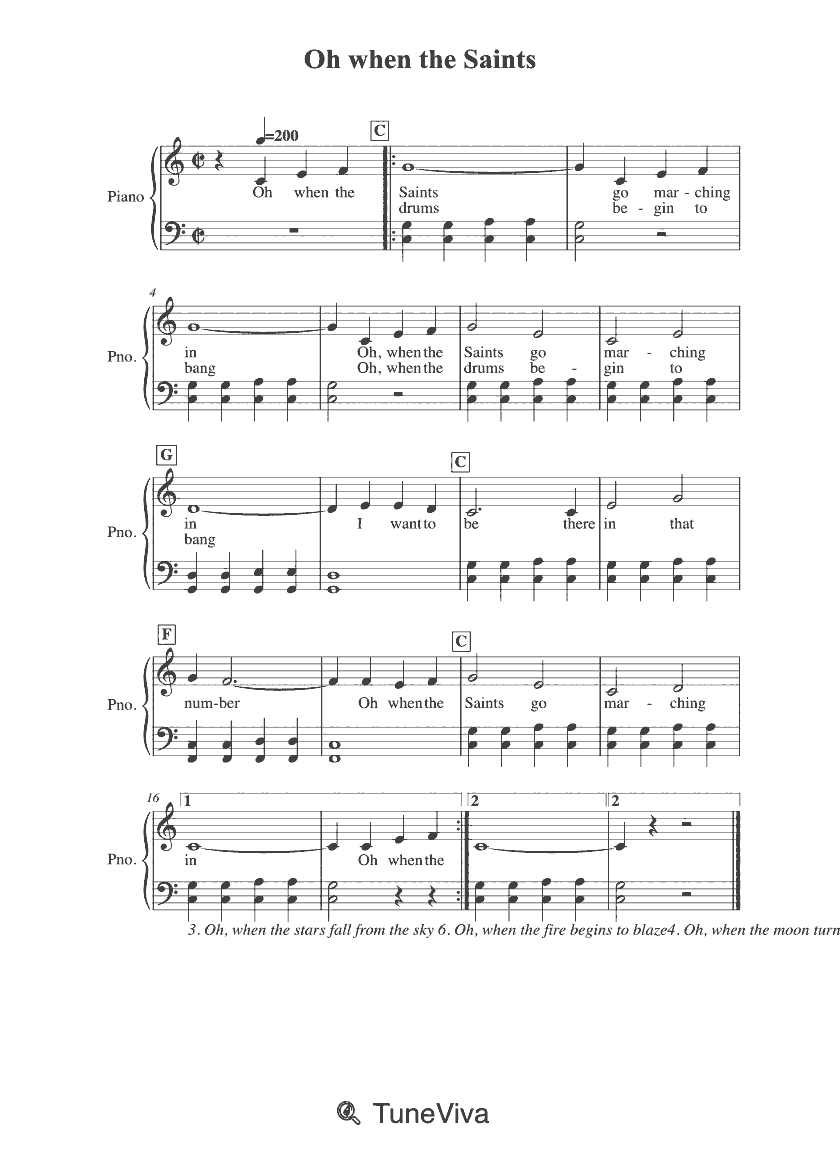
Oh when the Saints
James Milton Black
Piano · 1 min 23 sec
Open score165 James Milton Black scores, 75 with lyrics: When the Roll Is Called Up Yonder, When the Saints Are Marching In and I Remember Calvary, to preview and play.
The most-viewed entry on the page, a short saints song in the gospel idiom; the catalogue gives no hymnal source.
His 1896 song, with words by Katharine Purvis, and a likely ancestor of the later jazz standard with a similar title.
A communion hymn on the crucifixion, with words by W. C. Martin and music by Black; it appeared in The Epworth Hymnal No. 3 in 1900.
Written in 1893 after a Sunday-school roll call, with the tune Roll Call and a text drawn from 1 Thessalonians 4:16.
An invitation hymn on H. G. Jackson's words, built on a refrain that repeats the title after each verse.
A cheerful discipleship song in the Sunday-school manner, one of the less-documented entries on the page.
A testimony hymn in the first person, the kind of revival song his own compilations were built around.
Also known as He's Coming By and By, with words by Lizzie Akers; it was printed in Praise and Promise in 1900.
A Christmas piece; a hymn reference list gives it under the shorter title Sweet Voices.
A children's song in the Sunday-school idiom, short and repetitive by design.
Compare the instrument and arrangement details below, then open a score to check the notation. Different entries may be arrangements or editions of the same work; available playback tools are shown on each score page.
James Milton Black
Piano · 1 min 23 sec
Open score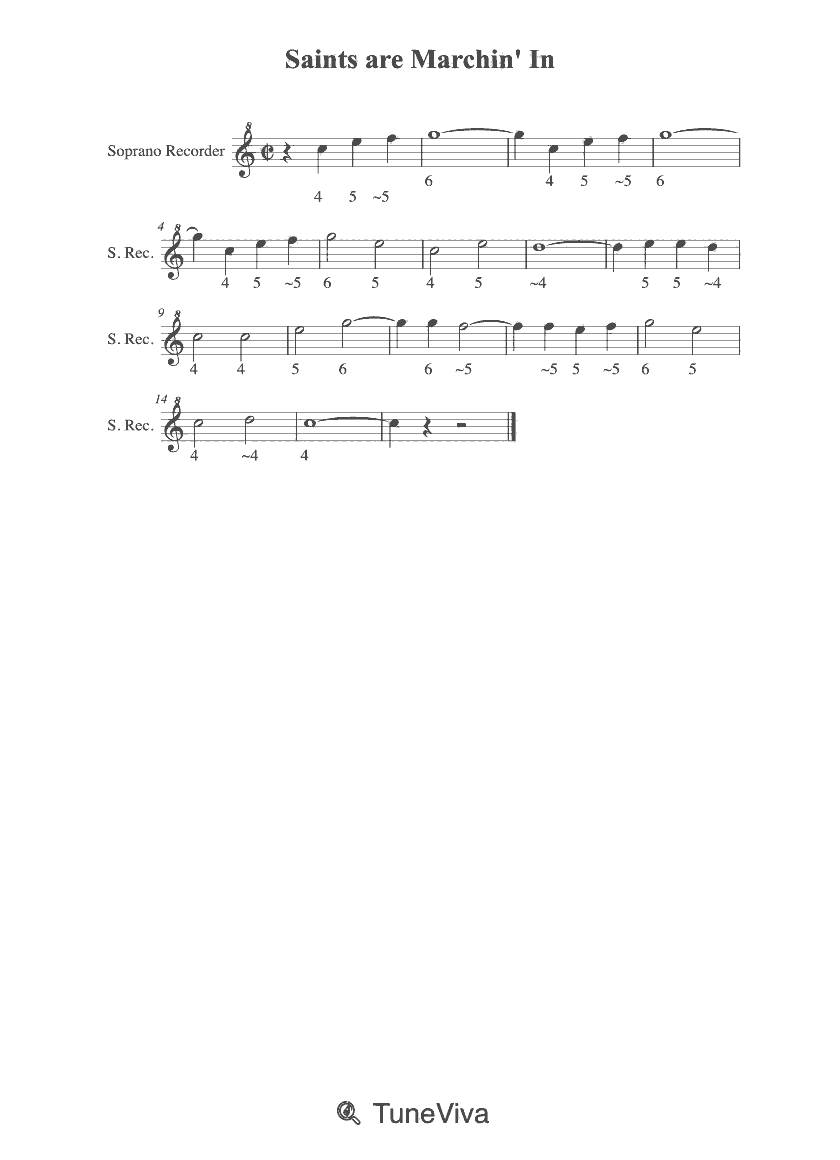
James Milton Black
Soprano Recorder · 32 sec
Open score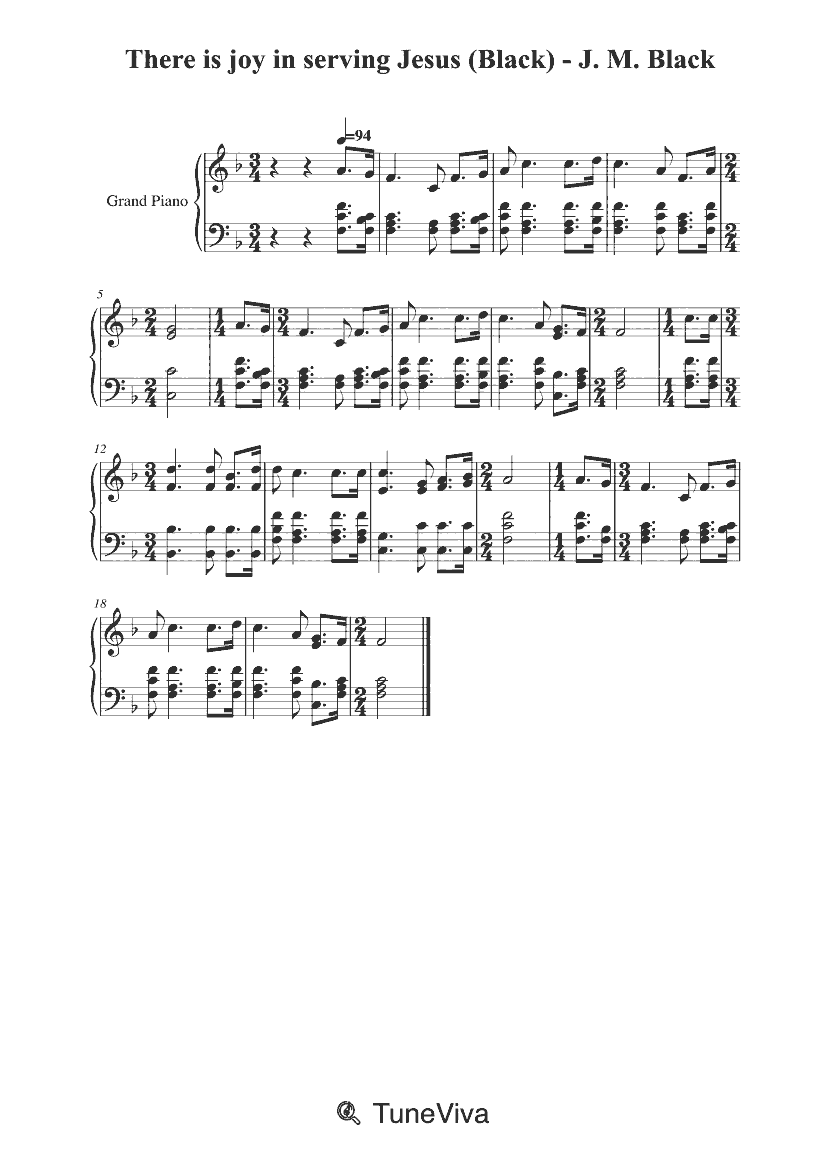
James Milton Black
Grand Piano · 32 sec
Open score
James Milton Black
Grand Piano · 37 sec
Open score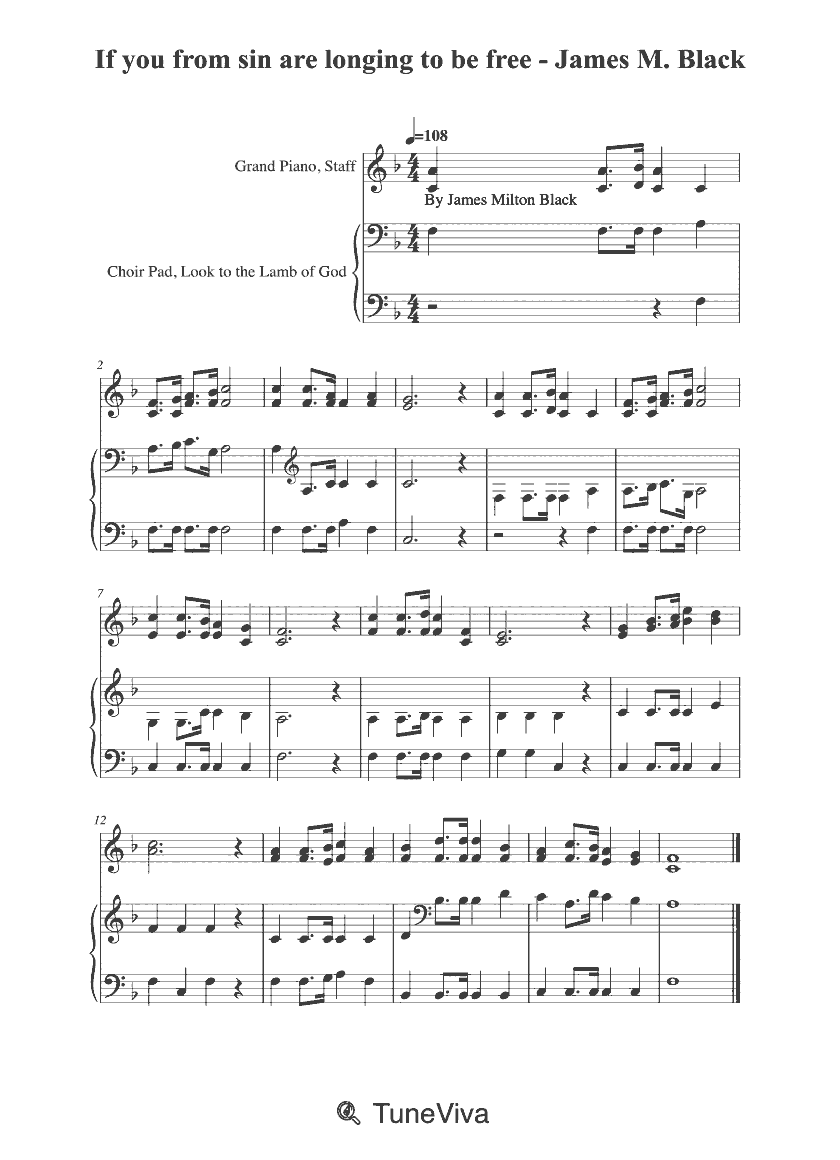
James Milton Black
Grand Piano, Staff; Choir Pad, Look to the Lamb of God · 36 sec
Open score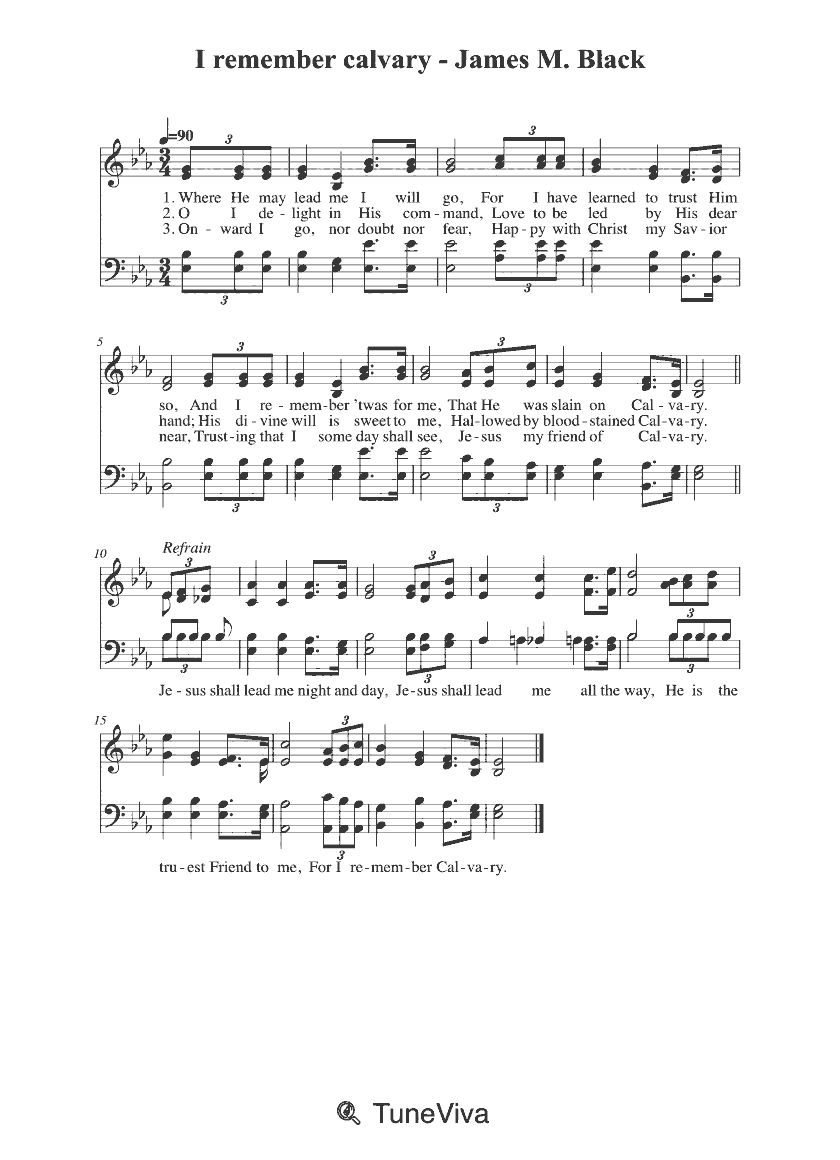
James Milton Black
31 sec
Open score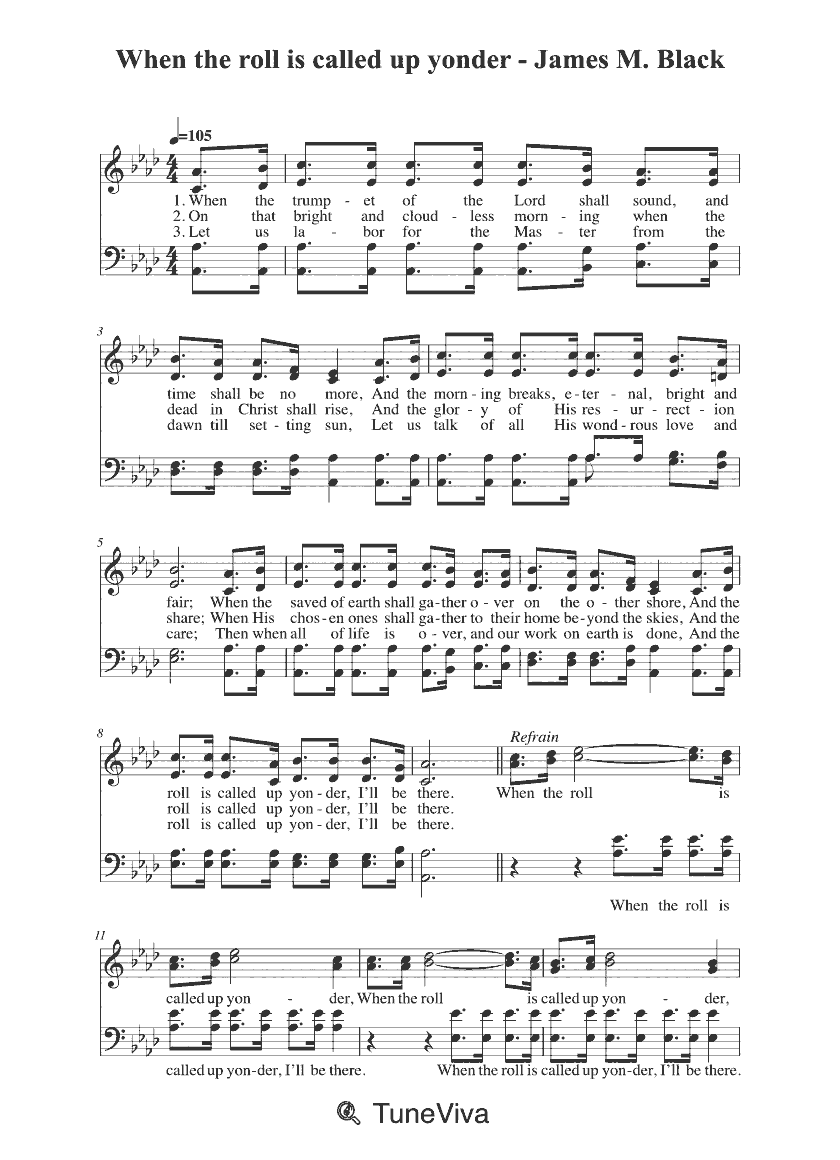
James Milton Black
37 sec
Open score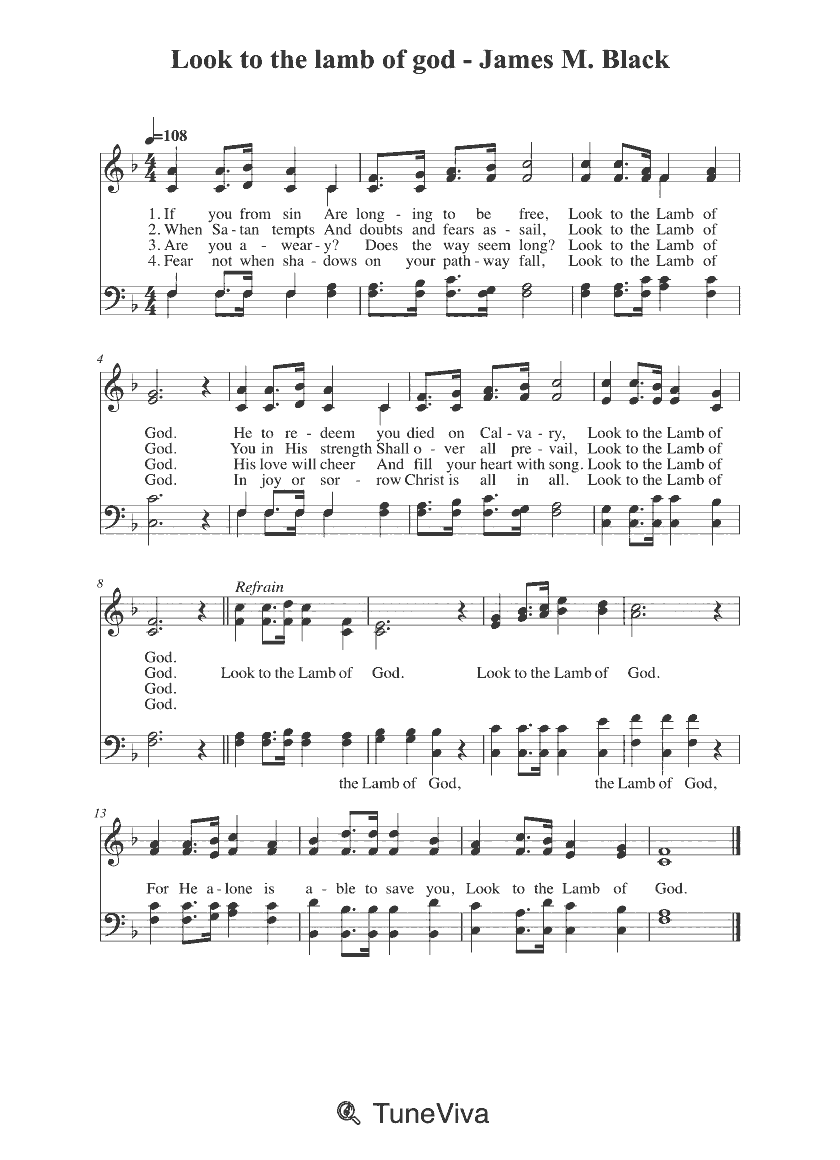
James Milton Black
34 sec
Open score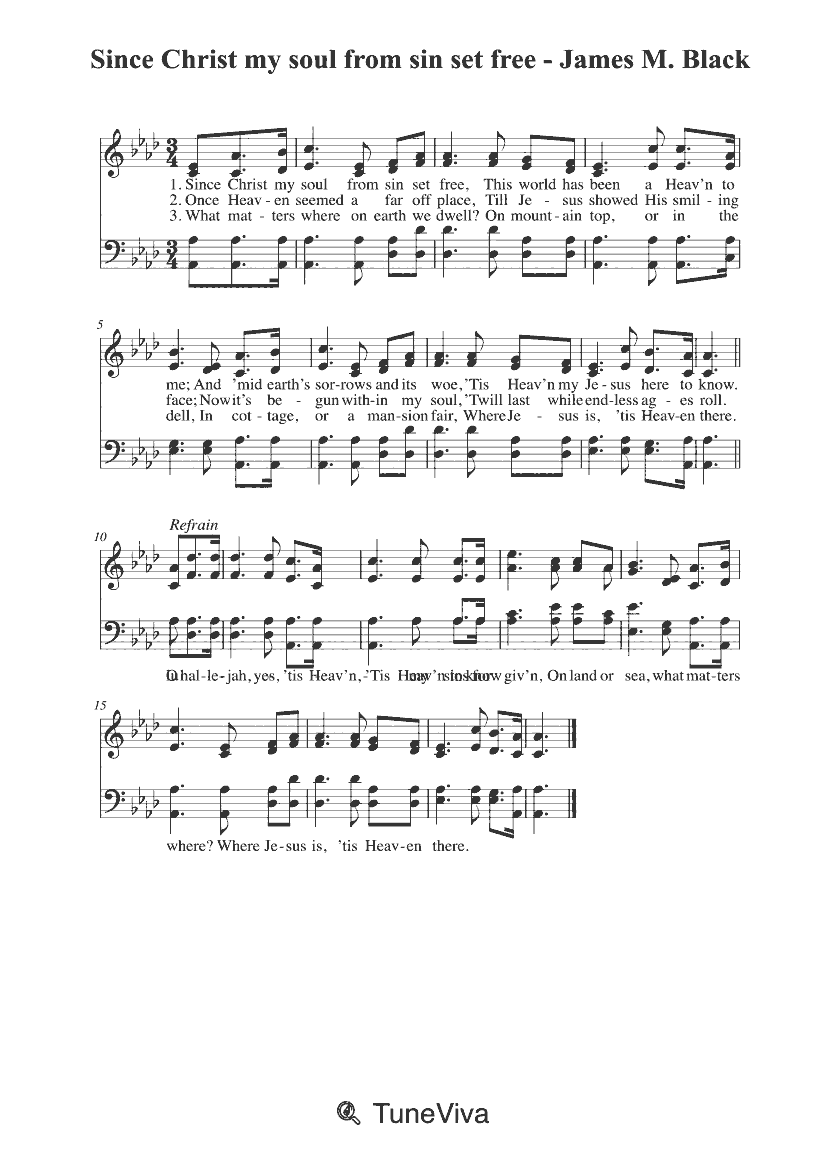
James Milton Black
23 sec
Open score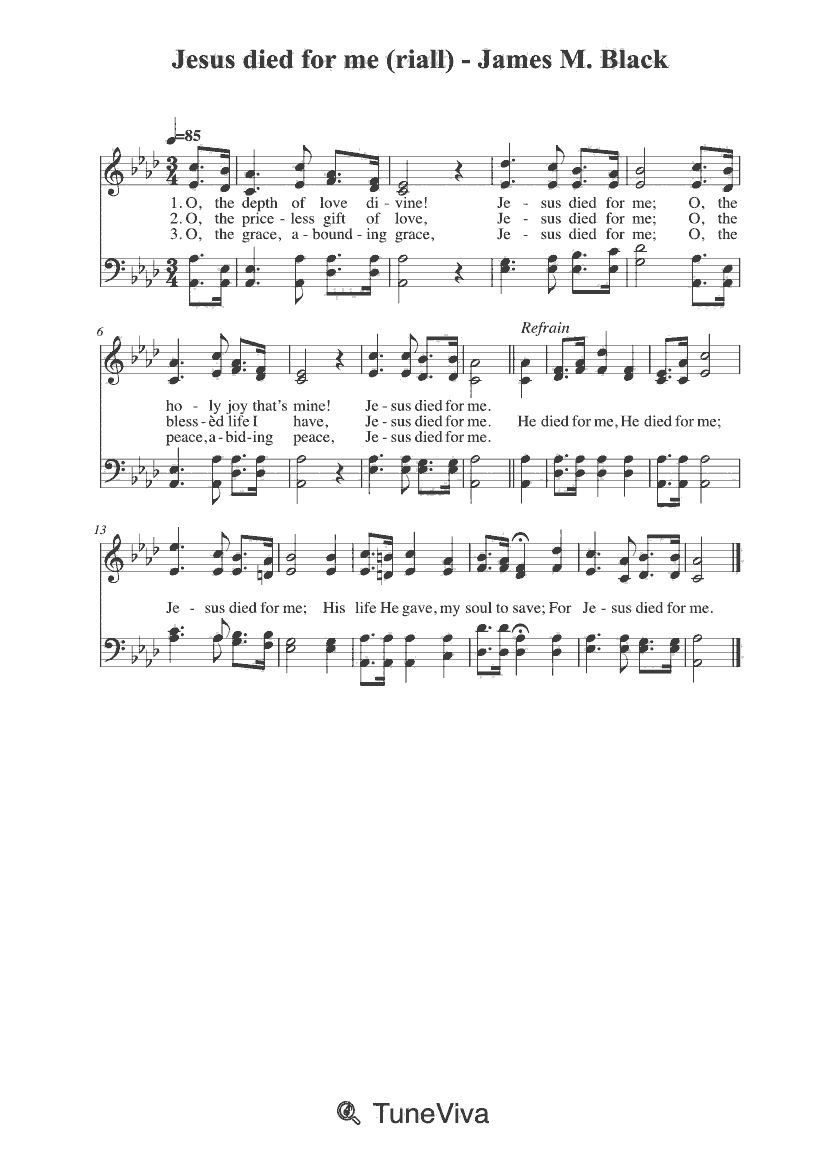
James Milton Black
34 sec
Open score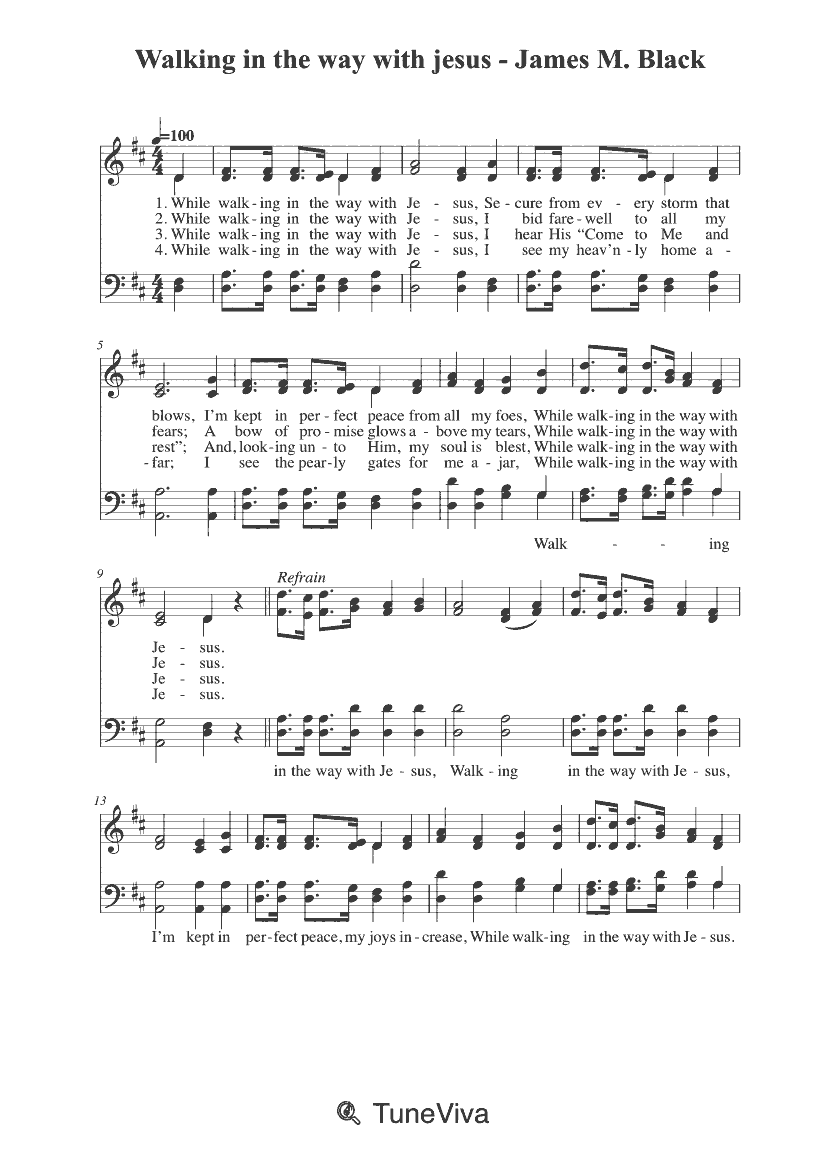
James Milton Black
31 sec
Open score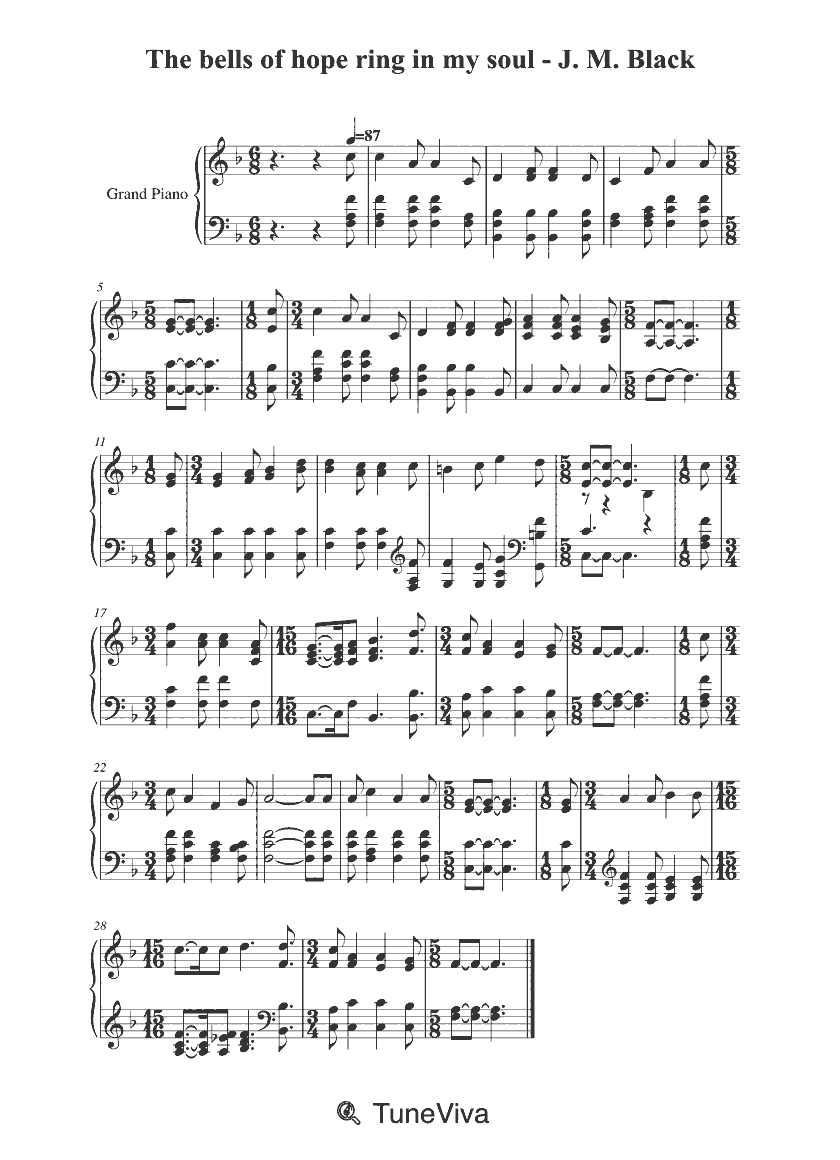
James Milton Black
Grand Piano · 38 sec
Open score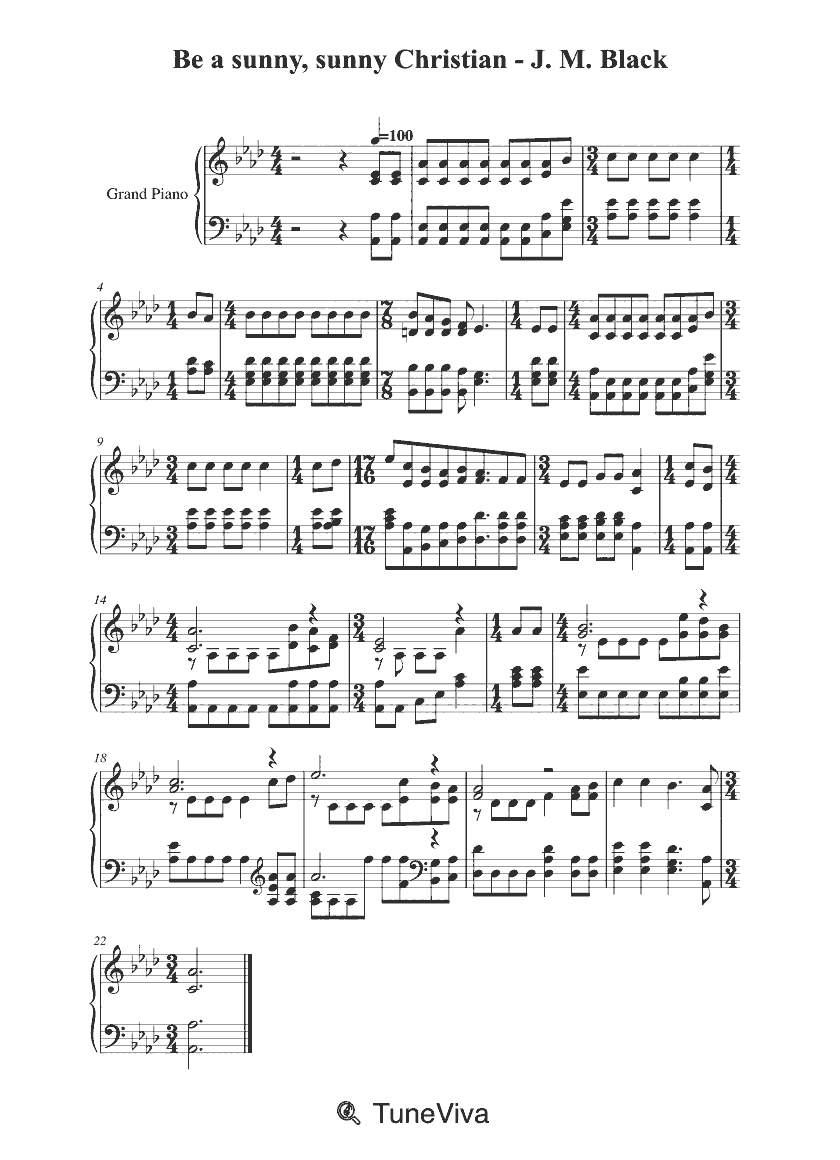
James Milton Black
Grand Piano · 37 sec
Open score
James Milton Black
Grand Piano · 35 sec
Open score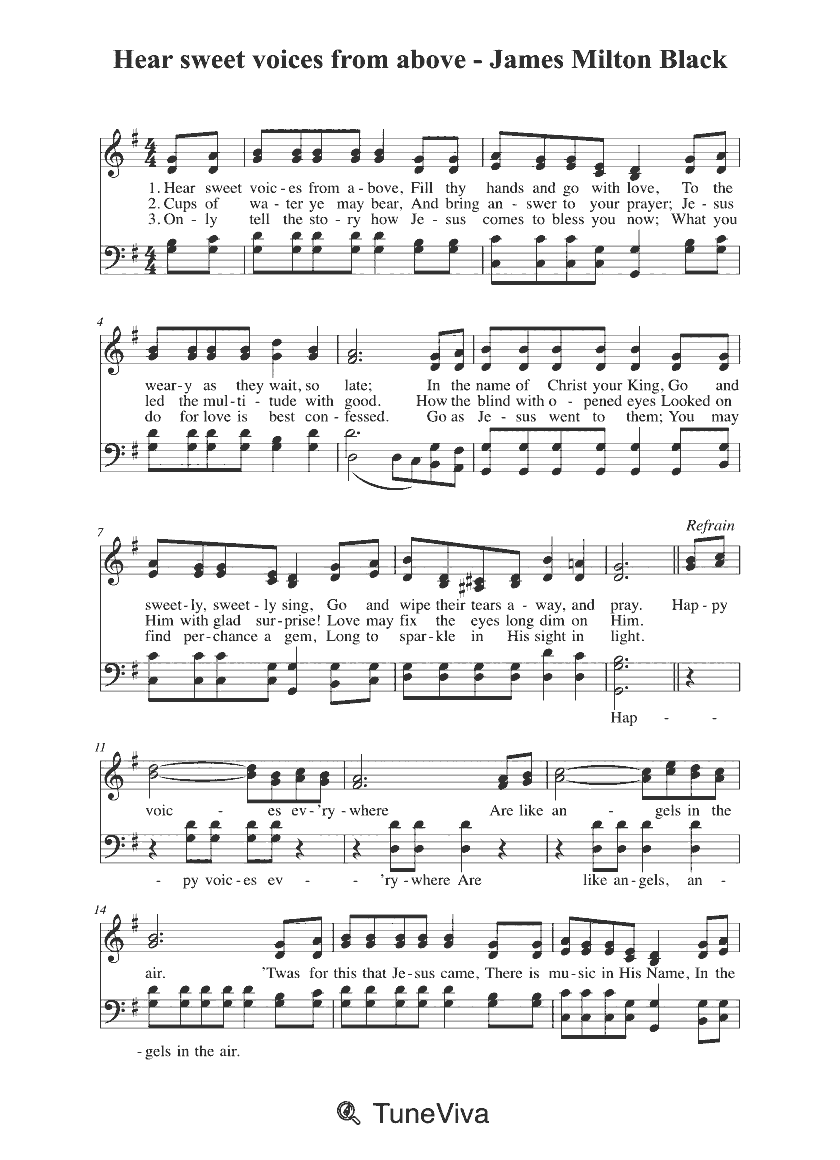
James Milton Black
32 sec
Open score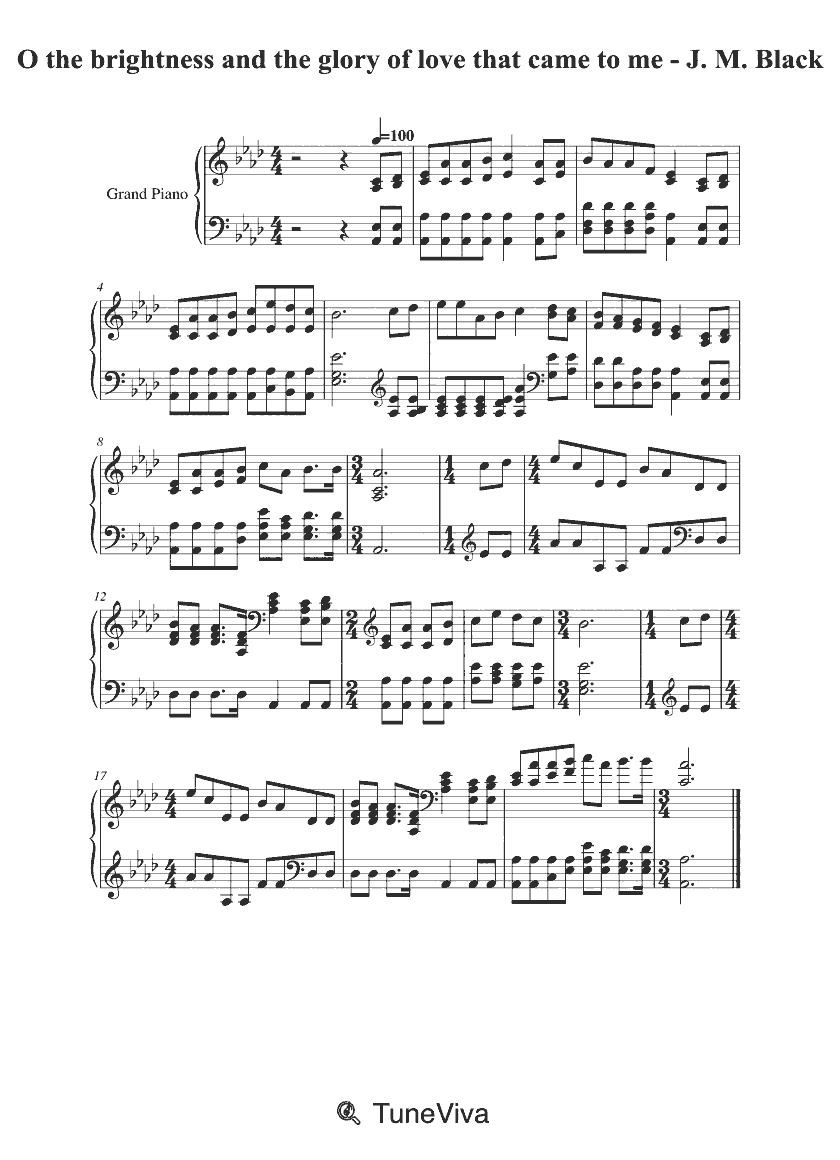
James Milton Black
Grand Piano · 40 sec
Open score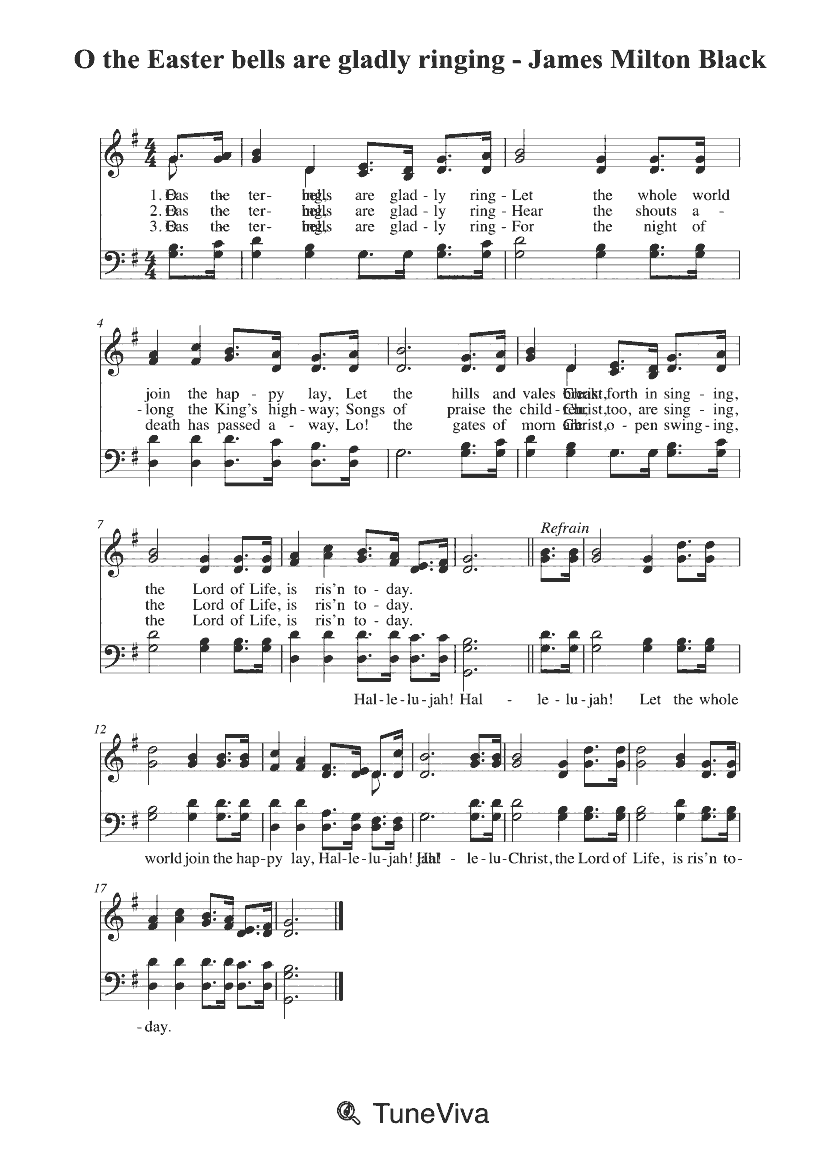
James Milton Black
28 sec
Open score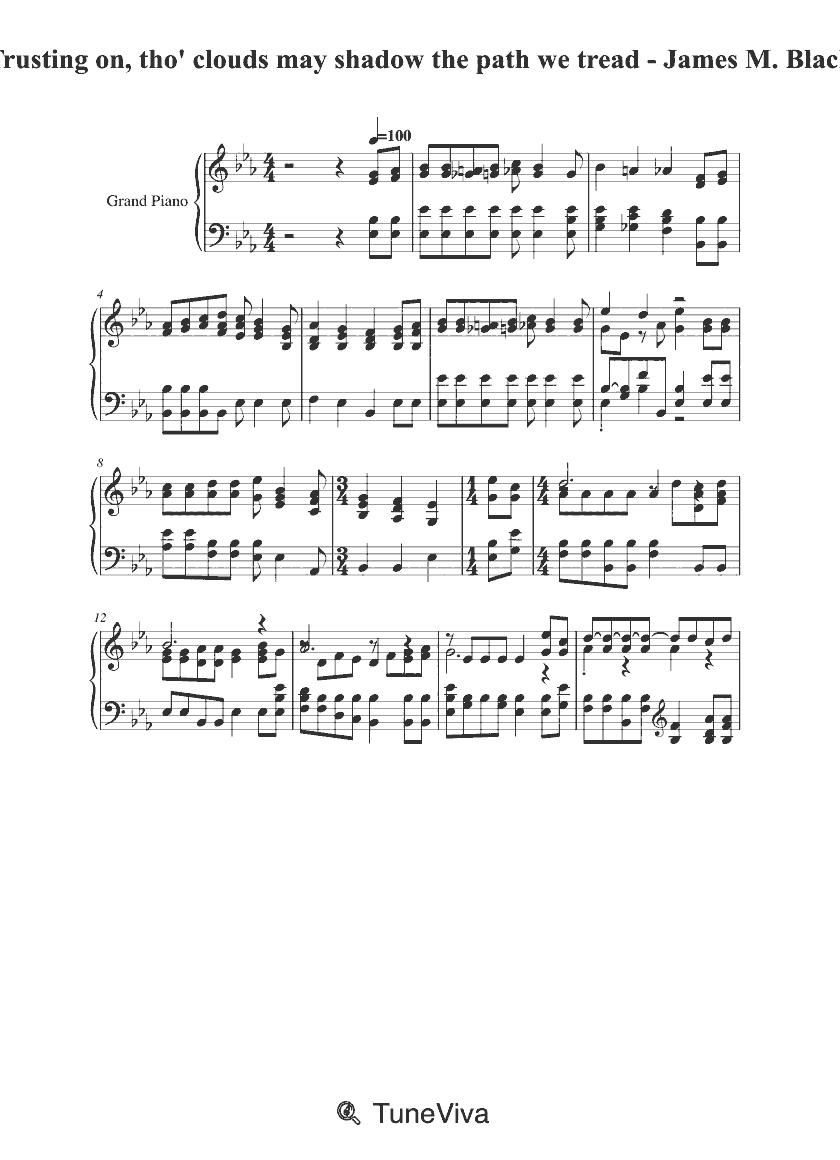
James Milton Black
Grand Piano · 40 sec
Open score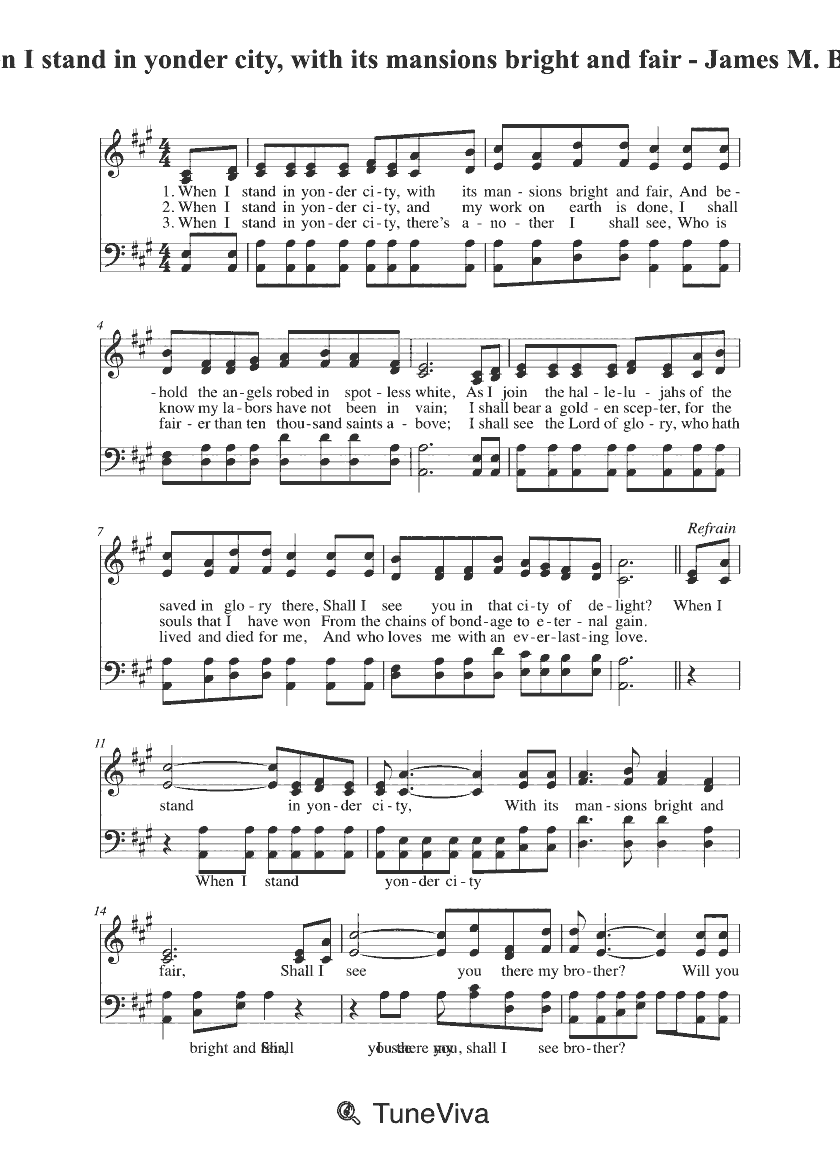
James Milton Black
32 sec
Open score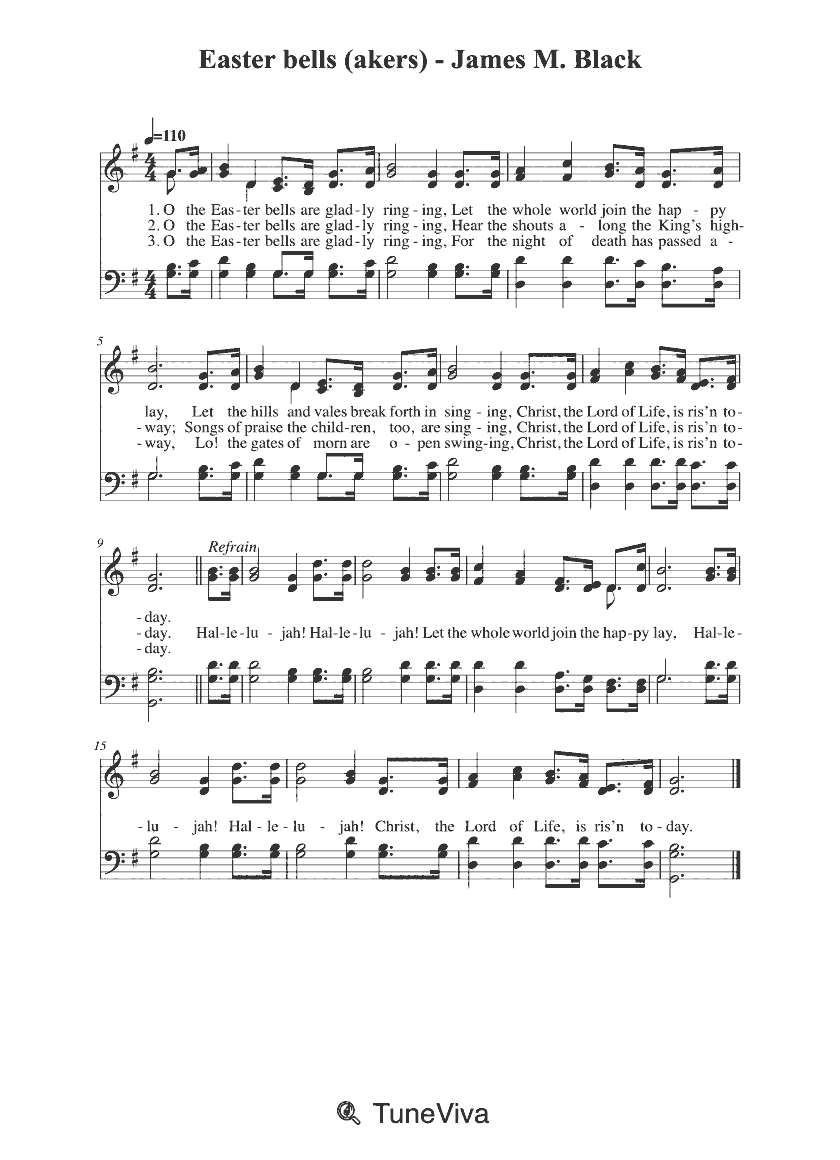
James Milton Black
31 sec
Open scorePage 1 of 9
James Milton Black spent his working life in Methodist Sunday schools and revival meetings, and the catalogue shows it: 165 scores, about 99 minutes of music and 49,840 notated notes. Just under half of the entries, 75 in all, carry lyrics. The page is led by two saints songs, with I Remember Calvary and When the Roll Is Called Up Yonder further down. James Milton Black (1856–1938) was an American composer of hymns, choir leader and Sunday school teacher, and the James M. Black sheet music gathered here reflects that hymn and Sunday-school world. His 1893 hymn When the Roll Is Called Up Yonder, with words and music by Black, is one of the most popular Christian hymns. Black is also associated with When the Saints Are Marching In, whose lyrics are by Katharine Purvis, and that hymn is distinct from the later 1927 song When the Saints Go Marching In.
Black was born on 19 August 1856 at South Hill, New York, and died on 21 December 1938 in Williamsport, Pennsylvania, where he had settled around 1881. He was a layman rather than a minister: a choir leader, Sunday-school teacher and song leader at the Pine Street Methodist Episcopal Church from 1904 until his death. He began his musical career working with John Howard in New York and with Daniel Towner of the Moody Bible Institute.
His main work was editorial. He compiled about a dozen gospel hymn books, beginning with Songs of the Soul in 1894, made with Joseph F. Berry, and continuing through The Epworth Hymnal No. 3 in 1900 and Sacred Praise in 1912. He wrote or set close to 1,500 songs and sat on the commission that produced the 1905 Methodist hymnal. When the Roll Is Called Up Yonder, from 1893, grew out of a Sunday-school roll call and a girl absent through pneumonia; its tune is called Roll Call.
The 165 entries are mostly short strophic songs with a refrain, which is why the whole page runs to only about 99 minutes. Difficulty is low: 37 entries at index 0, 82 at index 1 and 46 at index 2. Several are settings of other people's words, among them Katharine Purvis's text for When the Saints Are Marching In, H. G. Jackson's for Look to the Lamb of God and W. C. Martin's for I Remember Calvary, and the catalogue lists them under Black because he supplied the music.
Black’s hymn and Sunday-school context: James Milton Black was an American composer of hymns, a choir leader and a Sunday school teacher. His church work was at the Methodist Episcopal Church in Williamsport, Pennsylvania. The scores associated with him belong to congregational hymn and Sunday-school repertoire; individual versions may be labelled for piano, soprano recorder or other forces, so check the version rather than assuming original instrumentation.
The two “saints” titles: Two titles with “saints” need separating. When the Saints Are Marching In has lyrics by Katharine Purvis and is associated with Black. When the Saints Go Marching In is a later publication, from 1927, with similar words and music, and the two should not be confused. A listing titled Oh, When the Saints also appears, but its artist label differs, so verify the actual score before treating it as Black’s hymn.
When the Roll Is Called Up Yonder: When the Roll Is Called Up Yonder dates from 1893, with words and music by Black. Its origin is linked to a Sunday-school roll call, an absent child who had pneumonia and the biblical idea of the Book of Life. Its lyrics were first published in Songs of the Soul, and the hymn has been translated into at least 14 languages. In 1945 Winston Churchill quoted it when asked about a meeting of the Big Three.
Reading the available versions: Available versions differ in opening key, time signature, tempo and instrumentation. Treat those details as descriptions of the particular version, not as evidence of Black’s original performing forces or tempo. When choosing, match the title, credited text author and instrumentation to your needs, and confirm the details in the score itself.
He wrote When the Saints Are Marching In in 1896, with words by Katharine Purvis. The jazz standard published in 1927 under a similar title is a later and different song that borrowed from it.
A Sunday-school roll call in which one girl was missing, ill with pneumonia. Black wrote both words and music in 1893 and named the tune Roll Call.
When the Roll Is Called Up Yonder, from 1893. It has been translated into at least fourteen languages and was quoted by Winston Churchill in 1945 when he was asked when the Allied leaders would next meet.
James Milton Black was an American composer of hymns, choir leader and Sunday school teacher, born in 1856 and died in 1938. He lived and worked in Williamsport, Pennsylvania, at the Methodist Episcopal Church.
James Milton Black is best known for the 1893 hymn When the Roll Is Called Up Yonder, for which he wrote both words and music. The hymn’s lyrics were first published in Songs of the Soul, and the hymn has been translated into at least 14 languages.
The hymn grew from a Sunday-school roll call in which a child was absent. Black visited the child’s home and called a doctor for pneumonia, then wrote the hymn after failing to find an existing hymn on a similar theme; the biblical idea of the Book of Life also shaped it.
When the Saints Are Marching In is a hymn with lyrics by Katharine Purvis that is associated with James Milton Black. It is not the same as When the Saints Go Marching In, a later 1927 publication with similar words and music.
James Milton Black was born in South Hill, New York, and lived, worked and died in Williamsport, Pennsylvania. His church work was at the Methodist Episcopal Church there.
Winston Churchill quoted When the Roll Is Called Up Yonder in 1945 when asked when the Big Three would meet, replying that he did not know but “When the roll is called up yonder, I’ll be there.” British press coverage noted that Churchill, an Anglican, was quoting a hymn associated with Methodist, Presbyterian and other chapel denominations.