
Auld Lang Syne
arr. John Kilpatrick
Piano · 1 min 4 sec
Open scoreAuld Lang Syne sheet music on TuneViva includes a piano arrangement and a four-part SATB setting, with scores that credit Robert Burns as lyricist and one entry that labels the music as a 'Scotch Air'. The versions shown begin in different key signatures and all use an opening 4/4 time signature. Compare the part layout, key and tempo indications before choosing a score for performance or practice.
Scores 1–20 of 63
arr. John Kilpatrick
Piano · 1 min 4 sec
Open score
Anonymous
Sopran; Alt; Tenor +1 parts · 55 sec
Open score
Scotch Air
P1 · 31 sec
Open score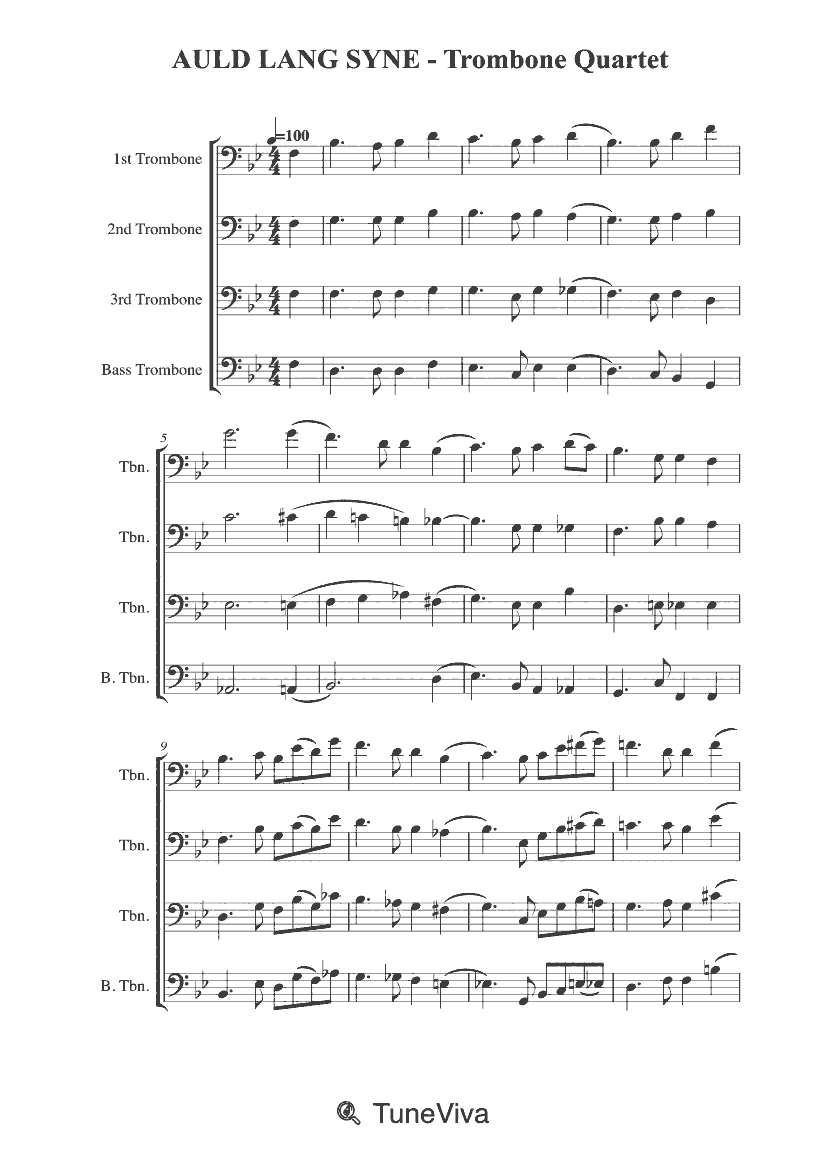
Robert Burnsarr. Dave Boag
Trombone Quartet
1st Trombone; 2nd Trombone; 3rd Trombone +1 parts · 38 sec
Open score
Anonymous
fra The Cornish Song Book
Soprano; Alto; Tenor +1 parts · 58 sec
Open score
Arr: Ludwig van Beethoven
Fiolin; Cello; S/A +3 parts · 1 min 55 sec
Open score
Misc Traditional
718
Piano · 32 sec
Open score
Too Many Zooz
Tenor Saxophone; Piano · Arr. SaxyTroy · 3 min 50 sec
Open score
Calvin Neason
Soprano; Alto; Tenor +1 parts · 38 sec
Open score
arr. John Kilpatrick
Piano · 1 min 32 sec
Open score
traditional
for venova
Venova; Soprano Saxophone · 32 sec
Open score
Scottish Tune (Auld Lang Syne)
52 sec
Open score
Misc Traditional
1 min 4 sec · Score #202699
Open score
Traditional
Melody; Harmony · 1 min 3 sec
Open score
Traditional
Melody; Harmony · 1 min 3 sec
Open score
Misc Traditional
1 min 36 sec
Open score
Misc Traditional
32 sec
Open score
Traditional Scottish Tune
35 sec
Open score
Misc Traditional
1 min 4 sec · Score #205623
Open score
Traditional
3 min 9 sec
Open scorePage 1 of 4
The selection includes a piano arrangement and an SATB setting with soprano, alto, tenor and bass parts. A pianist needing a keyboard layout should start with the piano score, while a choir or quartet needs the four-part version. The title alone does not confirm how many verses are set, whether lyrics are printed under every part, or whether the piano writing is a full accompaniment, so check the first page of each score.
The piano arrangement opens with no sharps or flats. The SATB setting and the entry labelled 'Scotch Air' open with one flat, and the 'Scotch Air' entry specifies F major. All three scores show 4/4. Only the SATB score gives an opening tempo, 70 BPM; the other versions do not state one. These are starting indications for individual scores rather than a fixed performing tradition.
Several different arrangements can share the title Auld Lang Syne. The selection does not verify the number of verses, the complete text, the difficulty level or the exact instrumentation beyond the part names shown. Treat each score as one version and compare its opening page, part layout and text underlay before committing to it for a rehearsal or performance.
A 4/4 opening and a stated tempo of 70 BPM in the SATB score give a practical reference for rehearsal. The piano score provides no tempo marking, so a player must choose one. Confirm the key signature and part layout first, then work at a steady pace that allows the text or melody to stay clear.
Score parts: Piano. Catalogue duration 1 min 4 sec. Opening key signature: No sharps or flats. Opening time signature: 4/4.
Score parts: Sopran, Alt, Tenor, Bass. Catalogue duration 55 sec. Opening key signature: 1 flat. Opening time signature: 4/4. Opening tempo: 70 BPM.
Score parts: P1. Catalogue duration 31 sec. Opening key signature: 1 flat (F major). Opening time signature: 4/4.
The scores in this selection name Robert Burns as lyricist. One entry describes the music as a 'Scotch Air', so the tune is presented as traditional rather than as a named composer's original work. The selection does not provide further biographical or manuscript evidence.
The selection includes a piano arrangement and a four-part SATB setting. The SATB version distributes the music across soprano, alto, tenor and bass; the piano version is laid out for keyboard. Check each score's first page for the exact part layout and text underlay.
Keys differ between the versions shown. The piano arrangement opens with no sharps or flats, while the SATB setting and the entry labelled 'Scotch Air' open with one flat. A score's opening key signature is a practical starting point, not proof of a single authoritative key for the song.
All three scores in this selection show an opening time signature of 4/4. That means four crotchet, or quarter-note, beats to the bar in each version. The SATB score adds an opening tempo of 70 BPM; the others do not specify a tempo.
The catalogue entries here do not name a single composer for the melody. One score credits Robert Burns as lyricist and labels the music as a 'Scotch Air'; another gives 'NA' as composer. The selection therefore supports a traditional attribution rather than a securely identified composer.
Only the SATB score in this selection states an opening tempo: 70 BPM. No tempo is given for the piano arrangement or the 'Scotch Air' entry. Treat 70 BPM as one editorial suggestion for that setting, not a definitive tempo for every performance.