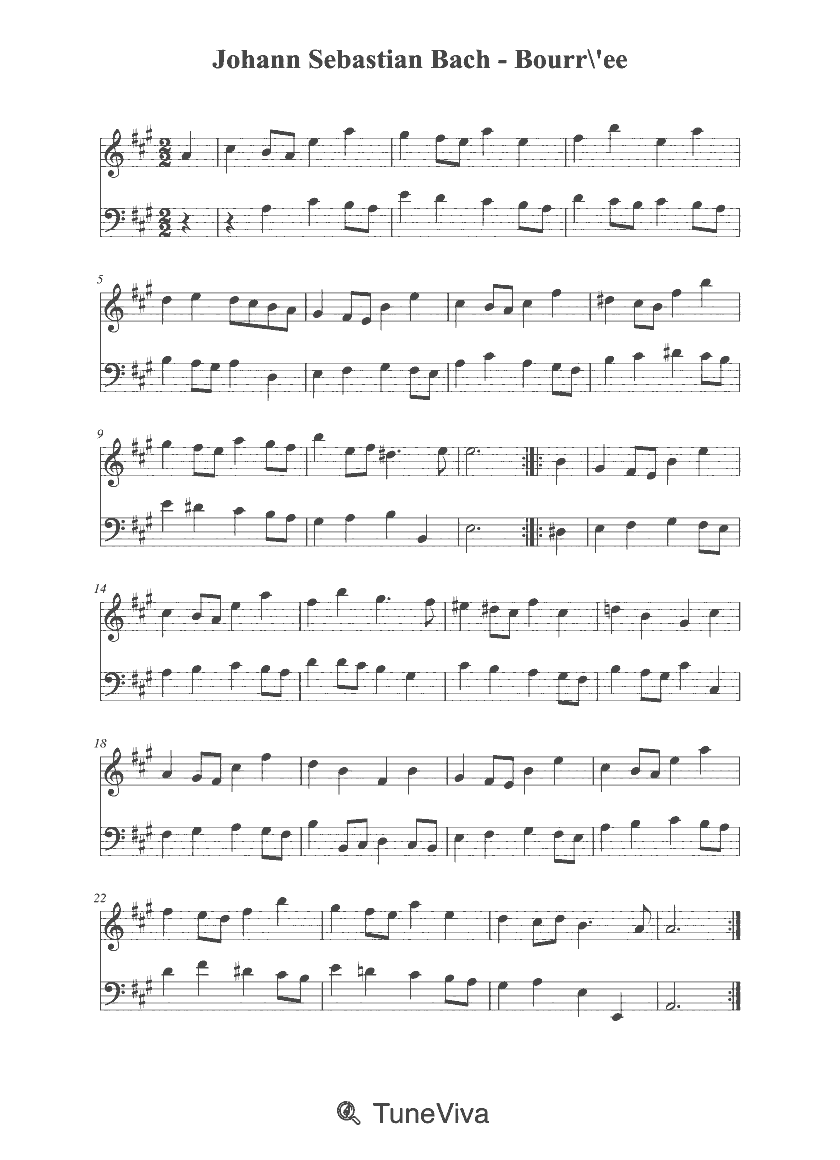
Johann Sebastian Bach - Bourr\'ee
Johann Sebastian Bach
3 min 4 sec
Open scoreScores titled Bourrée are listed here with Johann Sebastian Bach as composer. The versions shown do not share the same opening key or metre: some begin in E minor with a 4/4 signature, while another begins in A major with 2/2. Those opening details are the clearest way to distinguish the versions before choosing one.
Scores 1–20 of 30
Johann Sebastian Bach
3 min 4 sec
Open score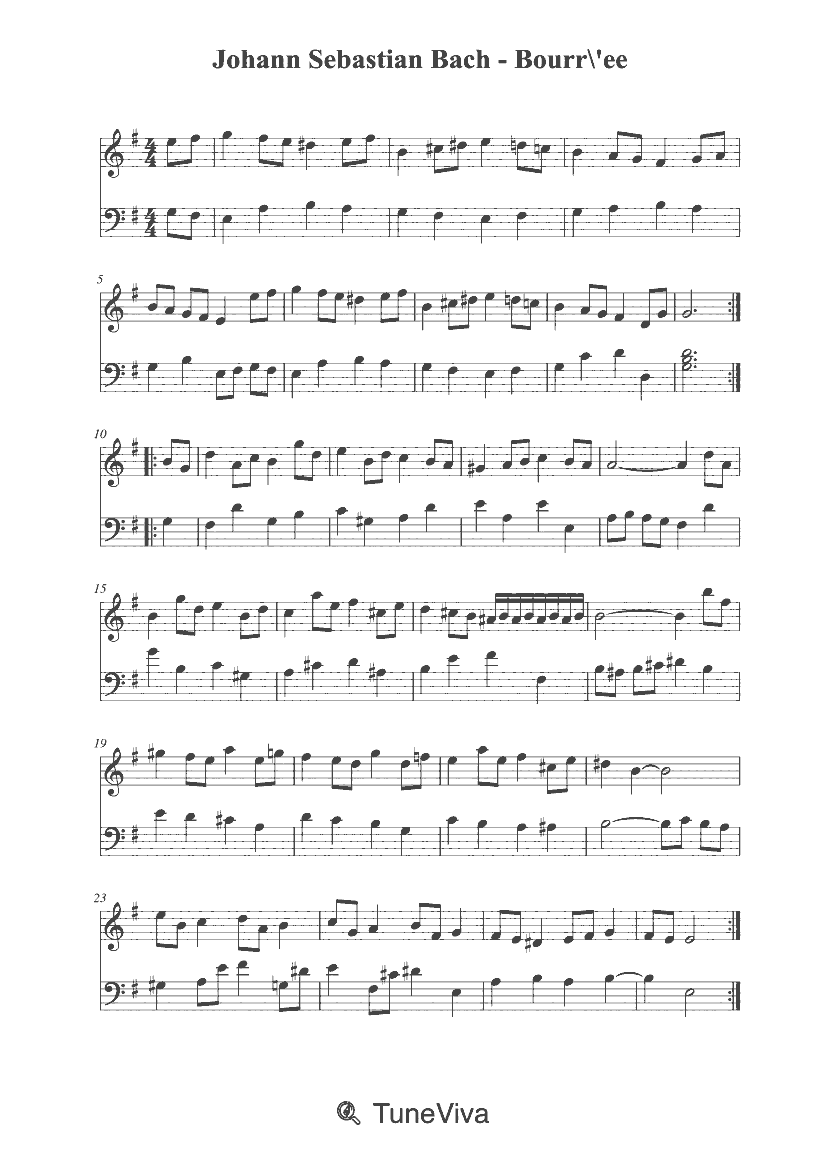
Johann Sebastian Bach
from Suite BWV 996 (E minor version)
1 min 36 sec
Open score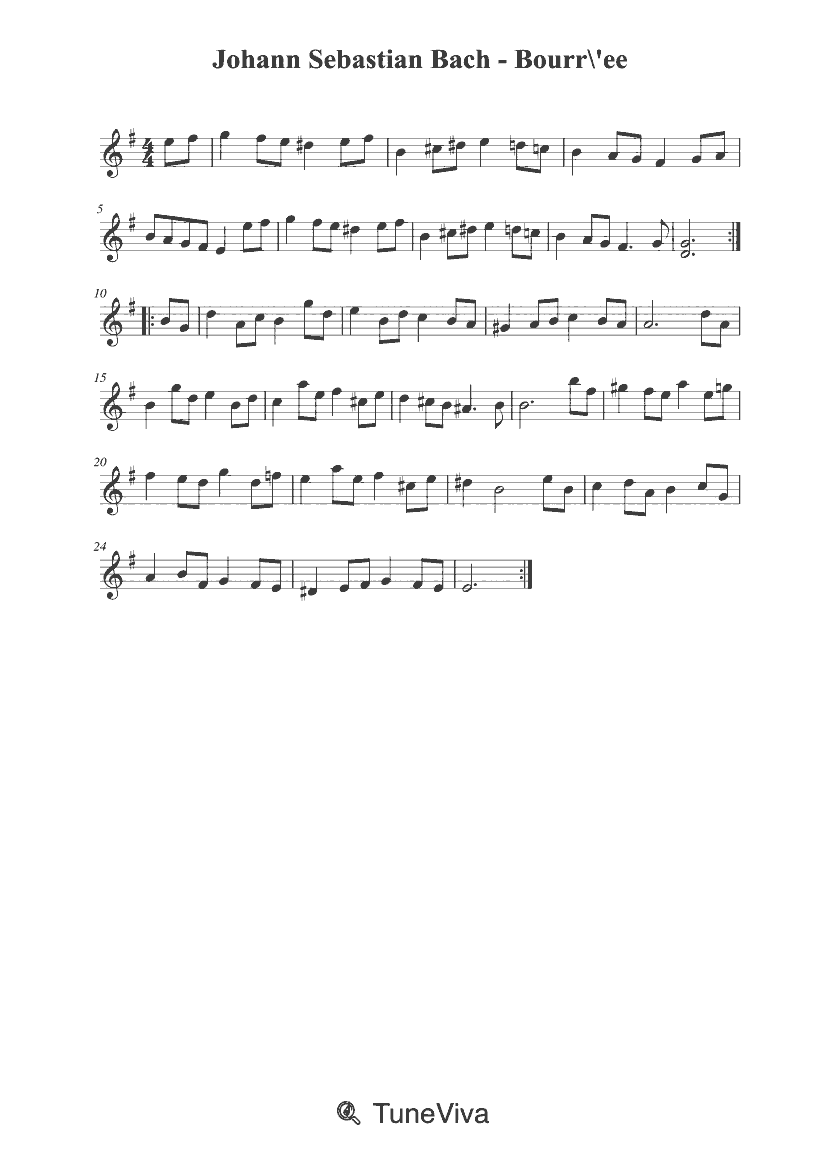
Johann Sebastian Bach
from Suite BWV 996
1 min 36 sec · Score #4266
Open score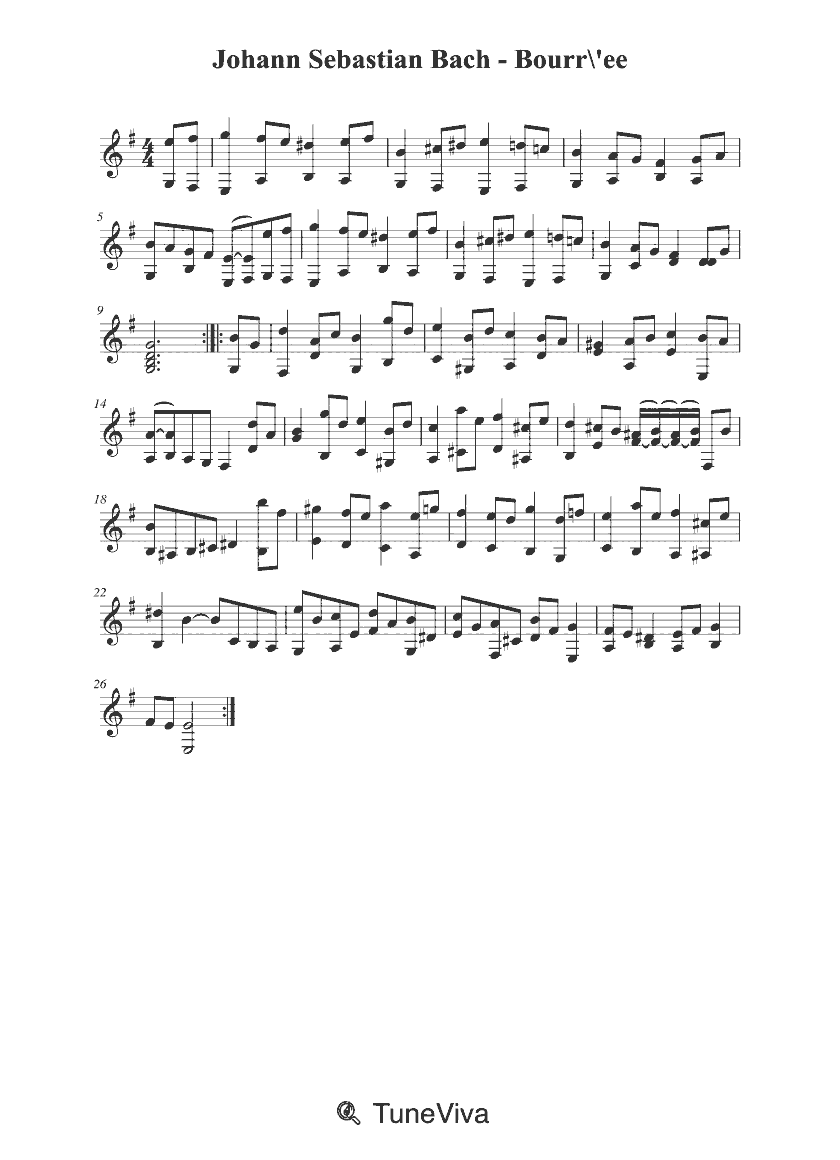
Johann Sebastian Bach
from Suite BWV 996
1 min 36 sec · Score #49786
Open score
Misc tunes
32 sec · Score #234921
Open score
Misc tunes
32 sec · Score #180049
Open score
Misc tunes
32 sec · Score #46752
Open score
Misc tunes
32 sec · Score #50193
Open score
Misc tunes
24 sec · Score #165210
Open score
Misc tunes
31 sec
Open score
Misc tunes
1 min 4 sec
Open score
Misc tunes
24 sec · Score #31497
Open score
Misc tunes
24 sec · Score #43268
Open score
Misc tunes
18 sec
Open score
Misc tunes
32 sec · Score #139903
Open score
Misc tunes
32 sec · Score #177075
Open score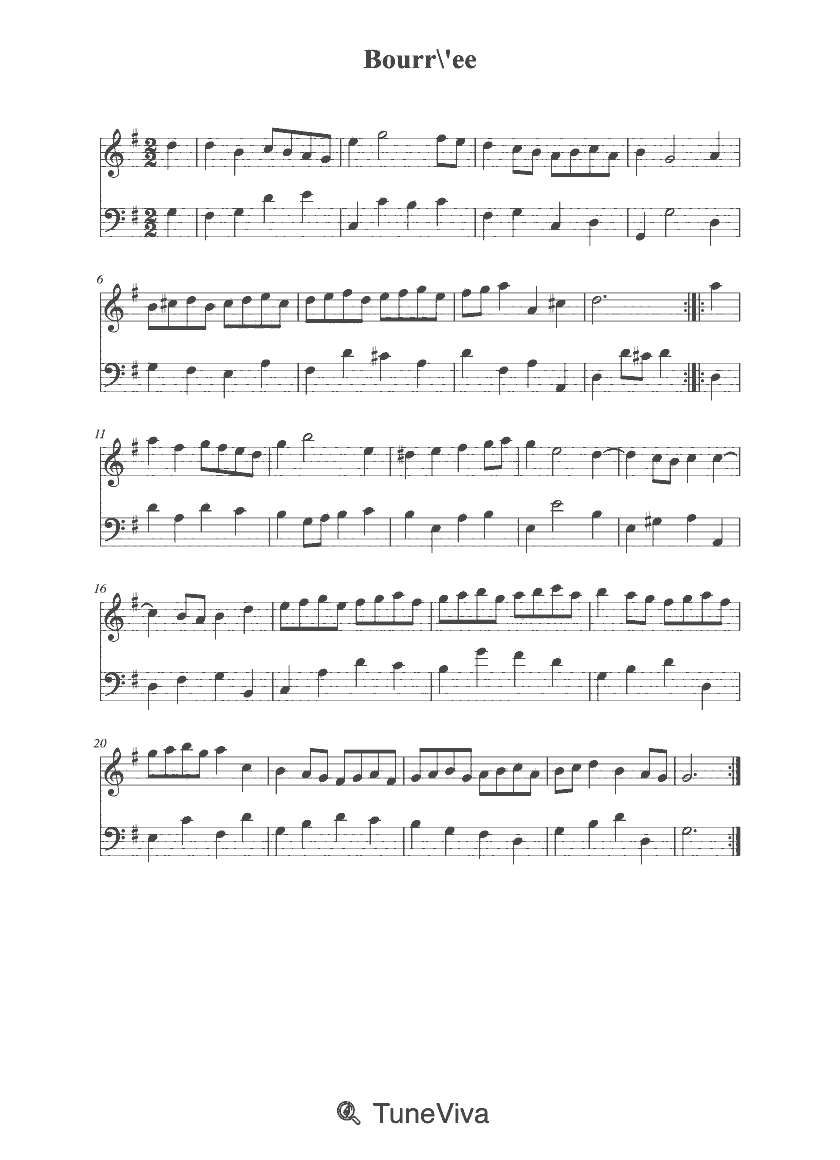
Georg Friedrich H\andel
2 min 56 sec
Open score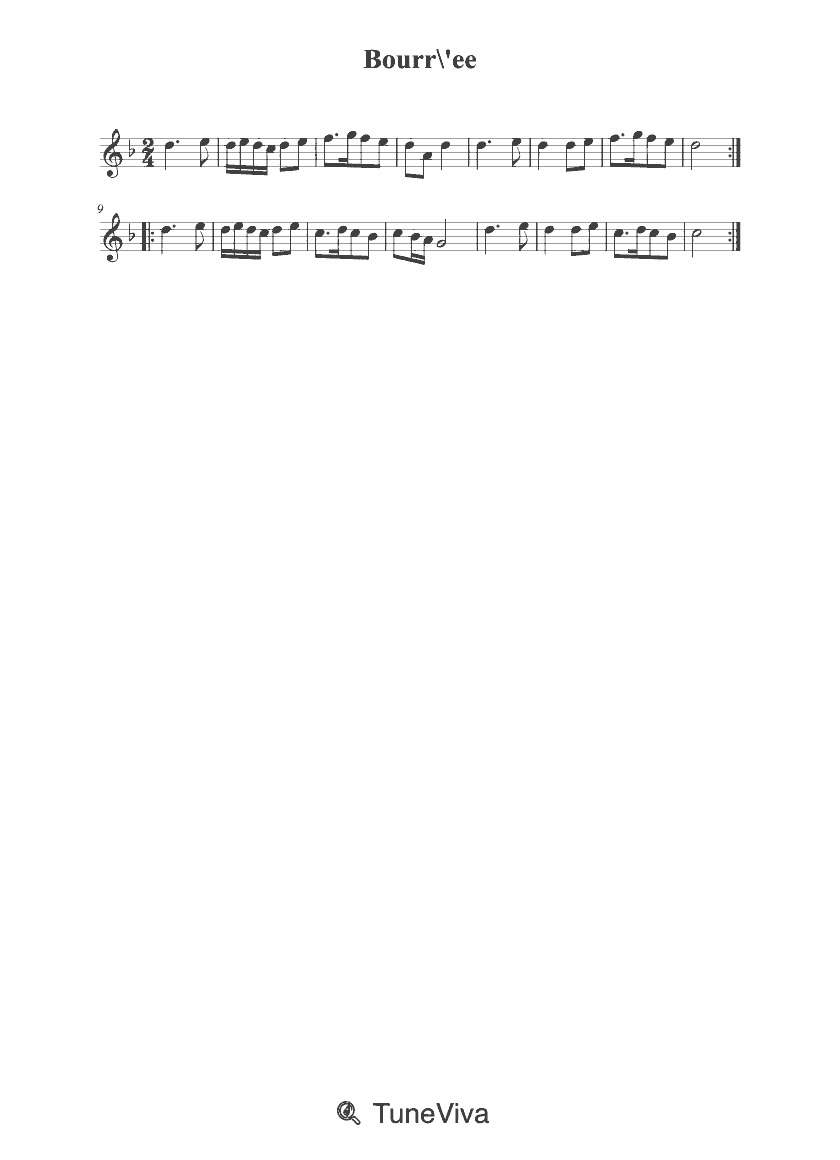
Misc tunes
33 sec
Open score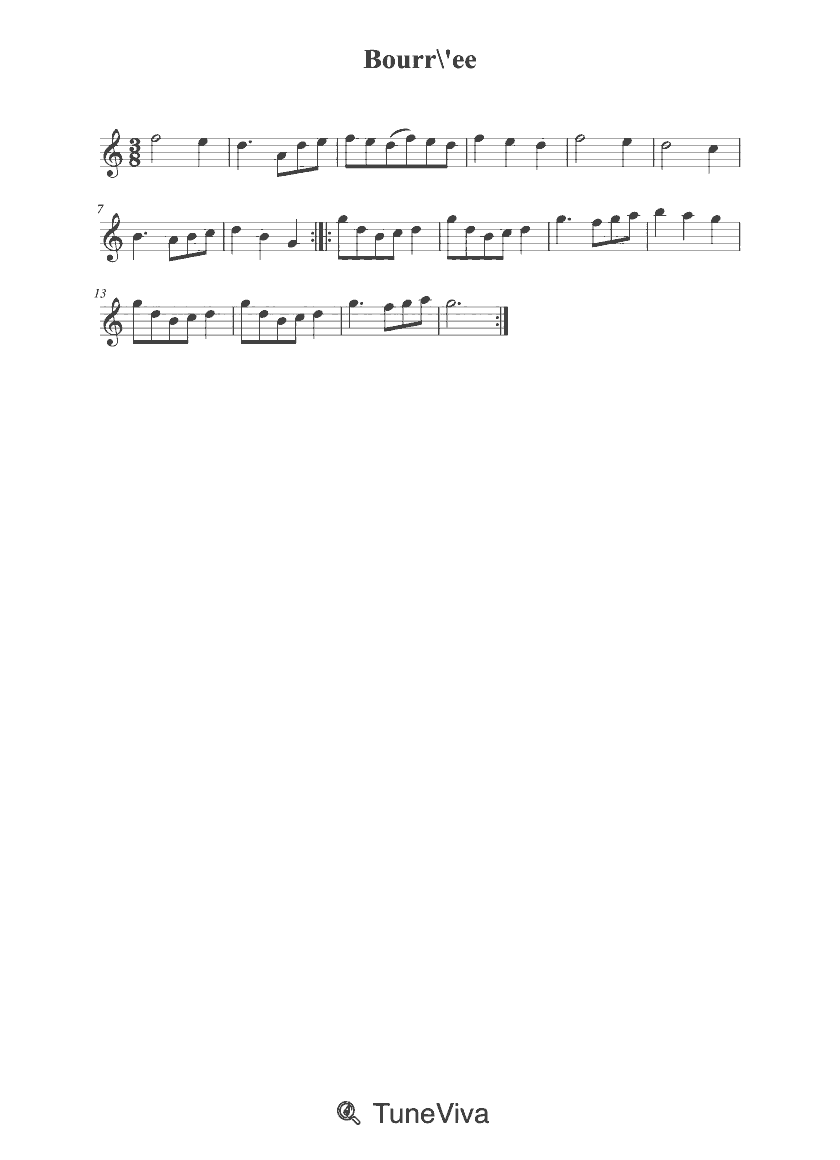
Misc tunes
24 sec · Score #227593
Open score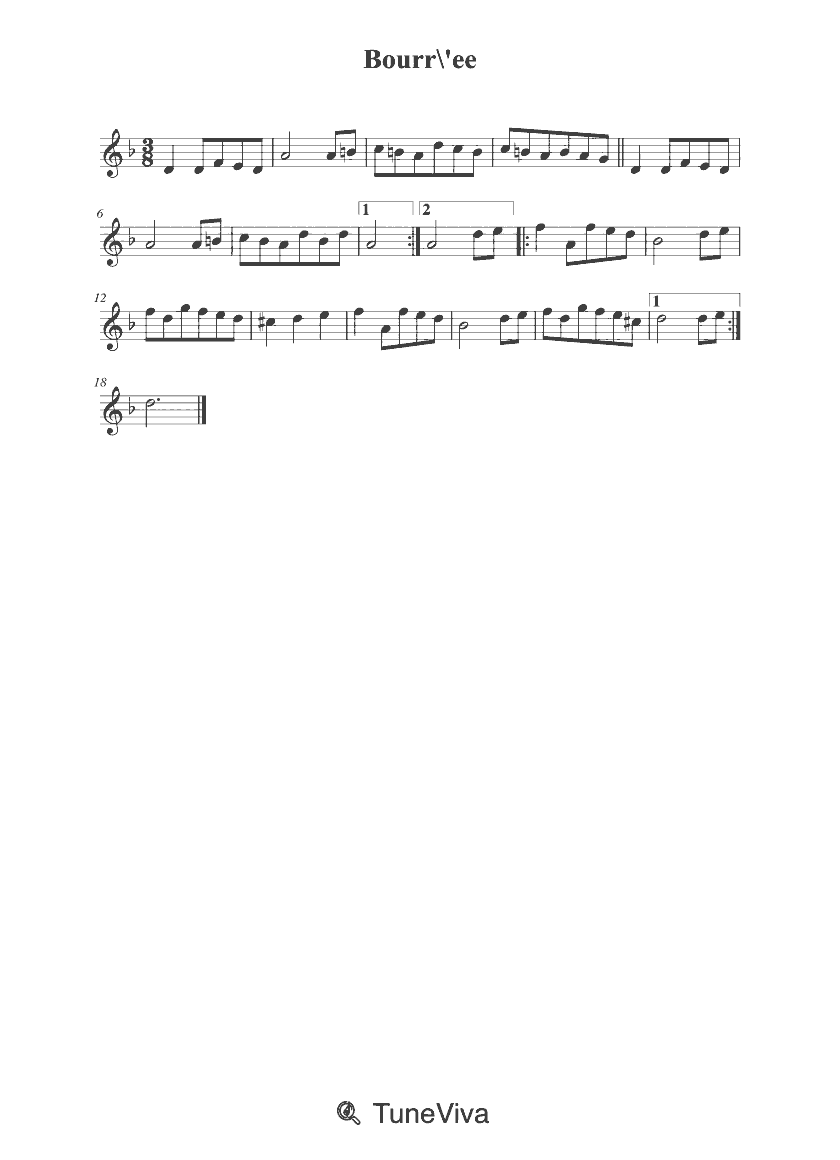
Misc tunes
24 sec · Score #27491
Open scorePage 1 of 2
If you are looking for a particular Bach Bourrée, begin with its key and time signature. The scores grouped here show E minor with 4/4 and A major with 2/2. Those openings are not interchangeable at sight; the difference may reflect a transposition, a different movement, or another arrangement, but the available information does not establish which.
The titles name Bach and Bourrée but do not state an instrument, arrangement level, or original medium. Inspect the clef, range, number of parts, and any editorial markings in the score. A keyboard arrangement and a solo instrumental version can share a title without serving the same purpose.
More than one score begins in E minor with 4/4, so key and metre alone may not distinguish every copy. Compare the complete melodic line, form, and ending. Durations and part counts describe individual scores and should not be treated as proof of identity or difficulty.
The titles attribute the music to Bach, but no supporting reference is supplied here for a specific work number, date, or original instrumentation. Keep historical claims separate from what the score itself shows, and verify them against a reliable edition or reference source.
Catalogue duration 3 min 4 sec. Opening key signature: 3 sharps (A major). Opening time signature: 2/2.
Catalogue duration 1 min 36 sec. Opening key signature: 1 sharp (E minor). Opening time signature: 4/4.
Catalogue duration 1 min 36 sec. Opening key signature: 1 sharp (E minor). Opening time signature: 4/4.
Several scores titled Johann Sebastian Bach – Bourrée begin in E minor with a 4/4 time signature. E minor and 4/4 identify that group, but they do not by themselves prove which Bach movement or arrangement each score contains.
A score titled Johann Sebastian Bach – Bourrée begins in A major with a 2/2 time signature. A major and 2/2 distinguish that version from the E minor 4/4 scores, but the supplied information does not identify its movement, instrumentation, or relationship to the others.
The available information cannot establish that the E minor and A major scores are the same piece. They may represent different movements, transpositions, or arrangements, but key and metre alone do not prove identity; compare the full melodic content and any work number printed in the score.
The titles and composer attribution do not name an instrument. The clef, range, number of parts, and texture in the complete score are the reliable clues; do not assume piano, violin, or another medium from the shared title alone.
Compare the opening key and metre first, then check the clef, range, texture, form, and any editorial notes in the complete score. For the versions here, E minor with 4/4 and A major with 2/2 are the clearest documented differences; difficulty and original instrumentation are not verified.