
The Sea Shanty Suite
Misc Traditional
Alto Saxophone · 4 min 21 sec
Open scoreDrunken Sailor sheet music is represented here in several forms: an alto saxophone score in The Sea Shanty Suite, a tenor and bass setting titled What Shall We Do With The Drunken Sailor, and a large ensemble movement, Sea Shanty Suite - Movement One: Chants of a Drunken Sailor. The scores are attributed to Misc Traditional and filed under folk, and their listed openings differ in key, time signature and tempo, so compare instrumentation and starting details before choosing.
Scores 1–20 of 55
Misc Traditional
Alto Saxophone · 4 min 21 sec
Open score
Misc Traditional
Movement One: Chants of a Drunken Sailor
Piccolo; Flute 1; Flute 2 +28 parts · 2 min 21 sec
Open score
Misc Traditional
Tenor; Bass · 58 sec
Open score
Misc Traditional
Sea Shanties
Soprano; Alto; Tenor +1 parts · 44 sec
Open score
Misc Traditional
Violinen
Piano · 40 sec
Open score
Misc Traditional
Violinen
Piano · 40 sec
Open score
anon.
21 sec · Score #185294
Open score
Misc Traditional
Violino; Piano · 54 sec
Open score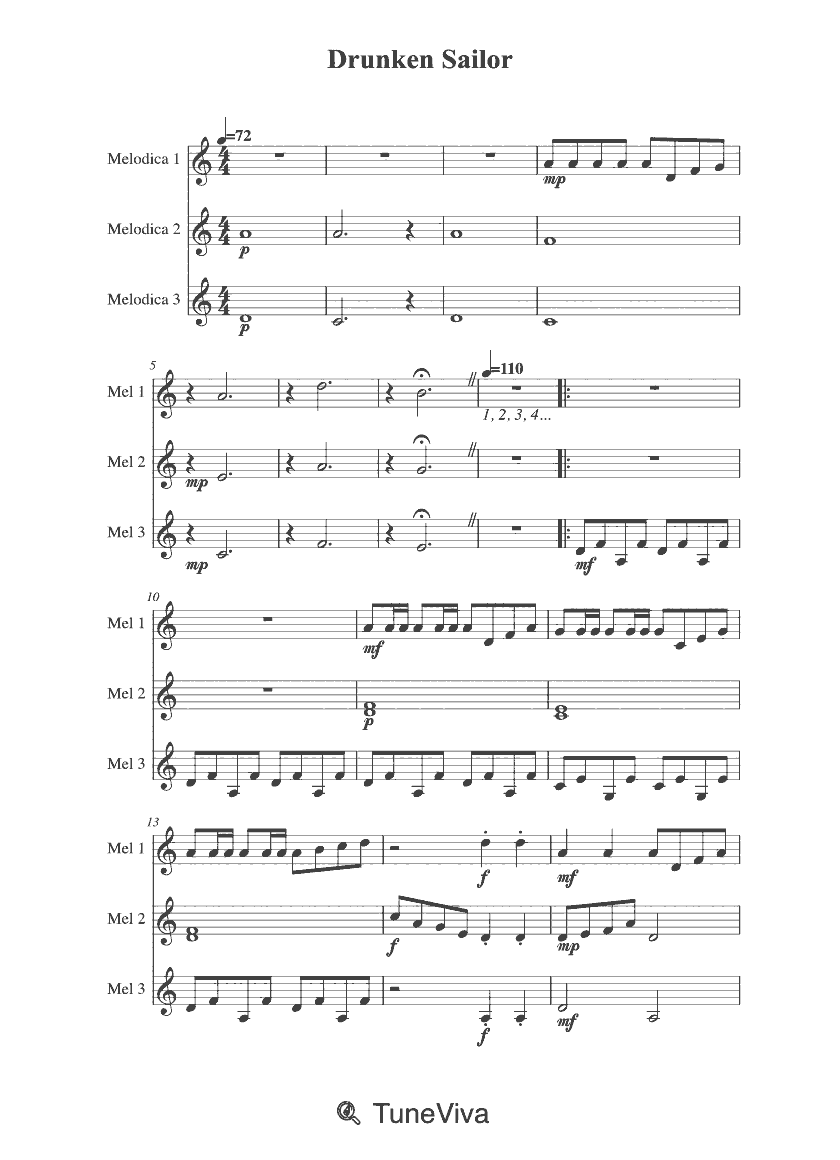
AJ Siragusa
Arranged for Melodica Trio
Melodica 1; Melodica 2; Melodica 3 · 1 min 16 sec
Open score
Misc Traditional
5 min 20 sec
Open score
anon.
21 sec · Score #94884
Open score
Trad.
What Shall We Do
25 sec
Open score
Misc Traditional
29 sec
Open score
Misc Traditional
3 min 12 sec
Open score
Misc Traditional
16 sec
Open score
Misc Traditional
2 min 37 sec
Open score
Misc Traditional
2 min 46 sec
Open score
Anonymous
1 min 3 sec
Open score
anon.
2 min 53 sec
Open score
anon.
21 sec · Score #234125
Open scorePage 1 of 3
The represented Drunken Sailor scores are not interchangeable. One is listed for alto saxophone, another for tenor and bass parts, and a third is a large ensemble movement with woodwinds, saxophones, brass, double bass and percussion. Check the named parts first so you choose a score that fits the performer or group you have.
The alto saxophone score opens with three sharps in 2/4 at 180 BPM; the tenor and bass score opens with no sharps or flats in 2/4 at 100 BPM; the large ensemble movement opens in 2/4 at 114 BPM and lists several opening key signatures. These details describe the opening of each score, not every key, tempo or metre change that may follow.
What Shall We Do With The Drunken Sailor is grouped with Drunken Sailor under the same song name, so the longer title is presented as a title variant in this listing. Suite titles such as The Sea Shanty Suite and Sea Shanty Suite - Movement One: Chants of a Drunken Sailor place their scores in a larger titled context; do not assume every score is the same arrangement.
The represented scores do not verify the song’s origin, composer, original instrumentation, difficulty grade or completeness. Use the listed parts, key signatures, time signatures and tempos to shortlist a score, then inspect the actual music before relying on it for performance, teaching or transcription.
Score parts: Alto Saxophone. Catalogue duration 4 min 21 sec. Opening key signature: 3 sharps. Opening time signature: 2/4. Opening tempo: 180 BPM.
Score parts: Piccolo, Flute 1, Flute 2, Oboe 1, Bassoon 1, Bassoon 2, …. Catalogue duration 2 min 21 sec. Opening key signature: No sharps or flats; 4 sharps; 2 sharps; 3 sharps; 1 sharp. Opening time signature: 2/4. Opening tempo: 114 BPM.
Score parts: Tenor, Bass. Catalogue duration 58 sec. Opening key signature: No sharps or flats. Opening time signature: 2/4. Opening tempo: 100 BPM.
The represented Drunken Sailor scores include an alto saxophone score in The Sea Shanty Suite, a tenor and bass score titled What Shall We Do With The Drunken Sailor, and a large ensemble movement called Sea Shanty Suite - Movement One: Chants of a Drunken Sailor. These are separate score presentations with different listed instrumentation, so their parts should not be treated as interchangeable.
Sea Shanty Suite - Movement One: Chants of a Drunken Sailor lists a large wind, brass, saxophone and percussion ensemble: piccolo, two flutes, oboe, two bassoons, piccolo clarinet, three B♭ clarinets, bass clarinet, two alto saxophones, tenor and bass saxophones, three B♭ trumpets, four horns, three trombones plus bass trombone, euphonium, tuba, double bass, glockenspiel, concert bass drum, bongos, cymbal and concert snare drum.
No single key or tempo is given across these Drunken Sailor scores. The alto saxophone score opens with three sharps at 180 BPM; the tenor and bass score opens with no sharps or flats at 100 BPM; the large ensemble movement opens in 2/4 at 114 BPM and lists several opening key signatures. These are opening indications rather than a summary of every change in the music.
The score titled What Shall We Do With The Drunken Sailor is grouped with Drunken Sailor under the same song name, so the longer title is presented as a title variant rather than a separate work in this listing. That score is listed for tenor and bass parts and opens with no sharps or flats in 2/4 at 100 BPM.
One represented Drunken Sailor score provides tenor and bass parts, with no sharps or flats in the opening key signature, 2/4 time and a 100 BPM opening tempo. The part names indicate two voice ranges; the listing does not provide further detail about lyrics, choral forces or accompaniment.
The Sea Shanty Suite is a titled score associated with Drunken Sailor; the represented version is listed for alto saxophone and opens with three sharps in 2/4 at 180 BPM. Its title suggests a suite context, but the listing does not identify the arranger or describe the other movements.