
Scotland the Brave
Misc tunes
Bagpipe · 32 sec
Open scoreScotland the Brave appears here in three markedly different scorings: a score with a bagpipe part, a thirteen-part ensemble arrangement, and a shorter single-part setting. All three open in 4/4, but their keys and durations vary considerably, so comparing the scoring and key details is the quickest way to choose a version that suits your instrument or group.
Scores 1–20 of 47
Misc tunes
Bagpipe · 32 sec
Open score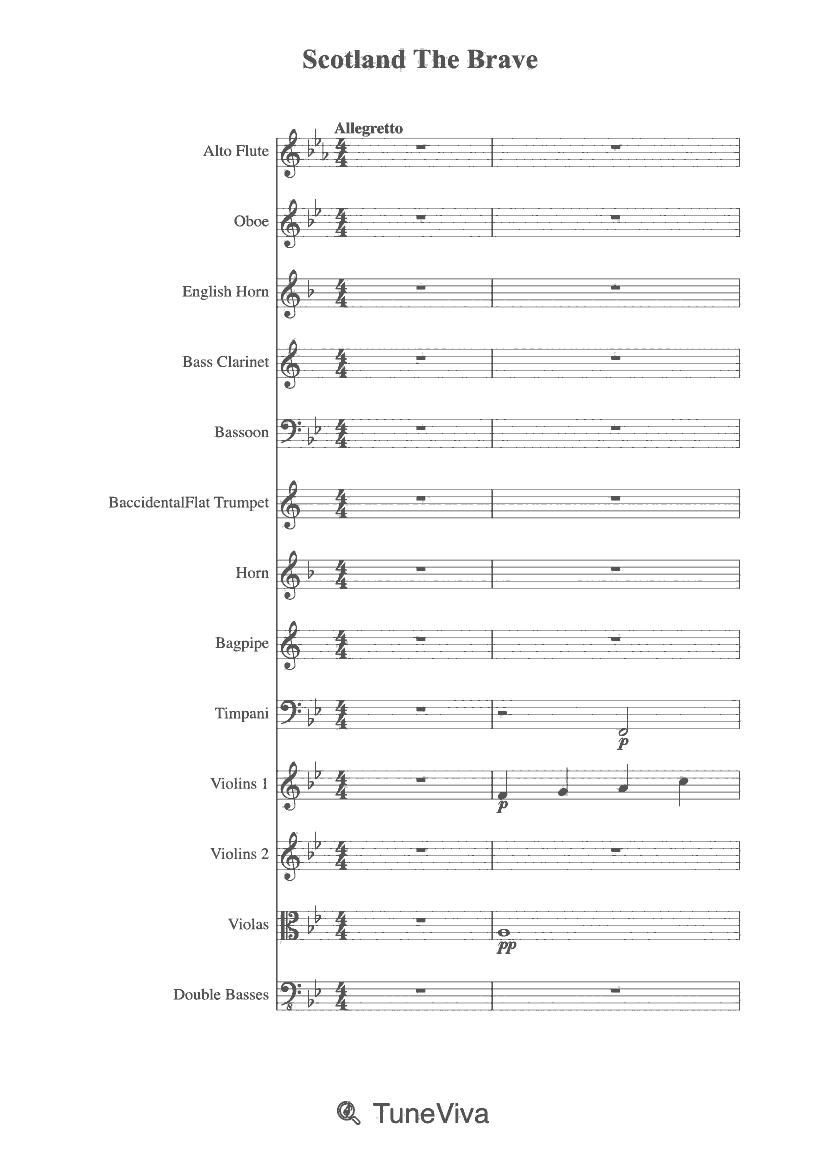
The original composer of Scotland the Brave is unknown. This Arrangement & Orchestration by V. A. Riddell 05/22/2014
Alto Flute; Oboe; English Horn +10 parts · 3 min 40 sec
Open score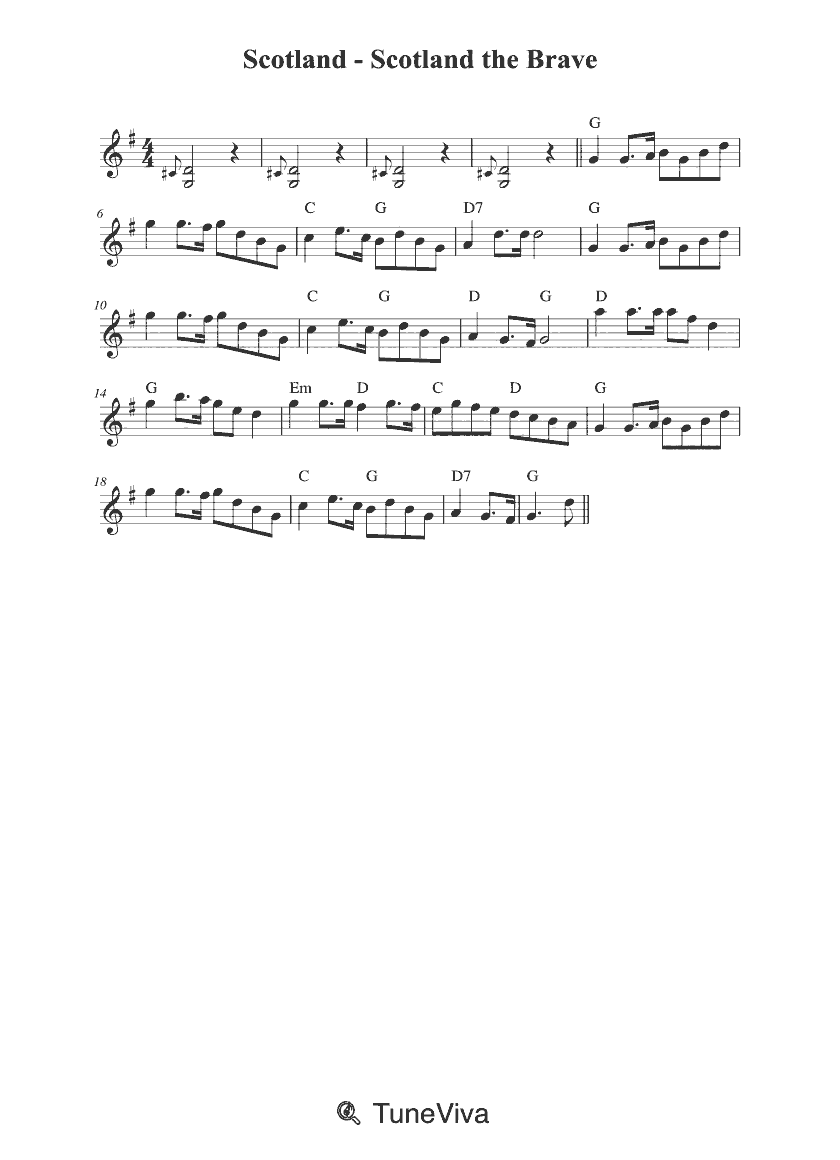
Scotland
38 sec
Open score
Misc tunes
33 sec · Score #103582
Open score
Trad.
34 sec · Score #248916
Open score
Misc tunes
33 sec · Score #213286
Open score
Trad.
32 sec · Score #171866
Open score
Misc tunes
51 sec
Open score
Misc tunes
32 sec · Score #3761
Open score
Trad.
1 min 37 sec
Open score
Misc tunes
40 sec
Open score
Trad.
34 sec · Score #203269
Open score
Misc tunes
24 sec
Open score
Misc tunes
a la Three Left Feet
2 min 7 sec
Open score
Misc tunes
32 sec · Score #95932
Open score
Trad.
32 sec · Score #27830
Open score
Trad.
34 sec · Score #87752
Open score
Misc tunes
2 min 8 sec
Open score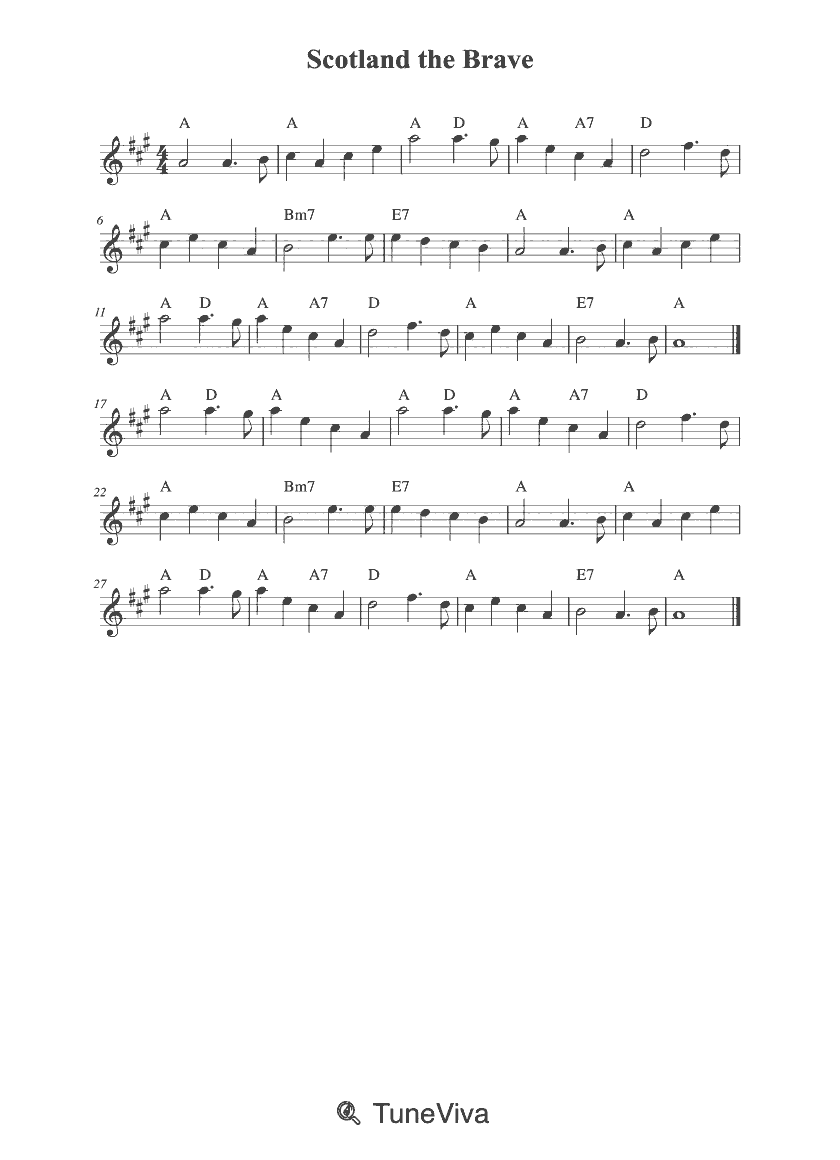
(unknown)
1 min 4 sec
Open score
Misc tunes
31 sec
Open scorePage 1 of 3
The three scores are not interchangeable versions of the same texture. One score lists a bagpipe part only. A second is a thirteen-part arrangement scored for alto flute, oboe, English horn, bass clarinet, bassoon, trumpet, horn, bagpipe, timpani, violins 1 and 2, violas, and double basses. The third is a single-part setting with no named instrumentation. All three open in 4/4, but their key signatures and lengths differ.
If you need a bagpipe line, the score listed with a bagpipe part is the most direct option. If you are programming a mixed ensemble, the thirteen-part arrangement includes bagpipe alongside woodwinds, brass, timpani, and strings. The shorter single-part setting does not name its instrument, so check that detail before selecting it for a specific player.
The bagpipe score opens with two sharps. The shorter single-part setting opens in G major with one sharp. The ensemble arrangement lists several opening key signatures across its parts, including three flats, two flats, one flat, and no sharps or flats. In a multi-part score, check each part rather than assuming that one key signature applies throughout.
Only the thirteen-part arrangement gives an opening tempo, listed as 120 BPM. The recorded durations also differ sharply: about 32 seconds for the bagpipe score, about 3 minutes 40 seconds for the ensemble arrangement, and about 38 seconds for the shorter single-part setting. These details describe individual scores and should not be treated as fixed performance lengths or a standard tempo for the tune.
Score parts: Bagpipe. Catalogue duration 32 sec. Opening key signature: 2 sharps. Opening time signature: 4/4.
Score parts: Alto Flute, Oboe, English Horn, Bass Clarinet, Bassoon, B♭ Trumpet, …. Catalogue duration 3 min 40 sec. Opening key signature: 3 flats; 2 flats; 1 flat; No sharps or flats. Opening time signature: 4/4. Opening tempo: 120 BPM.
Catalogue duration 38 sec. Opening key signature: 1 sharp (G major). Opening time signature: 4/4.
The available scores include a setting with a bagpipe part, a large ensemble arrangement scored for alto flute, oboe, English horn, bass clarinet, bassoon, trumpet, horn, bagpipe, timpani, violins, violas, and double basses, and a shorter single-part setting whose instrumentation is not named.
The listed scores all open in 4/4, but their keys differ. One bagpipe score opens with two sharps, one single-part setting is in G major with one sharp, and the ensemble arrangement lists several opening key signatures across its parts, including three flats, two flats, one flat, and no sharps or flats.
The available score information does not identify a reliable original composer. One arrangement is credited to V. A. Riddell for the arrangement and orchestration and states that the original composer is unknown; the other listed scores do not provide a composer credit.
Listed durations vary widely: about 32 seconds for the bagpipe score, about 3 minutes 40 seconds for the ensemble arrangement, and about 38 seconds for the shorter single-part setting. These timings belong to individual scores and should not be treated as fixed performance lengths.
Only the thirteen-part ensemble arrangement lists an opening tempo, 120 BPM. The bagpipe score and the shorter single-part setting give no tempo marking, so the listed 120 BPM is not evidence of a standard tempo for the tune.
Choose the score with the bagpipe part if you need a focused bagpipe line. Choose the thirteen-part arrangement if you are programming a mixed ensemble and can cover parts such as flute, oboe, bassoon, strings, timpani, and bagpipe. The shorter single-part setting gives no instrumentation, so confirm what it is scored for before use.