
Turkey in the Straw
Traditional (American)
Violin · 32 sec
Open scoreTurkey in the Straw sheet music is available here in piano and violin versions, including a longer piano score titled an 1899 arrangement. This page helps you compare instrumentation, opening key and time signature, length and attribution so you can choose a score that suits your instrument and purpose. Historical details about the tune’s origin are not established by the available information, so the guidance focuses on what the scores themselves show.
Scores 1–20 of 28
Traditional (American)
Violin · 32 sec
Open score
American folk tunearr. by Otto BonnellCopied from scan made by New York Public Library
Sample
Piano · 1 min 40 sec
Open score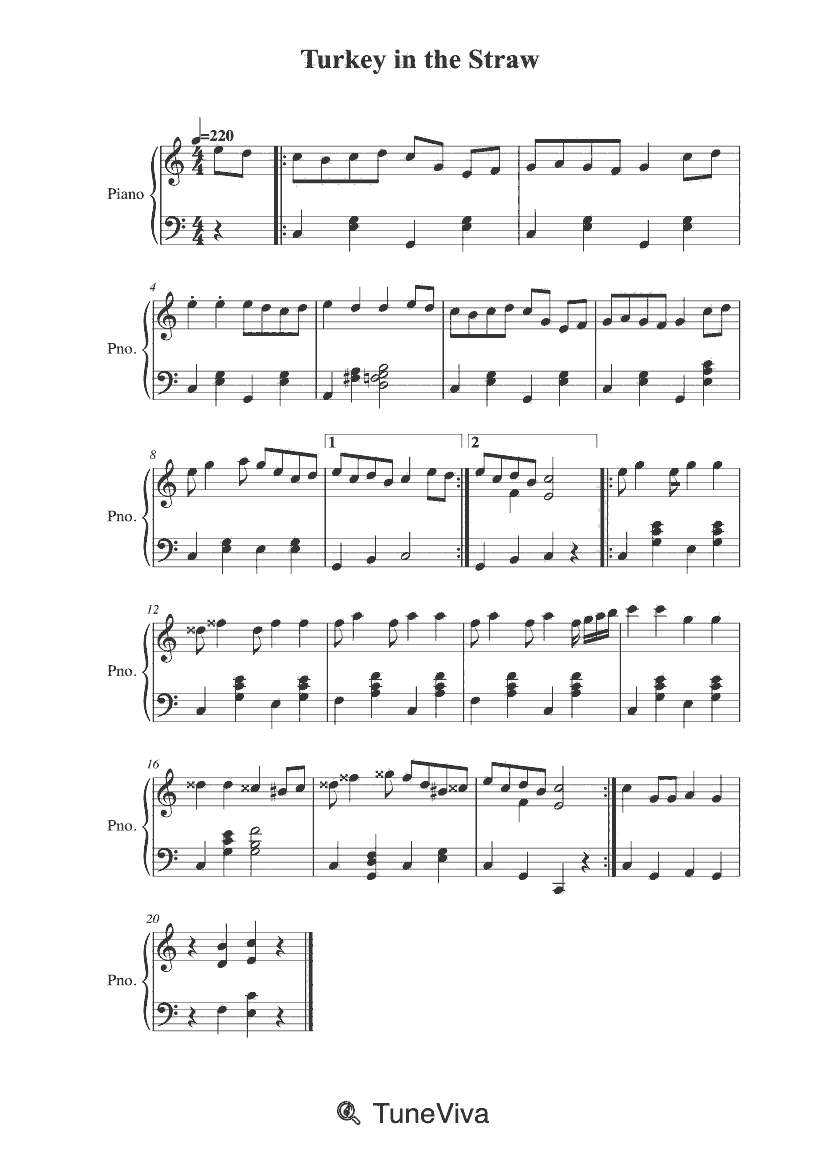
mmaldonado64
Piano · 37 sec
Open score
Misc Traditional
38 sec
Open score
Misc Traditional
32 sec · Score #136066
Open score
Trad.
55 sec · Score #234214
Open score
Misc Traditional
1 min 2 sec
Open score
Misc Traditional
32 sec · Score #223044
Open score
Misc Traditional
1 min 6 sec
Open score
Misc Traditional
32 sec
Open score
anon.
1 min 6 sec
Open score
Trad.
55 sec · Score #6825
Open score
Misc Traditional
43 sec
Open score
Misc Traditional
1 min 25 sec · Score #155514
Open score
Misc Traditional
1 min 17 sec
Open score
Trad
1 min 3 sec
Open score
Misc Traditional
1 min 20 sec
Open score
Misc Traditional
1 min 4 sec
Open score
Misc Traditional
32 sec · Score #63713
Open score
Misc Traditional
1 min 25 sec · Score #127447
Open scorePage 1 of 2
The scores represented here differ substantially. Two are labelled for piano: a short version of roughly 37 seconds and a longer version titled an 1899 arrangement, credited to Otto Bonnell, of roughly 100 seconds. A third is labelled for violin and is listed at roughly 32 seconds. These durations and part labels are useful starting points, not proof of completeness or difficulty; inspect the notation before choosing.
All three listed versions show 4/4 time at the opening. The piano versions open with no sharps or flats, while the violin version opens with two sharps. Opening tempos are listed as 220 BPM and 165 BPM for the piano scores; no opening tempo is shown for the violin score. Treat these as score-specific details rather than fixed features of the tune.
One score is titled “Turkey in the Straw (1899 arrangement)” and its credit line names Otto Bonnell as arranger and notes that it was copied from a scan made by the New York Public Library. That supports the existence of an arrangement attribution in the score listing, but it does not establish the tune’s origin, composer, or first publication. Distinguish the arrangement credit from the underlying traditional tune.
Pianists can compare the two piano-labelled scores by length, attribution and notation rather than assuming one is a beginner version. Violinists have a separate two-sharp version in 4/4; check the range, bowing marks and whether the score contains a complete melody or an accompaniment. No difficulty grade is verified for any version.
Score parts: Violin. Catalogue duration 32 sec. Opening key signature: 2 sharps. Opening time signature: 4/4.
Score parts: Piano. Catalogue duration 1 min 40 sec. Opening key signature: No sharps or flats. Opening time signature: 4/4. Opening tempo: 165 BPM.
Score parts: Piano. Catalogue duration 37 sec. Opening key signature: No sharps or flats. Opening time signature: 4/4. Opening tempo: 220 BPM.
Turkey in the Straw is an American folk tune. The sheet-music versions described here present it as an instrumental piece in 4/4 time, with piano and violin scorings among the available versions.
Available Turkey in the Straw sheet music includes two versions labelled for piano and one labelled for violin. The part label indicates the intended instrument, but it does not guarantee that the score is complete or idiomatic; check the notation and range before choosing.
One piano version of Turkey in the Straw is a short score listed at about 37 seconds with 428 notes. The other is titled “Turkey in the Straw (1899 arrangement)”, credited to Otto Bonnell as arranger, and listed at about 100 seconds with 1,258 notes. Both open in 4/4 with no sharps or flats, but the scores should be compared directly because the details may not be exact.
The piano versions of Turkey in the Straw open with no sharps or flats, while the violin version opens with two sharps. These are separate arrangements, so they need not be in the same key. An opening key signature also does not by itself prove the key of the whole piece.
The available information does not establish that. One score is titled “Turkey in the Straw (1899 arrangement)” and credits Otto Bonnell as arranger, but that does not prove the tune’s origin, first publication date, or that the arrangement is the original version.
Before choosing a Turkey in the Straw score, check the instrument label, opening key and time signature, length, attribution, and whether the notation gives a complete melody or only a part. Piano and violin versions are not interchangeable, and no difficulty grade is verified for the listed scores.