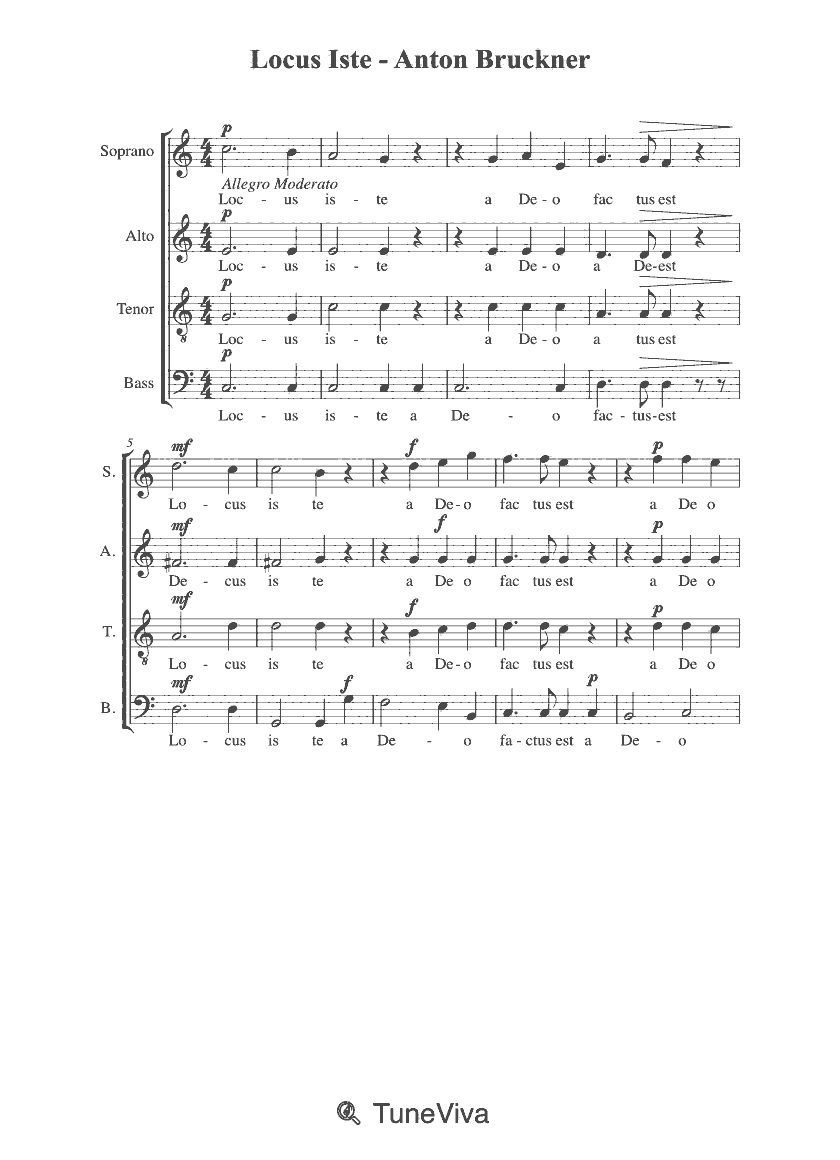
Locus Iste (Bruckner) - SATB
Anton Bruckner (1824-1896)
classical
4 tracks
Anton Bruckner's page holds twenty-seven scores, about ninety-four minutes of music and 29,331 notated notes, and it is a choral composer's catalogue before it is a symphonist's: nineteen entries carry lyrics, and the most-viewed file is an SATB Locus iste. Beside it sit the Aequale for three trombones and a second engraving of the same gradual. Only one score reaches complexity index 2, while twenty-six sit at 0, so the collection looks easier on paper than it sounds in a choir stall. The surprises are the orchestral parts, a piano scherzo and seven entries with no genre tag at all.
Bruckner was born on 4 September 1824 in Ansfelden, a village south of Linz where his father kept the school and gave him his first music lessons. After his father died in 1837 he became a choirboy at the Augustinian monastery of Sankt Florian, and he returned there in 1845 as a teacher, taking the organ post in 1848. The monastery organ stayed at the centre of his musical life, and he was buried in the crypt beneath it in 1896. He studied counterpoint with Simon Sechter from 1855 and worked with Otto Kitzler from 1861, and only after that did he begin composing on a large scale.
The sacred music here comes from across that career. Locus iste, WAB 23, was written in 1869 for the dedication of the Votivkapelle at the New Cathedral in Linz. Pange lingua, WAB 33, is a four-part setting of 1868 and apparently the last work he wrote in Linz before moving to Vienna. The Tantum ergo, WAB 32, is an early setting of about 1845 that the WAB catalogue long listed under Pange lingua, because the Tantum ergo is the closing part of that hymn. The Aequale No. 1, WAB 114, is a short piece for three trombones from 1847, written for the funeral of his aunt Rosalia Mayrhofer.
The symphonies appear only at the edges: a horn and Wagner tuba part for the Seventh, WAB 107, completed in 1883 and revised two years later, whose Adagio is often heard as an elegy for Wagner. None of the twenty-seven files is a complete symphony score, and the collection mixes the motets with an orchestral part and a single piano piece.
The motets reward a plain approach: tune the unaccompanied lines slowly, breathe where the text pauses, and let the suspensions resolve without pushing. In Locus iste the opening imitations should build rather than announce themselves. The Aequale needs three trombones of matched weight, because the parts are equal and any one of them can dominate. The Seventh Symphony file is a single line, so count rests carefully and listen for the Wagner tubas, whose blend with the horns is the real difficulty of the passage.
The most-viewed score here: the 1869 gradual WAB 23, written for the dedication of the Votivkapelle at Linz's New Cathedral.
A C minor piece for three trombones from 1847, composed for the funeral of Bruckner's aunt Rosalia Mayrhofer.
A separate engraving of the same gradual rather than a merged edition; the catalogue does not say which publisher's text it follows.
The catalogue gives no WAB number. Bruckner set the hymn at least three times, and the other Pange lingua entry on this page is the Tantum ergo WAB 32.
An orchestral part, not a score: the E major Seventh was completed in 1883 and revised in 1885, and its Adagio is often read as an elegy for Wagner.
A D major setting of about 1845 that the WAB catalogue misclassified as Pange lingua; the title records the correction.
An eight-part arrangement for two male-voice choirs. The original Ave Maria, WAB 6, is scored SAATTBB and dates from 1861.
A Marian antiphon of 1878 for tenor, four-part choir and organ, set in the Phrygian mode.
A short piano piece with no WAB number; Bruckner's keyboard output consists mainly of teaching pieces and dances.
An extract from the finale of the Fifth, WAB 105 (1876-78), not the complete movement.
Twenty-seven, running to about ninety-four minutes of music and 29,331 notated notes. Nineteen of the entries include lyrics.
The top of the page lists four separate files under that title, at 4,720, 778, 254 and 121 views. They are different engravings, not a merged edition, so compare the scoring before choosing one.
No. It is a horn and Wagner tuba part, not a full score or a set of orchestral parts.
They come from the Werkverzeichnis Anton Bruckner, the thematic catalogue compiled by Renate Grasberger, which numbers the sacred choral works first and the orchestral works later.
The title records a correction. The D major setting WAB 32 was catalogued as Pange lingua, but it sets only the Tantum ergo verses that close the hymn.
Catalog editions and arrangements attributed to Anton Bruckner.
Anton Bruckner (1824-1896)


(1. Moses 29 17-22)




IV. Finale


SATB a capella


Copyright 2016 by CPDL This edition can be fully distributed duplicated performed and recorded

Copyright 2016 by CPDL This edition can be fully distributed duplicated performed and recorded