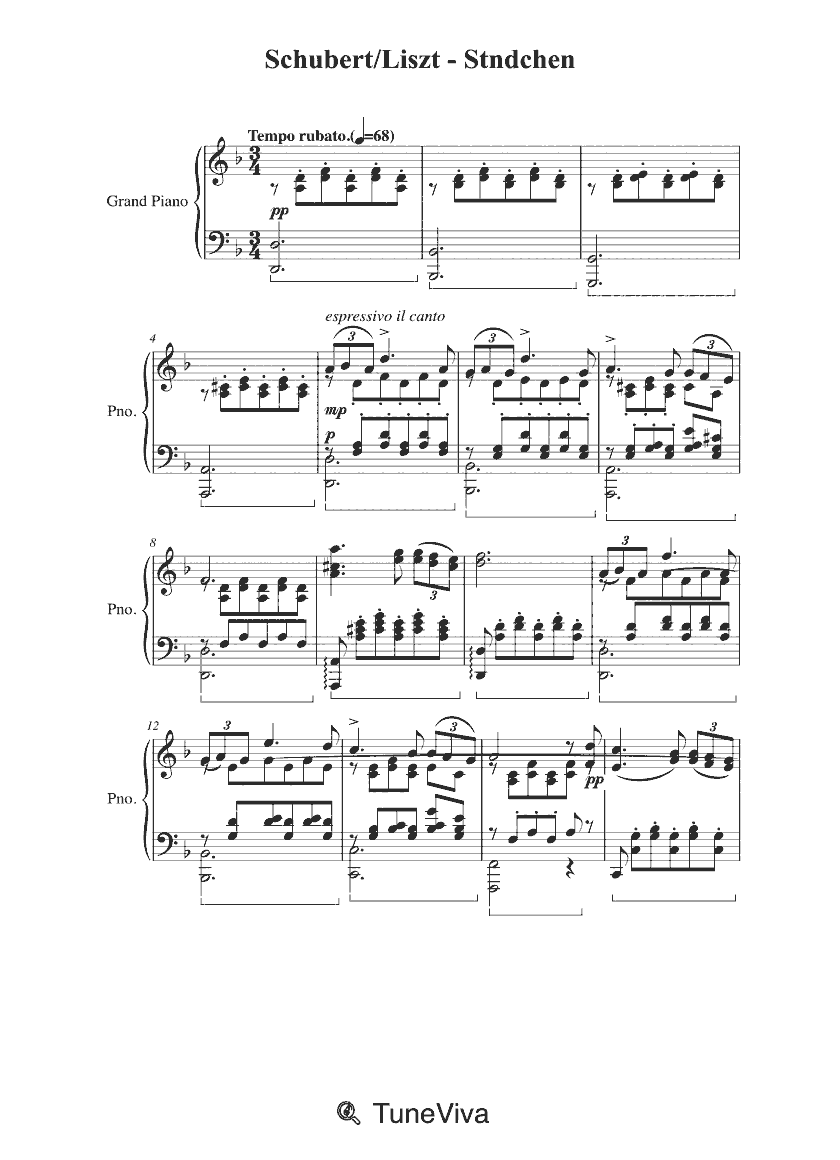
Schubert/Liszt - Ständchen
Franz Schubert
Grand Piano · 6 min 37 sec
Open score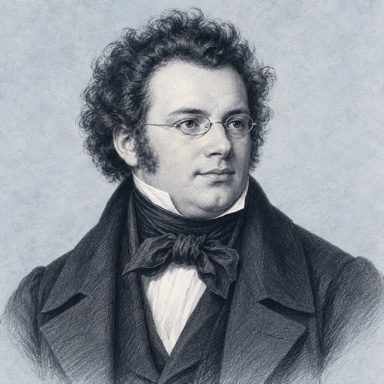
231 Franz Schubert scores to preview and download: Ständchen, Erlkönig, the E-flat Piano Trio and the Allegretto in C minor, by the Viennese master of song.
Liszt's piano transcription of the Serenade, the most-viewed item in the collection by a wide margin.
A solo piano version of the same melody, showing how widely the song circulated as parlour music.
The slow movement of the E-flat piano trio, a cantabile melody that became one of his best-loved instrumental tunes.
The Goethe ballad that made his reputation, with galloping piano triplets driving the ride.
The Sanctus of Schubert's German Mass, a congregational setting rather than a concert piece.
A late piano miniature from 1827, melancholy and only a few minutes long.
The final song of Winterreise, a bare strophic setting for the hurdy-gurdy man.
The Serenade in its original voice-and-piano form, from the posthumous Schwanengesang.
His setting of Ellen's prayer from Walter Scott's The Lady of the Lake, one of his most widely arranged melodies.
The opening song of the cycle, where the rejected wanderer sets out into the snow.
If you came for Ständchen, check the work or collection listed with the title. Schubert wrote more than one serenade, and arrangements can omit the voice part. For Erlkönig, use a score with the vocal text and piano accompaniment if you want to rehearse the song. Work out the repeated accompaniment and count where the singer enters before putting the two parts together.
Compare the instrument and arrangement details below, then open a score to check the notation. Different entries may be arrangements or editions of the same work; available playback tools are shown on each score page.
Franz Schubert
Grand Piano · 6 min 37 sec
Open score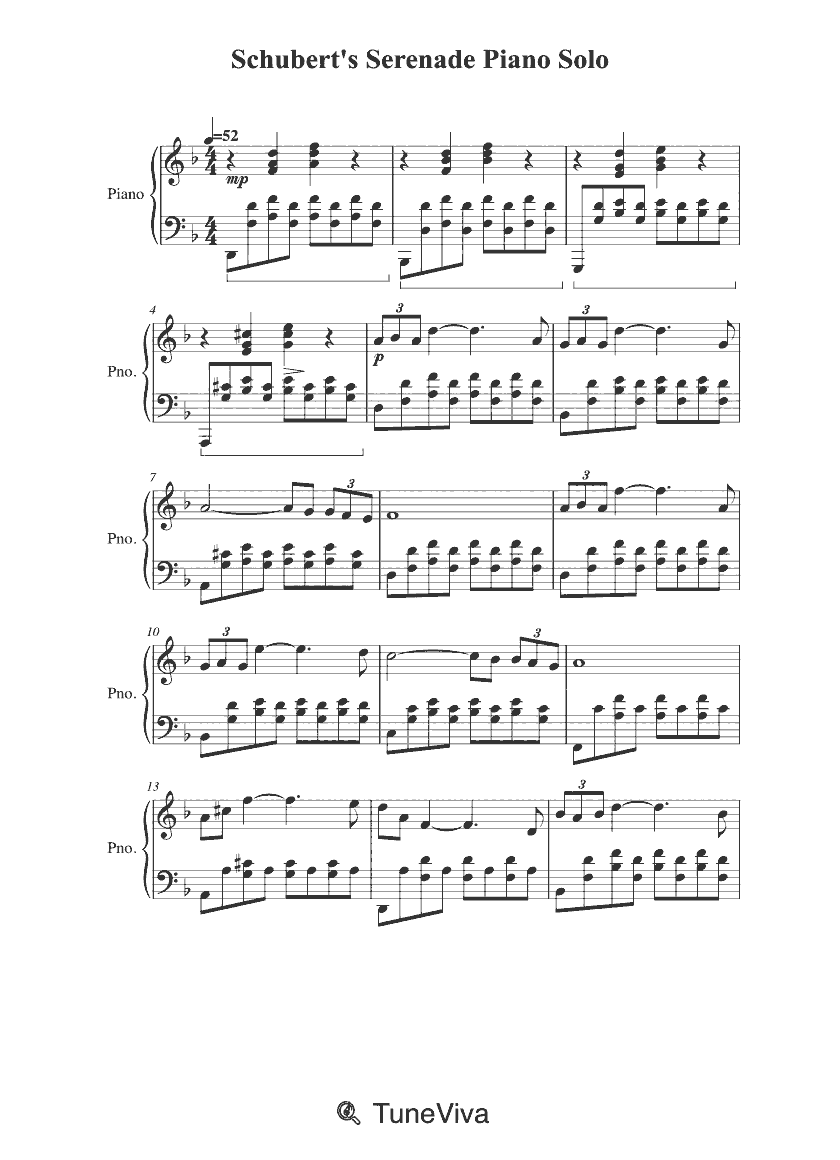
Franz Schubert
Piano · 3 min 32 sec
Open score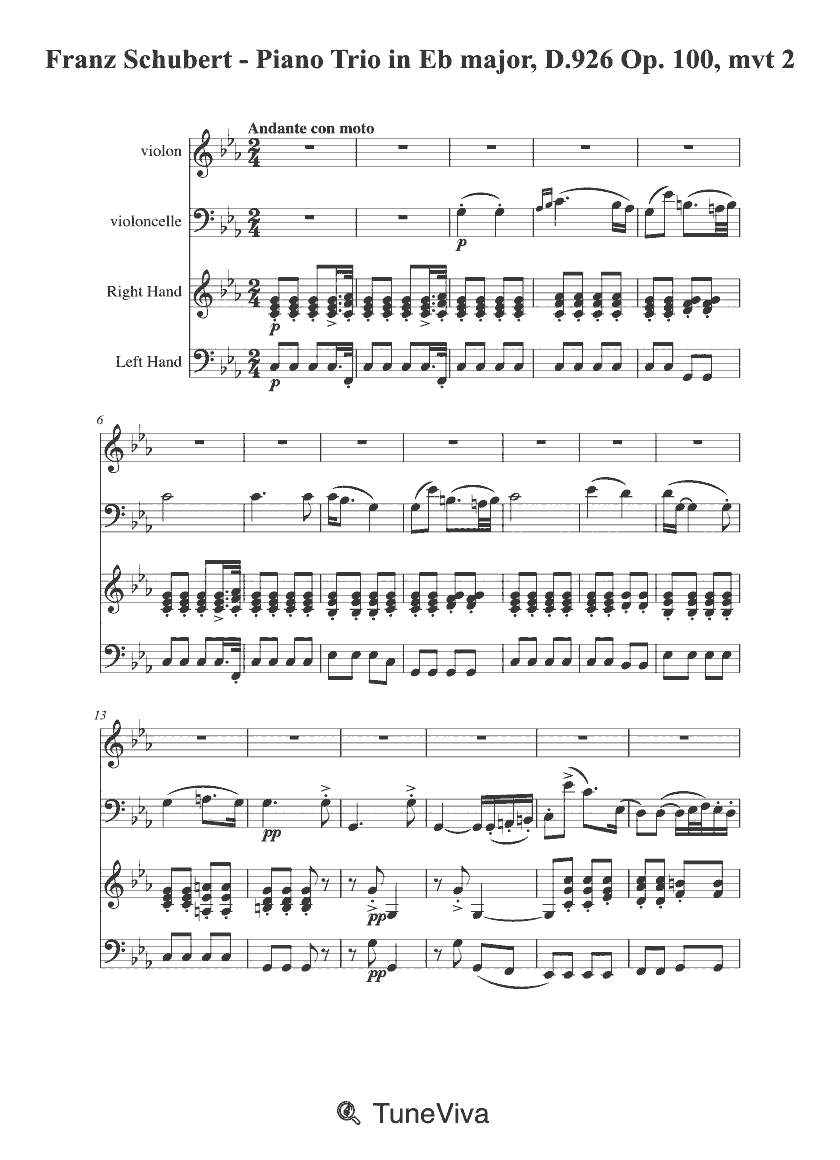
Franz Schubert
violon; violoncelle; Right Hand +1 parts · 10 min 12 sec
Open score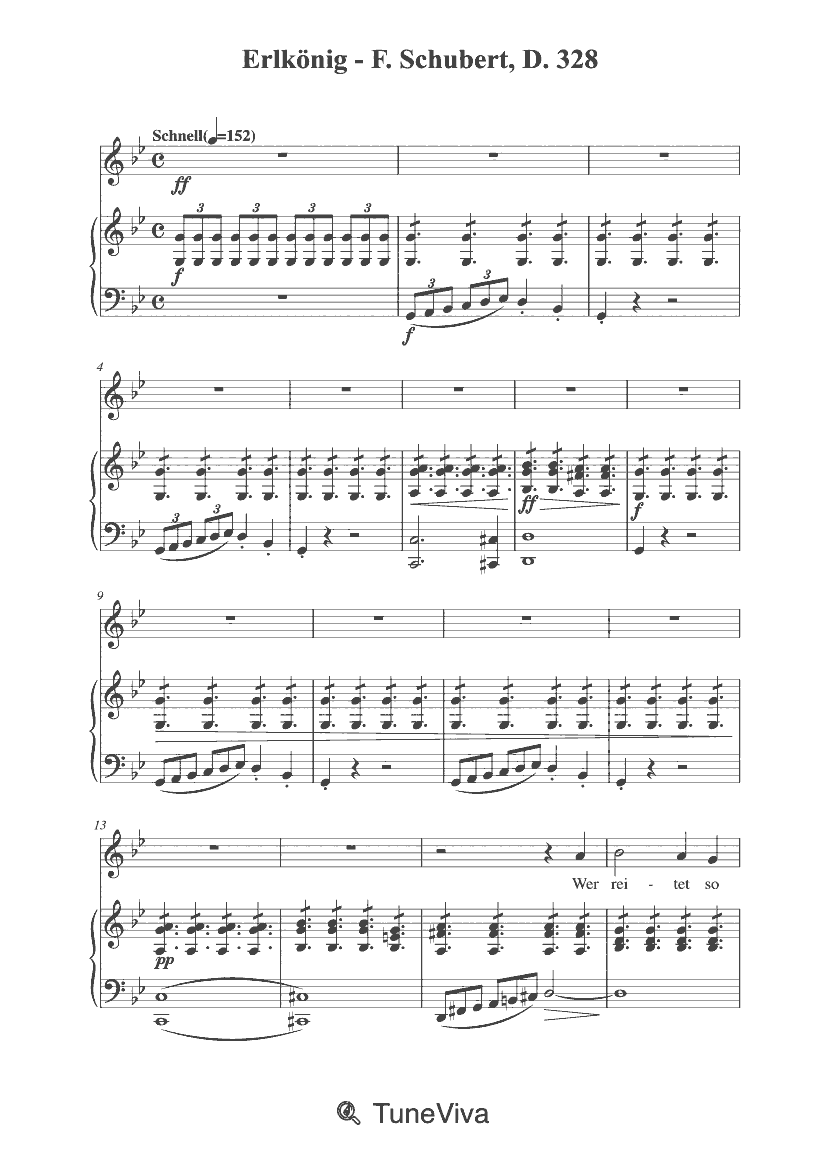
Franz Schubert
D. 328; Op. 1
Voice; Piano · 4 min 43 sec
Open score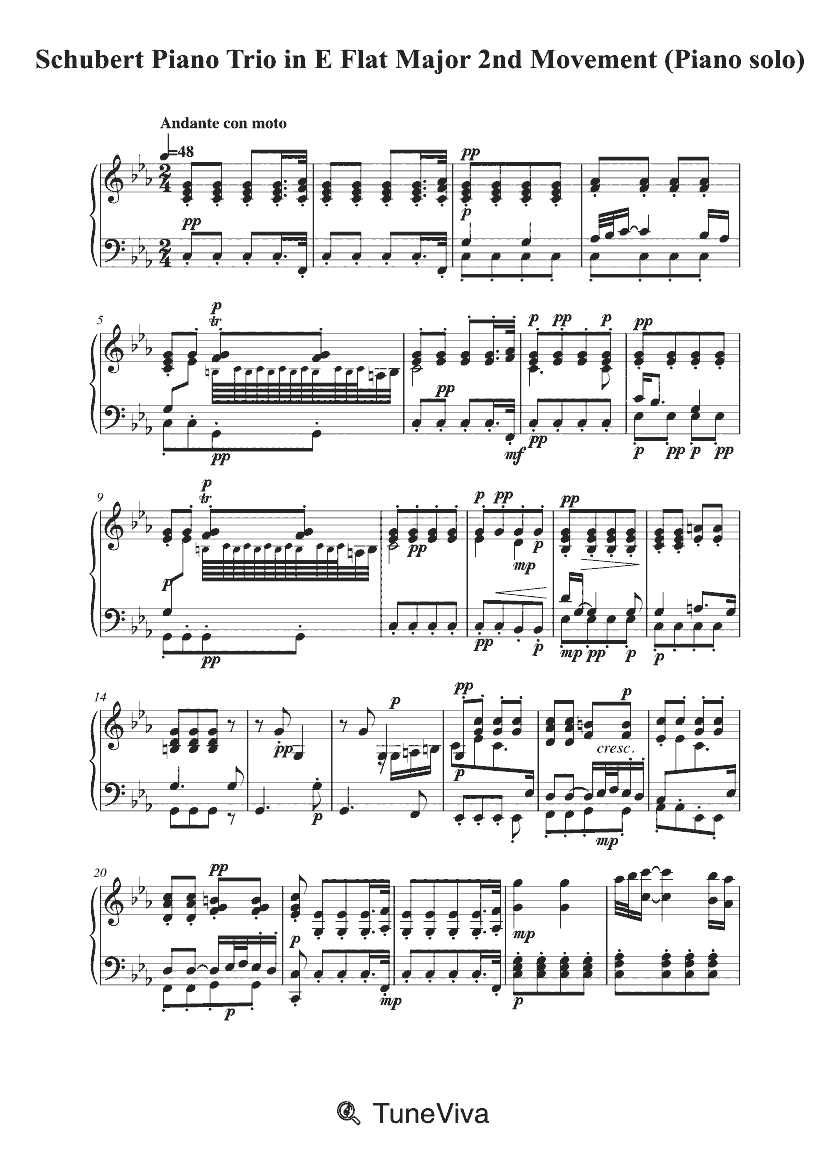
Franz Schubert
2nd Movement
Piano · 5 min 39 sec
Open score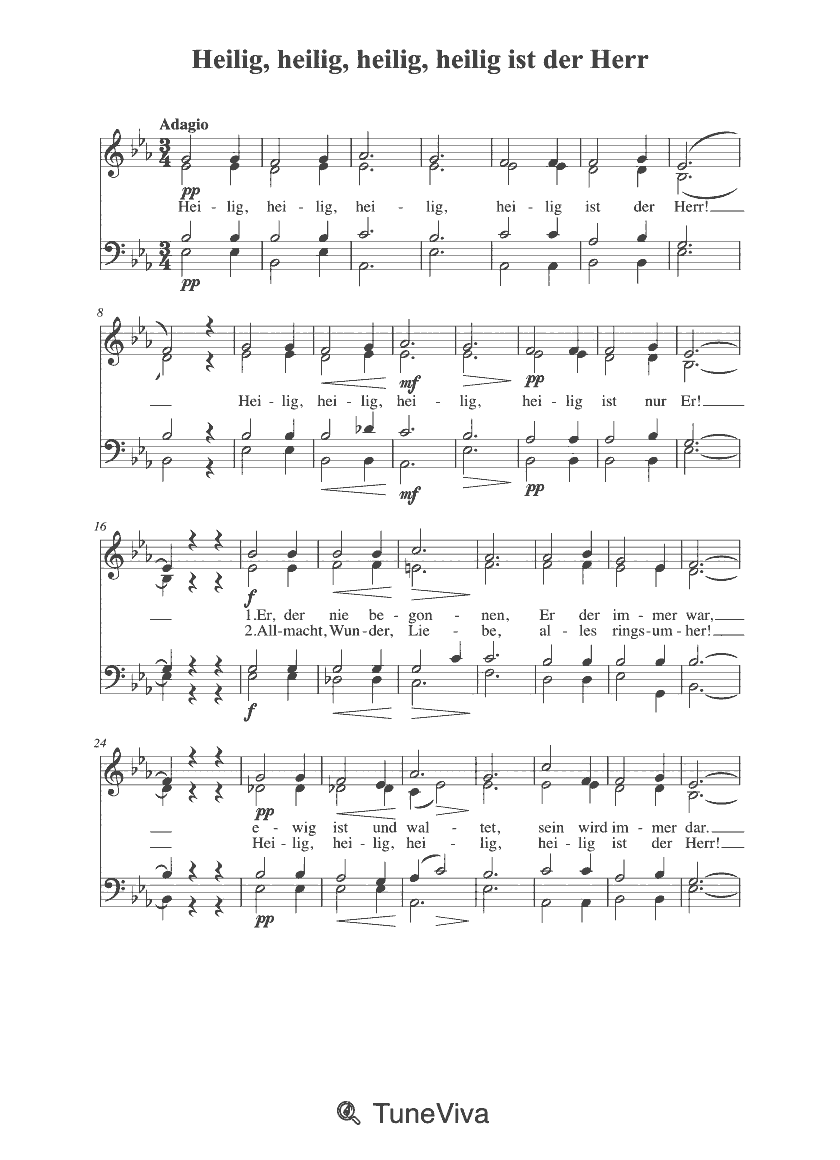
Franz Schubert
Soprano; Bass · 5 min 18 sec
Open score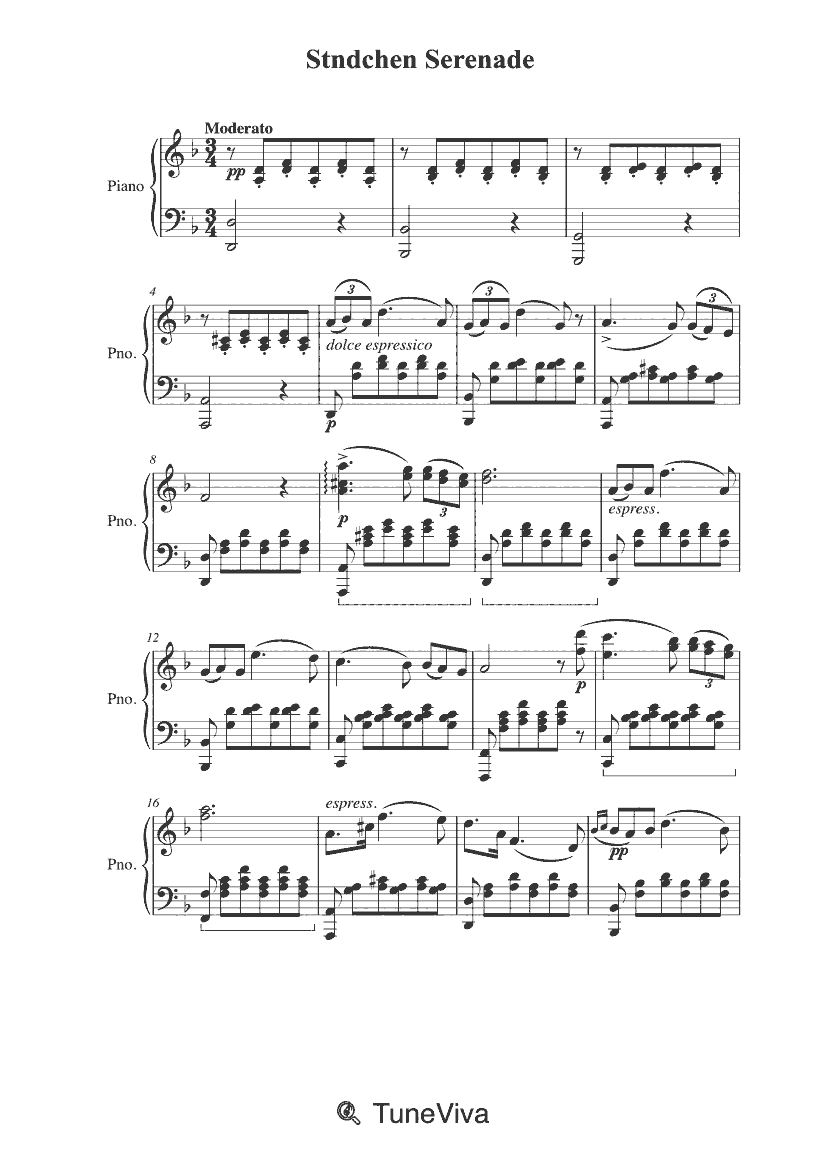
Franz Schubert
arranged by August Horn
Piano · 3 min 4 sec
Open score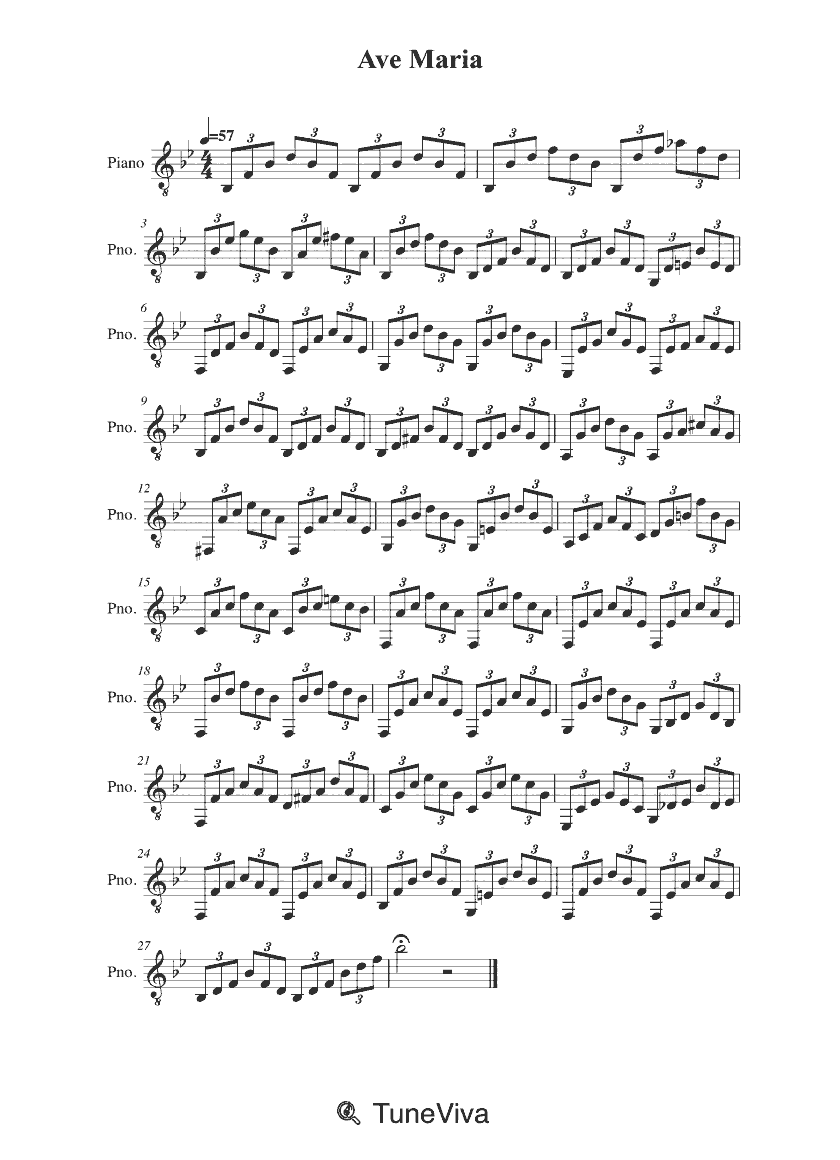
Franz Schubert
Piano · 55 sec
Open score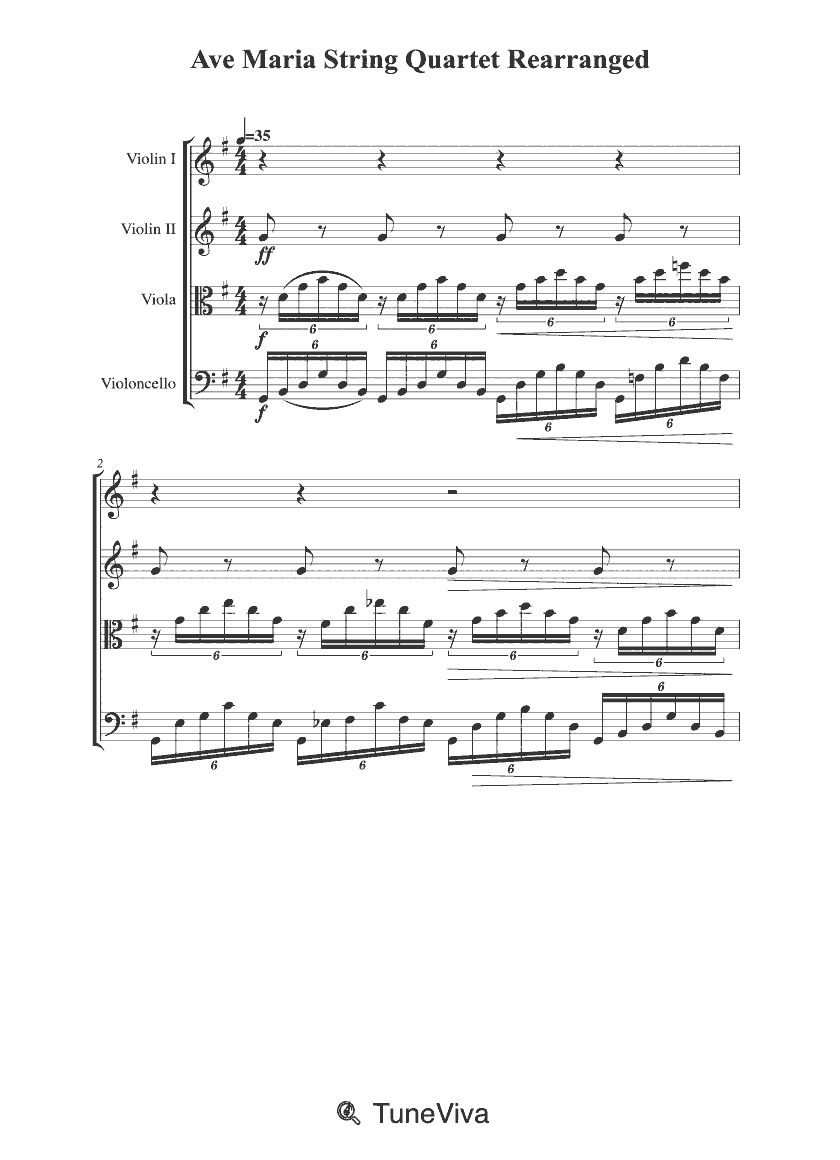
Franz Schubert
String Quartet Rearrenged
Violin I; Violin II; Viola +1 parts · 2 min 3 sec
Open score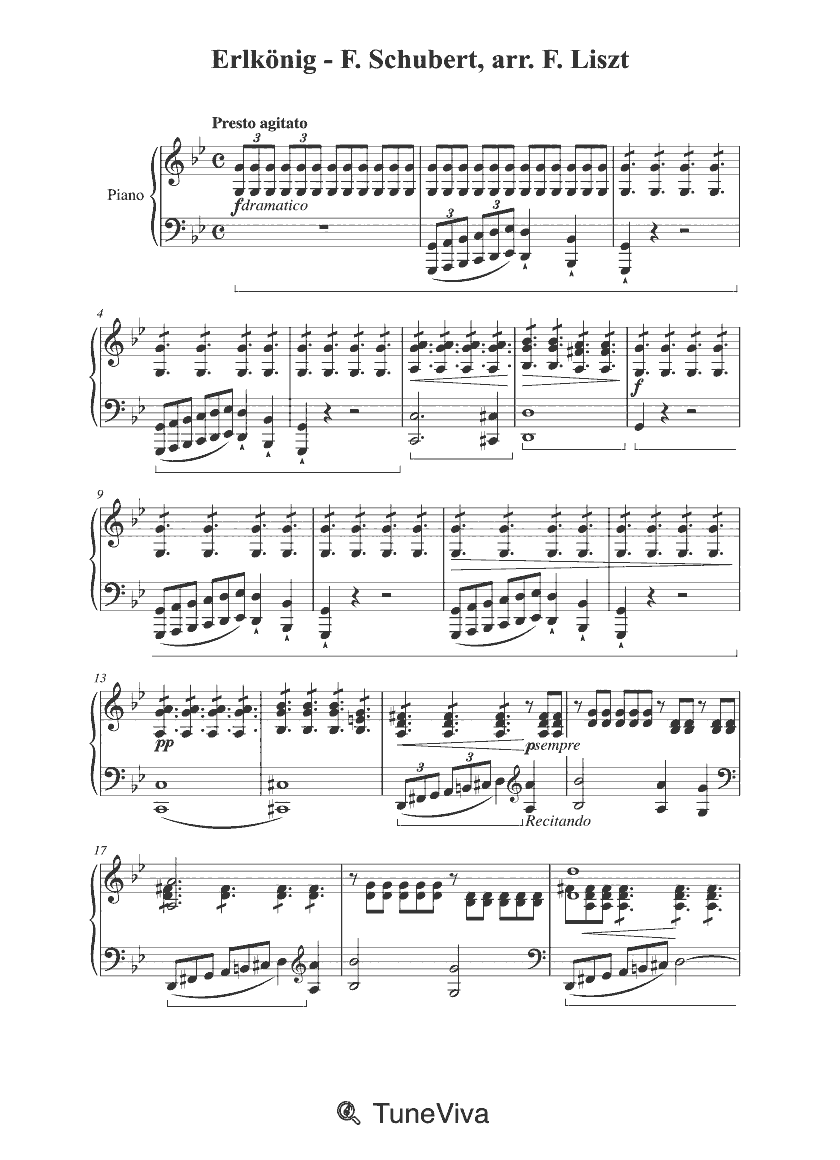
Franz Schubert
Op. 1 (Schubert)
Piano · 5 min 4 sec
Open score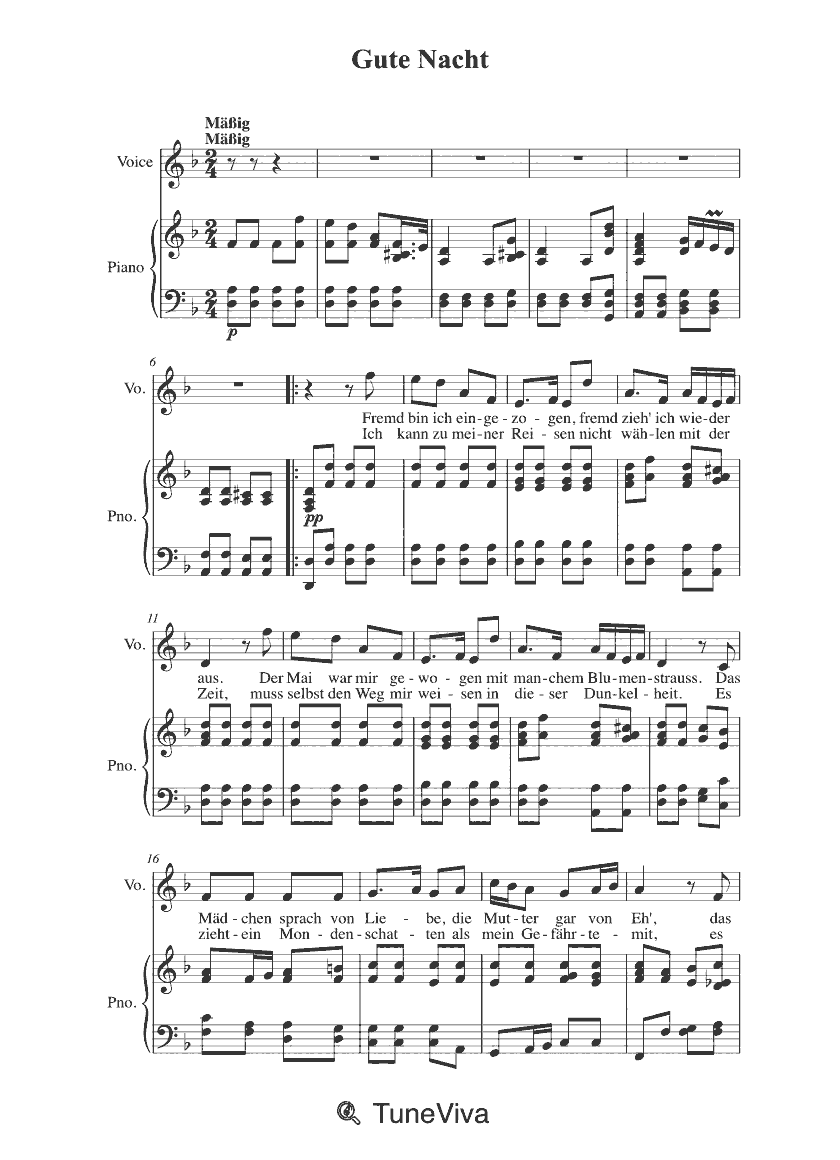
Franz Schubert
Voice; Piano · 2 min 57 sec
Open score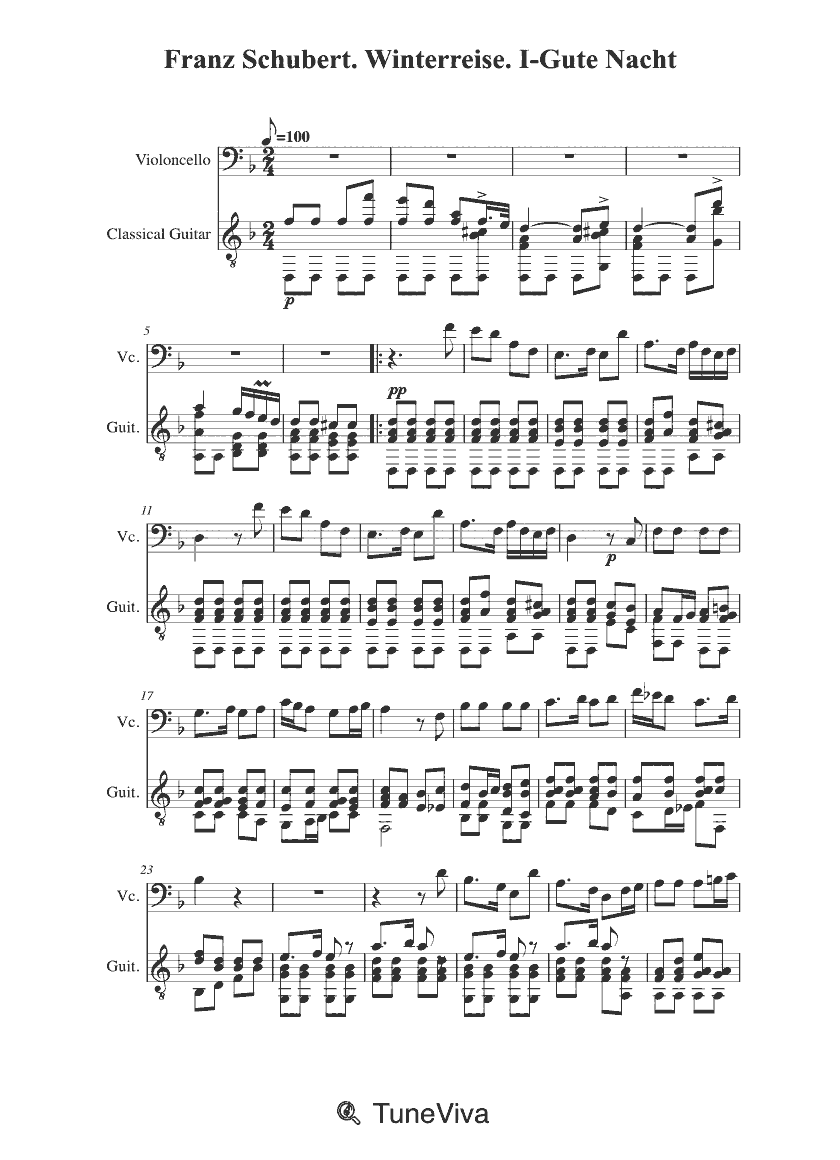
Franz Schubert
Du cycle de lied Winterreise
Violoncello; Classical Guitar · Arr. Frédéric Jacques · 10 min 8 sec
Open score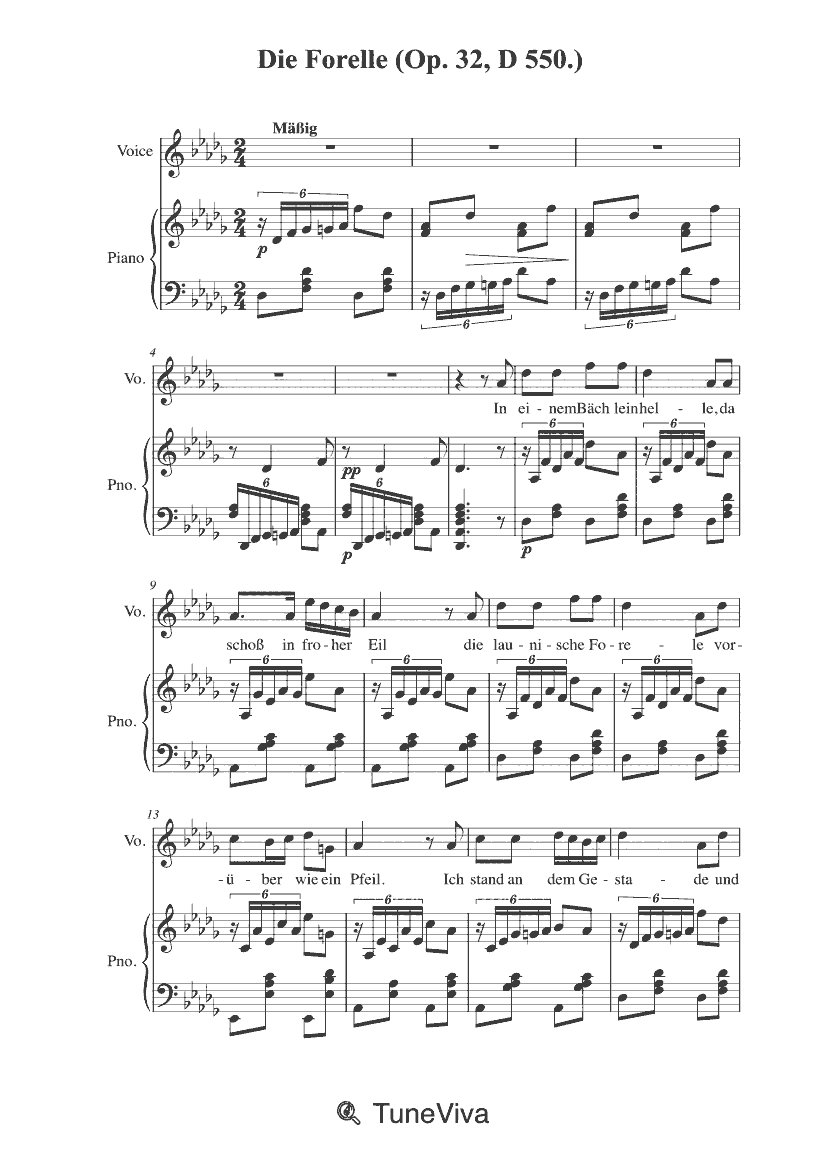
Franz Schubert
The Trout
Voice; Piano · 1 min 42 sec
Open score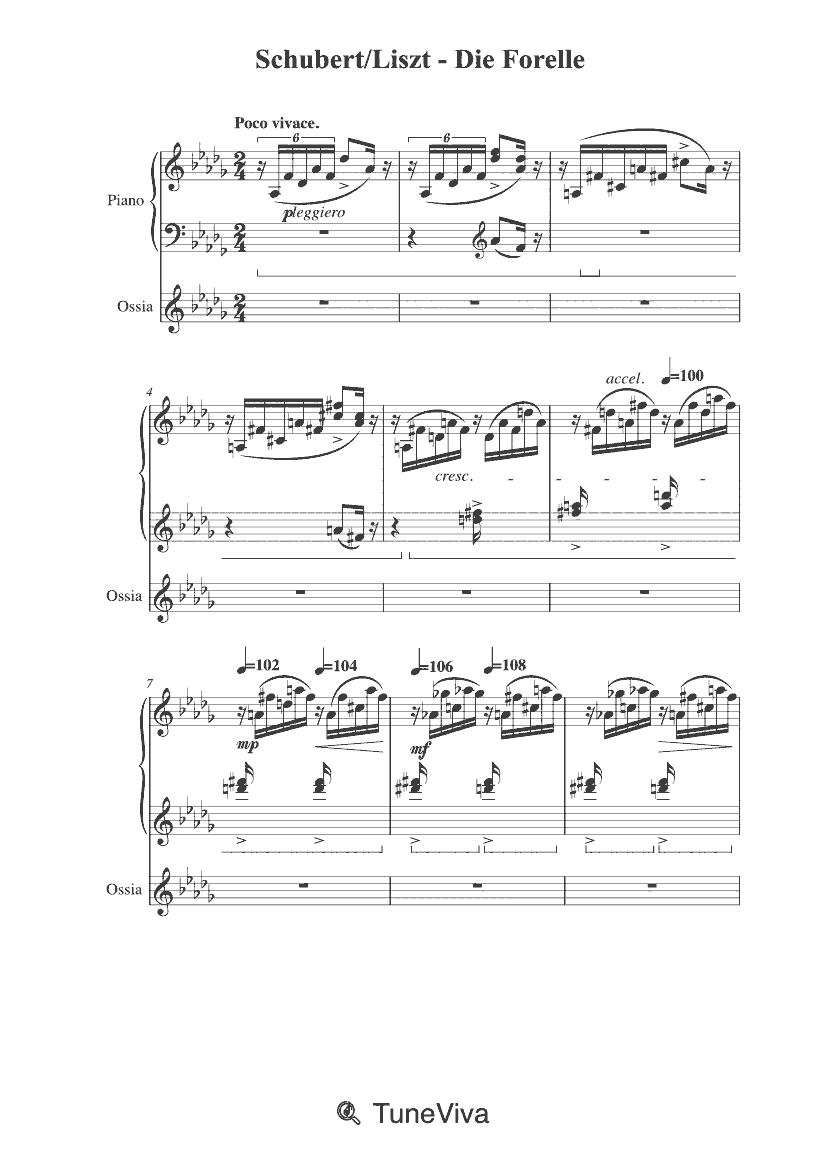
Franz Schubert
The Trout 2nd version of arrangement for piano solo by Franz Liszt.
Piano; Ossia · 3 min 31 sec
Open score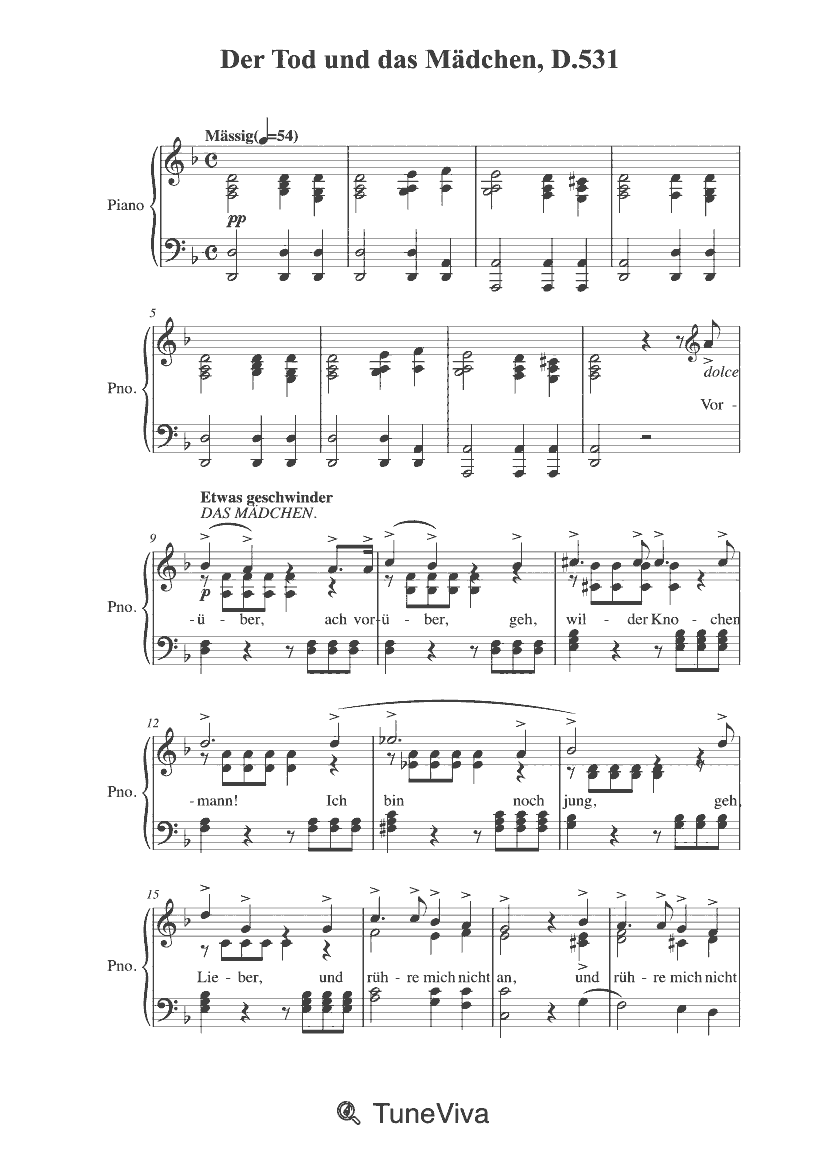
Franz Schubert
Ausgewählte Lieder von Franz Schubert für Pianoforte solo arrangirt
Piano · 3 min 15 sec
Open score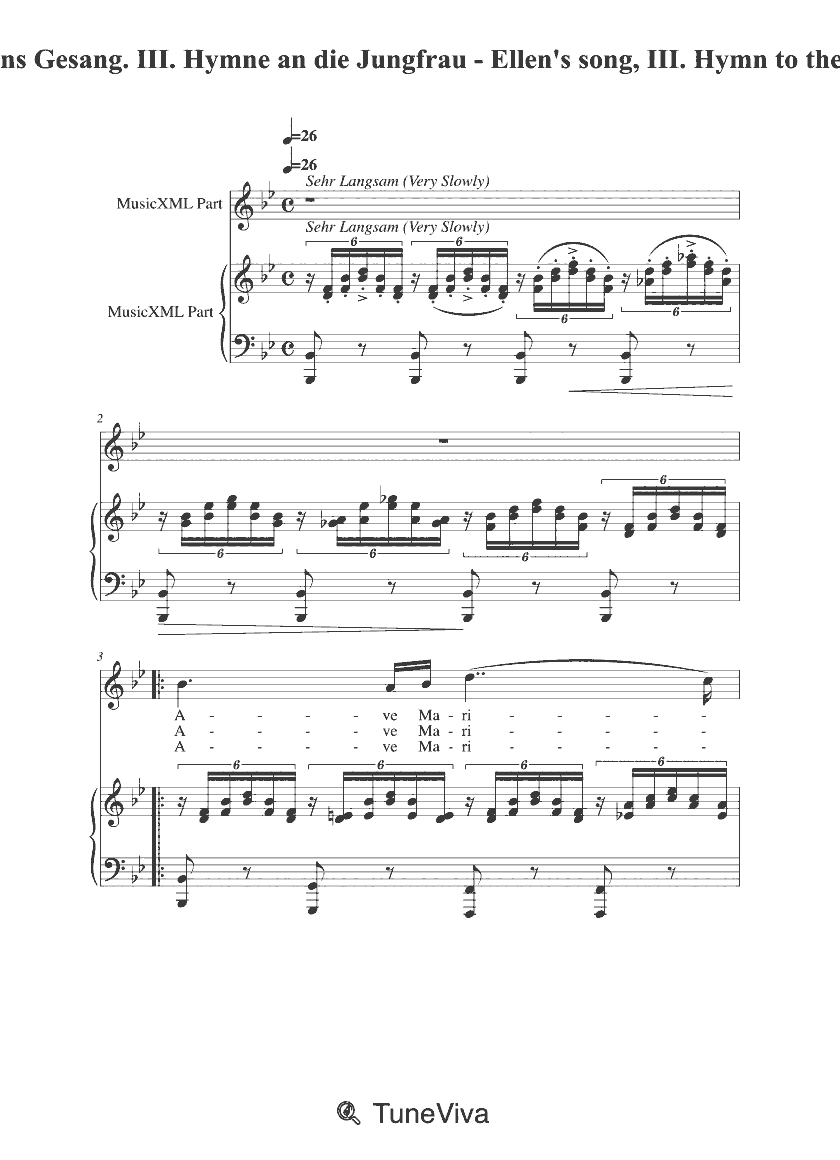
Franz Schubert
MusicXML Part · 4 min 59 sec
Open score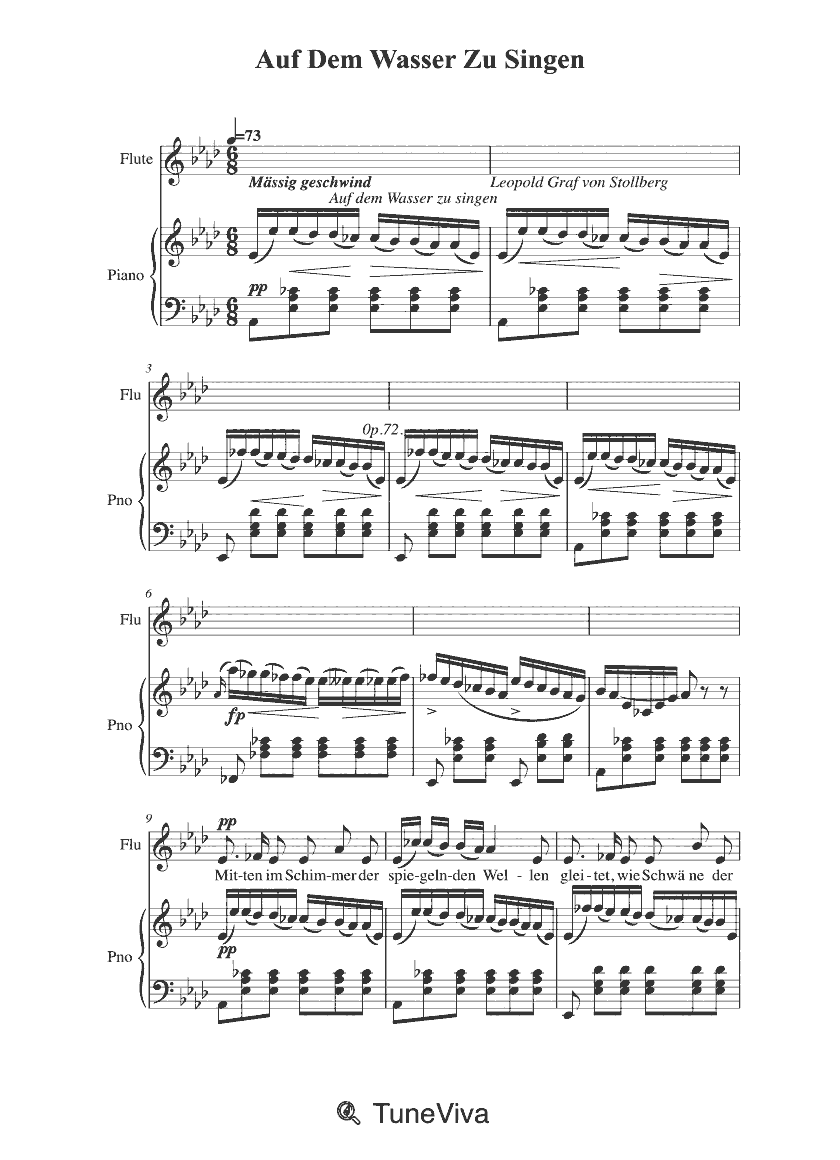
Franz Schubert
Flute; Piano · 2 min 6 sec
Open score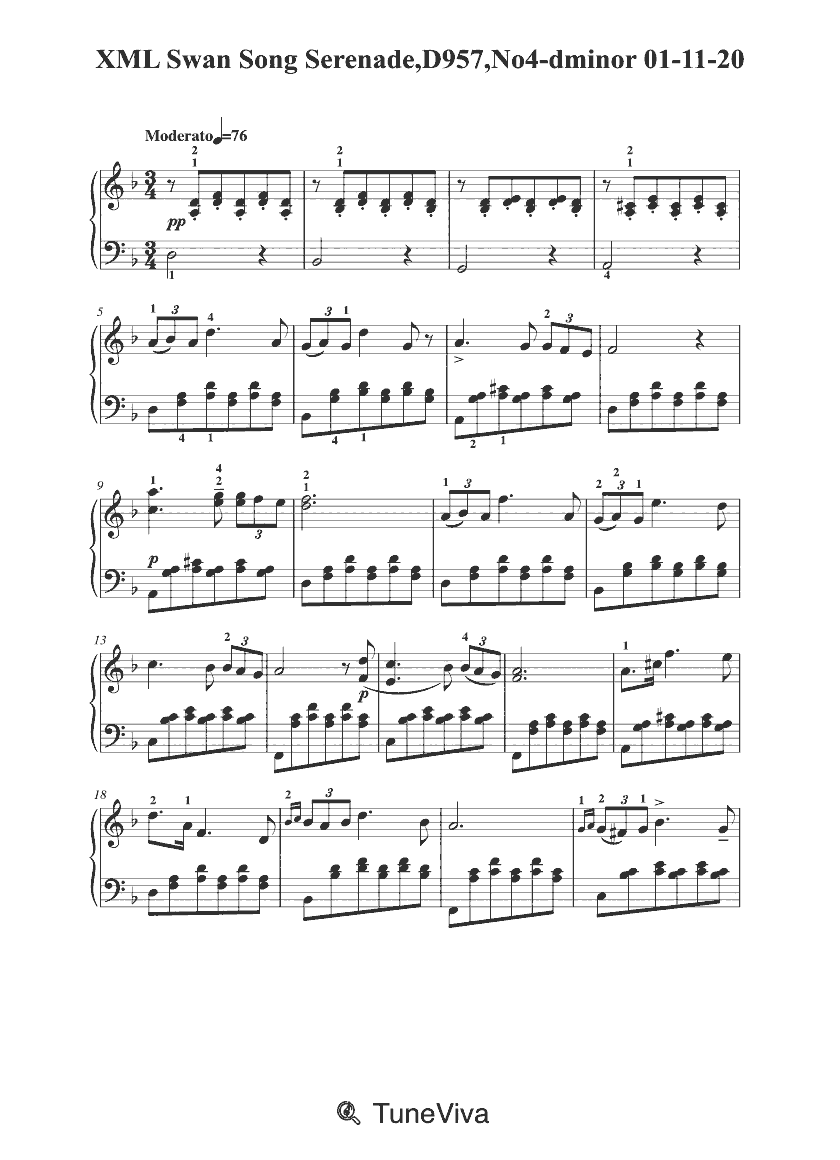
Franz Schubert
Part 1 · 3 min 14 sec
Open score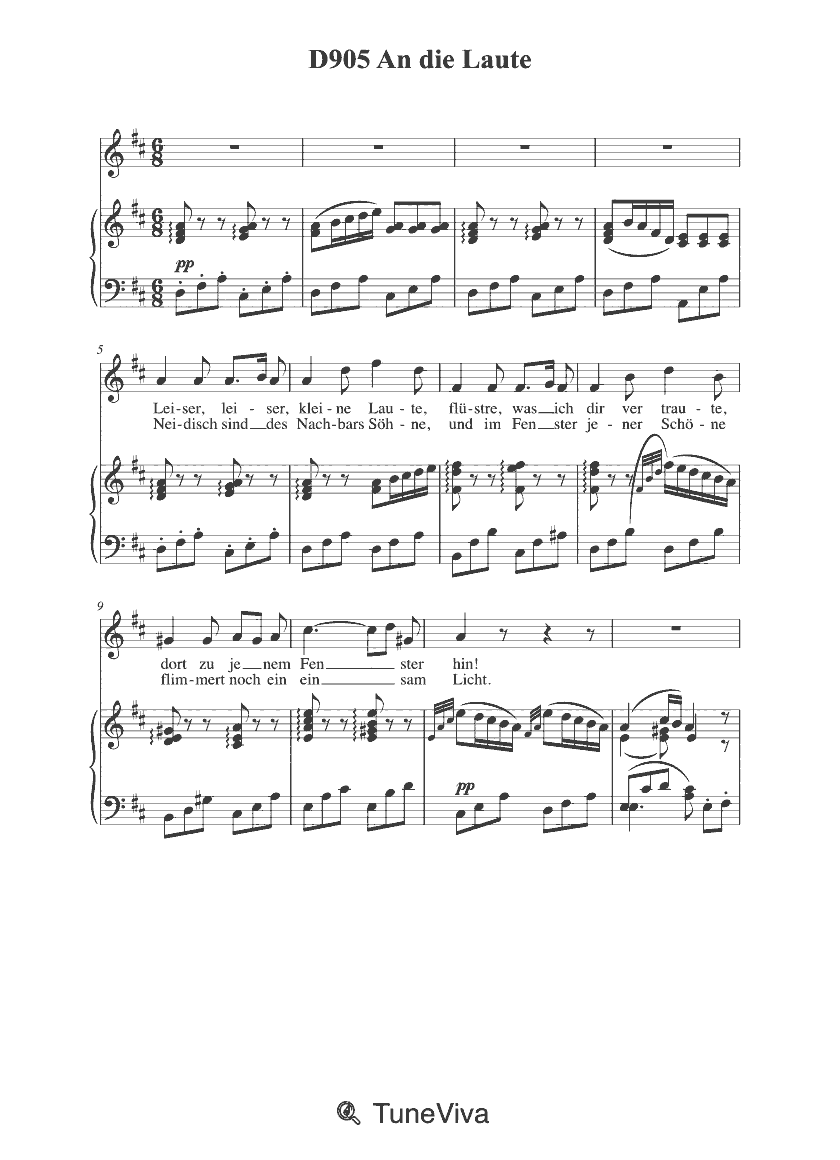
Franz Schubert
Voice; Piano · 37 sec
Open score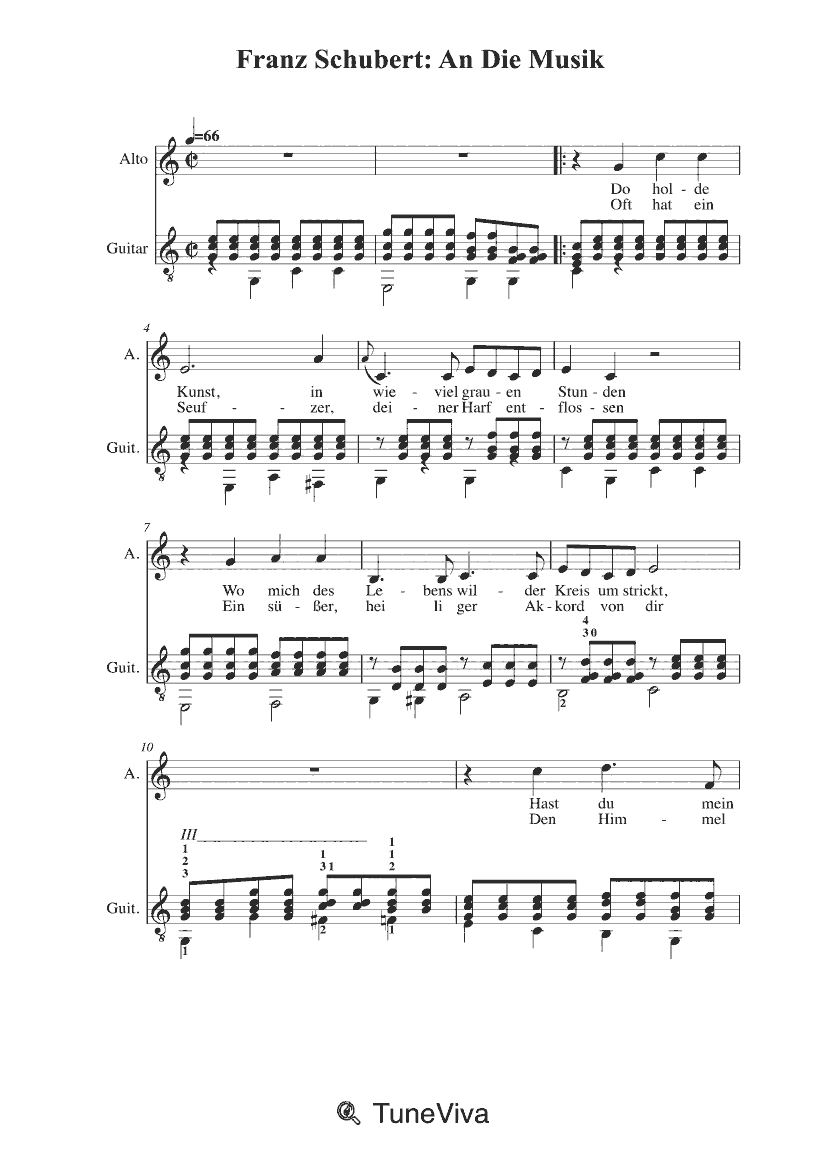
Franz Schubert
Alto; Guitar · Arr. Masahiro Matsuno · 5 min 13 sec
Open scorePage 1 of 12
Schubert wrote more than six hundred songs before he died at thirty-one, and this catalogue reflects that bias: vocal settings outnumber everything else, with piano pieces and chamber transcriptions filling out the list. Vienna is the setting for nearly all of it, from the Himmelpfortgrund suburb where he was born in 1797 to the lodgings where he completed Winterreise in 1827. Of the 231 Schubert scores on TuneViva, 153 carry lyrics. The most-viewed items are not the symphonies but domestic pieces: Liszt's arrangement of the Serenade, the slow movement of the E-flat piano trio, and Erlkönig, the ballad that made his name with Viennese audiences. Franz Schubert was an Austrian composer of the late Classical and early Romantic eras, and Franz Schubert sheet music is inseparable from the German Lied: his output includes more than 600 songs as well as symphonies, sacred music, operas, and a large body of piano and chamber music. This selection gathers individual songs such as Erlkönig, Gute Nacht and Der Leiermann from Winterreise, and the Ständchen from Schwanengesang, alongside piano pieces and a piano-trio movement. It is a practical starting point for singers, pianists and chamber players rather than a complete edition.
Schubert was born on 31 January 1797 in Himmelpfortgrund, then a suburb of Vienna, the twelfth child of a parish schoolmaster. He sang in the imperial chapel choir, entered the Stadtkonvikt in 1808, and studied composition with Antonio Salieri. He left the school in 1813 to train as a teacher, but the songs kept coming; 1815 alone produced hundreds of them, including Erlkönig.
He never held a court post and depended on a circle of friends, yet the 1820s brought the song cycles Die schöne Müllerin and Winterreise, the late piano sonatas and impromptus and the String Quintet in C, alongside the earlier Trout Quintet of 1819. A public concert of his own works in March 1828 was the only one he gave; he died on 19 November that year, officially of typhoid fever.
The catalogue holds 231 scores, 153 with lyrics, running to about 709 minutes and 304,568 notated notes. Alongside the Serenade and Erlkönig, frequently opened titles include the final song of Winterreise, Der Leiermann, the fourth song of Schwanengesang, and Schubert's setting of Ave Maria. Two of the three index-3 items are the Winterreise songs, where the piano writing is as demanding as the voice.
Schubert's songs and cycles: Schubert's vocal output is central to this selection. The source biography notes more than 600 Lieder and names Gretchen am Spinnrade, Erlkönig and Ave Maria, as well as the cycles Die schöne Müllerin and Winterreise and the collection Schwanengesang. Here, Winterreise is represented by individual songs—No.1 Gute Nacht and No.24 Der Leiermann—and Schwanengesang by No.4 Ständchen; these are separate songs, not a single continuous cycle score. Erlkönig appears as a score labelled for voice and piano.
Piano music and Serenade versions: The selection includes a piano transcription of the Serenade credited to Schubert/Liszt, a separate piano solo of the Serenade, and the voice-and-piano Ständchen from Schwanengesang. If you need the Serenade as a song, start with the Schwanengesang No.4 entry; if you need a solo piano piece, compare the two piano versions. The source biography also identifies the Impromptus and the last three piano sonatas among Schubert's piano works, though those complete works are not listed among the selected scores here.
Chamber and other instrumental scores: The selected scores include a movement from the Piano Trio in E-flat major, Op. 100, and the Allegretto in C minor, D.915 for piano. The trio entry is laid out with violin, cello and piano parts, so it is a chamber score rather than a solo reduction. Check the title and scoring before assuming you are getting a complete multi-movement work: the entry names movement 2.
Reading the score details: The selected scores list their forces and opening key, time signature and tempo. These details describe that particular score, not necessarily Schubert's original instrumentation or an authoritative edition. For example, the Ave Maria entry is labelled for piano alone, while Erlkönig is labelled Voice; Piano. Use these details to choose a version that fits your forces, and check editorial titles and keys against the score itself.
The piano transcription of the Serenade, catalogued as Schubert/Liszt - Stndchen, followed by a piano solo of the same melody.
It includes individual songs from Winterreise and Schwanengesang, such as Gute Nacht and Der Leiermann, rather than the cycles as a single file.
Only within a circle of Viennese admirers; his one public concert of his own music took place in March 1828, eight months before he died.
They refer to the Deutsch catalogue of Schubert's works, the standard way of identifying pieces that often circulated without opus numbers.
Franz Schubert is an Austrian composer of the late Classical and early Romantic eras whose output includes more than 600 Lieder. His works include the songs Gretchen am Spinnrade, Erlkönig and Ave Maria; the song cycles Die schöne Müllerin and Winterreise; Schwanengesang; the Trout Quintet; the Unfinished Symphony; the String Quartet Death and the Maiden; and the Impromptus for solo piano.
The selection includes Erlkönig for voice and piano; Winterreise No.1 Gute Nacht and No.24 Der Leiermann; Schwanengesang No.4 Ständchen for voice and piano; and Ave Maria in a piano score. These are individual scores rather than a complete published songbook.
Winterreise is a song cycle by Franz Schubert, named in the source biography alongside Die schöne Müllerin. This selection contains two individual songs from it: No.1 Gute Nacht and No.24 Der Leiermann, both listed with voice and piano parts. The complete cycle is not presented as one score in this selection.
Erlkönig is one of Schubert's songs, and the score in this selection is labelled for voice and piano. The piano part is not a separate solo work in this entry; it accompanies the vocal line. The source biography lists Erlkönig among Schubert's Lieder.
Piano choices in this selection include the Allegretto in C minor, D.915; a piano solo of the Serenade; a Serenade transcription credited to Schubert/Liszt; and an Ave Maria score labelled for piano. Schubert's wider piano output also includes the Impromptus and the last three piano sonatas, according to the source biography.
Appreciation of Franz Schubert's music during his lifetime was limited to a relatively small circle of admirers in Vienna. He gave a public concert of his own works in March 1828, the only such concert in his career, and died eight months later at the age of 31.
The selected movement from Schubert's Piano Trio in E-flat major, Op. 100, is laid out with violin, cello and piano parts. It is therefore a chamber score for three players, not a solo piano arrangement. The entry identifies the movement as movement 2, so it should not be taken as the complete trio.
The selection contains three distinct Serenade-related entries: a piano transcription credited to Schubert/Liszt, a piano solo, and the voice-and-piano Ständchen from Schwanengesang. Their titles and scoring differ, so they are not interchangeable versions. Singers should begin with the Schwanengesang song; pianists can compare the two solo piano entries.