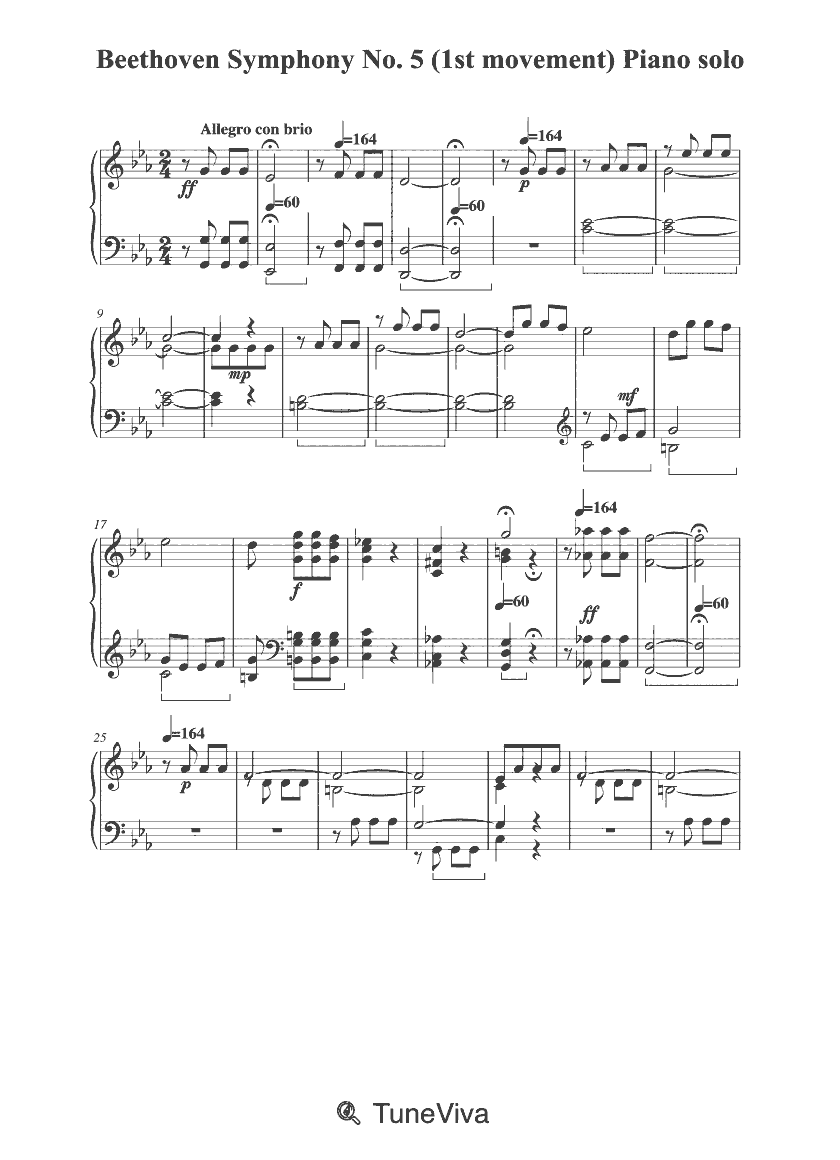
Beethoven Symphony No. 5 (1st movement) Piano solo
Ludwig van Beethoven
First Movement
Piano · 9 min 41 sec
Open score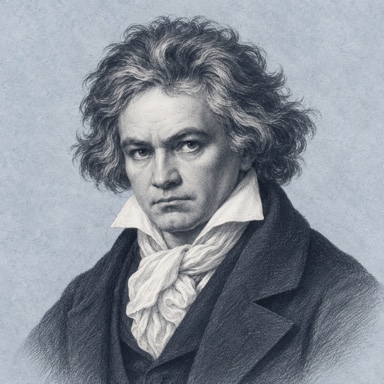
346 Beethoven scores to preview and download, from Für Elise and the Moonlight Sonata to piano solos of the Fifth, Seventh and Ninth Symphony movements.
Piano · 9 min 41 sec
The most-viewed score in the collection, a piano reduction of the movement built on the four-note motif.
Other editions:
A jazz lead-sheet treatment of the first movement of the Piano Sonata No. 14, the second most-viewed item.
Piano · 1 min 15 sec
The bagatelle in A minor, among the most familiar piano pieces ever written.
Other editions:
Piano · 10 min 46 sec
The Allegretto of the Seventh, a movement famous for its steady, ostinato pulse.
Other editions:
The choral finale with the Ode to Joy, reduced for piano and voices.
The full sonata in a conventional piano edition, alongside the jazz lead sheet.
Piano · 14 min 54 sec
The opening movement of the Pastoral Symphony in piano reduction.
Other editions:
Violin · 3 min 22 sec
A short, widely taught piece, here in a solo violin arrangement.
Other editions:
Piano · 1 min 20 sec
Other editions:
If you want solo piano, compare the Adagio from the Pathétique with a complete Moonlight Sonata edition. The Adagio is one movement, while the complete Moonlight includes a short Allegretto and a fast finale as well as its familiar opening. For the Fifth Symphony, look for a piano reduction if one player needs to cover orchestral ideas. The opening motif alone does not tell you whether the rest of the movement is included.
Compare the instrument and arrangement details below, then open a score to check the notation. Different entries may be arrangements or editions of the same work; available playback tools are shown on each score page.
Ludwig van Beethoven
First Movement
Piano · 9 min 41 sec
Open score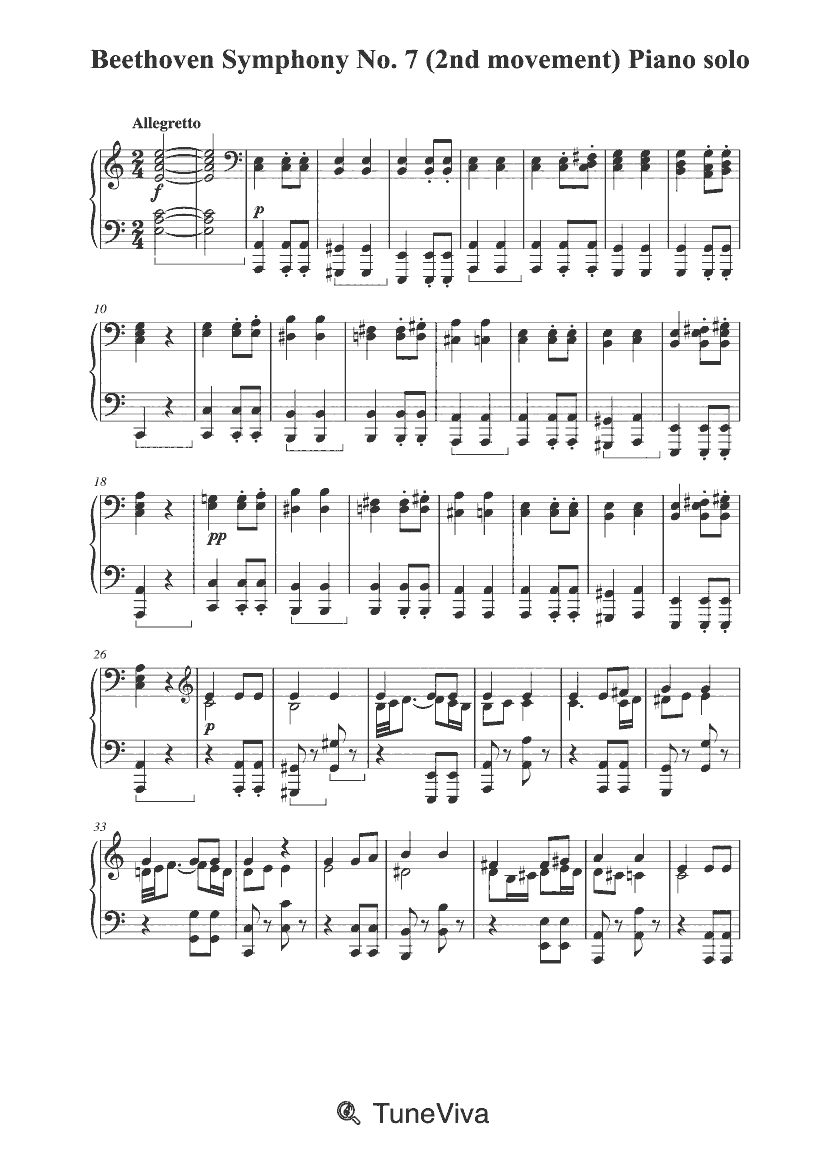
Ludwig van Beethoven
Second Movement
Piano · 10 min 46 sec
Open score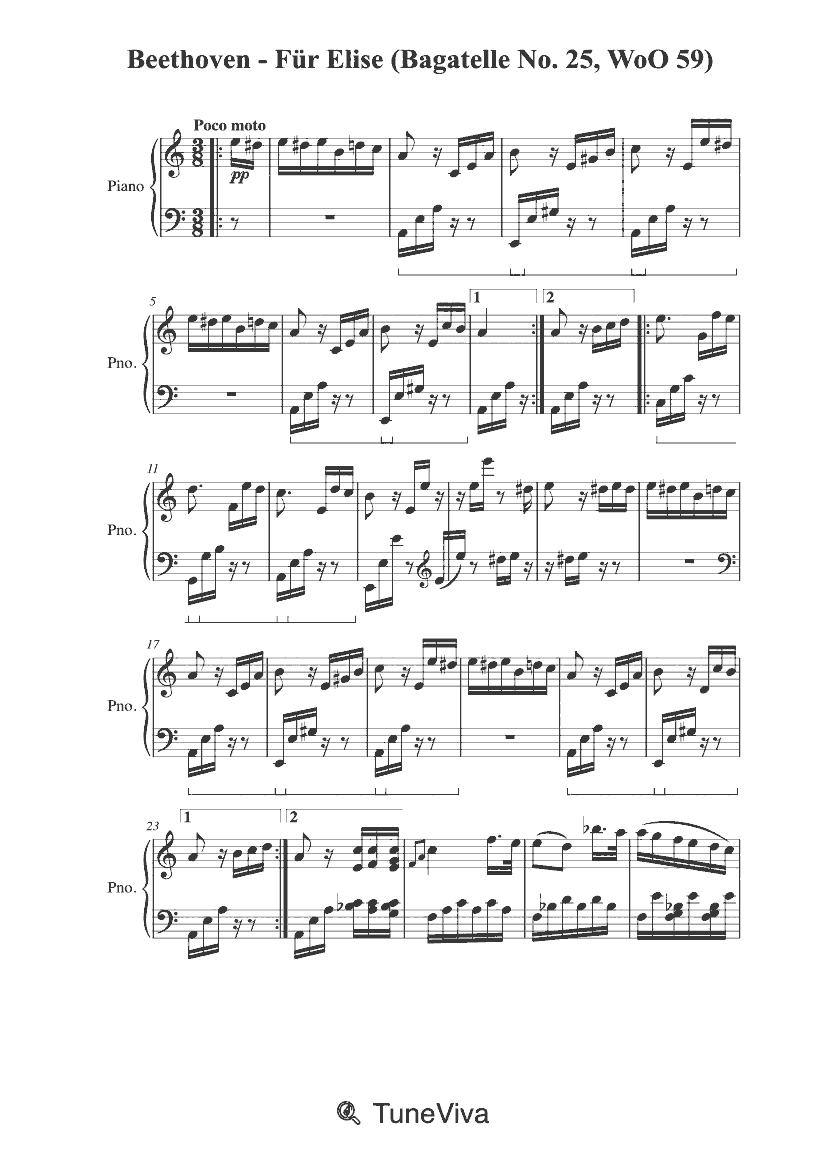
Ludwig van Beethoven
Piano · 1 min 15 sec
Open score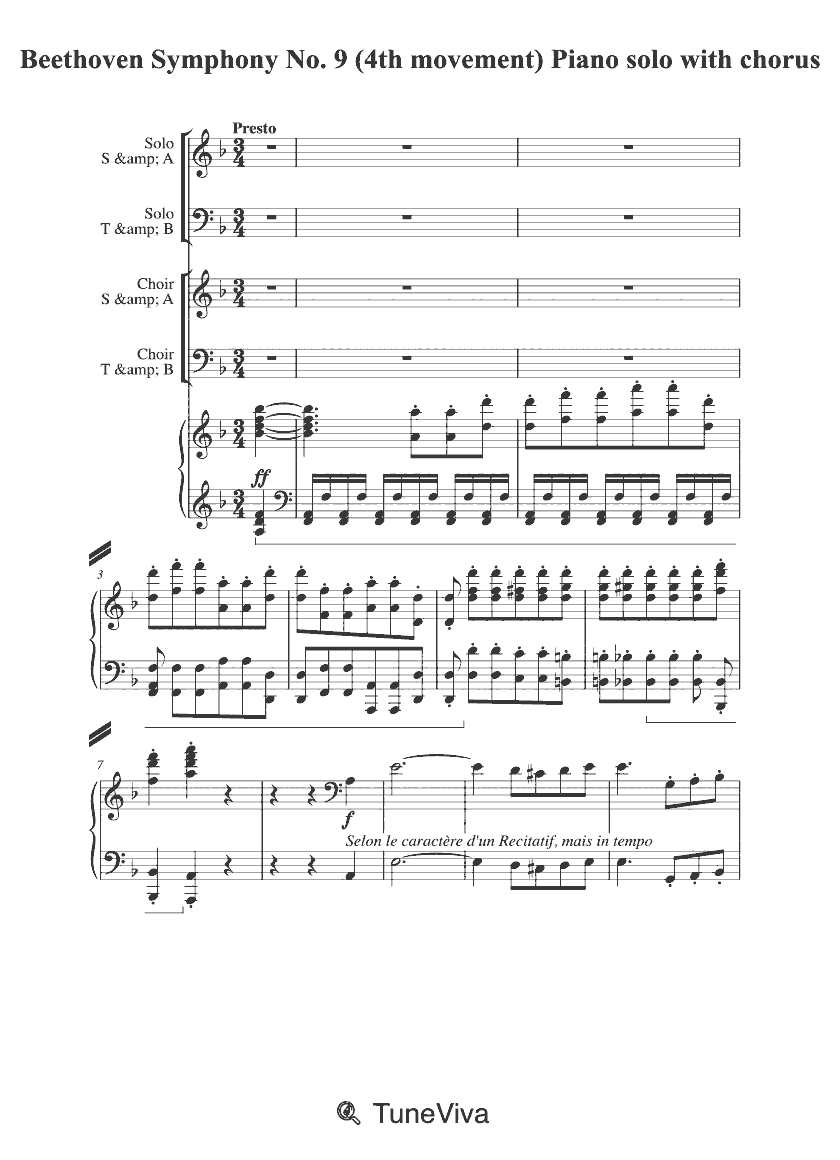
Ludwig van Beethoven
Fourth Movement (Choral)
Solo S & A; Solo T & B; Choir S & A +2 parts · 21 min 53 sec
Open score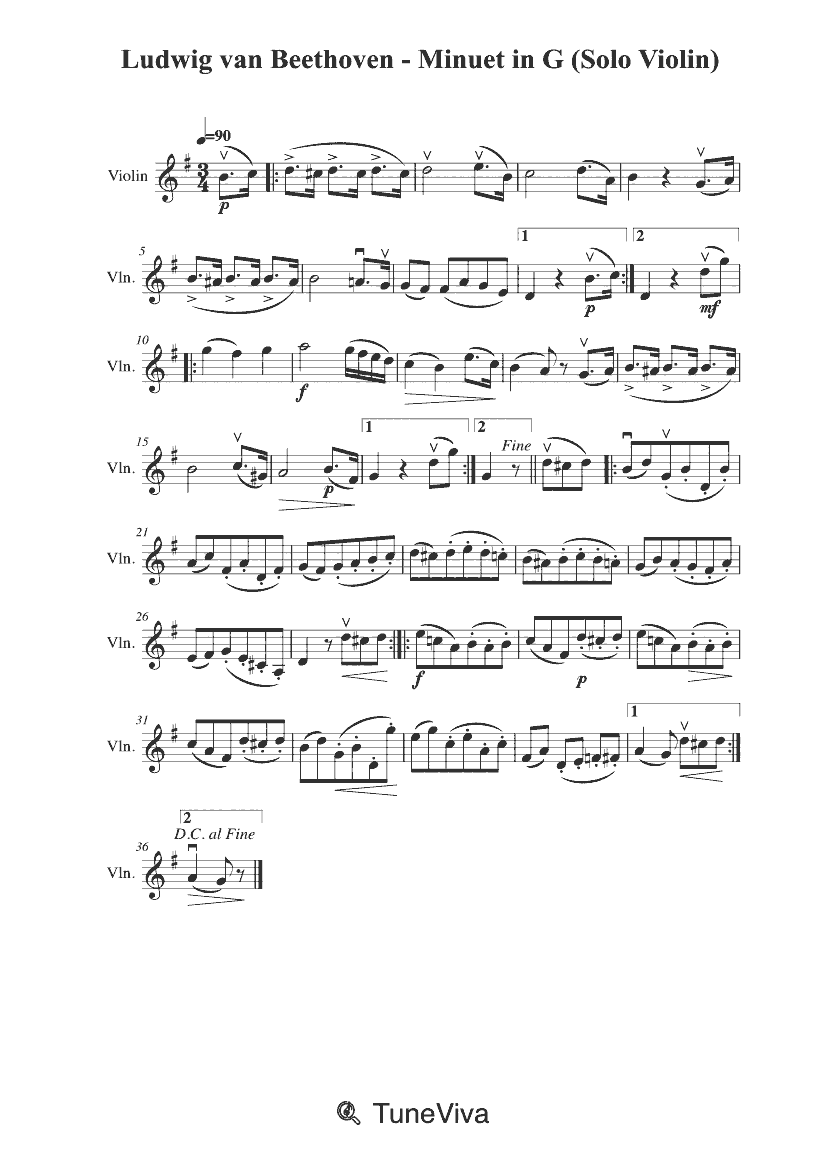
Ludwig van Beethoven
Scored by Sean Mail
Violin · 3 min 22 sec
Open score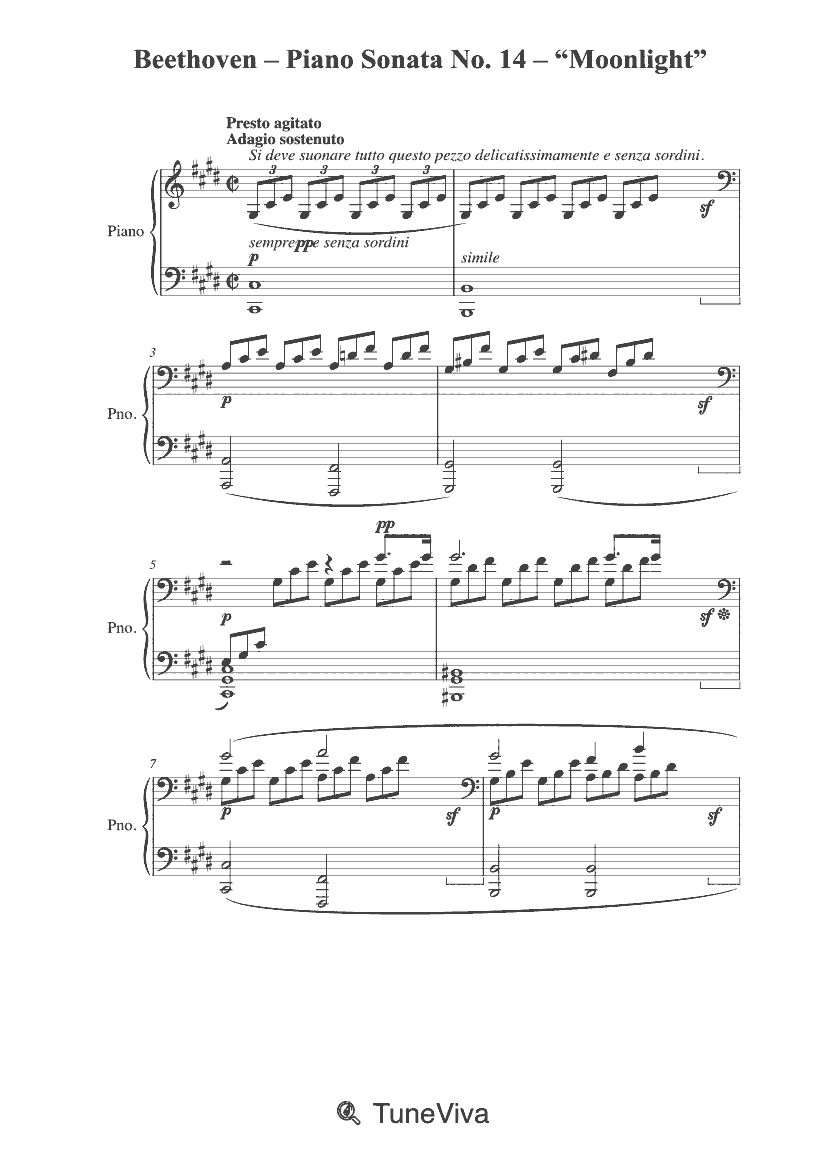
Ludwig van Beethoven
Piano · 19 min 57 sec
Open score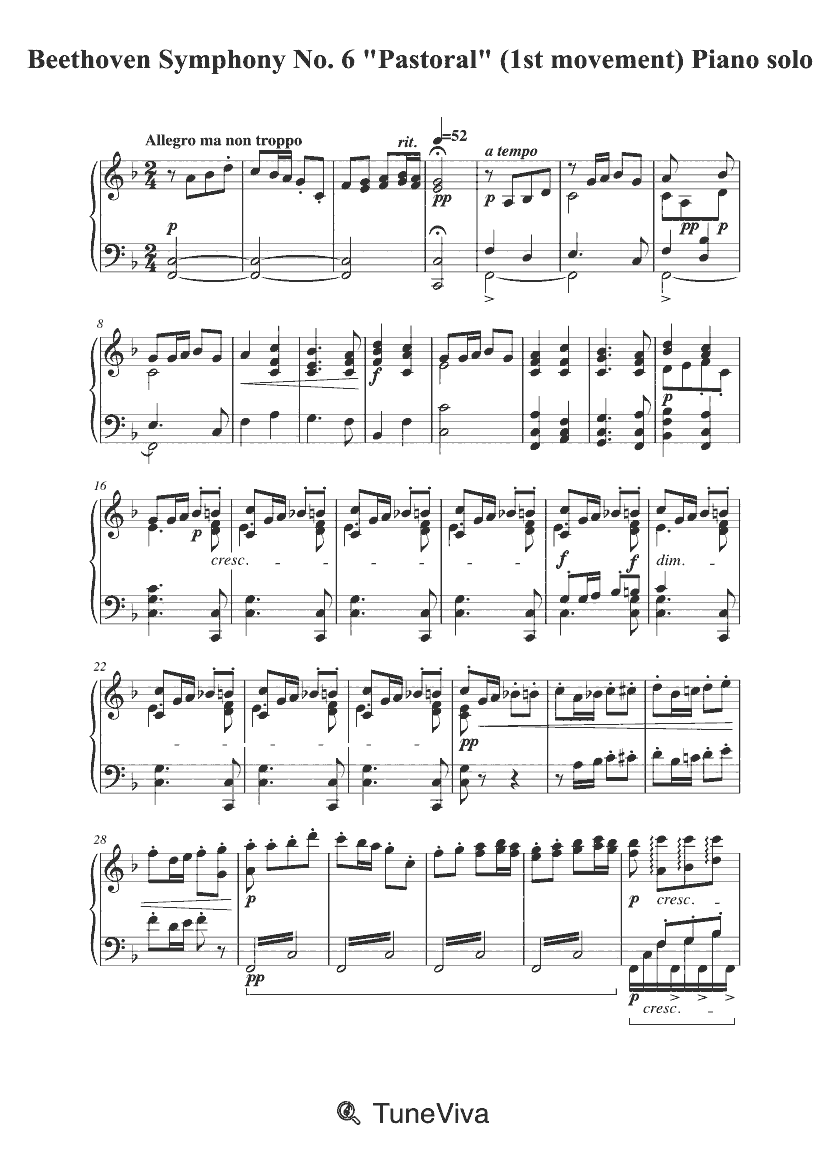
Ludwig van Beethoven
PastoralFirst Movement
Piano · 14 min 54 sec
Open score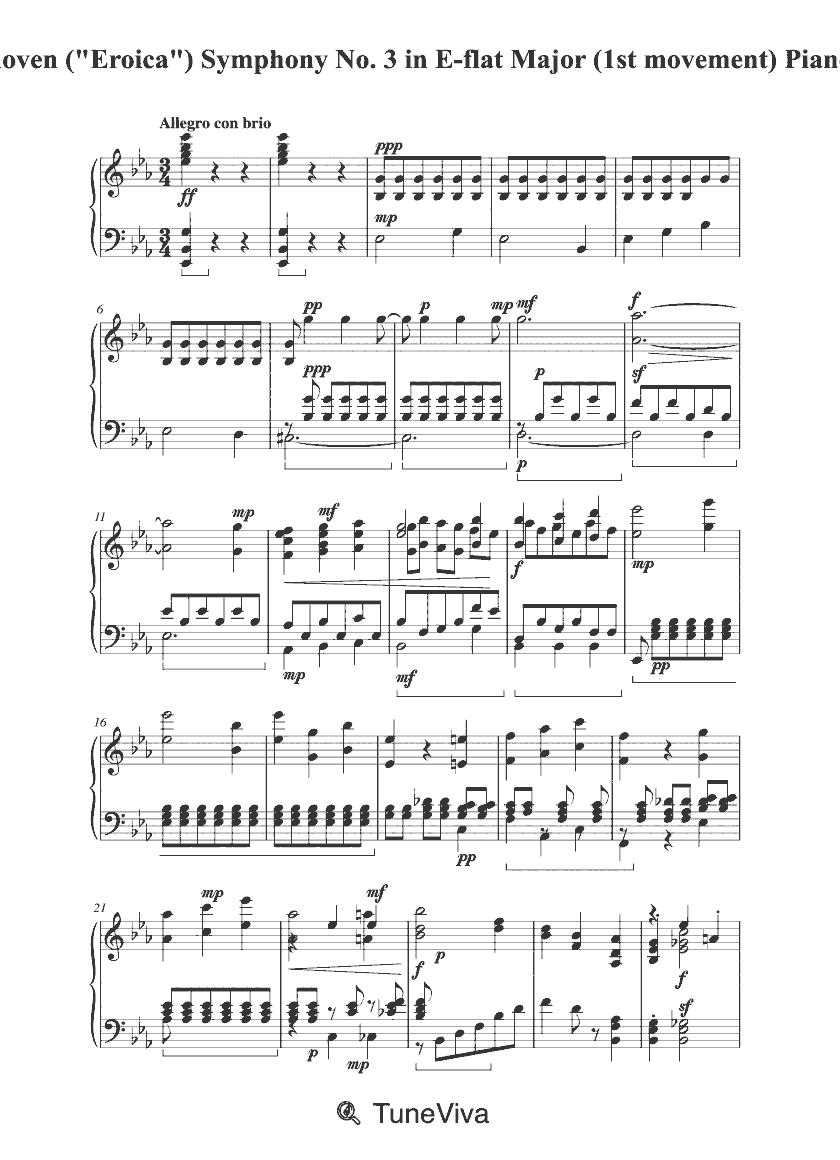
Ludwig van Beethoven
EroicaFirst Movement
Piano · 16 min 39 sec
Open score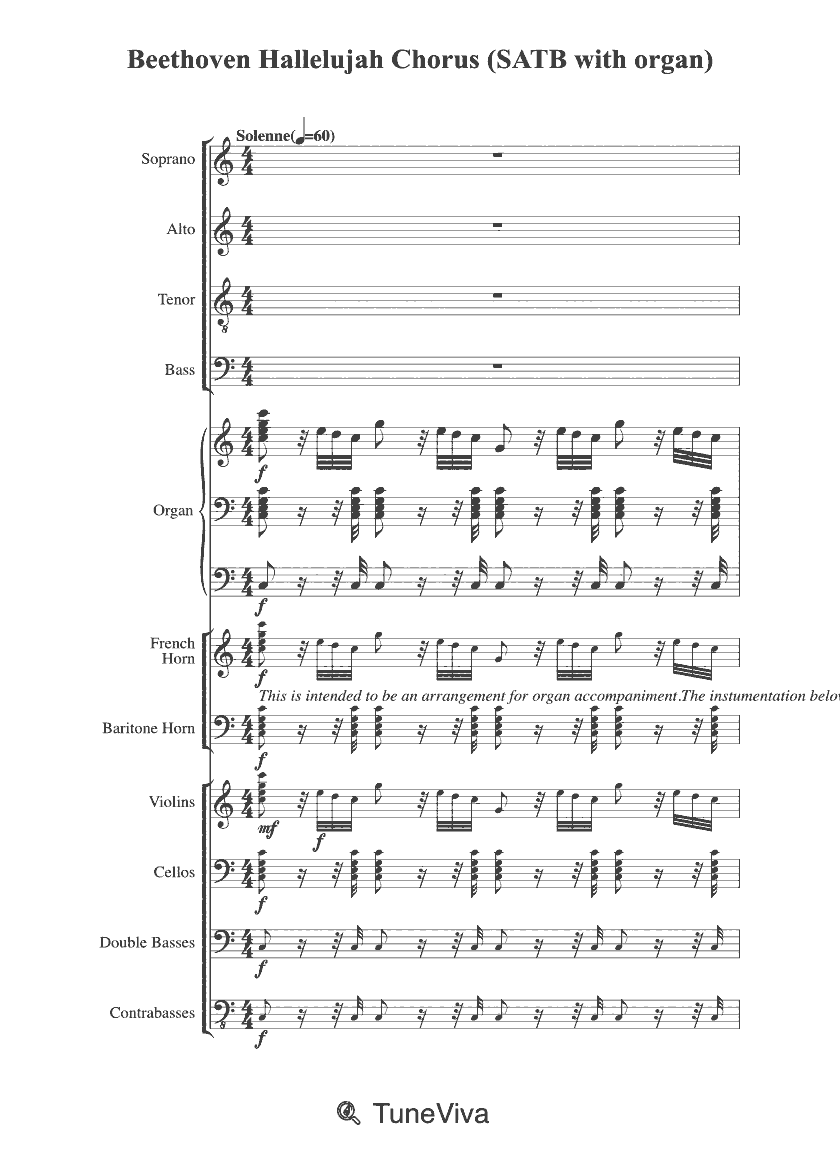
Ludwig van Beethoven
From Christ on the Mount of Olives
Soprano; Alto; Tenor +8 parts · 8 min 47 sec
Open score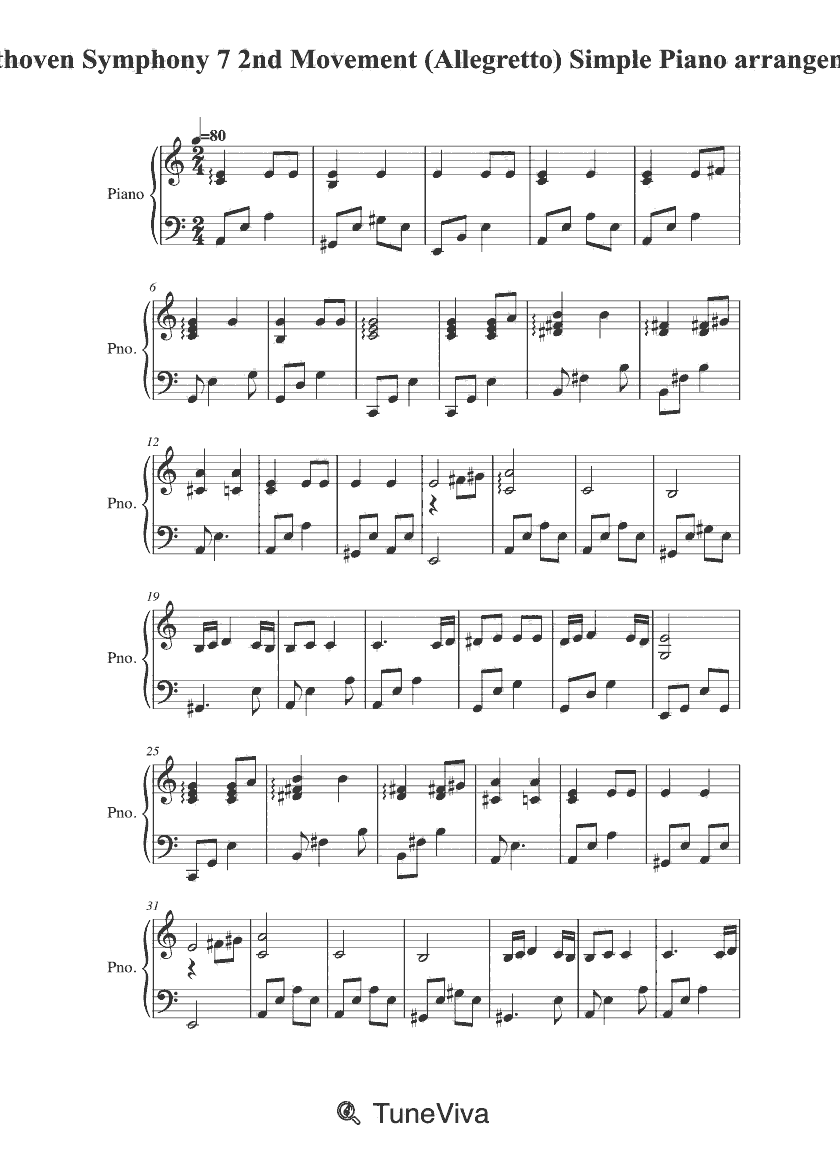
Ludwig van Beethoven
Simple arrangement for piano
Piano · 1 min 17 sec
Open score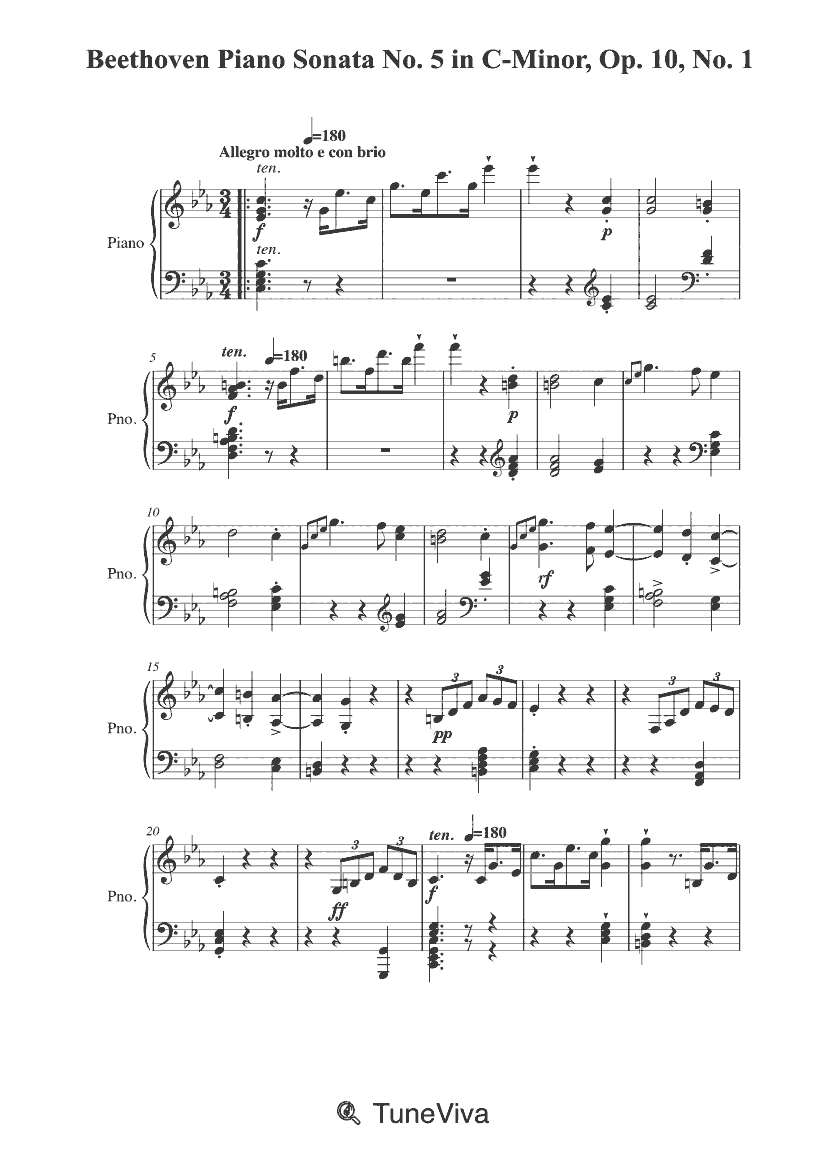
Ludwig van Beethoven
Op. 10 No. 1
Piano · 31 min 3 sec
Open score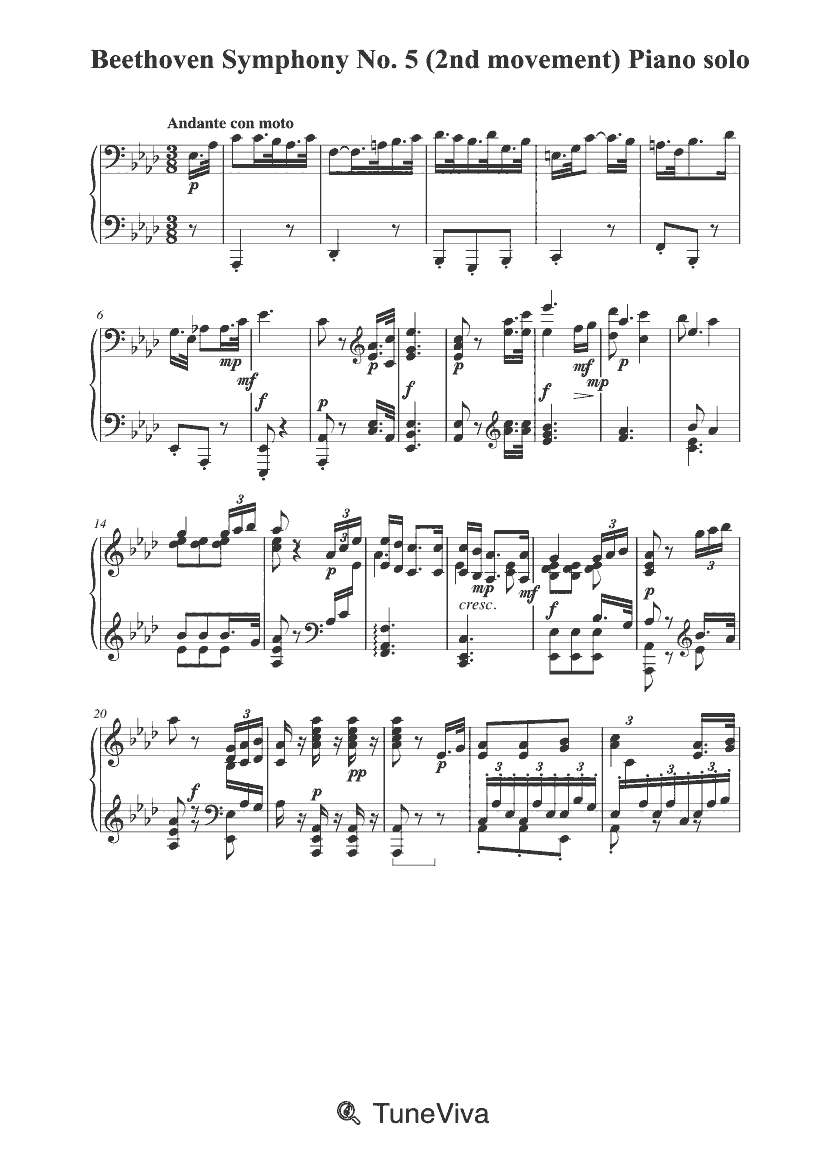
Ludwig van Beethoven
Second Movement
Piano · 4 min 6 sec
Open score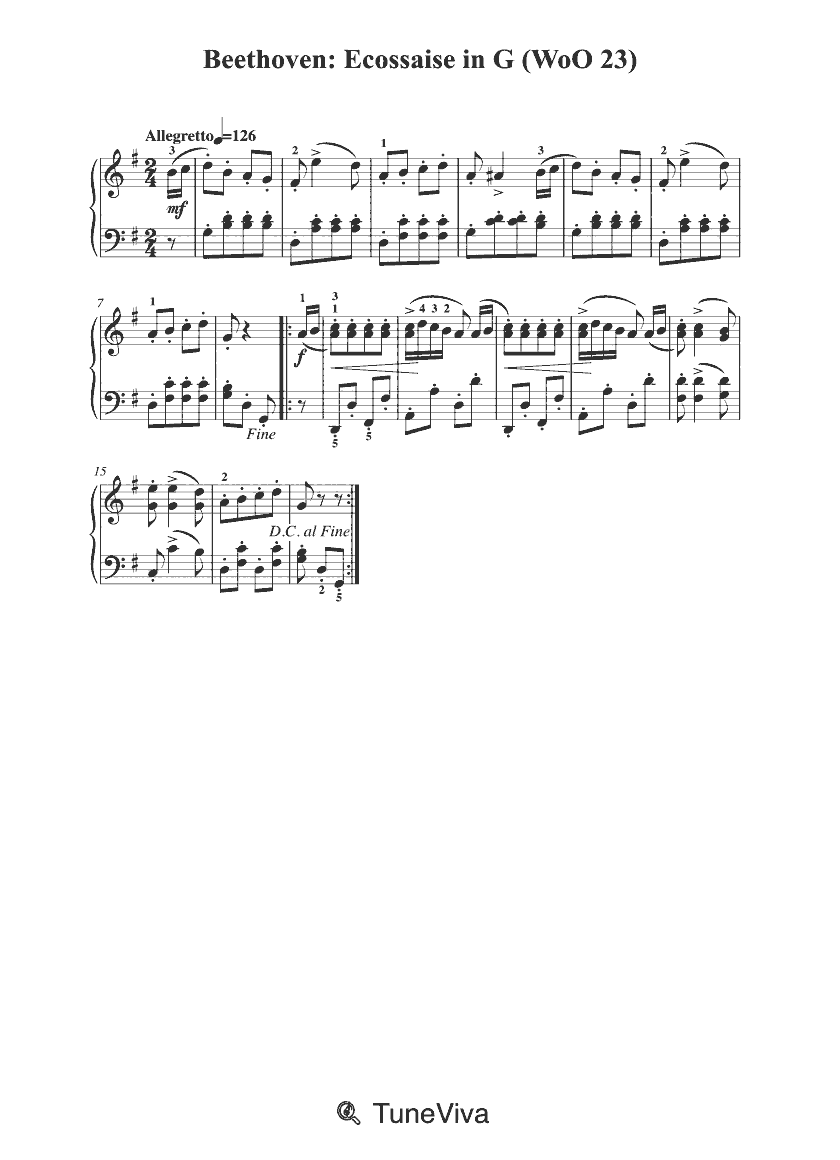
Ludwig van Beethoven
WoO 23
Piano · 23 sec
Open score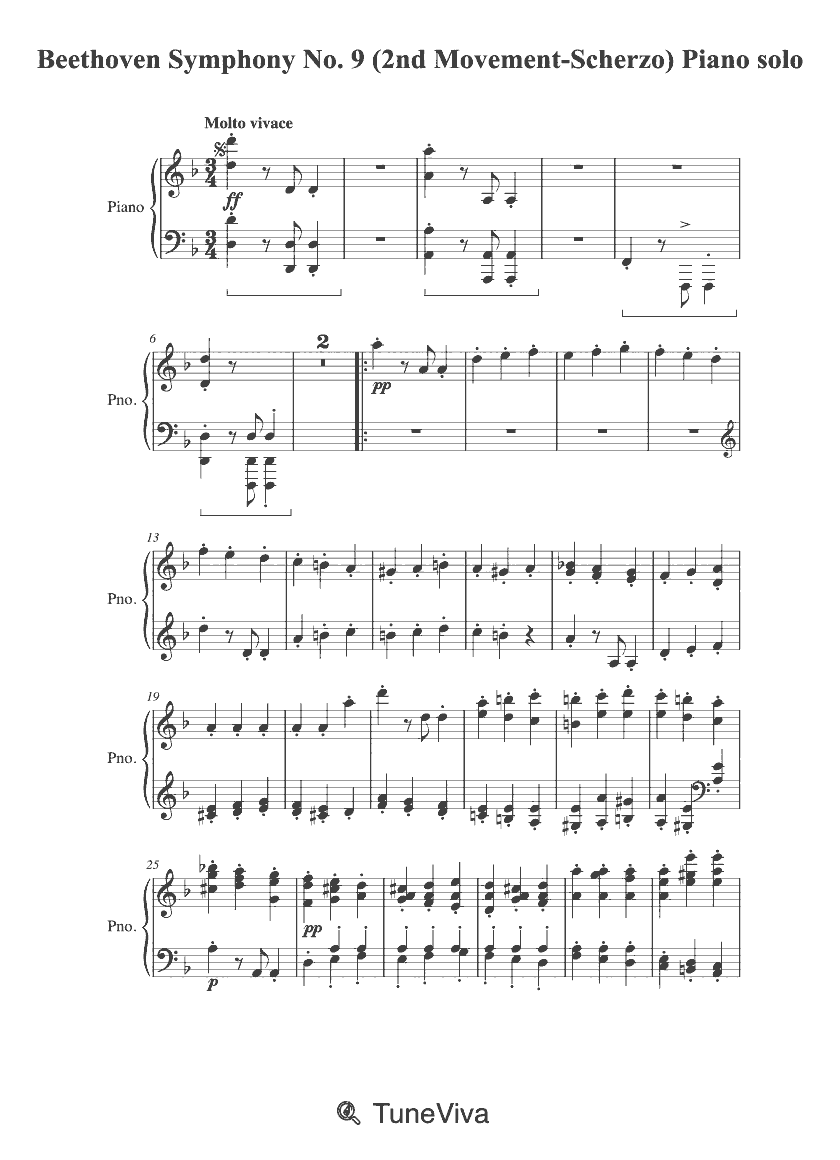
Ludwig van Beethoven
Second Movement - Scherzo
Piano · 1 hr 6 min 45 sec
Open score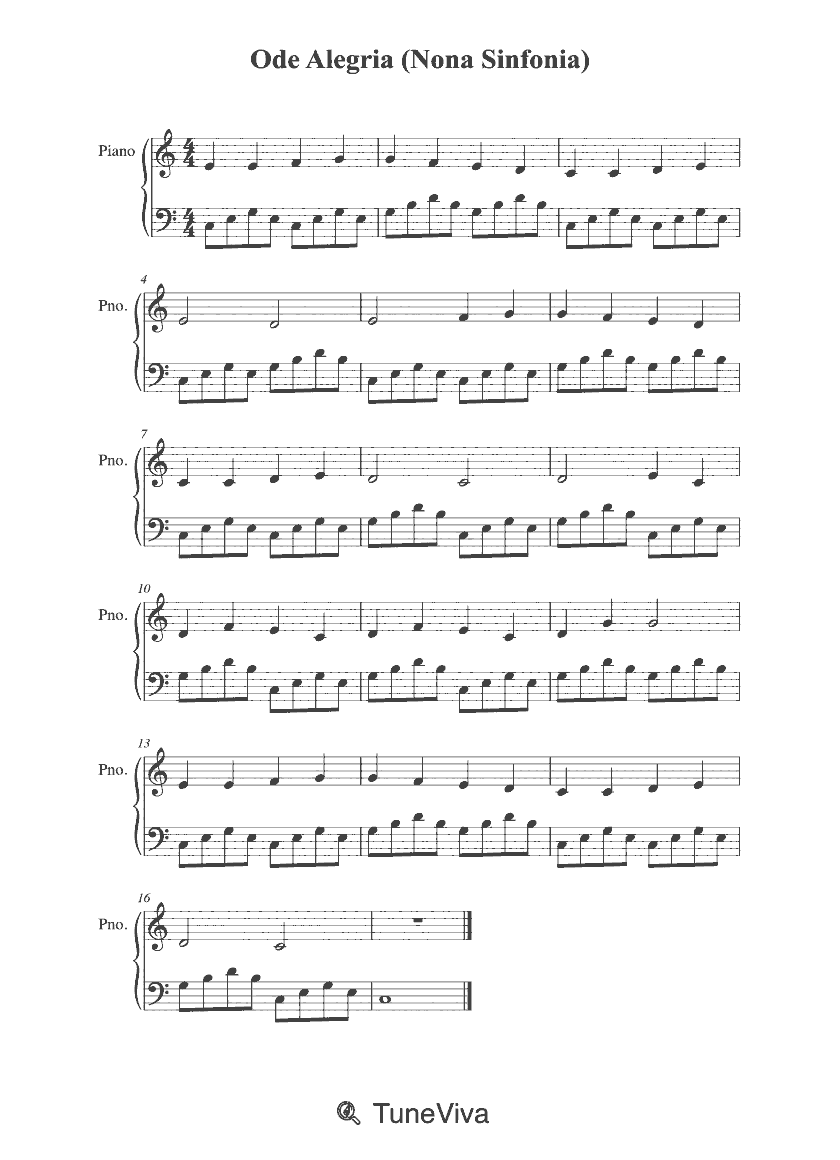
Ludwig van Beethoven
Piano · 34 sec
Open score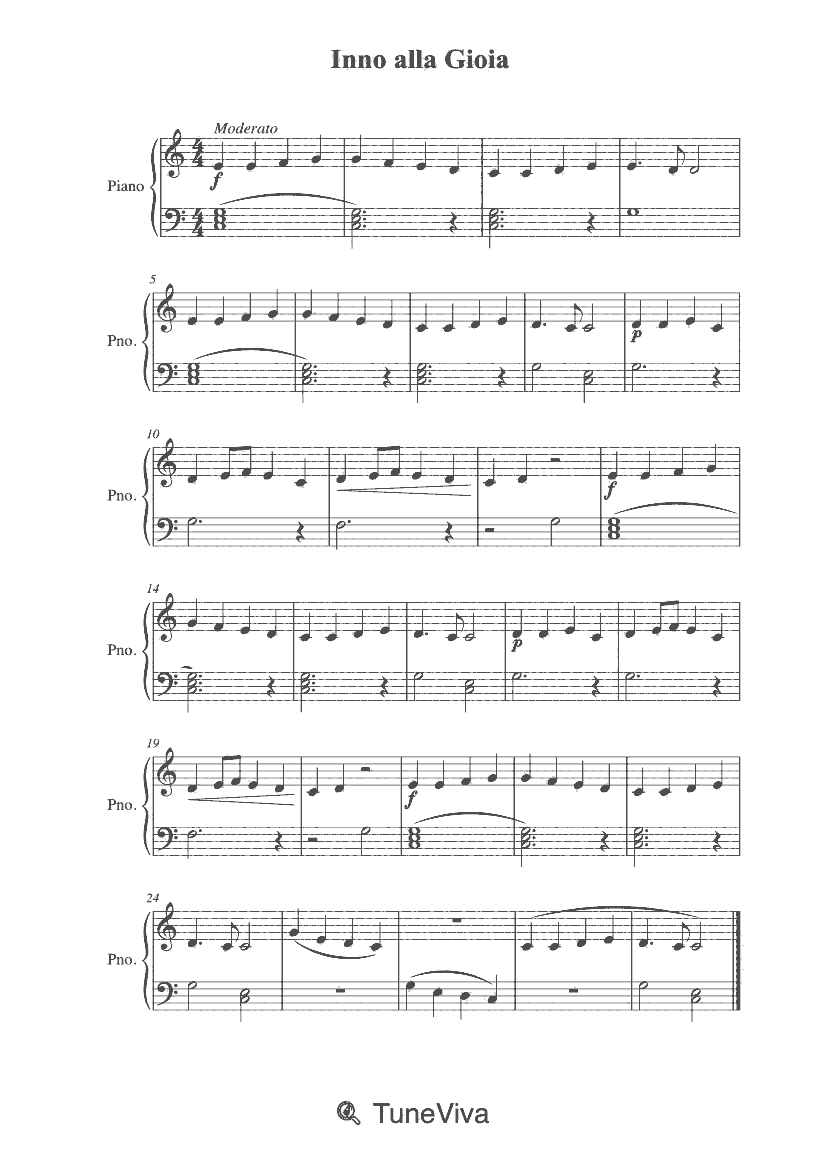
Ludwig van Beethoven
Piano · Arr. Dalla Nona Sinfonia · 56 sec
Open score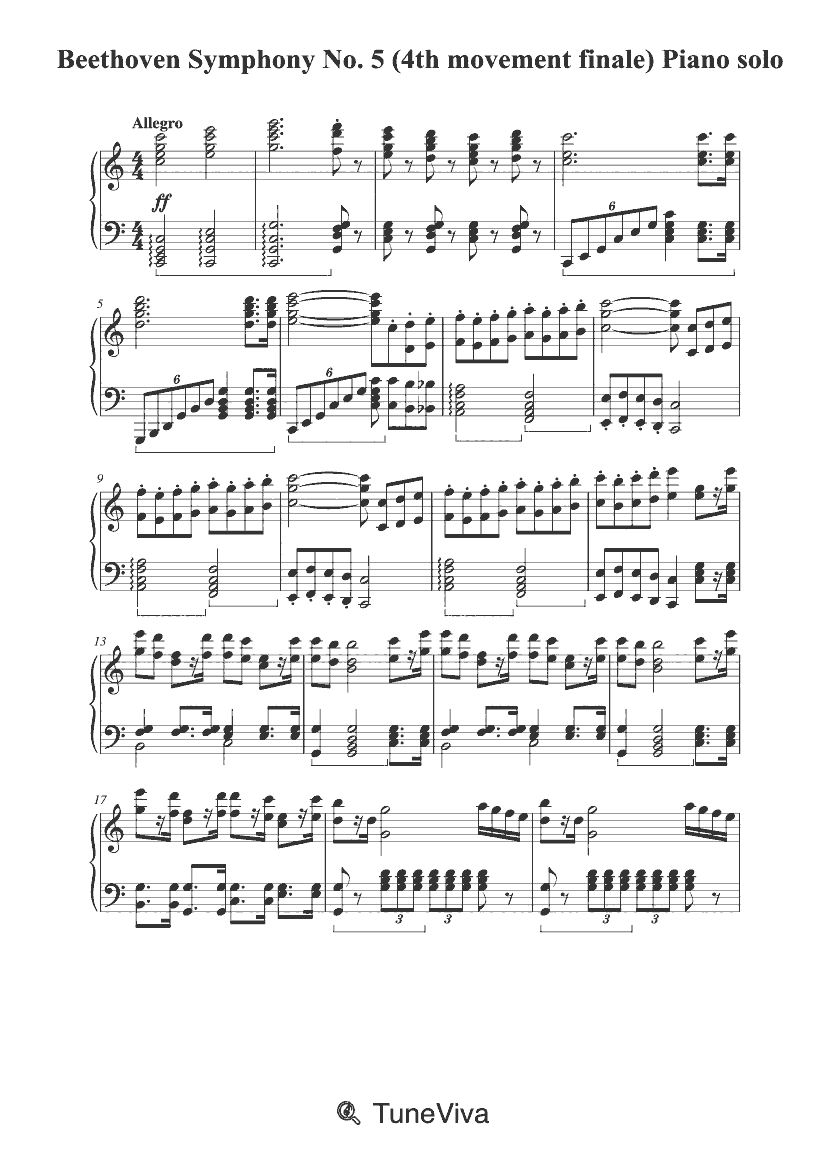
Ludwig van Beethoven
Fourth Movement Finale
Piano · 5 min 26 sec
Open score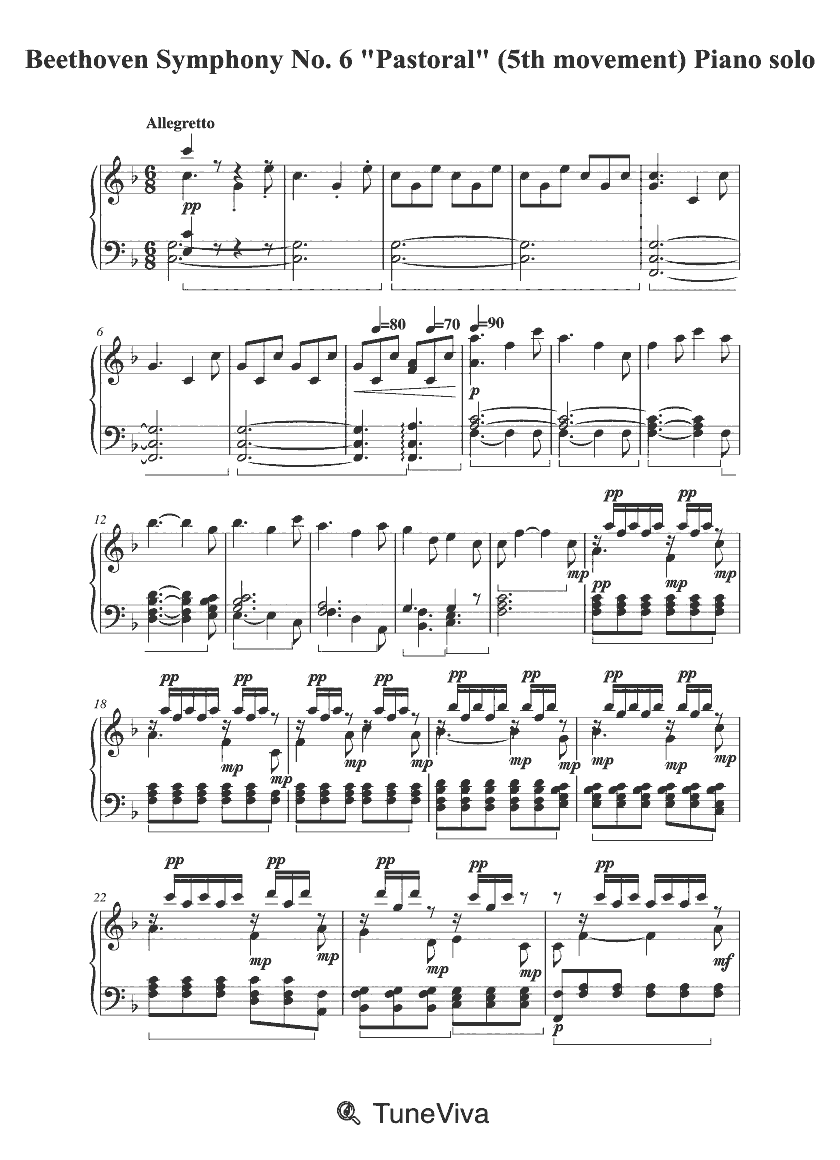
Ludwig van Beethoven
Pastoral Fifth Movement
Piano · 6 min 4 sec
Open score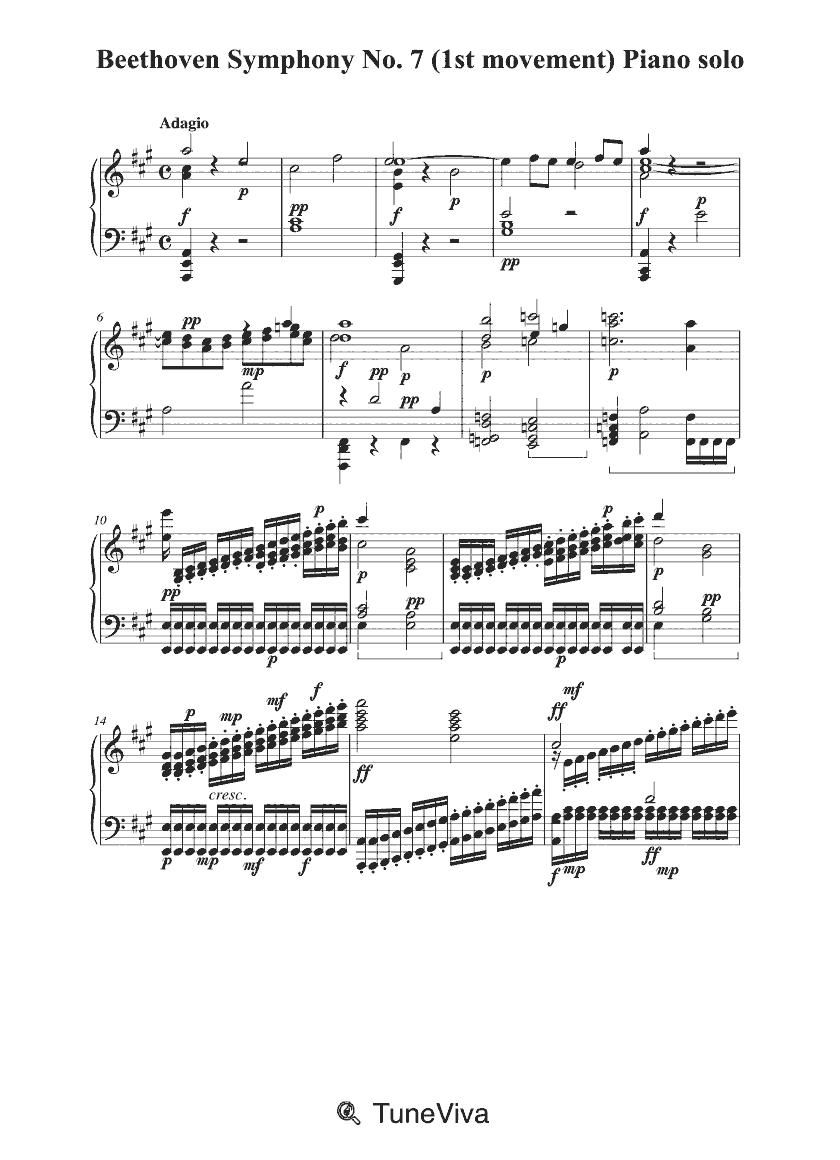
Ludwig van Beethoven
First Movement
Piano · 8 min 55 sec
Open score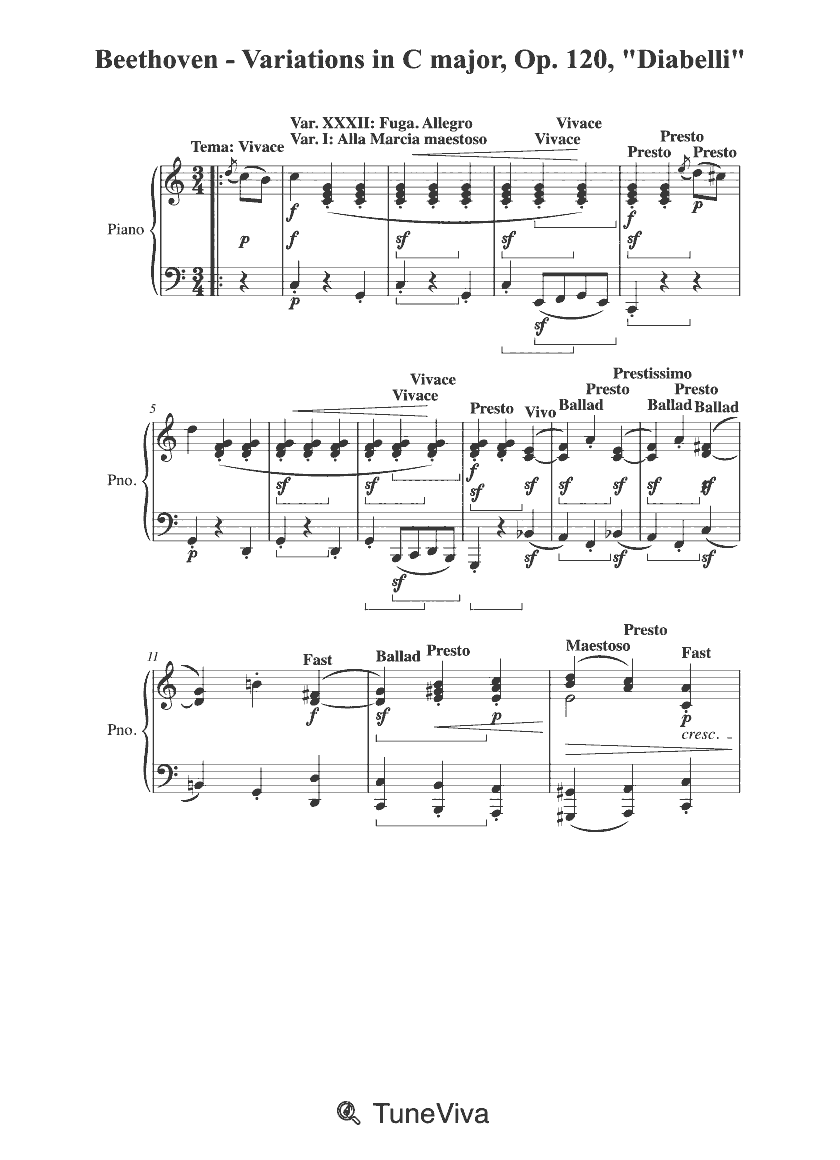
Ludwig van Beethoven
on a waltz by A. Diabelli Op. 120
Piano · 48 min 10 sec
Open scorePage 1 of 18
The most-viewed score on this page is a piano solo of the first movement of Beethoven's Fifth Symphony, with more than 392,000 views. The second is a jazz lead sheet of the Moonlight Sonata. That pairing says something about this catalogue: it holds 346 Beethoven scores, and many of them are arrangements and reductions rather than urtexts. Fifty-one carry lyrics, and the total runs to about 1,859 minutes. Für Elise, the Moonlight and the Pastoral are all here, along with four symphony movements set for piano and a small group of choral arrangements. Beethoven sheet music on this page ranges from original piano works to arrangements: the Moonlight Sonata in a full piano edition and as a jazz lead sheet, Für Elise, piano reductions of movements from the Fifth, Sixth, Seventh and Ninth Symphonies, and a solo violin Minuet in G. Because the selection mixes originals with reductions and arrangements, the scoring and title of each score matter when choosing what to play.
Beethoven was baptised in Bonn on 17 December 1770; the family home in the Bonngasse is now the Beethoven-Haus museum. His father Johann, a tenor, taught him harshly, and he later studied with the court organist Christian Gottlob Neefe. In 1792 he moved to Vienna, where he took counterpoint lessons with Haydn and also studied with Johann Albrechtsberger and Antonio Salieri. His patrons included Prince Karl Lichnowsky, Prince Lobkowitz, Archduke Rudolf and Prince Kinsky; Rudolf, Kinsky and Lobkowitz eventually guaranteed him an annual pension.
Hearing loss began around 1798. In 1802, at Heiligenstadt, he wrote the letter to his brothers now known as the Heiligenstadt Testament, recording thoughts of suicide and his resolve to keep composing. He was never completely deaf, but he used conversation books from 1818. The heroic middle period produced the Eroica, the Fifth and Sixth Symphonies, the Violin Concerto and the Emperor Concerto. Fidelio, his only opera, was first staged in 1805 and revised repeatedly. The Missa solemnis was completed in 1823, and the Ninth Symphony had its premiere in 1824; the late string quartets followed. He died in Vienna on 26 March 1827.
The catalogue holds 346 Beethoven scores, with 51 lyrics-bearing entries and 1,250,304 notated notes across roughly 1,859 minutes. The most-viewed titles are predominantly piano reductions of orchestral movements and well-known short pieces, which makes the collection useful to a pianist who wants to play familiar music without a full orchestra.
Original piano music and arrangements: The Moonlight Sonata appears in a conventional piano edition, while a separate jazz lead sheet treats material from the same sonata. Für Elise is listed as a piano bagatelle, WoO 59. The symphony items are piano reductions of individual movements, and the Minuet in G is a solo violin arrangement. Check the score parts before assuming you are getting a complete work in its original instrumentation.
The Fifth Symphony at the keyboard: Beethoven composed the Fifth Symphony between 1804 and 1808; it has four movements and opens with the short-short-short-long motif often called “fate knocking at the door.” A piano reduction of the first movement transfers that motif and the movement’s momentum to two hands, so aim for clear articulation and a balance between the motif and its accompaniment rather than trying to imitate an orchestra’s volume.
Reading the Moonlight Sonata’s title: Piano Sonata No. 14 in C-sharp minor, Op. 27 No. 2, was completed in 1801 and dedicated in 1802 to Beethoven’s pupil Countess Julie “Giulietta” Guicciardi. Its first edition is headed Sonata quasi una fantasia — a sonata in the manner of a fantasy. The nickname “Moonlight” was not Beethoven’s; it arose from imagery later proposed by the poet Ludwig Rellstab. That context helps explain why the work is often described as freely shaped rather than as a conventional sonata.
Beethoven’s middle period and the works around it: Source material divides Beethoven’s career into three periods. In the middle period (1802–1812) he developed a distinctive style; the Third (Eroica) and Fifth Symphonies premiered in 1805 and 1808, and the period also includes Fidelio, the Violin Concerto, the Razumovsky quartets, the Waldstein and Appassionata sonatas, the Kreutzer sonata and the Seventh Symphony. This context can help place the Fifth, Seventh and Pastoral reductions alongside the piano sonatas when choosing scores.
The catalogue holds more than one version of the sonata, including a jazz lead-sheet treatment and a conventional piano edition.
No. The Hallelujah Chorus is from Handel's Messiah. The catalogue has an entry titled Beethoven Hallelujah Chorus, but the attribution is doubtful.
Yes. The catalogue includes piano reductions of movements from the Third, Fifth, Sixth, Seventh and Ninth.
Beethoven’s Fifth Symphony opens with a four-note short-short-short-long motif, often described as “fate knocking at the door.” The symphony was composed between 1804 and 1808, has four movements, and was first performed in Vienna in 1808. The piano solo on this page is a reduction of the first movement.
The nickname “Moonlight Sonata” was not given by Beethoven. It arose from imagery later proposed by the poet Ludwig Rellstab, and the sonata’s first edition is headed Sonata quasi una fantasia. The work is Op. 27 No. 2, completed in 1801 and dedicated in 1802 to Beethoven’s pupil Countess Julie “Giulietta” Guicciardi.
“Quasi una fantasia” means “sonata in the manner of a fantasy” or “sonata resembling a fantasy.” Beethoven used it as the heading of Piano Sonata No. 14, Op. 27 No. 2, signaling a free-flowing, improvisatory character within a sonata.
The jazz lead sheet is a separate arrangement of material from Beethoven’s Piano Sonata No. 14, not the original piano sonata. Beethoven’s work is a sonata for piano, Op. 27 No. 2, headed Sonata quasi una fantasia; the lead sheet is listed with lead and bass parts, so it is not the same score as the piano edition.
The Fifth and Sixth Symphonies were completed during 1807–1808 and premiered together at a concert in Vienna on 22 December 1808. The programme consisted entirely of Beethoven premieres and lasted more than four hours. The Fifth Symphony is dedicated to Prince Joseph Franz von Lobkowitz and Count Razumovsky.
Beethoven studied composition with Joseph Haydn in Vienna.
Beethoven’s middle period is usually dated 1802–1812. Works from this period include the Third (Eroica) and Fifth Symphonies, Fidelio, the Violin Concerto, the Razumovsky quartets, the Waldstein and Appassionata sonatas, the Kreutzer sonata and the Seventh Symphony. His late period includes the Missa solemnis, the Ninth Symphony and the late string quartets.