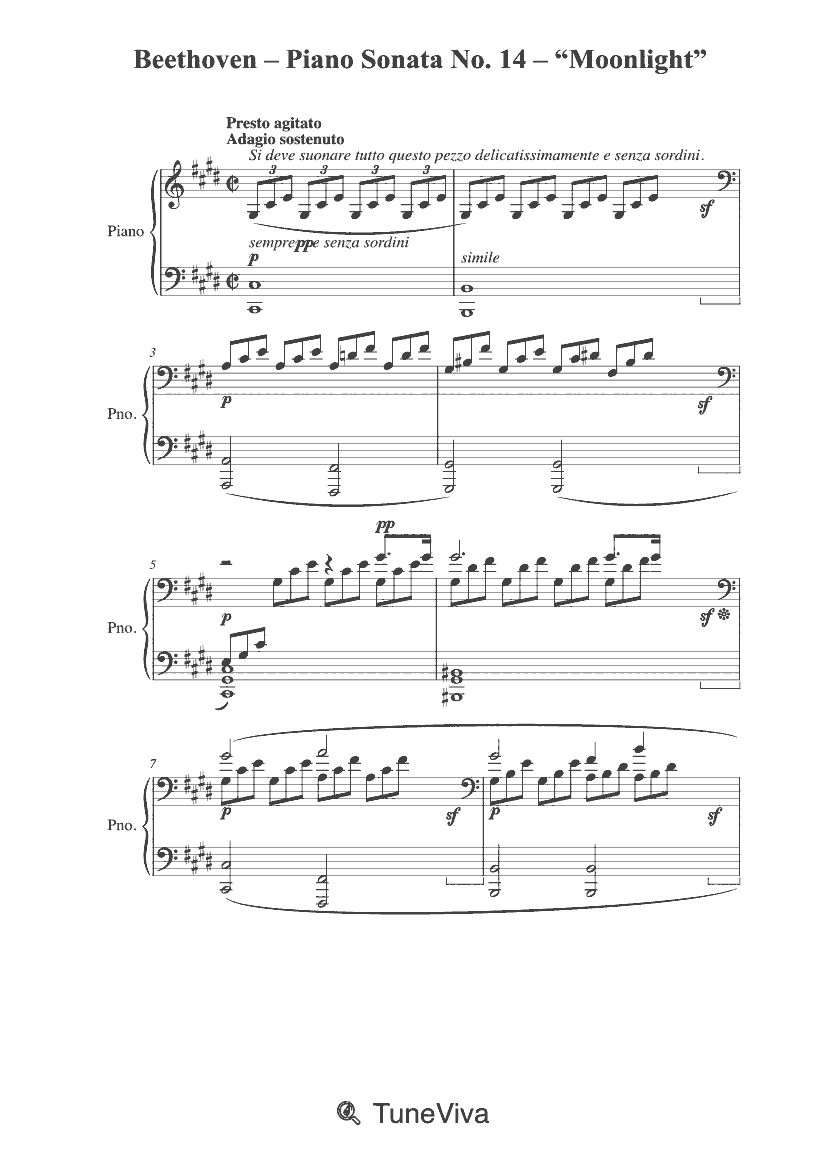
Beethoven – Piano Sonata No. 14 – “Moonlight”
Ludwig van Beethoven
Follow the score, hear the music, then make it your own.
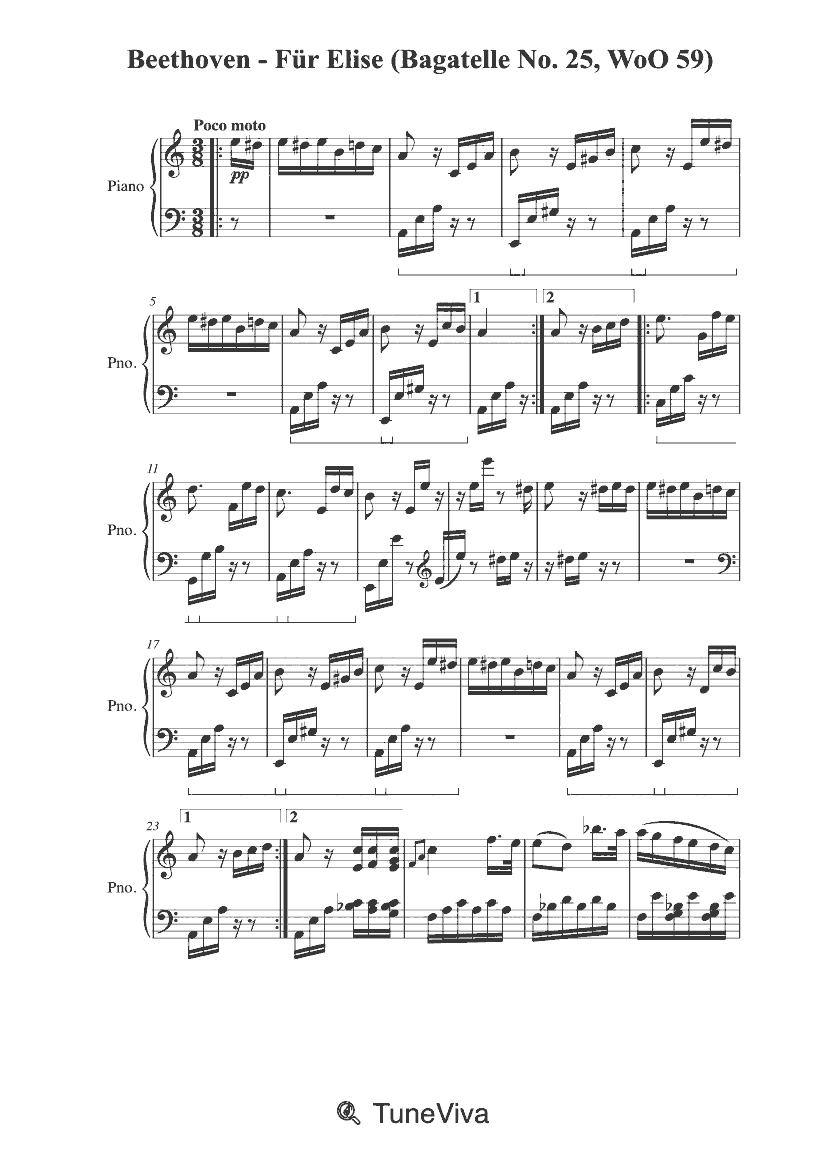
Beethoven’s Für Elise, WoO 59, is an A minor bagatelle for piano. This edition opens Poco moto and pianissimo, with two quiet sixteenth notes, E and D♯, before the first full 3/8 bar. Learn how that pickup leads into the tune, then use it as a landmark when the music returns from the contrasting episodes.
Score parts: Piano. Opening key signature: No sharps or flats. Opening time signature: 3/8. Opening tempo: 72 BPM. Estimated playback time: 1 min 15 sec. Listen while following the notation, adjust playback speed, or open this score in practice mode.
The alternating E and D♯ are the pickup. Continue through E–B–D–C to the first longer A and listen for the phrase to settle. Play that whole stretch before adding the left hand. When the bass begins, its broken A minor chord leads into a bar with an E bass and a G♯. Hear the pull between those two harmonies, then bring the bass down in volume until the right-hand line is easy to follow.
The familiar theme returns in several places, but the route into it changes. Follow the repeat signs and endings in this edition so you know where to resume. Later, the rising A minor arpeggios cover several octaves. Learn the first group and the landing of the next before trying to connect the whole sweep. Practise the return to the quiet opening as part of the passage, so that the release of tension has time to register.
Beethoven’s surviving sketches are held by Beethoven-Haus Bonn. Ludwig Nohl published the work in 1867 and reported the title from the manuscript he had seen. The manuscript is now missing, and the identity of the dedicatee remains uncertain. The work number WoO 59 is a reliable way to distinguish this bagatelle from other music with a similar title.
Mark where the E and D-sharp figure comes back after a contrasting passage. Start just before each return and continue through its first phrase rather than stopping on the familiar opening notes. You can then compare the two joins and hear how the bass re-enters. Leave enough time to release the previous texture so the quiet opening can sound light again.
It is in A minor. The opening key signature has no sharps or flats, while D♯ and G♯ appear as accidentals in the music.
It asks for a little motion. Keep the pickup and the first complete phrase moving gently, with room for the longer notes to settle.
The opening theme is followed by contrasting sections and returns. The later rising arpeggios make different technical demands from the first phrase.
Ludwig van Beethoven
Ludwig van Beethoven
Ludwig van Beethoven