

Bach: Polonaise in g Minor (BWV Anh. 125)
Notebook for Anna Magdalena Bach BWV Anh. 125
classical
1 tracks
The running keyboard line of the Solfeggio in C minor is a useful starting point for Carl Philipp Emanuel Bach, but it represents only one corner of his work. The composer lived from 1714 to 1788 and was Johann Sebastian Bach’s second son. His music ranges well beyond the short keyboard pieces that often introduce him to players.
This collection brings together 19 catalog scores under his full name and common initials, including the misspelling ‘Carl Phillip Emanuel Bach’. They are individual editions and arrangements, not 19 independently verified compositions. Start with the Solfeggietto, then compare the shorter keyboard pieces below.
Carl Philipp Emanuel Bach was born in Weimar in 1714 and studied music with his father, Johann Sebastian Bach. His reputation during his lifetime extended beyond the keyboard: the modern Complete Works project covers instrumental and vocal music rather than a narrow collection of student pieces. His keyboard treatise, Versuch über die wahre Art das Clavier zu spielen, appeared in two parts in 1753 and 1762 and addresses performance, embellishment and accompaniment.
The familiar Solfeggietto is identified in the scholarly catalogues as Wq 117/2 and H 220. The Complete Works introduction uses the title Solfeggio in C Minor and records its first publication in 1770. Both names are useful when comparing editions. Wq and H numbers refer to different catalogues, so two numbers alongside a title need not mean two different pieces.
The TuneViva grouping joins spelling variants of the same composer credit. It does not turn every uploaded attribution into a scholarly conclusion. Some files preserve a Bach-family title or an arrangement credit; compare the work number and the individual score before choosing an edition. Source titles remain visible so that an existing link or a familiar catalogue reference can still be recognized. The selected links offer contrasting entry points rather than a complete survey of his output.
For the Solfeggietto, practise short groups slowly enough to hear the harmonic change under the running notes. Where the line passes between the hands, aim for continuity rather than a new accent at each handover. In the shorter dances, establish the pulse before adding ornaments. These are practice suggestions, not an examination grade. Playback programs describe the uploaded file’s sounds; they do not establish which historical keyboard instrument the composer intended.
Also known as the Solfeggio in C minor, Wq 117/2. A short keyboard piece built around a flowing line.
A keyboard dance retained here under the catalog’s Bach-family numbering. Compare the source attribution when choosing an edition.
A different keyboard entry point beyond the Solfeggio; the H number helps distinguish it from similarly named files.
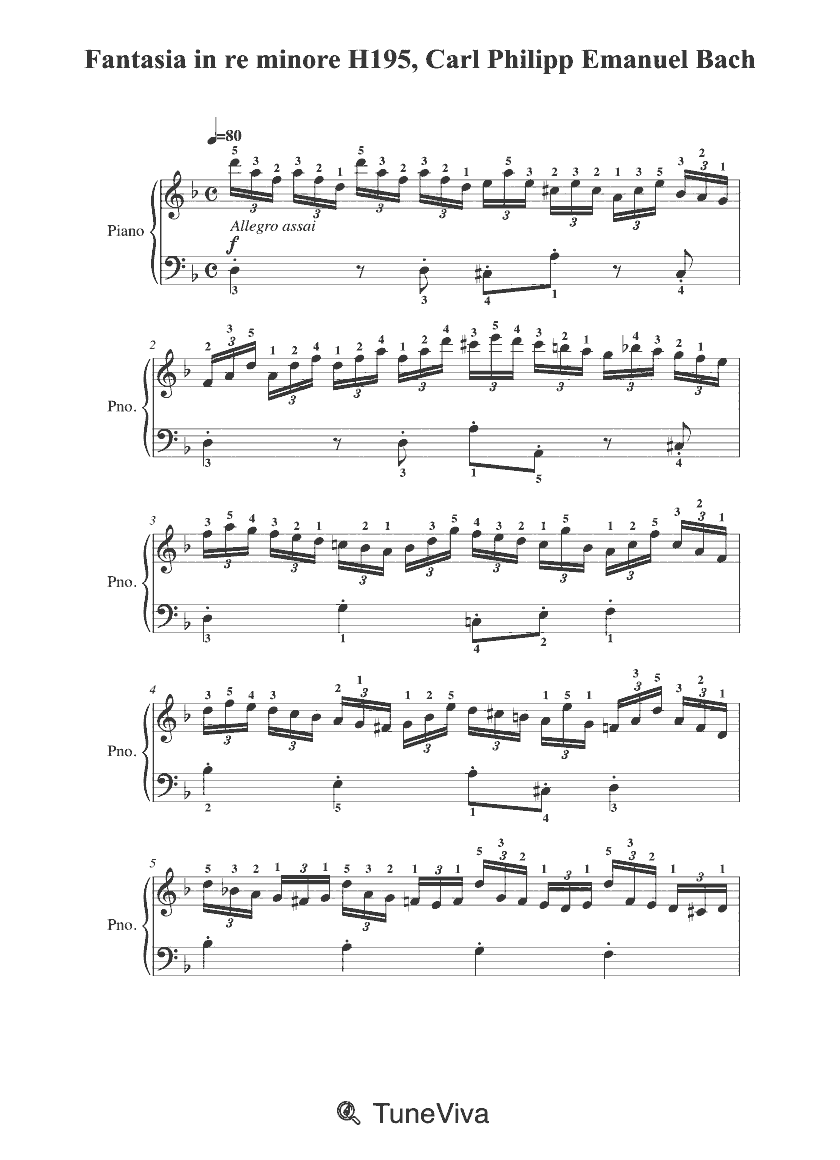
A short fantasia entry in the catalog, useful for comparing texture and pacing with the dances.
No. Carl Philipp Emanuel Bach was Johann Sebastian Bach’s son. Their catalogues and composer collections are separate.
The Complete Works introduction uses Solfeggio in C Minor, Wq 117/2, H 220. Solfeggietto is the familiar title used by many editions.
They count catalog files under the merged composer credits, including editions and arrangements. They are not a count of unique authenticated works.
Catalog editions and arrangements attributed to Carl Philipp Emanuel Bach.
Notebook for Anna Magdalena Bach BWV Anh. 125

Notebook for Anna Magdalena Bach BWV Anh. 122

(Attributed to J. S. Bach as BWV 1031)

H. 220 Wq. 117:2

Orchestrated For Flute Oboe Harp/Piano Viola and Cello


Wq 117/39 H98

H.195 (Wq.117/15)


from Notebook for Anna Magdalena Bach (1725)

Arrangement of the Adagio per il Organo (H. 352) for Flute Oboe and Cello



Harpsichord
