

classical
4 tracks
The catalogue holds 54 Arcadelt scores, about 212 minutes of music and 35,658 notated notes, and 52 of them carry lyrics. Five separate files are settings of the Ave Maria, and the most-viewed of them has 4,112 views, more than five times the next entry. Il bianco e dolce cigno, the madrigal that made his name, appears twice. Around those sit French chansons, Latin motets, a complete Mass and a handful of madrigals. Forty-eight entries are logged at complexity index 0 and six at index 1; 43 are filed as classical, two as religious music and nine left unclassified.
Arcadelt was born in the Habsburg Netherlands, at Namur according to the most recent reference works, on 10 August 1507; older biographies put his birth at Liège around 1505. He was in Florence by the late 1520s and in Rome by 1538 or 1539, where he sang in the papal choir at St Peter's and then in the Sistine Chapel. In 1542 he set two sonnets by Michelangelo, who received them politely and paid him in satin. He left Italy in 1551 for France, became maître de chapelle to Charles de Guise, Cardinal of Lorraine, and died in Paris on 14 October 1568.
His first book of four-voice madrigals, printed in Venice at the end of the 1530s, was reprinted for a century. He left roughly 250 madrigals, 125 chansons and 24 motets, with three masses collected in a Paris print of 1557. Il bianco e dolce cigno, a setting of Giovanni Guidiccioni, turns on a rising figure at the 'thousand deaths' of its closing line. The Ave Maria is not a Renaissance motet at all: in 1842 Pierre-Louis Dietsch fitted the Latin prayer to Arcadelt's chanson 'Nous voyons que les hommes' and added a bass line, and that is the piece behind every Ave Maria file here.
The entries come from several name buckets, including 'Jacob Arcadelt', and their composer fields carry incompatible dates — 1500, 1504, 1505 and 1514 all appear. The music fits the profile: mostly four-voice secular pieces, a Missa Ave Regina Coelorum running to 8,293 notes, and an eight-voice Pater noster. Some titles are set in capitals and one carries Polish rehearsal instructions, suggesting a teaching edition rather than a critical one.
Arcadelt's madrigals move syllable by syllable and stay largely diatonic, so the difficulties are rhythmic rather than harmonic: keep the declamation even and let the homophonic passages sound as speech. In Il bianco e dolce cigno, shape the rising figure at 'mille morte' without slowing the pulse. The Ave Maria is a 19th-century harmonisation and should be sung with the smooth, chordal blend of a Romantic motet rather than the independent lines of a Renaissance one. The three-voice SAA version suits small choirs, since the middle part carries much of the harmony.
The most-viewed score here: Dietsch's 1842 Latin contrafactum of the chanson 'Nous voyons que les hommes', with an added bass, for four mixed voices.
A second four-voice entry for the same contrafactum, filed under the 'Jacob Arcadelt' spelling with a birth date of 1504 or 1505.
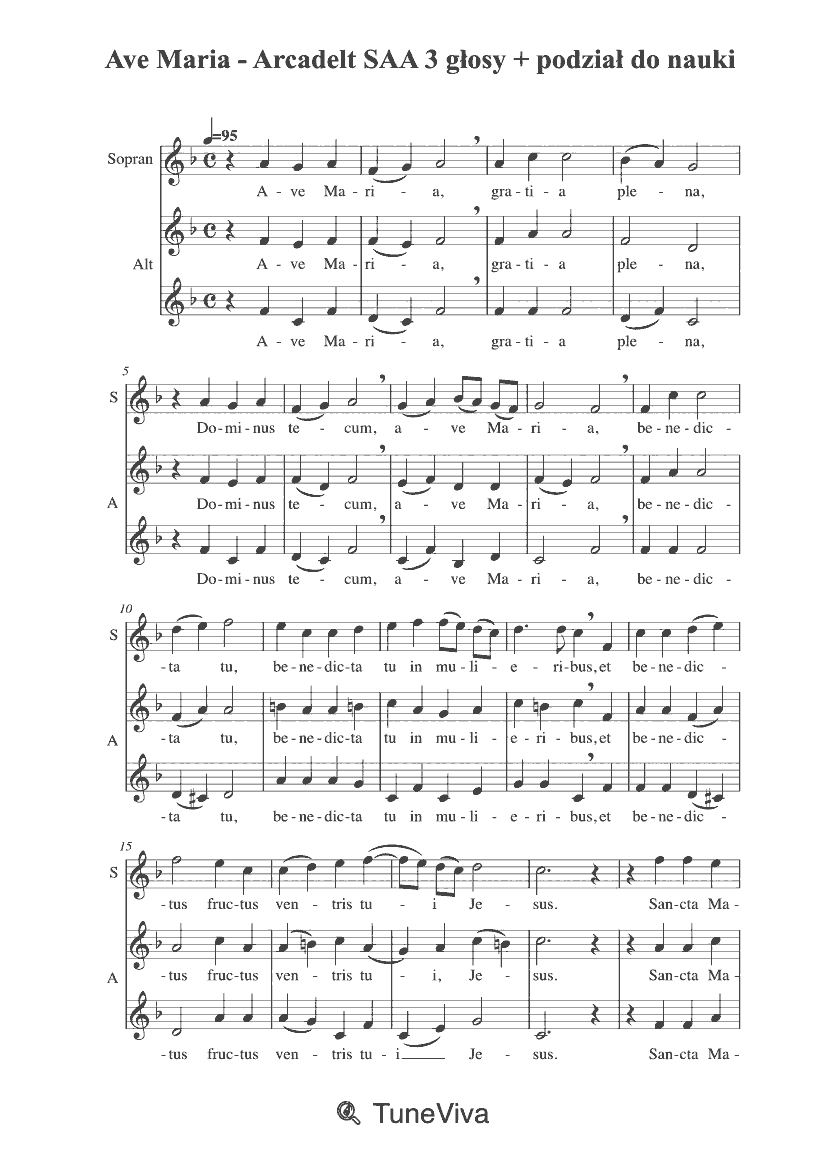
A three-voice SAA version with a division of parts for rehearsal, prepared for a Polish choir; the catalogue does not name the editor.
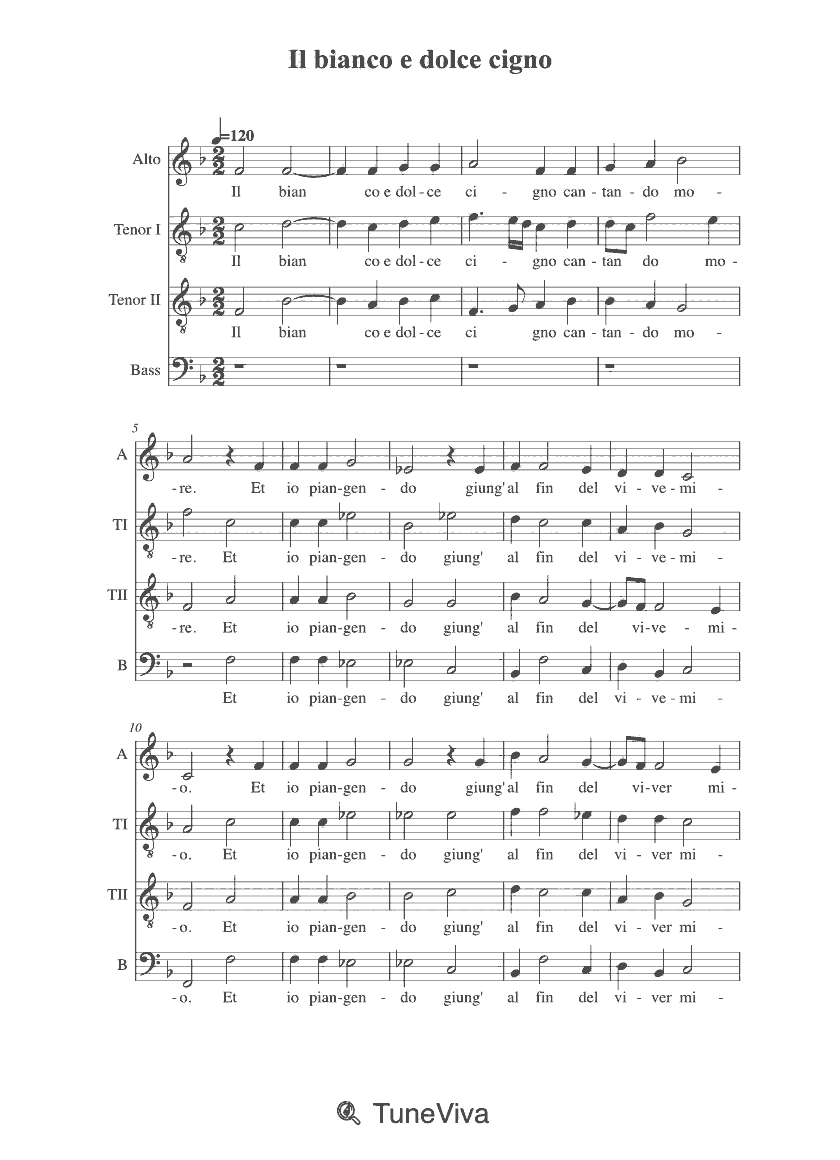
The four-voice madrigal on Guidiccioni's text, from the first book, and the most famous piece Arcadelt wrote.
A French chanson on a rustic text, printed in Paris by Le Roy and Ballard in 1554 and set here for four voices.
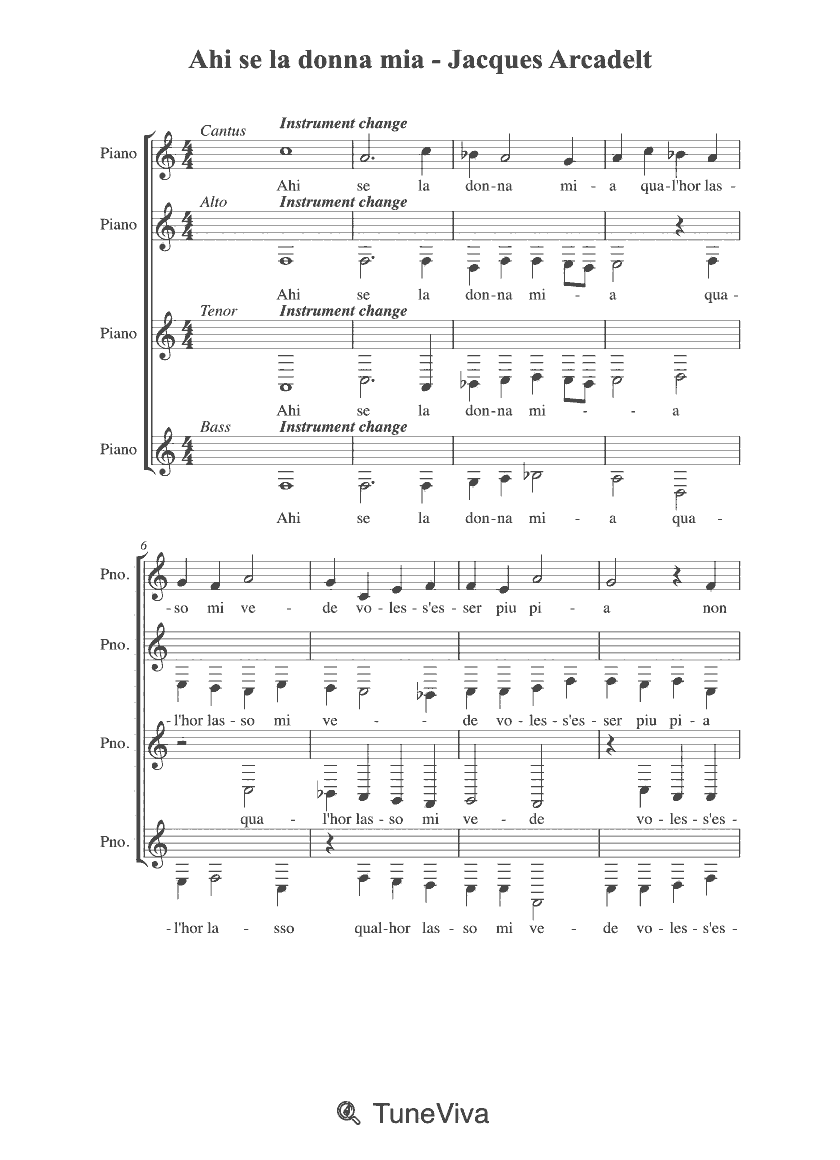
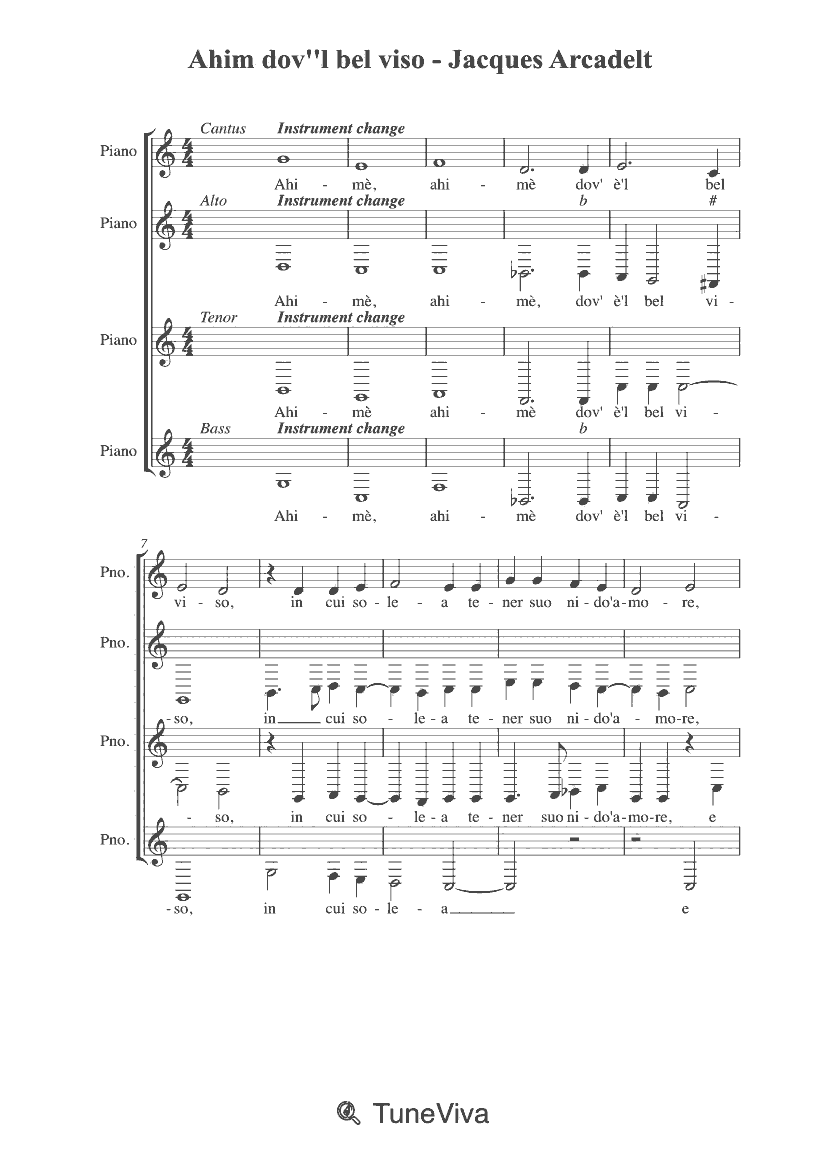
A four-voice madrigal on the pains of love, one of the secular pieces that made up the bulk of his output.
The complete Mass, printed in the 1557 Paris collection of his three masses; at 8,293 notes it is the longest file on the page.
An eight-voice setting of the Lord's Prayer (SSAATTBB), listed in RISM and in the Vatican Library as a motet for eight voices.
A three-voice madrigal from the Primo libro di madrigali a 3 voci (1542); the catalogue gives no poet for it.
There are 54, running to about 212 minutes of music and 35,658 notated notes. Fifty-two of them include lyrics.
No. In 1842 Pierre-Louis Dietsch took Arcadelt's chanson 'Nous voyons que les hommes', fitted the Latin prayer to it and added a bass line. The result was published as Arcadelt's Ave Maria and has been sung under his name ever since.
They are different scorings of the same contrafactum: four mixed voices, three women's voices, and a file titled 'A V E M A R I A 4VOCI'. The catalogue does not say whether they descend from one edition or from several.
A four-voice madrigal on a poem by Giovanni Guidiccioni, printed in the first book and famous for the rising figure that illustrates the 'thousand deaths' of its last line.
Catalog editions and arrangements attributed to Jacques Arcadelt.



VAgnus Dei




This work is licensed under CC0: creativecommons.org/publicdomain/zero/1.0/

This work is licensed under CC0: creativecommons.org/publicdomain/zero/1.0/

