classical
1 tracks
James Hill wrote tunes for dancers in Newcastle pubs and at race meetings, and the catalogue keeps them as single-line fiddle music: 67 scores, about 101 minutes and 16,117 notated notes. Not one entry carries lyrics, and every score sits at the same complexity index, 1.
The most-viewed items are the hornpipes the session repertoire still plays: The Flying Dutchman, The Pear Tree, The Enterprise, Navvy on the Line and The Champion. Several appear more than once, and some titles carry a manuscript source such as 'Roose.1118' instead of a publication.
Hill was born in Dundee around 1811 and moved with his family to Newcastle upon Tyne, where he spent the rest of his short life, living on Bottle Bank in Gateshead and keeping a public house. He was baptised at Christ Church, North Shields, and married there in 1833. Contemporary accounts describe him playing in pubs, markets and at race meetings, and later writers called him the Paganini of Bottle Bank. He died in 1853, aged 42, of tuberculosis.
His reputation rests on the Newcastle hornpipe, a common-time tune type with a steadier tread than its Irish cousin. The High Level Bridge and The Beeswing were printed in Ryan's Mammoth Collection in Boston in 1884 and became widely known among hornpipe players; The Beeswing is named for the racehorse that won the Ascot Gold Cup in 1842. Around fifty tunes are credited to him, and the figure is unstable because nineteenth-century collections attached his name to pieces he did not write. Blaydon Flats is the usual example.
That instability is visible in this catalogue. It merges 'By James Hill' and 'Attributed to James Hill elsewhere', so a title in the list may be securely his, merely ascribed to him, or a setting copied from a manuscript. Fifty-nine entries are indexed as classical and eight carry no genre. Duplicate titles are different files for one tune: there are three Champion Hornpipes and several Flying Dutchmen.
Hill's hornpipes are built for a steady, sprung bow: the dotted rhythm is written, not added, so play it as notation rather than as a lilt. Keep the first finger free for the frequent C-naturals and the passing accidentals that give the Tyneside style its edge. In The Champion and The Flying Dutchman the second part climbs into the upper octave, so save bow length for that climb. A light staccato in the crotchets keeps the triplets crisp.
The most-viewed score on the page, for a tune the catalogue also holds under two plainer titles.
A two-part hornpipe in the compact shape that runs through Hill's output.
Named, like several of his tunes, after a vessel or a public house rather than a person.
Its title refers to the railway labourers who built the lines through Tyneside in Hill's lifetime.
Probably the most widely played of his tunes, and the one most often used to teach the Newcastle style.
Long a session standard; the catalogue files it under Hill, though it also circulates as a traditional tune.
An entry keyed to a numbered manuscript collection rather than to a printed title.
One of the noisier catalogue titles, set in capitals in the source and kept that way.
Named for the mare that won the Ascot Gold Cup in 1842; the catalogue gives only a manuscript siglum for its source.
67, running to about 101 minutes of music and 16,117 notated notes. None of them has lyrics.
No. He was born in Dundee and worked in Newcastle and Gateshead, though his tunes travelled into Irish and American session books through collections such as Ryan's Mammoth Collection of 1884.
The catalogue merges several sources, each with its own title form. The Champion appears three times and The Flying Dutchman three times, and the duplicate files may differ in key or in the setting of the second part.
The Pear Tree and Off to California are the shortest and most forgiving of the common set, while The Champion's second part asks for a secure climb into the upper octave.
Catalog editions and arrangements attributed to James Hill.


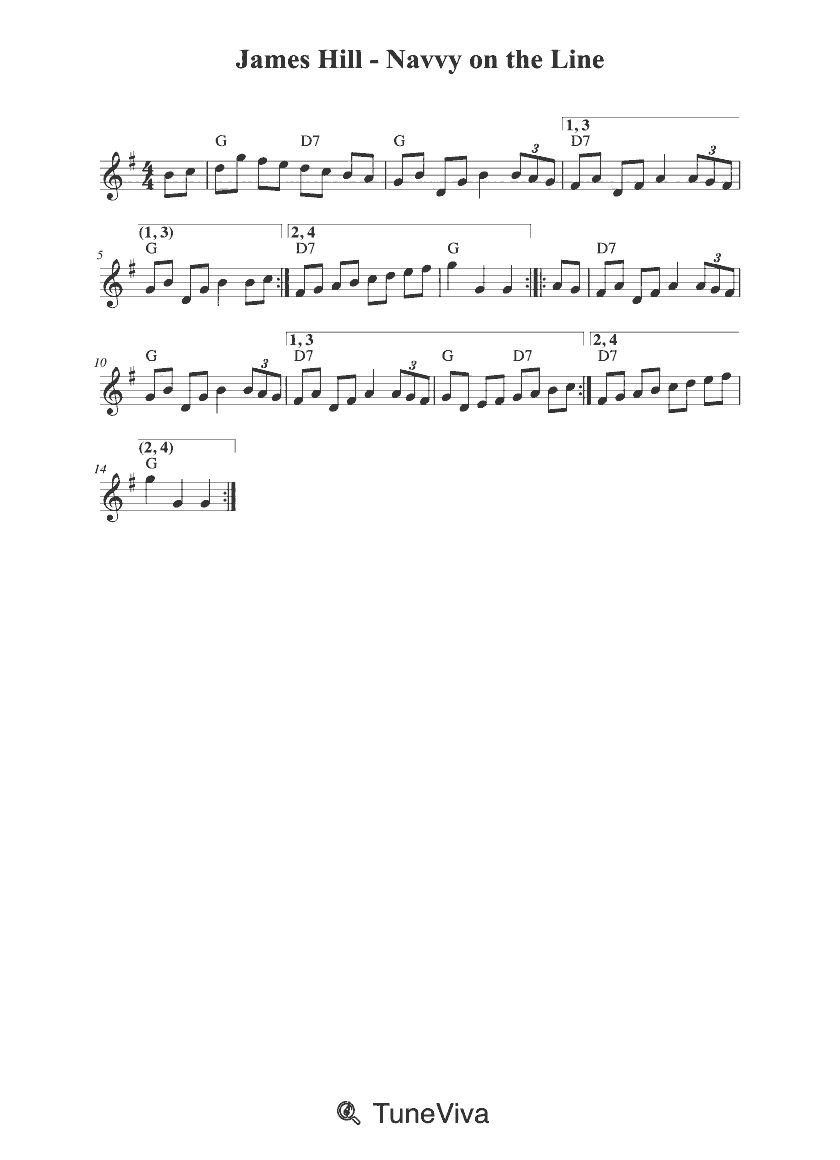


Navvie on the Lineaka. Roose.1118 The


Hornpipe. WHL.[127] ANo. 1. WHL.[127]