classical
2 tracks
Ralph Erskine Hudson spent his working life writing songs for revival meetings, Sunday schools and temperance campaigns, and the catalogue samples that output: 28 scores, about 16 minutes of music and 7,234 notated notes, with 14 files carrying words. Nothing here is long; most items are a single stanza and a refrain, and 24 of the 28 sit at complexity index 0 or 1. The most-viewed title is Satisfied, his 1875 setting of Clara Tear Williams's words, followed by His yoke is easy and by Hudson arrangements of two hymns that usually go to other tunes.
Hudson was born in Napoleon, Ohio, in July 1843 (the day is given as 9 July in one account and 12 July in another) and grew up in Philadelphia. He enlisted in Company K of the 10th Pennsylvania Reserve Regiment in June 1861, served as a hospital nurse at Annapolis, where he met Mary Smith, and was discharged in June 1864. After the war he taught music at a college in Alliance, Ohio, and set up as a music publisher there, working as a lay preacher in the Methodist Episcopal Church. His songbooks came steadily: Salvation Echoes (1882), Gems of Gospel Songs (1884), Songs of Peace, Love and Joy (1885), The Temperance Songster (1886) and Songs of the Ransomed (1887). He moved to Cleveland in 1897 and died there on 14 June 1901; he is buried in Alliance.
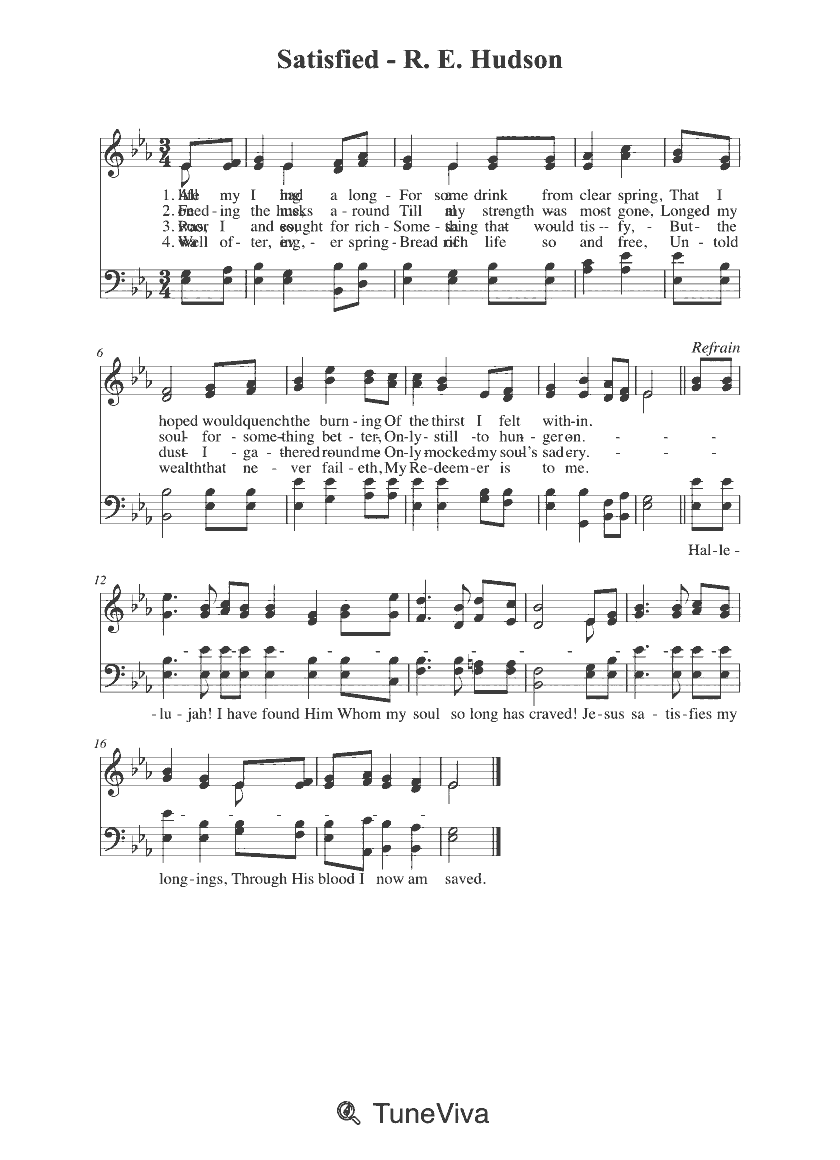
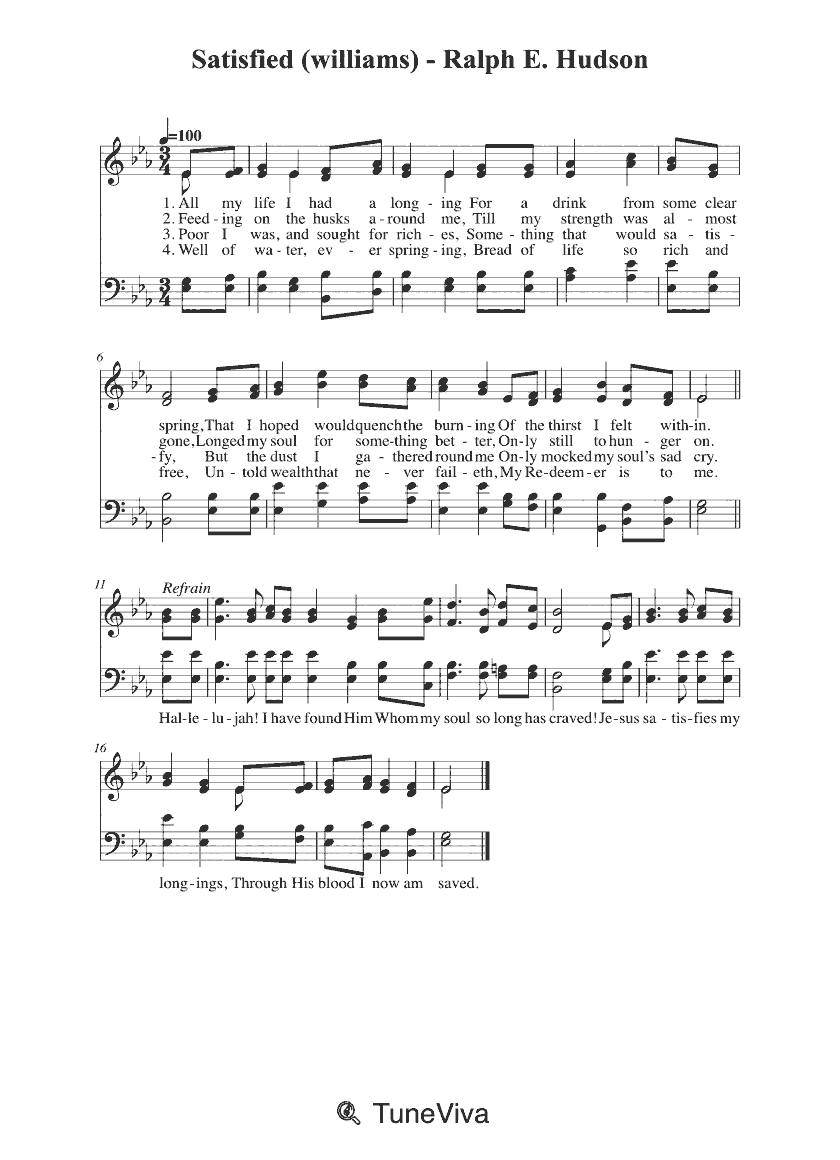
Several pieces in the catalogue are hymns he fitted with new tunes or refrains. “Alas! and Did My Saviour Bleed” gained the refrain “At the cross, at the cross”, and “O for a Thousand Tongues to Sing” gained “Blessed be the name of the Lord”, both of which travelled further than the nineteenth century did. Satisfied is the best documented of them: Williams recalled that in about 1875, while helping at meetings in Troy, Ohio, where Hudson led the singing, he asked her for a song for a book he was preparing; she wrote the words before sleeping and he composed the music the next morning. The catalogue holds the result twice, in two files of 18 bars each, and holds His yoke is easy twice as well.
The gospel-song idiom is repetitive by design: verse, refrain, verse, refrain, with the refrain carrying the emotional weight. Keep the refrain slightly lighter and quicker than the verse, and do not let the four-square harmony stiffen the words — the setting is syllabic, and a misplaced accent is more noticeable here than a wrong note. Short choruses such as the ten-bar His yoke is easy are meant to be repeated, so plan the last verse before you begin. Tempos in this repertory are modest, and the usual mistake is to take the refrain too fast.
The most-viewed file. Clara Tear Williams wrote the words at Troy, Ohio, in 1875 after Hudson asked her for a song for a book he was preparing; he set them the next morning, and the hymn was in print by 1881.
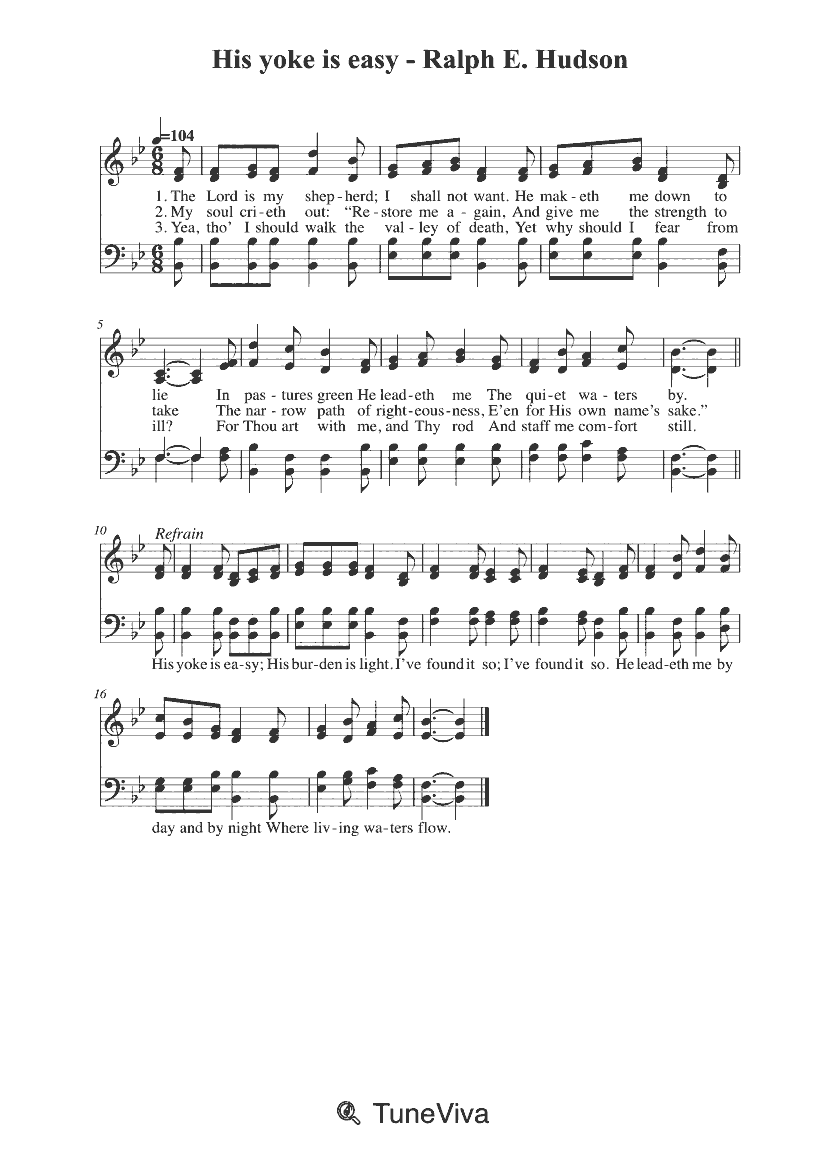
A chorus on Matthew 11:28-30, “my yoke is easy and my burden is light”; 18 bars and 268 notes, and the second most-viewed file.
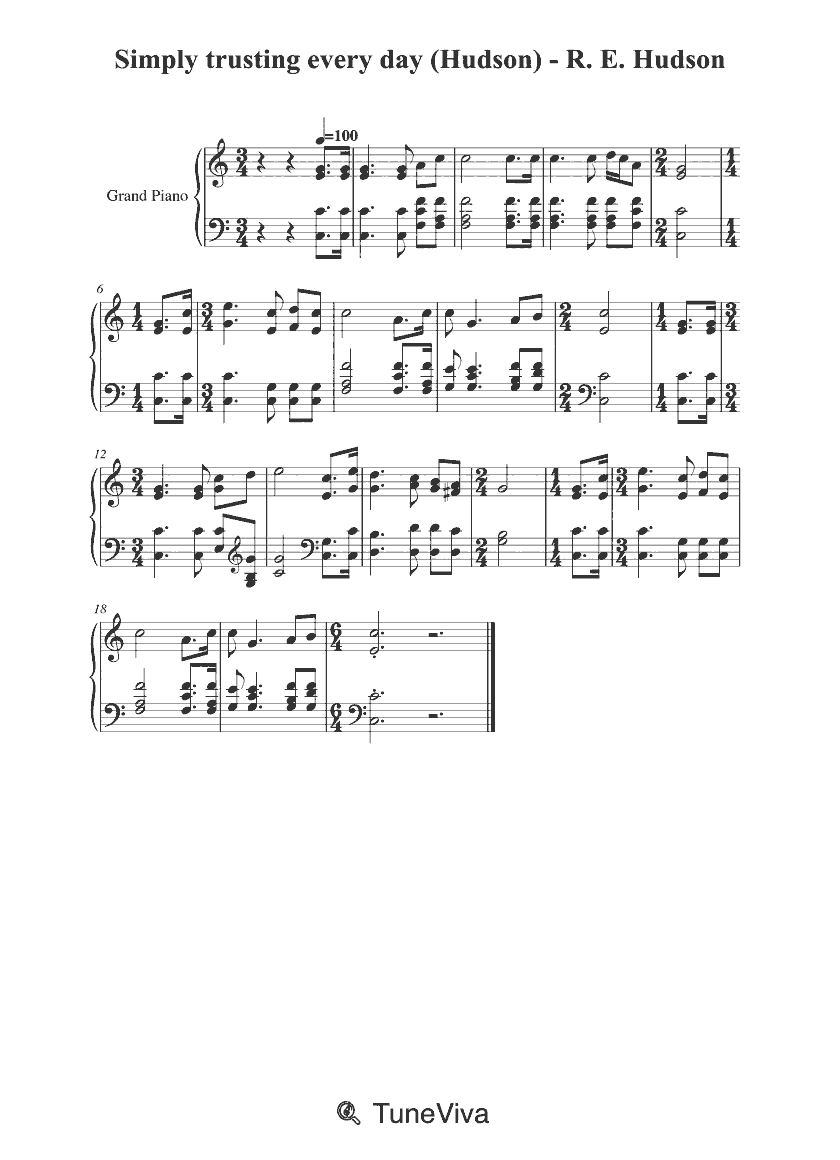
The hymn “Simply trusting every day”, usually credited to Fanny Crosby, in a Hudson setting; the parenthetical tag separates his tune from the melody most hymnals print.
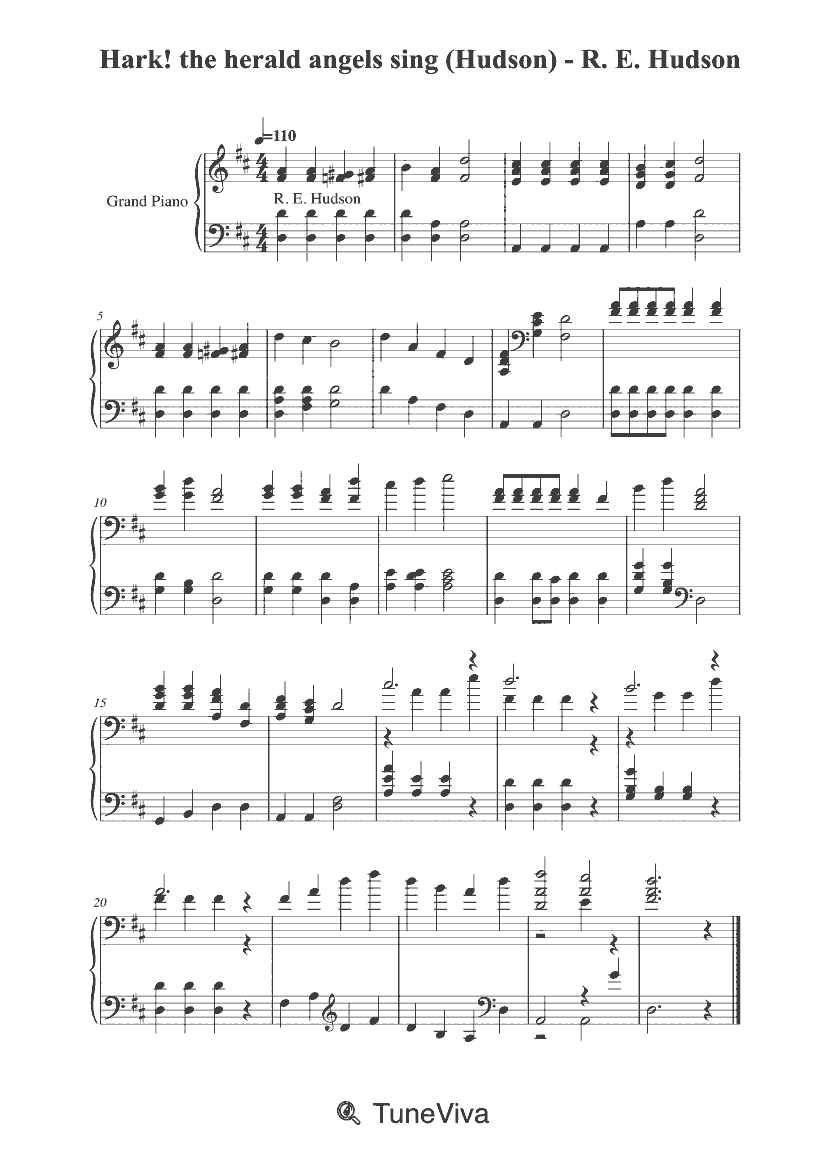
Charles Wesley's Christmas hymn with a Hudson tune rather than the Mendelssohn music that most hymnals use; 24 bars at complexity index 2.
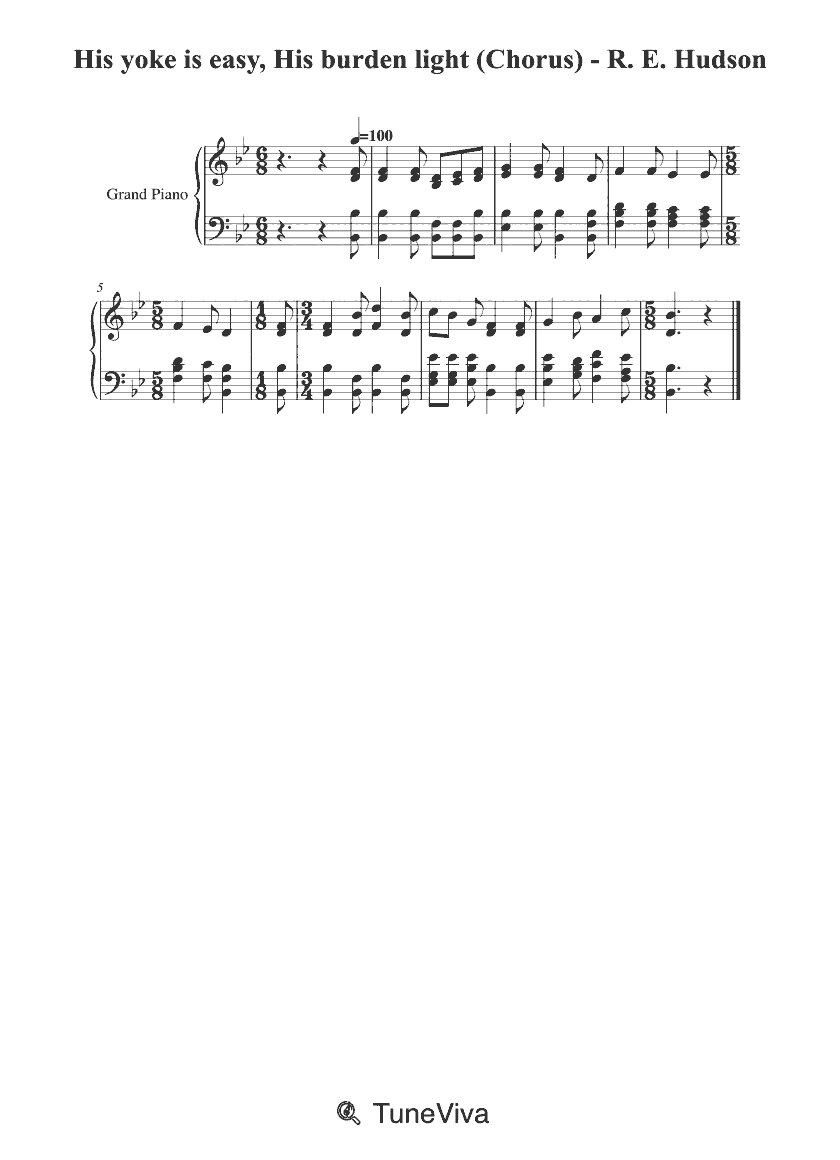
The chorus alone, 10 bars and 127 notes, the shortest file in the collection; a cut-down version of the same text as the entry above.
At 56 bars and 535 notes, the longest piece in the collection, and the one that departs furthest from the single-stanza pattern.
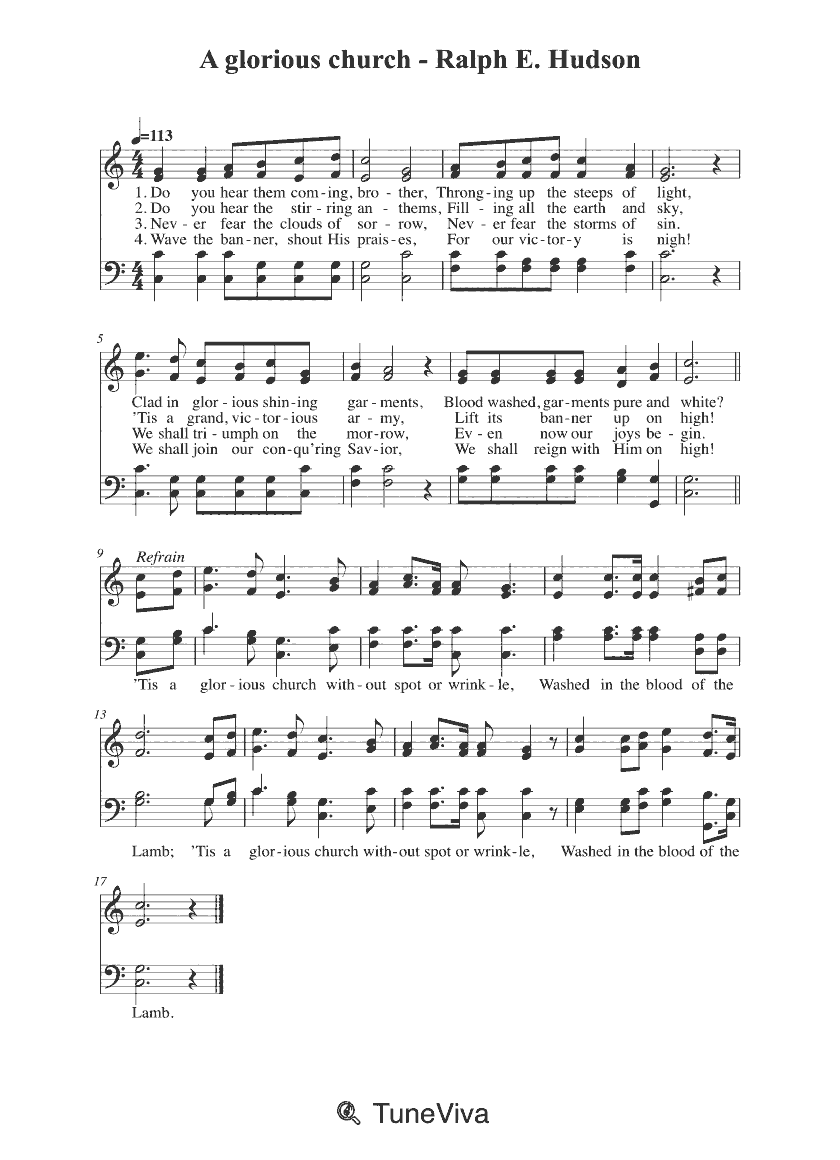
The title echoes Ephesians 5:27, “a glorious church, not having spot, or wrinkle”; 17 bars and 264 notes.
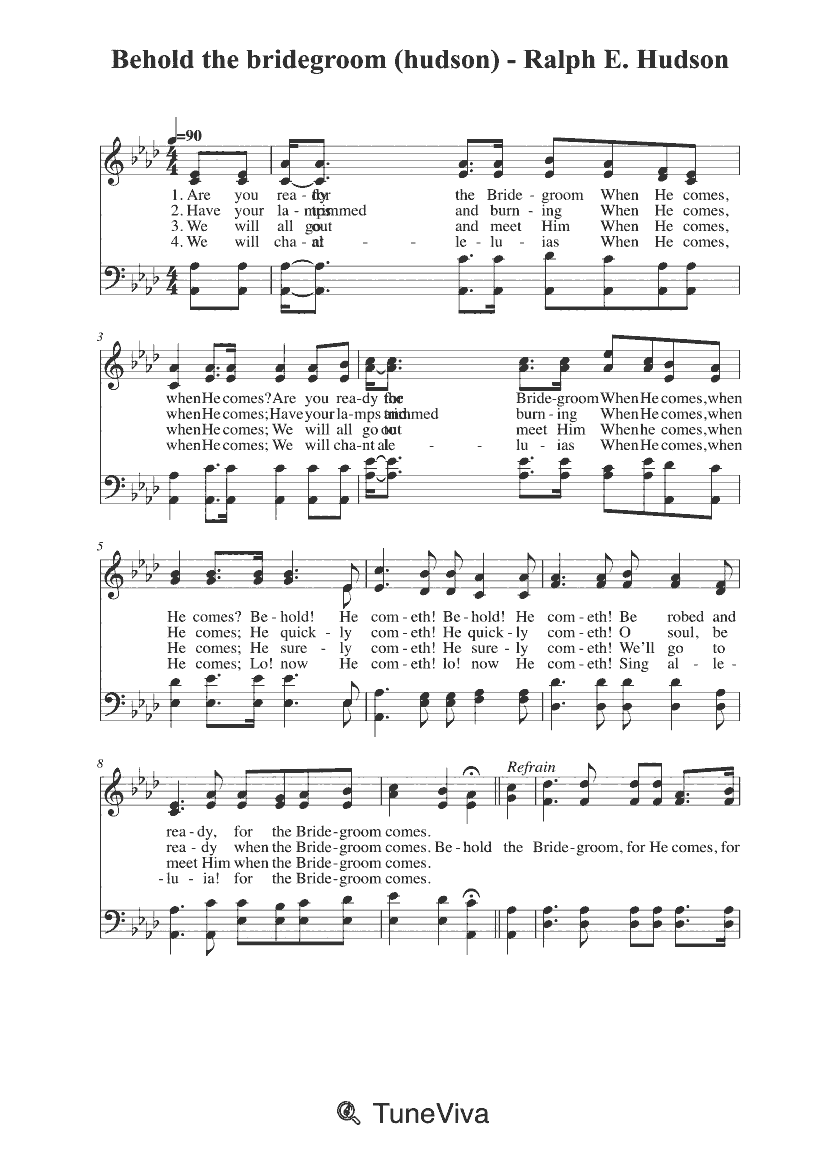
An Advent piece that takes its cue from the cry of the bridegroom in Matthew 25; 18 bars with a refrain.
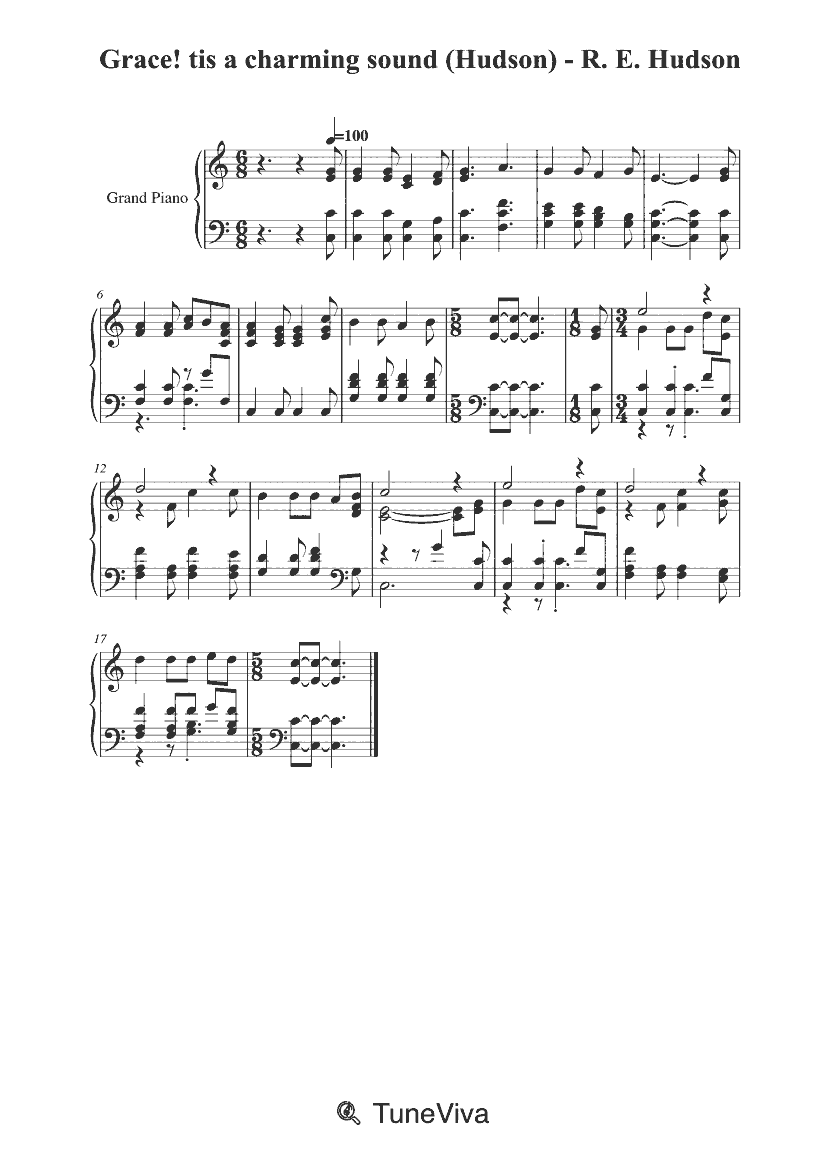
Isaac Watts's hymn in a Hudson setting of 16 bars; the same text attracted dozens of tunes in this period, and Hudson's is one of the shorter ones.
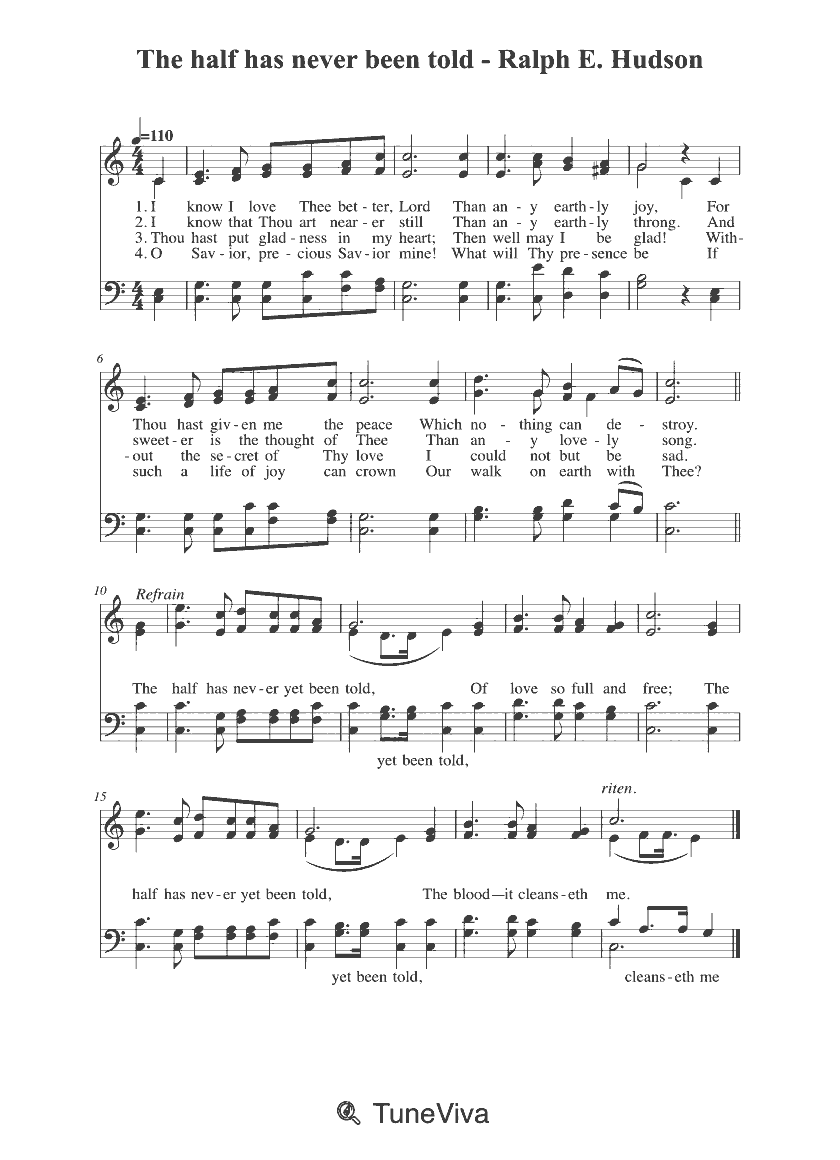
The title comes from the Queen of Sheba in 1 Kings 10:7; 18 bars, with a full text attached to the file.
There are 28, running to about 16 minutes of music and 7,234 notated notes. Half of them, 14 files, include the words.
Because the hymn usually goes to another tune. The tag marks his setting — his music for “Hark! the herald angels sing”, for instance, as against Mendelssohn's — and it was added by the cataloguer, not by Hudson.
Yes. That is the opening line of Clara Tear Williams's text, and the tune is normally called SATISFIED. Hudson wrote the music in 1875 and it was published in 1881.
No. He taught music, ran a publishing business and served as a lay Methodist preacher, then worked as an evangelist and temperance campaigner; hymn writing ran alongside that rather than replacing it.
Catalog editions and arrangements attributed to R. E. Hudson.