James Scott Skinner - Hector the Hero
Listen & explore
Follow the score, hear the music, then make it your own.
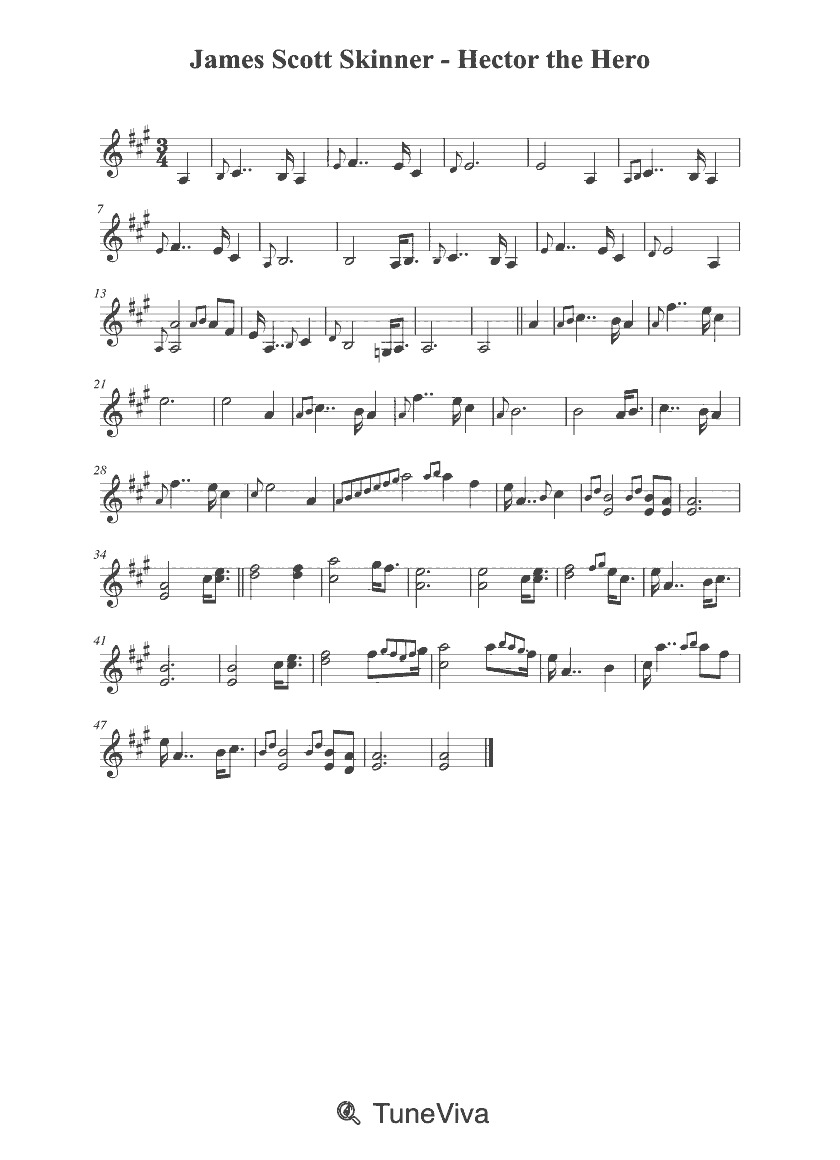
About this score
James Scott Skinner wrote Hector the Hero in 1903 after the death of General Sir Hector MacDonald, and the tune has served as a gathering elegy ever since. This edition sets it out as Skinner's fiddle would have carried it: a single melodic line in 3/4 and A major, fifty bars long, with a handful of two-note chords for warmth and almost no other instruction. The playback runs about seventy-two seconds, which is exactly the length the air needs.
Opening key signature: A major (3 sharps). Opening time signature: 3/4. Estimated playback time: 1 min 12 sec. Listen while following the notation, adjust playback speed, or open this score in practice mode.
- Duration (approx.)
- 1 min 12 sec
- Opening key signature
- A major (3 sharps)
- Opening time signature
- 3/4
- Genre
- Classical Folk
The story in the title
Skinner, the Aberdeenshire fiddler and composer remembered as the Strathspey King, was at the height of his fame when news came that General Sir Hector MacDonald, a celebrated soldier of humble origins, had died by his own hand in 1903. Skinner's response was this air, dignified and singable, and it passed immediately into the repertory of fiddlers and pipers. The title does the emotional work: the music itself stays calm, which is why it has been played at commemorations for more than a century. Playing it well means respecting that restraint; the tune asks for tone rather than display.
A waltz-time lament
The metre is 3/4 from the first bar to the last, and the key is the three sharps of A major. The line sits between G3 and B5, moving in a mixture of eighth and half notes with thirty sixteenth notes supplying the ornamental turns. Only twenty-four notes are written as two-note chords, brief doublings that thicken the sound at cadences, and a single accidental appears beyond the signature. There are no tempo or dynamic markings on the page, so the air's pace is a decision for the player; the playback offers one sensible reading in about seventy-two seconds.
Playing an elegy
Because the notation leaves dynamics open, build your own plan: a quiet start, a fuller middle passage, and a return to quiet for the final cadence. The sixteenth-note turns should lean into the main note that follows them rather than standing alone. Hold the two-note chords gently, letting the lower note sound as support rather than a second melody. Where the tune rises to its highest A, resist any urge to force the sound; Skinner's fiddle style kept melody singing above all, and the air survives best when it stays vocal in character.
Practice tips
- Plan one dynamic arc for the whole air: quiet opening, fuller middle, quiet close, and rehearse it as deliberately as the notes.
- Lean each sixteenth-note turn into the main note that follows rather than letting it stand alone.
- Keep the two-note chords soft; let the lower note support the melody instead of competing with it.
- Sing the tune first to find its natural waltz sway, then bring that breath-based phrasing to the instrument.
Questions about this score
Who was Hector the Hero written for?
General Sir Hector MacDonald, a famous soldier of humble Scottish origins who died in 1903. James Scott Skinner composed the air in his memory, and it has been played at commemorations since.
Why is an elegy in 3/4?
Skinner wrote it as an air rather than the dance forms he was famous for. The waltz metre gives the tune its gently moving, processional quality while keeping it easy to sing.
What is marked on the page?
Very little. The edition gives the melody, a few two-note chords and one accidental beyond the A major signature, with no tempo words or dynamics; the playback suggests one workable pace.
How long does the playback run?
About seventy-two seconds, covering all fifty bars of the air at a pace suited to its character.