Sonata in F minor, K.466
Listen & explore
Follow the score, hear the music, then make it your own.
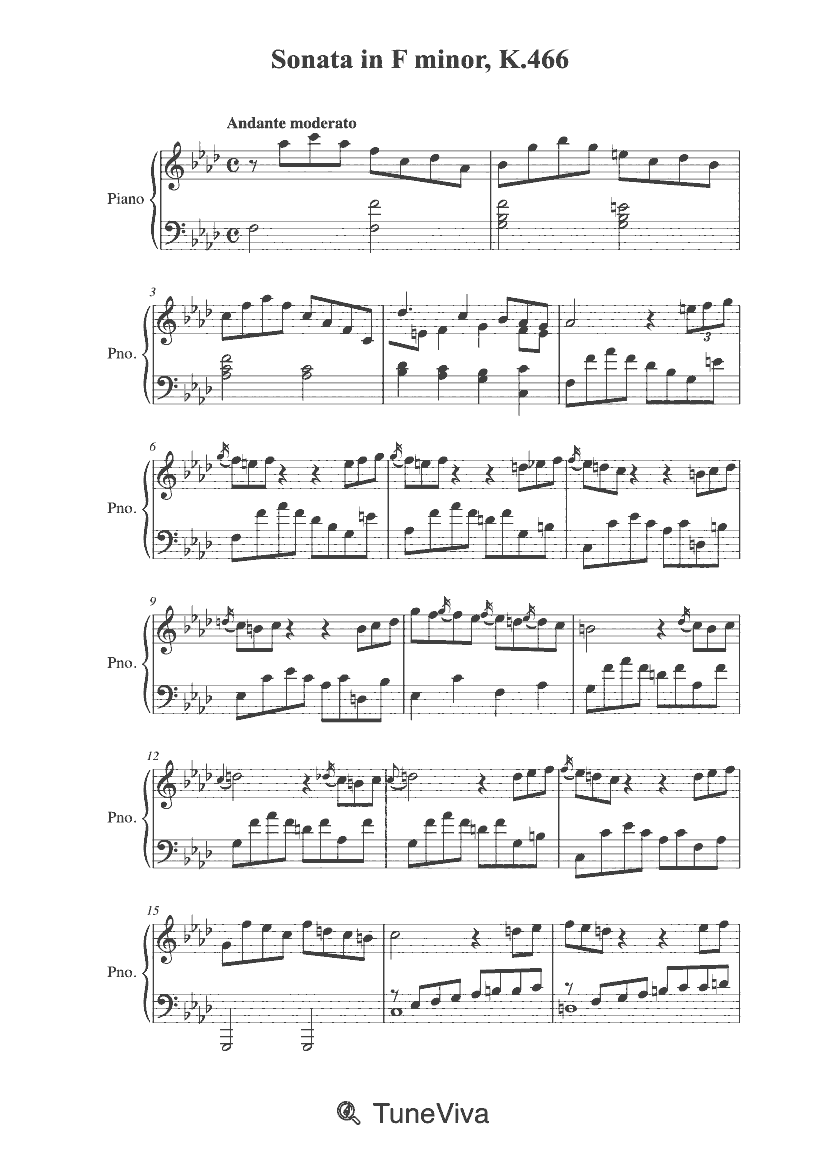
About this score
Domenico Scarlatti's Sonata in F minor, K.466 is one of the five hundred and fifty-five keyboard sonatas' most recorded pages, a stormy Allegro whose repeated-note opening and cross-hand passages have tested pianists since the instrument took the sonatas over, and this edition gives it complete: seventy-six bars of 4/4 in the four-flat signature, with seven inverted mordents and four trills printed.
Score parts: Piano. Opening key signature: 4 flats. Opening time signature: 4/4. Opening tempo: 75 BPM. Estimated playback time: 8 min 6 sec. Listen while following the notation, adjust playback speed, or open this score in practice mode.
- Duration (approx.)
- 8 min 6 sec
- Score parts
- Piano
- Opening key signature
- 4 flats
- Opening time signature
- 4/4
- Opening tempo
- 75 BPM
- Genre
- Classical
The sonata's storms
K.466 opens with pounding repeated octaves and never fully calms: the F minor signature carries the sonata's urgency, the phrases slam and rebound, and the famous central passages cross the hands in Scarlatti's signature Spanish-guitar swagger. Pianists treat it as a virtuoso calling card; the notation's ornaments mark the original keyboard style.
The piano edition
One thousand and thirty-three notes across the single stave, the ornaments printed at their spots, the sound tempo recorded at 75, no dynamics marked. The ornaments, inverted mordents and trills, belong to the harpsichord style the sonata was born in.
Practice tips
- Learn the repeated-note opening with loose wrist; the sonata's storm lives in those octaves.
- Practise the cross-hand passages slowly before speed; the hand-crossings are the sonata's signature.
- Execute the seven inverted mordents and four trills exactly where printed.
- Keep the F minor tension consistent; the sonata never fully relaxes.
Questions about this score
What is Sonata K.466?
Domenico Scarlatti's Sonata in F minor, one of his 555 keyboard sonatas and among the most performed and recorded of them.
Was it written for piano?
No, Scarlatti wrote for harpsichord; the piano edition keeps the printed ornaments of the original keyboard style.
What makes it a test for pianists?
The repeated-note opening and the cross-hand passages, the sonata’s signature techniques, demand loose wrists and careful hand planning.