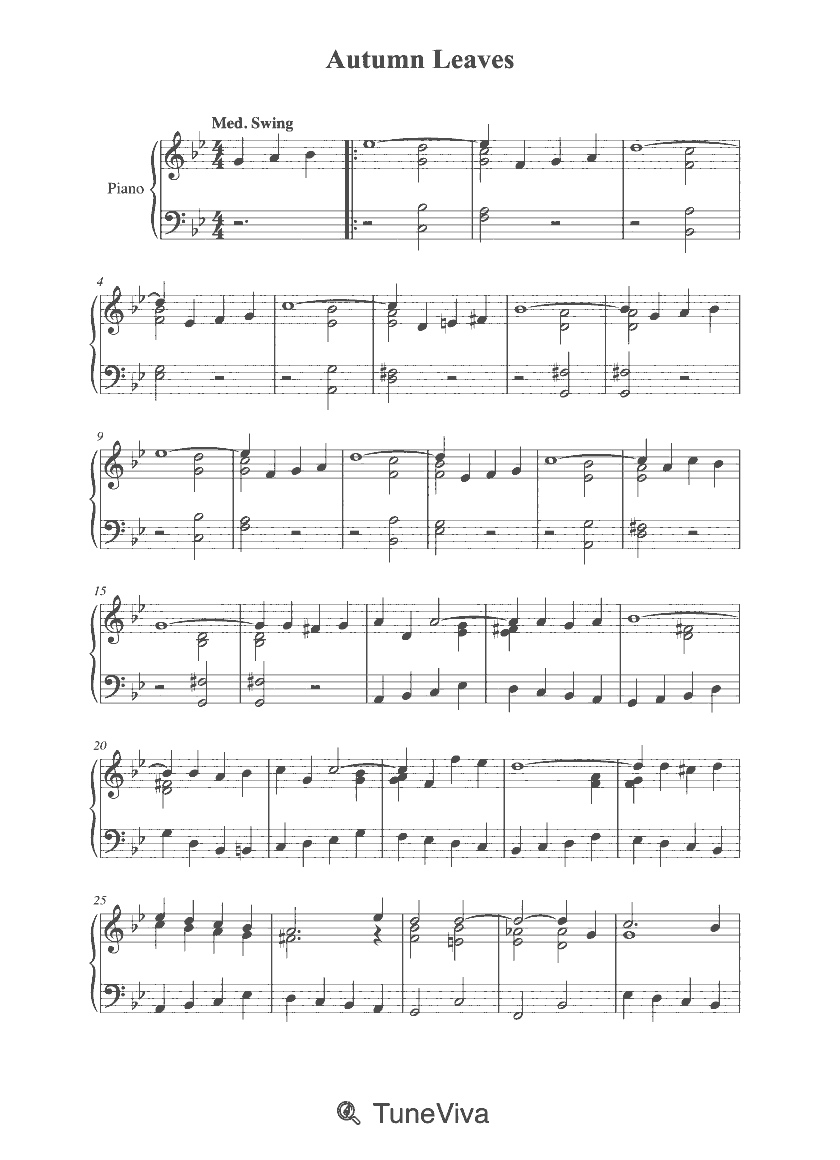
Autumn Leaves
Joseph Kosma
Follow the score, hear the music, then make it your own.
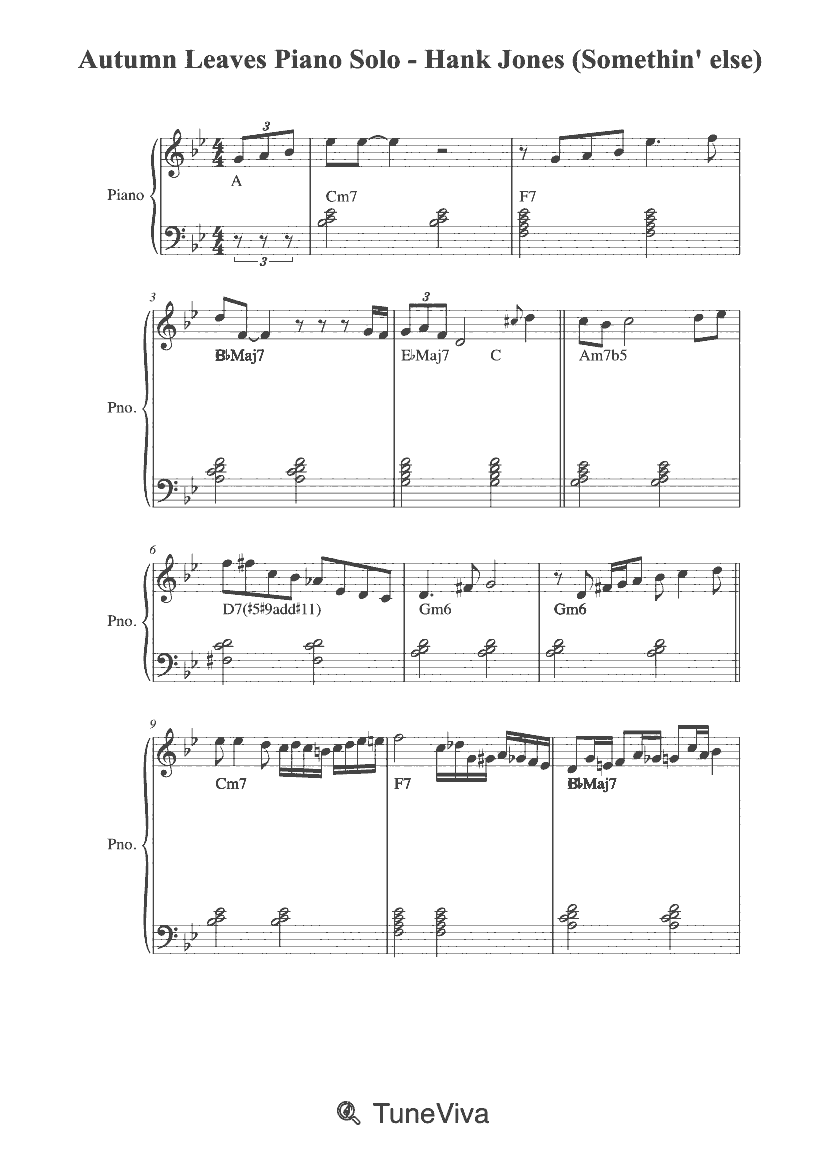
Autumn Leaves is Joseph Kosma's melody from the 1945 French song Les feuilles mortes, with words by Jacques Prévert and an English lyric Johnny Mercer added later, and it became one of the small set of standards every jazz player keeps ready. This file transcribes the piano from Hank Jones's take on Somethin' Else, the 1958 album he made with Cannonball Adderley: thirty-three bars of 4/4 in the two flats of G minor, the tune stated in unhurried half notes over a churning chordal texture, with the full playback lasting about forty-six seconds.
Score parts: Piano. Opening key signature: 2 flats. Opening time signature: 4/4. Estimated playback time: 46 sec. Listen while following the notation, adjust playback speed, or open this score in practice mode.
Kosma wrote Les feuilles mortes for Marcel Carné's film Les portes de la nuit, Prévert supplied the elegiac words, and the melody crossed to America where Mercer's English lyric carried it into the repertoire. Its form, a pair of eight-bar strains, a bridge and a return, made it a favourite for players and singers alike, and Cannonball Adderley's album Somethin' Else, with Miles Davis guesting and Hank Jones at the piano, opens with it at a relaxed pace. This transcription takes Jones's piano from that record: the tune unadorned, the accompaniment full of movement, the swing supplied by feel rather than notation.
The half notes dominate, two hundred and twenty-six of them, because Jones states the melody plainly and lets the harmony do the talking beneath: one hundred and sixty-three chord notes and forty-two accidentals across thirty-three bars. The signature is the two flats of G minor, the standard jazz key for the tune, and the texture runs from the bottom of the piano to D6. Two stray letter marks sit where lyrics might otherwise be, the only remnants of text in the file. The tempo is not printed; the swing identity of the take must be heard from the playback, which runs about forty-six seconds.
Treat the page as a map of one performance, not the tune's official text. Start by playing the melody alone in half notes, singing Mercer's words over it to find the phrasing. Then take the accompaniment in two-bar units, listening to the playback for where Jones pushes the harmony, and note that many of the forty-two accidentals are passing colours rather than chord tones. Practise the left-hand figures until they swing at a moderate tempo before adding the right hand. Finally, improvise from the map: play the chords as written, then reshape them your own way, which is the point of learning a jazz transcription at all.
Joseph Kosma composed the melody for the 1945 French song Les feuilles mortes, with words by Jacques Prévert. Johnny Mercer's English lyric carried it into the jazz repertoire, where it became a standard.
The 1958 album by Cannonball Adderley on which Hank Jones played piano, with Miles Davis as guest. Its opening track is Autumn Leaves, and this file transcribes Jones's piano from that performance.
The two flats of G minor, the key most jazz players use for the tune. The melody sits in half notes while the accompaniment moves underneath.
About forty-six seconds for the thirty-three bars, which is enough to hear the whole take's shape before working through it slowly.
A B
Joseph Kosma