Nearer my God to Thee
Listen & explore
Follow the score, hear the music, then make it your own.
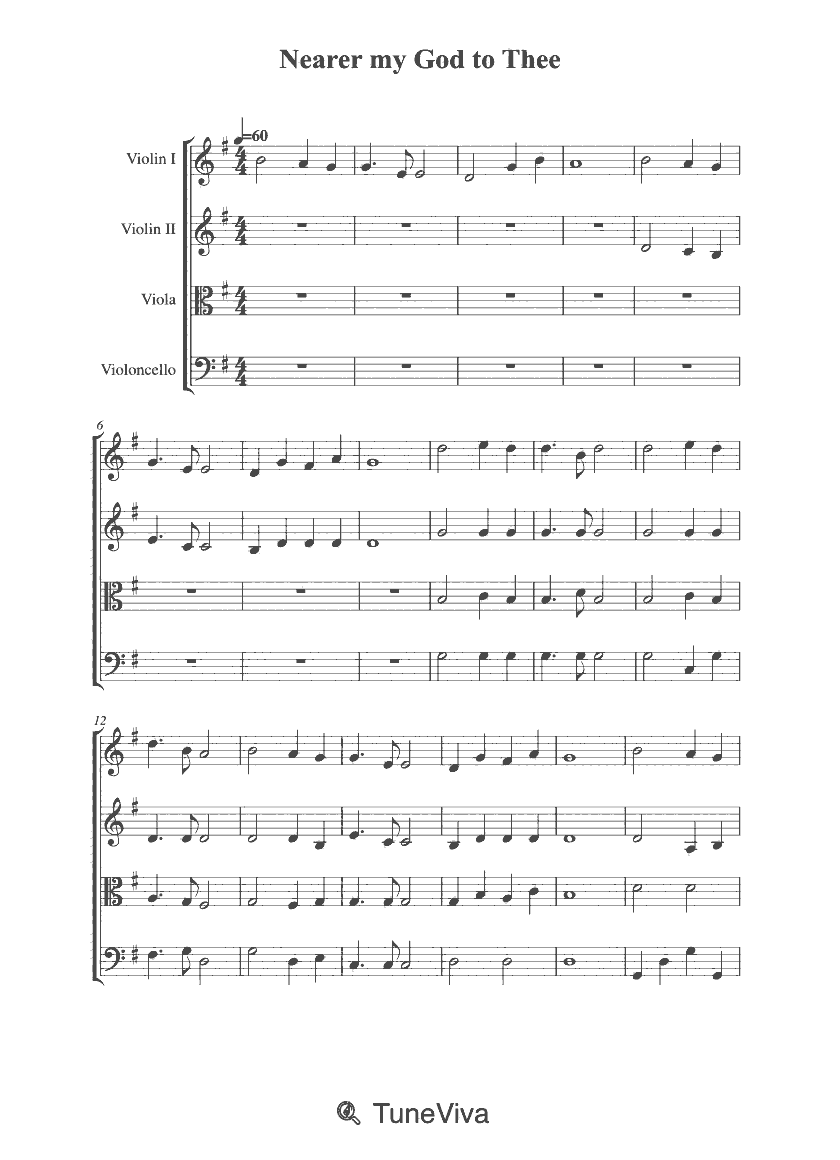
About this score
Nearer, my God, to Thee is the hymn the world associates with the band of the Titanic, and the subtitle of this file carries that word plainly. The tune itself comes from Lowell Mason, the great American hymn composer of the nineteenth century, and this edition sets it for string quartet: seventy-two bars of 4/4 in G major at a solemn 60 beats a minute, four equal parts and no dynamics printed, with the playback running just under five minutes.
Score parts: Violin I; Violin II; Viola; Violoncello. Opening key signature: 1 sharp. Opening time signature: 4/4. Opening tempo: 60 BPM. Estimated playback time: 4 min 48 sec. Listen while following the notation, adjust playback speed, or open this score in practice mode.
- Duration (approx.)
- 4 min 48 sec
- Score parts
- Violin I; Violin II; Viola; Violoncello
- Opening key signature
- 1 sharp
- Opening time signature
- 4/4
- Opening tempo
- 60 BPM
- Genre
- Classical
The hymn and the ship
Sarah Fuller Adams's text, nearer, my God, to Thee, nearer to Thee, was set to Mason's tune and became one of the most sung hymns of the English-speaking world. When the Titanic sank in 1912, several survivors reported that the ship's band played a hymn as the deck tilted, and the one remembered was this, though witnesses disagreed about which tune variant they heard. The story has made the association permanent, and this file's subtitle carries it. Whatever the historical truth, the music itself is a model of Mason's craft: stepwise, singable, and built to swell without ornament.
Four strings, one hymn
The quartet divides the hymn conventionally: the first violin carries the tune between G3 and E6, the second and viola fill the middle, and the cello grounds it from C2. The texture is mostly quarters and halves, the rhythm of steady hymn singing, with only two accidentals beyond the signature and no dynamic marks at all. Seventy-two bars cover the hymn plus a doubling of its strains, and the playback at 60 beats a minute gives every phrase room to breathe. Because nothing is marked, the interpretation, from tempo flexibility to swell points, belongs entirely to the four players.
Making a quartet sound like a congregation
Rehearse the tune alone in the first violin while the others hum their parts, so everyone hears where the hymn's phrases turn. Then rehearse as a quartet with an agreed breathing scheme: breathe together or not at all, since a single player gasping breaks the congregation effect. Decide where the swells fall, usually on the rising lines to each phrase's summit, and keep the 60-beat pace unhurried but never dirge-like. The two accidentals deserve care in tune, as they colour the harmony's one turn. End the final chord by releasing bows at slightly different moments, the softest way a quartet can fade.
Practice tips
- Agree a breathing scheme before the first run-through: breathe together or not at all.
- Plan the swells on the rising lines to each phrase summit, and keep 60 beats a minute unhurried but not dirge-like.
- Tune the two accidentals carefully; they colour the harmony's one turn beyond G major.
- Release the final chord with bows leaving the strings at slightly different moments for a soft fade.
Questions about this score
Why is this hymn linked with the Titanic?
Survivors of the 1912 sinking reported that the ship's band played a hymn as the deck tilted, and the one most remembered was Nearer, my God, to Thee. The file's subtitle carries that association.
Who wrote the tune?
Lowell Mason, the leading American hymn composer of the nineteenth century. The words were written by Sarah Fuller Adams, and the two have travelled together since.
What do the four parts do?
The first violin carries the tune up to E6, the second violin and viola fill the middle, and the cello grounds the harmony from C2. The texture is steady hymn rhythm in quarters and halves.
How long does the playback run?
Just under five minutes for the seventy-two bars in G major at 60 beats a minute.