El Dia Que Me Quieras V1.1
Listen & explore
Follow the score, hear the music, then make it your own.
About this score
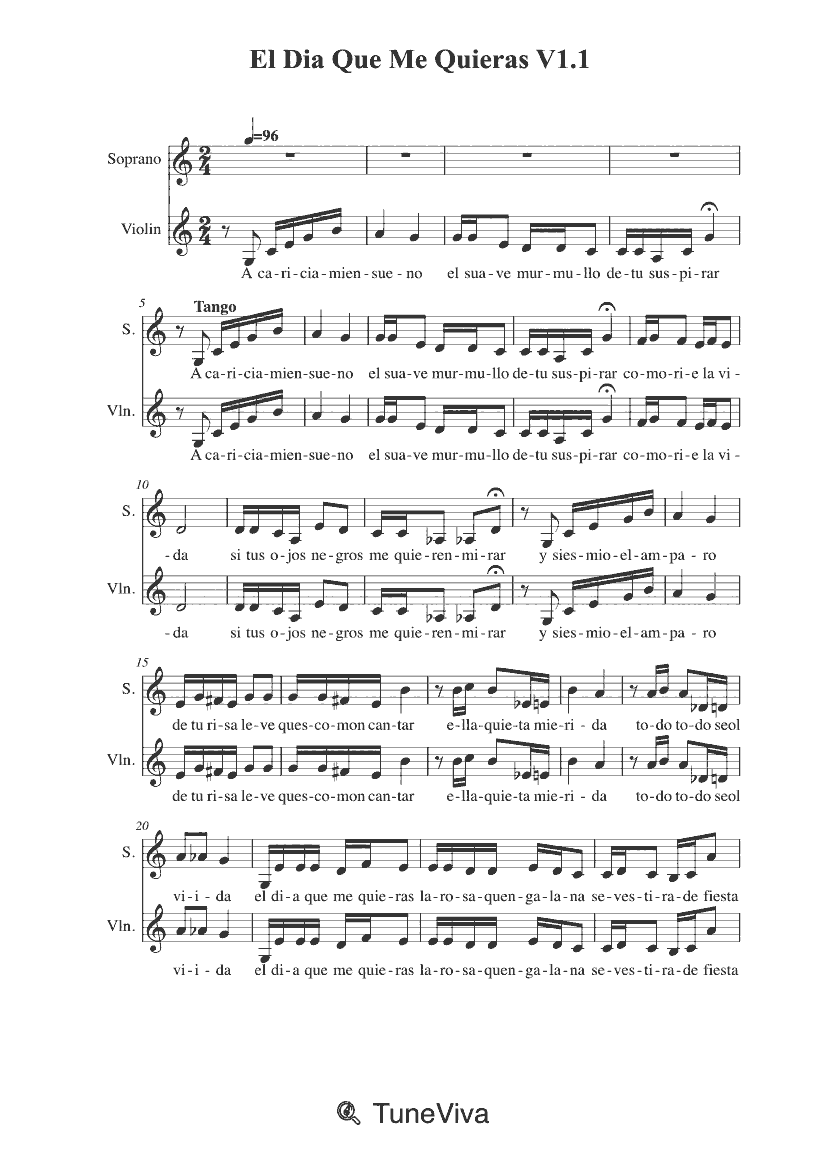
El día que me quieras is Carlos Gardel's grandest tango ballad, written with Alfredo Le Pera for the 1935 film of the same name, the year of Gardel's death, and its promise, the day you love me, the rose will dress itself in its finest colour, is tango's most poetic verse. This edition arranges it for soprano and violin: forty-six bars of 2/4 with the word Tango printed in the notation.
Score parts: Soprano; Violin. Opening key signature: No sharps or flats. Opening time signature: 2/4. Opening tempo: 96 BPM. Estimated playback time: 1 min 0 sec. Listen while following the notation, adjust playback speed, or open this score in practice mode.
- Duration (approx.)
- 1 min 0 sec
- Score parts
- Soprano; Violin
- Opening key signature
- No sharps or flats
- Opening time signature
- 2/4
- Opening tempo
- 96 BPM
- Genre
- Worldmusic
The song and its film
Gardel made El día que me quieras as a star vehicle in New York, singing and acting opposite Rosita Moreno, and the film's title song became one of the Latin songbook's permanent treasures, recorded by every major tango and bolero voice since. Months later Gardel died in the Medellín plane crash, and the song's idealism became inseparable from his memory.
The duo's arrangement
The notation gives the soprano the melody with the text underlaid from the opening A, and the violin answers in Gardel's own idiom, one hundred and ninety-nine notes of ornamental support. No dynamics are marked beyond the printed Tango character; playback runs about three-quarters of a minute through the verse.
Practice tips
- Sing the Spanish text with the tango's slight rubato; the phrases lean on their final syllables.
- Let the violin echo the vocal line rather than compete; Gardel's music is a dialogue between voice and strings.
- Keep the 2/4 steady underneath the expressive melody.
- Follow the printed Tango character marking as the style's permission for expressive phrasing.
Questions about this score
Where is El día que me quieras from?
The 1935 film of the same name, Gardel's last starring vehicle before his death in the Medellín plane crash that year.
Who wrote the lyrics?
Alfredo Le Pera, Gardel's regular lyricist, whose verses gave the tango its rose-and-heaven imagery.
What forces does the arrangement need?
A soprano and a violin, with the Spanish text underlaid and the word Tango printed as the style marking.
Text marked as lyrics
A cariciamiensueno el suave murmullo detu suspirar comorie la vida si tus ojos negros me quierenmirar y siesmioelamparo de tu risa leve quescomon cantar ellaquieta mierida todo todo seol viida el dia que me quieras larosaquengalana sevestirade fiesta con su mejor color yal viento las campanas diran que yae res mia y locas las fontanas se contaran suamor la noche que me quieras desdel azul del cielo o las estrellas celosas nos miraran pasar yunrayo misterioso hara nidoen tu pelo luciernaga curioso que veras queres mi consuelo A cariciamiensueno el suave murmullo detu suspirar A cariciamiensueno el suave murmullo detu suspirar comorie la vida si tus ojos negros me quierenmirar y siesmioelamparo de tu risa leve quescomon cantar ellaquieta mierida todo todo seol viida el dia que me quieras larosaquengalana sevestirade fiesta con su mejor color yal viento las campanas diran que yae res mia y locas las fontanas se contaran suamor la noche que me quieras desdel azul del cielo o las estrellas celosas nos miraran pasar yunrayo misterioso hara nidoen tu pelo luciernaga curioso que veras queres mi consuelo