Gardel - Por una Cabeza, for Flute, Cello, and Piano
Listen & explore
Follow the score, hear the music, then make it your own.
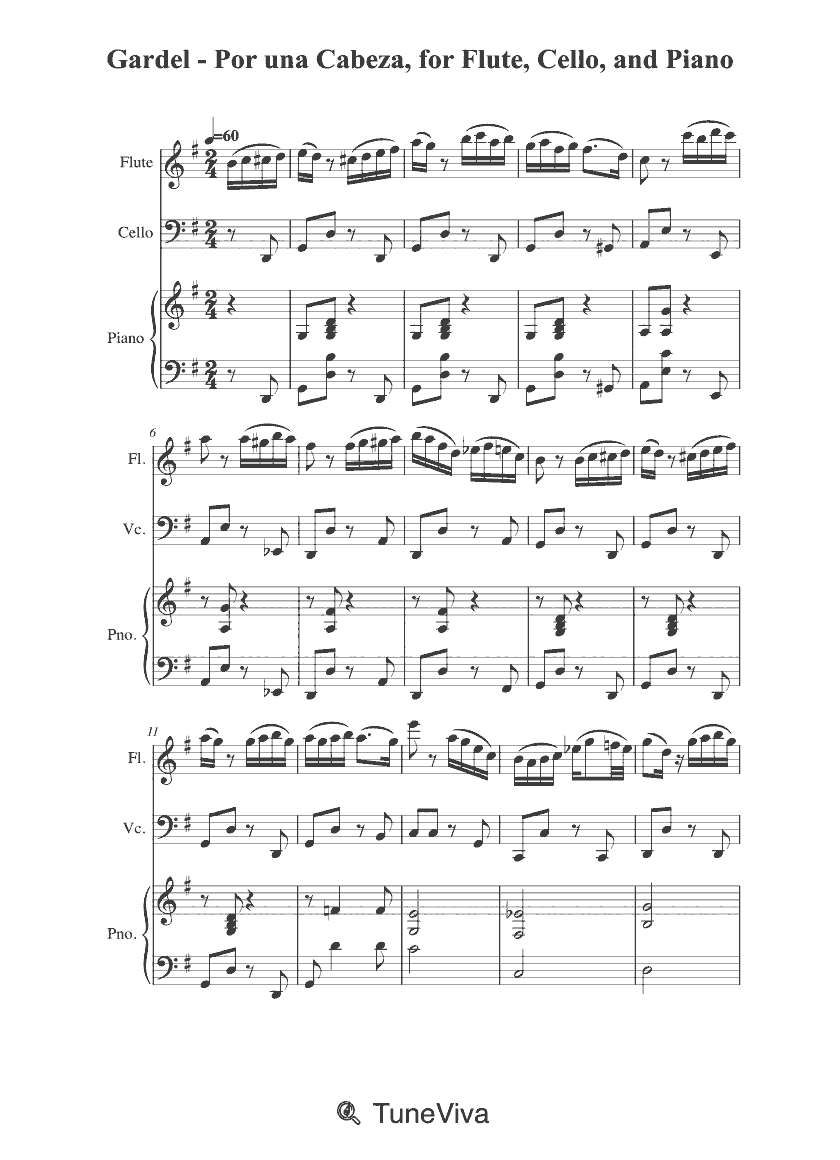
About this score
Por una Cabeza is Carlos Gardel and Alfredo Le Pera's 1935 tango, by one head, the horse-race image for a lover who loses everything on a photo finish, and this edition scores it for flute, cello and piano: sixty-five bars of 2/4 at 60 beats a minute, with the key alternating between one sharp and two flats at bars 18, 33 and 50, the tango's famous A-B dialogue.
Score parts: Flute; Cello; Piano. Opening key signature: 1 sharp. Opening time signature: 2/4. Opening tempo: 60 BPM. Estimated playback time: 2 min 9 sec. Listen while following the notation, adjust playback speed, or open this score in practice mode.
- Duration (approx.)
- 2 min 9 sec
- Score parts
- Flute; Cello; Piano
- Opening key signature
- 1 sharp
- Opening time signature
- 2/4
- Opening tempo
- 60 BPM
- Genre
- Worldmusic
The tango and its fame
Gardel sang it in the film El día que me quieras the year he died in the Medellín plane crash, and the tune became Hollywood's favourite tango, from Scent of a Woman's blind dance to True Lies. The melody's alternating sections, the seductive major strain and the brooding flat-key answer, are this edition's key plan, written directly in the signatures.
The trio edition
One thousand and twenty notes across flute, cello and piano, metre held in 2/4 throughout, the four key turns at bars 18, 33 and 50 marking the strains' alternation. The flute carries the singing theme; the cello answers; the piano keeps the tango's marcato floor.
Practice tips
- Follow the key plan exactly: one sharp, two flats at 18, one sharp at 33, two flats at 50.
- Keep the piano's marcato accompaniment sharp; the tango walks on that floor.
- Let the flute's theme sing seductively and the cello answer with the brooding strain.
- Count the 2/4 at the recorded 60; the tango's tension comes from its unhurried pace.
Questions about this score
What does Por una Cabeza mean?
By a head: the horse-racing image for losing everything on a photo finish, Gardel's metaphor for a lover's habit.
Who wrote it?
Carlos Gardel with lyricist Alfredo Le Pera in 1935; both died in the Medellín plane crash that year.
What forces does this edition need?
Flute, cello and piano, across sixty-five bars of 2/4 with the A-B key plan printed in the signatures.