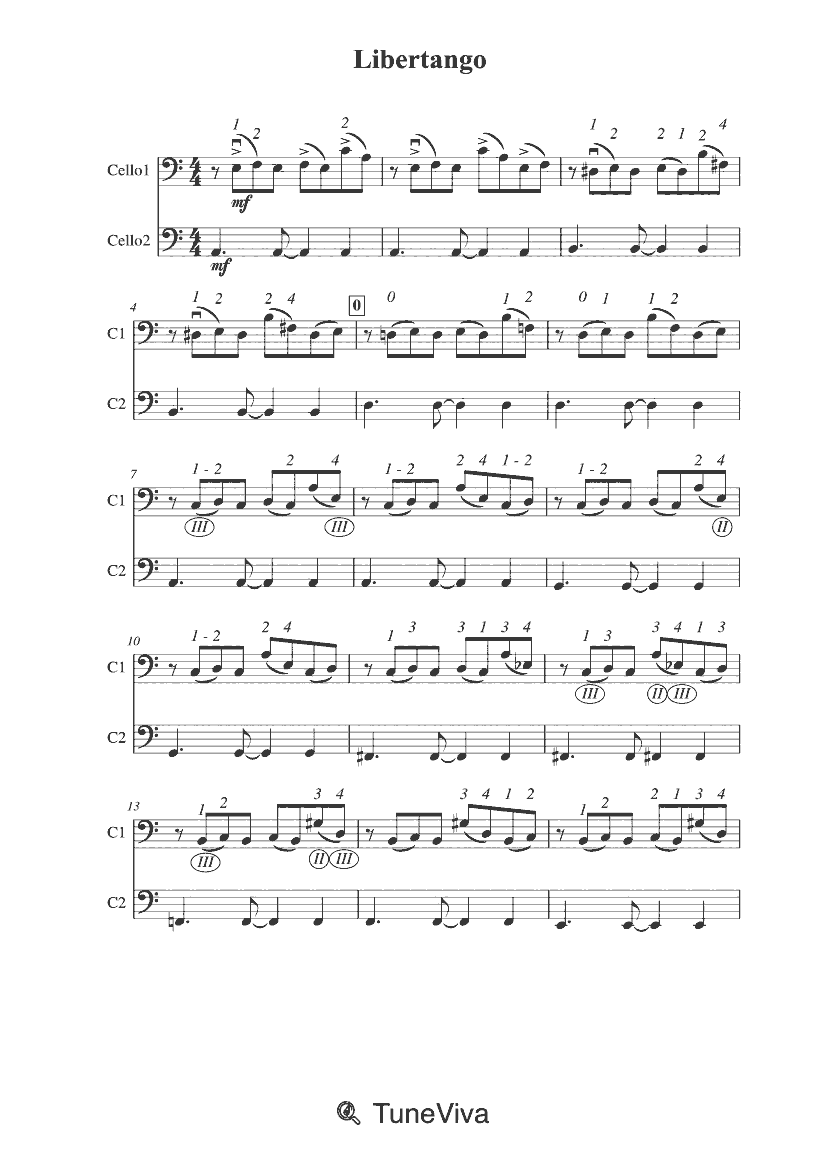
Libertango
Astor Piazzolla
Follow the score, hear the music, then make it your own.
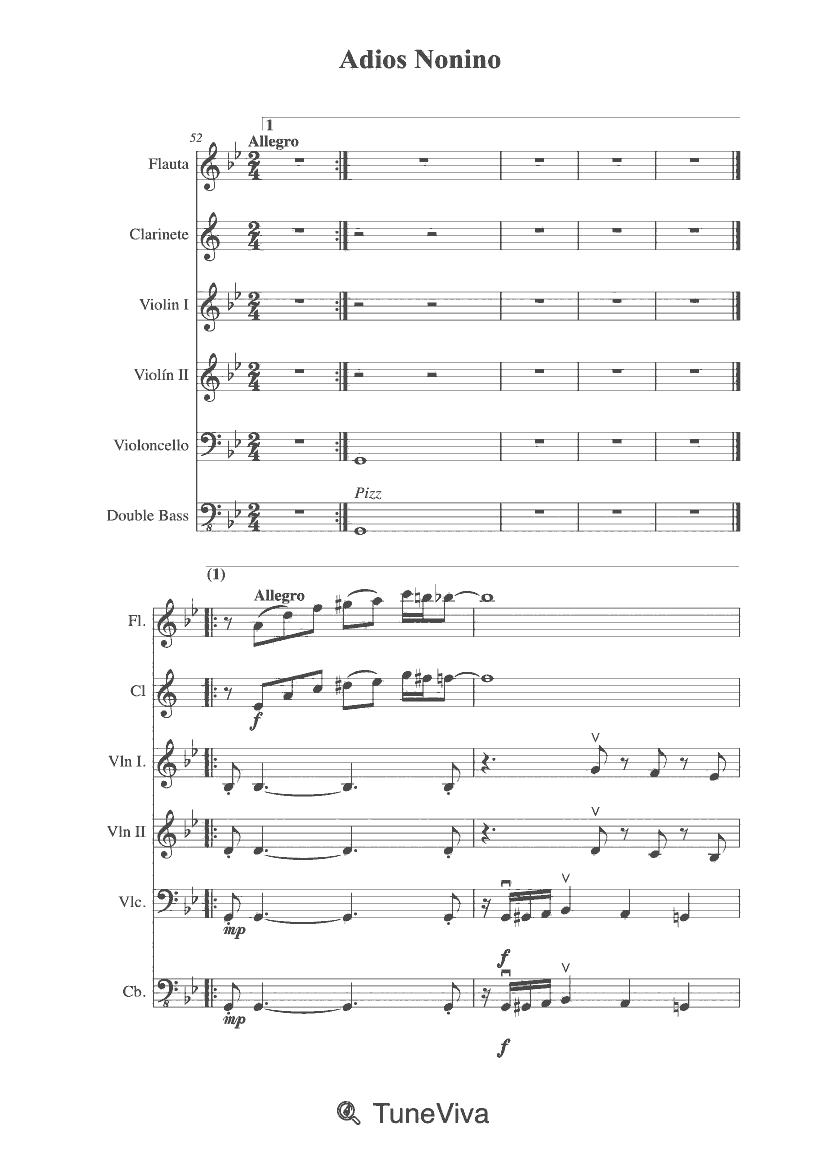
Adiós Nonino is Astor Piazzolla's 1959 farewell to his father, written the week after news of his death reached him in New York, and this edition scores it for chamber ensemble: Flauta, Clarinete, Violin I, Violín II, Violoncello and Double Bass, fifty-six bars with the famous Sur passage's dynamics marked f through mf to p, four tremolo passages, and fifty-five staccatos cutting the accompaniment sharp.
Score parts: Flauta; Clarinete; Violin I; Violín II; Violoncello; Double Bass. Opening key signature: 2 flats; No sharps or flats. Opening time signature: 4/4. Opening tempo: 132 BPM. Estimated playback time: 4 min 3 sec. Listen while following the notation, adjust playback speed, or open this score in practice mode.
Piazzolla reworked his earlier tango Nonino into Adiós Nonino after his father Vicente's death in October 1959, and the piece became the most autobiographical of all his works: the famous descending theme is grief itself, while the bandoneon-style passages rage around it. The chamber scoring keeps the tango's violence close, strings biting on the accents, flute and clarinet carrying the singing theme.
Eight hundred and ninety-one notes across the six parts, metre turning 4/4, 2/4 at 44, 4/4 at 47, 2/4 at 52 and back at 53, with the sound tempo dropping to 80 at bar 20 for the theme's entry. Four tremolo passages mark the strings' shimmer; the dynamics run f, p, mf, f across the span.
Nonino is the Ligurian-dialect word for grandfather, Piazzolla's name for his father Vicente; the piece is a farewell written after his 1959 death.
Flute, clarinet, two violins, cello and double bass, the chamber scoring printed across fifty-six bars.
The descending melody that enters at bar 20 in the printed slower tempo, the most autobiographical tune Piazzolla ever wrote.
Astor Piazzolla