Jingle Bells - Jazz Piano
Listen & explore
Follow the score, hear the music, then make it your own.
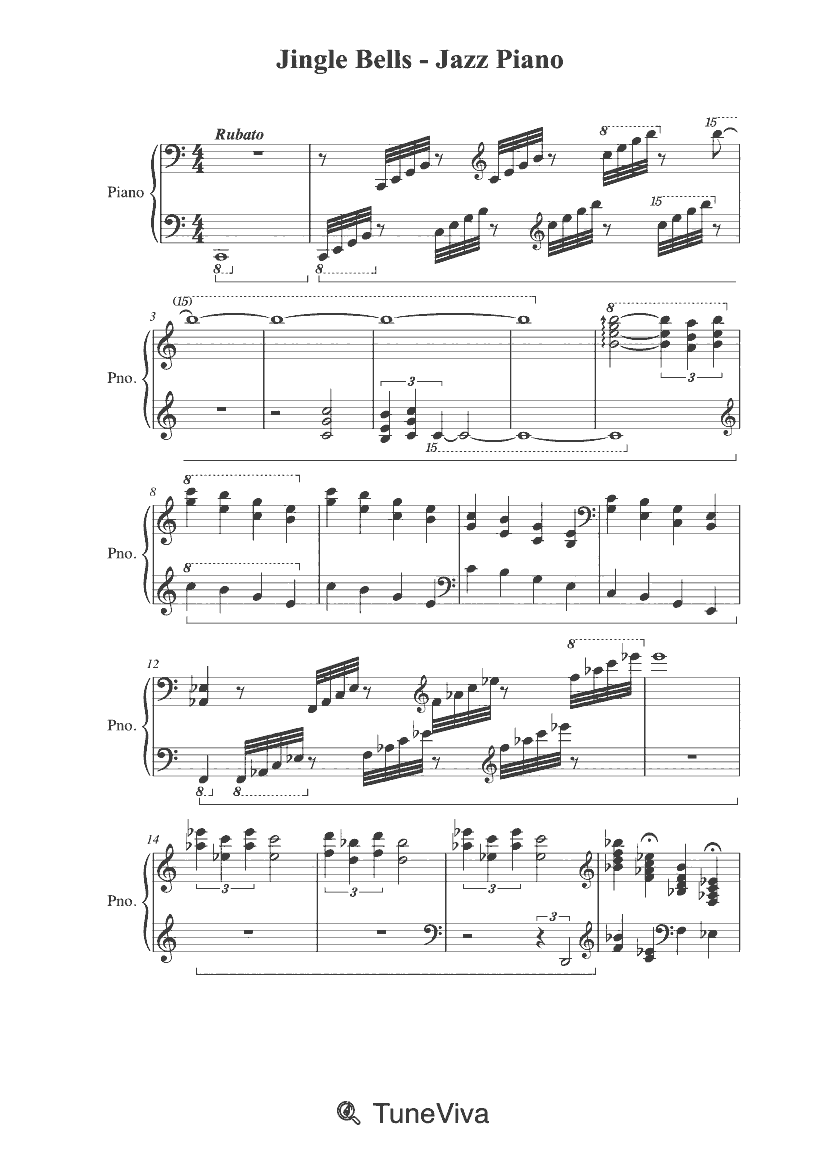
About this score
Jingle Bells began in 1857 as James Lord Pierpont's One Horse Open Sleigh, a song about sleigh races that has outlived every winter fashion since. This edition hands the tune to jazz piano: seventy-six bars with a printed Rubato opening, a Swing section, thirty-seven staccato marks, pedal markings through the texture and one stretched 6/4 bar near the middle. The signature stays at no sharps or flats and the full playback runs about two and a half minutes, long enough to hear the whole treatment unfold.
Score parts: Piano. Opening key signature: No sharps or flats. Opening time signature: 4/4. Estimated playback time: 2 min 34 sec. Listen while following the notation, adjust playback speed, or open this score in practice mode.
- Duration (approx.)
- 2 min 34 sec
- Score parts
- Piano
- Opening key signature
- No sharps or flats
- Opening time signature
- 4/4
- Genre
- Jazz
From sleighing song to swing
Pierpont wrote the song for a Boston Sunday school and published it in 1857 under the title One Horse Open Sleigh; the Jingle Bells name took over later, and the song slid from seasonal novelty to Christmas fixture over the following decades. It was never a carol in origin and this edition makes no pretence that it was: the jazz treatment treats the tune as a standard, something to be delayed, swung and punctuated. The famous chorus figure survives intact, which is why the treatment works; you always know where the sleigh is.
What the jazz treatment adds
The printed words tell you the plan. Rubato opens the piece, freeing the first phrases from strict time; Swing marks the point where the pulse locks in; and the pedal markings, sixteen of them, sustain the harmonies between the hands. The staccato marks, thirty-seven in all, lift the melody in the swung sections, and the single 6/4 bar at twenty-one briefly stretches the bar before returning to 4/4 two bars later. The piano covers the whole keyboard from its lowest C to its highest, which tells you the treatment has real weight in both bass and treble.
Practising the swing feel
Start with the swung sections rather than the rubato: set a steady quarter-note pulse, swing the eighths in a comfortable long-short lilt, and add the staccato lift only when the pulse is secure. The pedal markings matter more than they look; clear each one as it ends so the harmonies stay distinct under the melody. Take the Rubato opening last, when your ear knows the target of each phrase, and let it lean without losing the sense of the beat underneath. The 6/4 bar needs only counting; give it its full six beats and keep moving.
Practice tips
- Learn the swung sections first with a steady quarter pulse, then add the staccato lift once the lilt is stable.
- Clear each pedal marking as it ends; the harmonies need space or the texture turns to mud under the melody.
- Rehearse the Rubato opening after you know the swing sections, so each delayed phrase still aims at its landing.
- Count the 6/4 bar at twenty-one through in full and keep the pulse running straight through it.
Questions about this score
Who wrote Jingle Bells originally?
James Lord Pierpont published it in 1857 as One Horse Open Sleigh. The Jingle Bells title took over later, and the song grew from sleighing-race novelty into a Christmas fixture.
What do the printed words on the score mean?
Two markings guide the character: Rubato frees the opening phrases from strict time, and Swing sets the point where the pulse locks into a long-short lilt for the rest of the treatment.
How long does the playback run?
About two and a half minutes, covering all seventy-six bars including the rubato opening and the swung body of the piece.
Is the key signature complicated?
The piece stays under a signature of no sharps or flats throughout, with one 6/4 bar near the middle as the only change to the metre.