Chord Symbol Voicings for Playback
Listen & explore
Follow the score, hear the music, then make it your own.
About this score
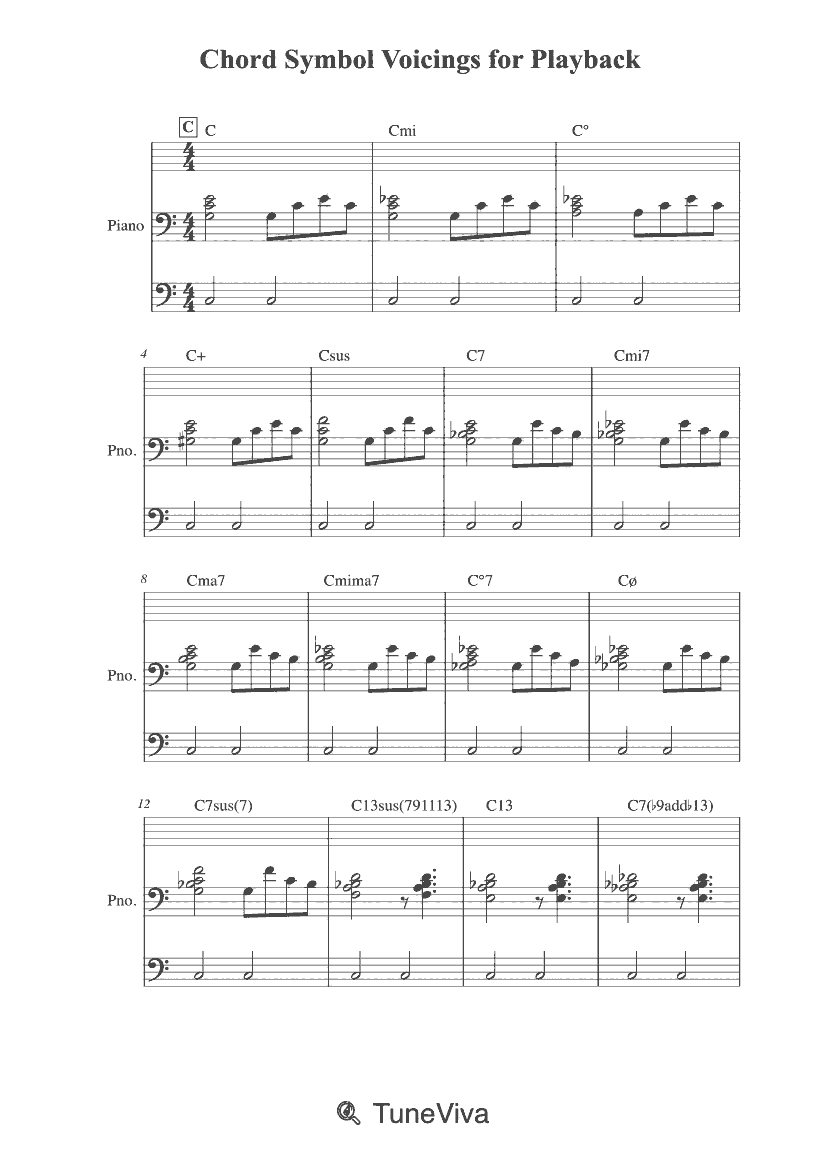
Chord Symbol Voicings for Playback is a study resource by Marc Sabatella, the American jazz educator whose primer on improvisation has guided self-taught players for decades. The file does what its title promises: two hundred and forty bars of piano music in 4/4, C major at the signature, built from chord voicings written out bar after bar, nine hundred and forty-eight chord notes and five hundred and twenty-eight accidentals charting the harmonic territory. The playback runs a full eight minutes, making it a companion for practice rather than a performance piece.
Score parts: Piano. Opening key signature: No sharps or flats. Opening time signature: 4/4. Estimated playback time: 8 min 0 sec. Listen while following the notation, adjust playback speed, or open this score in practice mode.
- Duration (approx.)
- 8 min 0 sec
- Score parts
- Piano
- Opening key signature
- No sharps or flats
- Opening time signature
- 4/4
- Genre
- Jazz
The educator behind the page
Sabatella is known for A Jazz Improvisation Primer, one of the earliest and most durable online guides to playing jazz, and for decades of teaching work around rhythm-section skills. A resource like this one is teaching by example: rather than explaining voicing theory in prose, it lays out two hundred and forty bars of real voicings that a player can hear, read and imitate. The playback's eight-minute length is the tell; this is material designed to be listened to repeatedly while studying the shapes on the page.
Reading a voicing study
The texture is uniformly piano, spanning E2 to G sharp 4, with half notes dominating one thousand three hundred and eighty of the two thousand three hundred and forty notes. Half notes are the voicer's natural unit: one chord per half bar, each given its shape. The five hundred and twenty-eight accidentals are where the teaching happens, since chromatic voicings, altered dominants and borrowed colours all live there. There are no tempo words, no dynamics and no repeats; the pulse is implicit, and the playback supplies it at its own steady rate.
Turning a study into technique
Work one section at a time. Take each two-bar unit, identify the chord from its shape, and name the intervals by ear after playing it; the goal is connecting sound to structure, not just reading. Practise each voicing in all twelve keys once you understand its construction, which is how these shapes become vocabulary. Then improvise small connections between voicings, the way a pianist would link them in real playing. Use the playback as a loop for ear training: hear a chord, name its quality, check yourself on the page. Eight minutes is long enough for a complete, unhurried session.
Practice tips
- Work in two-bar units: play each voicing, identify its chord, and name the intervals by ear.
- After understanding a voicing's construction, practise it in all twelve keys to build vocabulary.
- Use the playback as an ear-training loop: hear a chord, name its quality, verify on the page.
- Improvise small connections between voicings to turn the study shapes into real playing links.
Questions about this score
Who is Marc Sabatella?
An American jazz educator and pianist, author of the long-standing online guide A Jazz Improvisation Primer and a teacher of rhythm-section skills. This file is one of his study resources, written out for practice rather than performance.
What is the purpose of this file?
Its title says it plainly: chord symbol voicings laid out for playback, so a player can hear and study two hundred and forty bars of written-out voicings at a steady pulse.
What does the texture contain?
Two thousand three hundred and forty notes, mostly half notes, spanning E2 to G sharp 4, with nine hundred and forty-eight chord notes and five hundred and twenty-eight accidentals marking the chromatic voicings.
How long does the playback run?
A full eight minutes for the two hundred and forty bars, which makes it a companion for repeated listening during practice.