Don t You Worry Bout a Thing
Listen & explore
Follow the score, hear the music, then make it your own.
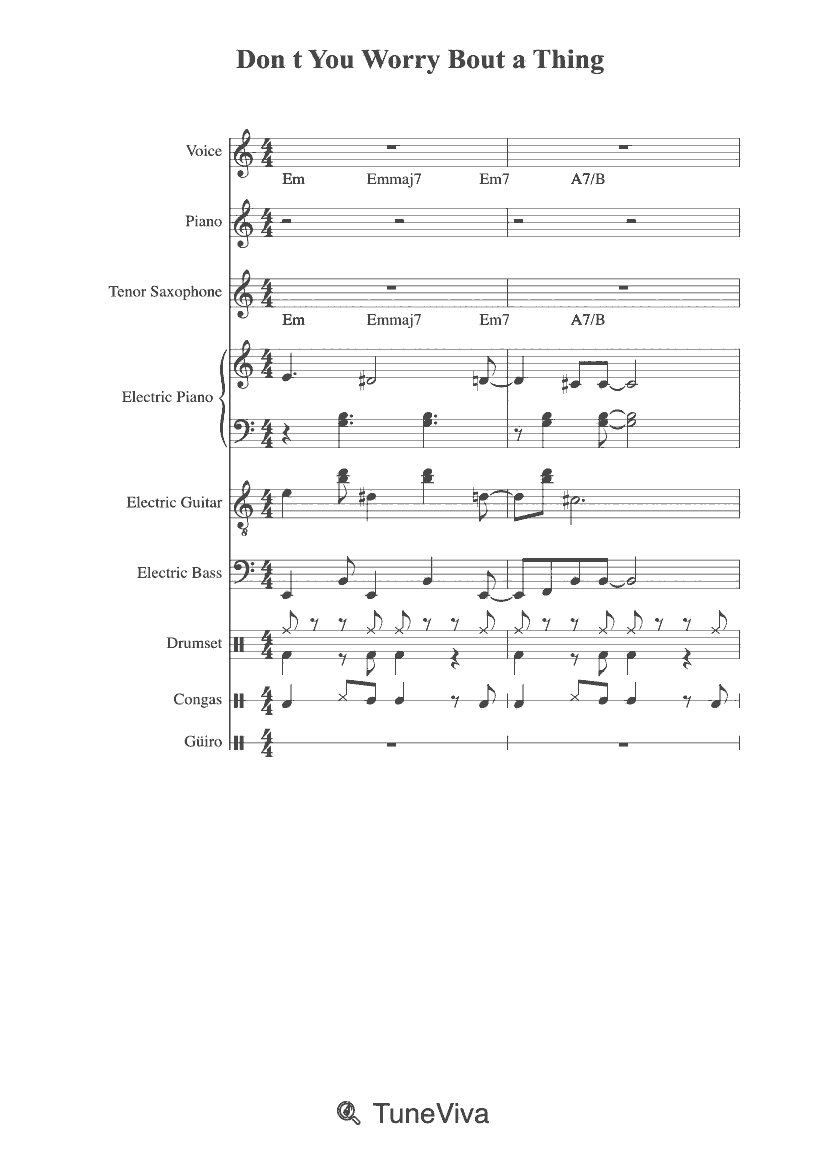
About this score
Don't You Worry Bout a Thing is Stevie Wonder's 1973 single from Innervisions, the album widely regarded as his greatest, and its Latin-inflected groove and(message about letting go made it one of the record's most joyous tracks. This edition arranges it for voice, piano, tenor saxophone, electric piano and electric guitar: a hundred and two bars of 4/4 in a no-key-signature span.
Score parts: Voice; Piano; Tenor Saxophone; Electric Piano; Electric Guitar; Electric Bass; Drumset; Congas; Güiro. Opening key signature: No sharps or flats. Opening time signature: 4/4. Estimated playback time: 6 min 27 sec. Listen while following the notation, adjust playback speed, or open this score in practice mode.
- Duration (approx.)
- 6 min 27 sec
- Score parts
- Voice; Piano; Tenor Saxophone; Electric Piano; Electric Guitar; Electric Bass; Drumset; Congas; Güiro
- Opening key signature
- No sharps or flats
- Opening time signature
- 4/4
- Genre
- Rbfunksoul
The song and Innervisions
Innervisions is Stevie Wonder's masterpiece, an album that addressed drug abuse, spirituality and social injustice alongside love songs, and Don't You Worry Bout a Thing is its most carefree track. The Latin rhythm section and Wonder's improvised-sounding vocal give it a carnival energy that contrasts with the album's darker material.
The band arrangement
The notation gives Voice three hundred and seventy-four notes, Piano four hundred and seventy, Tenor Saxophone three hundred and seventy-four, Electric Piano nine hundred and forty-three and Electric Guitar eight hundred and eighty-two, no dynamics marked. The no-key-signature span keeps the modal territory open throughout.
Practice tips
- Lock the groove before adding melody; the song's Latin-inflected rhythm is its foundation.
- Keep the electric piano's figures light and rhythmic rather than melodic.
- The tenor saxophone answers the voice's phrases; rehearse the handovers together.
- Since no dynamics are printed, hold one joyful, consistent level throughout.
Questions about this score
Which album is Don't You Worry Bout a Thing from?
Stevie Wonder's Innervisions of 1973, widely regarded as one of the greatest albums in popular music.
What gives the song its Latin character?
The rhythm section's Latin-inflected groove and Wonder's Spanish-accented phrasing on the title line.
What forces does the arrangement need?
Voice, piano, tenor saxophone, electric piano and electric guitar, each on its own stave.