
Ave Maria (Bach/Gounod) for violin and piano
J.S. Bach and Charles Gounod Arrangement by Jaime A. Snchez
For violin and piano
Violín; Piano · Arr. by Jaime A. Sánchez · 4 min 31 sec
Open scoreAve Maria is a title shared by several unrelated pieces, and the scores collected here come from more than one of them. This page currently lists a four-part setting attributed to Jacques Arcadelt alongside versions of the Bach/Gounod Ave Maria for violin and piano and for cello. Because the same name covers different works, the composer credit and the intended instruments matter more than the title when you are choosing Ave Maria sheet music.
Scores 1–20 of 71
J.S. Bach and Charles Gounod Arrangement by Jaime A. Snchez
For violin and piano
Violín; Piano · Arr. by Jaime A. Sánchez · 4 min 31 sec
Open score
Charles Gounod
Cello · 2 min 21 sec
Open score
Charles Gounod
Cello · 2 min 21 sec
Open score
Jacques Arcadelt
Soprano; Alto; Tenor +1 parts · 1 min 52 sec
Open score
Misc Praise Songs
Soprano; Alto; Ténor +1 parts · 2 min 11 sec
Open score
Recomposer par _notander_
Violon · 50 sec
Open score
Composer: Vladimir Vavilov
Piccolo; Flauta; Oboe +18 parts · Arr. C. Marrero · 4 min 7 sec
Open score
Bach-Gounod
Transp. mandoline 5 cordes
Flûte Traversière; Mand. oct. 5 cordes · 2 min 28 sec
Open score
Charles Gounod
Meditation on the First Prelude of J. S. Bach
Tromba in Si♭ · 1 min 47 sec
Open score
Jacques Arcadelt
Soprano; Alto; Tenor +1 parts · 1 min 6 sec
Open score
Claudio Monteverdi
tribus vocibus Sacrae Cantiunculae
S; A; B · 1 min 45 sec
Open score
Bach/Gounod
for Soprano Cello and Organ
B♭ Trumpet; Soprano; Alto +4 parts · 4 min 15 sec
Open score
Charles Franois Gounod
Voice; Pipe Organ · 5 min 1 sec
Open score
Ave Maria - Cherubini
Soprano; Organ · 3 min 9 sec
Open score
Jzef GRABOWSKI
(duet na Sopran i Alt)
Soprano; Alto; Organo · 2 min 6 sec
Open score
Mariano Garau
Soprano; Contralto; Tenore +1 parts · 3 min 5 sec
Open score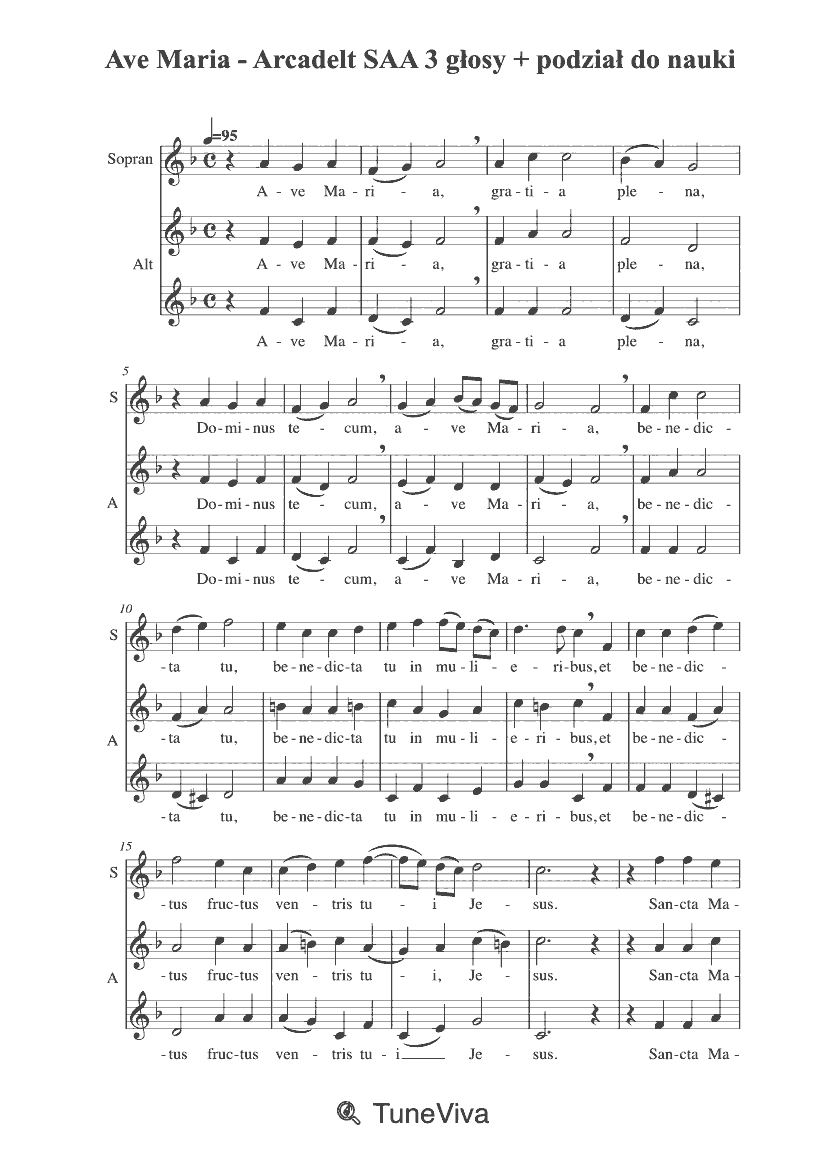
Jacques Arcadelt
Sopran; Alt · 5 min 49 sec
Open score
Hubert Cuypers
Bariton; Piano · 2 min 47 sec
Open score
Anton Bruckner
T1a; T2a; B1a +5 parts · 4 min 26 sec
Open score
Dvorak op. 19barr. satb opt. vln from sopr solo Brian Marble dedicated to my wife New Year 2015
Copyright 2015 by CPDL. This edition can be fully distributed duplicated performed and recorded.
Soprano; Alto; Tenor +3 parts · 3 min 36 sec
Open scorePage 1 of 4
A score called Ave Maria is not necessarily the same piece as another with the same name. The listings here fall into two groups: a four-voice setting credited to Jacques Arcadelt, and versions credited to J.S. Bach and Charles Gounod. Before you play or rehearse, check the composer line and the forces named in the listing. If a listing gives no composer, as with the cello version here, treat the title as a clue rather than proof of which piece the score contains.
Choirs looking for a vocal Ave Maria have the Arcadelt setting, scored for soprano, alto, tenor and bass. A violinist working with a pianist has the Bach/Gounod arrangement by Jaime A. Sánchez, which names both instruments. The cello listing carries a single part only, so players should open the score to see whether an accompaniment is included or expected before committing to a performance. Choosing by instrumentation is more reliable than choosing by title alone.
The Arcadelt score opens with a one-flat key signature in 4/4 at a marked 70 BPM; the Bach/Gounod violin and piano arrangement opens with no sharps or flats, also in 4/4. The cello version is listed with no sharps or flats but without a time signature. These describe only the opening of each score and do not establish its key name, its difficulty or any later changes. Players should confirm all markings against the score itself.
Score parts: Violín, Piano. Catalogue duration 4 min 31 sec. Opening key signature: No sharps or flats. Opening time signature: 4/4. Opening tempo: 70 BPM. Arranger: Arr. by Jaime A. Sánchez.
Score parts: Cello. Catalogue duration 2 min 21 sec. Opening key signature: No sharps or flats.
Score parts: Soprano, Alto, Tenor, Bass. Catalogue duration 1 min 52 sec. Opening key signature: 1 flat. Opening time signature: 4/4. Opening tempo: 70 BPM.
Ave Maria is a name used for many separate compositions rather than one single work, so two scores with that title can be entirely unrelated. The scores on this page include a four-voice setting attributed to Jacques Arcadelt and a version credited to J.S. Bach and Charles Gounod. Comparing the composer credit and the instrumentation is the quickest way to tell which piece a given score contains.
The Arcadelt Ave Maria score listed here is set for soprano, alto, tenor and bass, making it a four-part choral piece rather than a solo song. Its opening carries a one-flat key signature, a 4/4 time signature and a marked tempo of 70 BPM. Choirs should check the voicing and edition against the score before rehearsing.
Two instrumental versions of the Bach/Gounod Ave Maria appear here: one for violin and piano, arranged by Jaime A. Sánchez, and one for solo cello. Both listings show an opening key signature of no sharps or flats, and the violin and piano score is in 4/4. The cello listing contains a single cello part only, so players should check whether a keyboard accompaniment is included.
Credits differ across the page: the four-part setting is attributed to Jacques Arcadelt, while the violin and piano and cello versions are credited to J.S. Bach and Charles Gounod. The violin and piano score also names Jaime A. Sánchez as arranger, which makes it an arrangement for those forces rather than a composer's own version for them. The cello listing has no composer in its credit field, although its title names Bach and Gounod.
The cello version of the Bach/Gounod Ave Maria is listed with one part only, cello, so the score as described contains no separate piano part. Whether the version is meant as an unaccompanied solo or as a part to be played with accompaniment is not stated in the listing. Cellists should examine the score before planning a performance or rehearsal.