
Salve Regina
Meloda gregoriana
(Tono simple)
Órgano de tubos · 1 min 11 sec
Open scoreSalve Regina is a title shared by several different pieces rather than a single fixed work. The scores gathered here include a three-part traditional setting, Johann Michael Haydn's Salve Regina in D, MH 30, and a score labelled as a Gregorian melody. Because their scoring and musical character differ, compare instrumentation, texture and key details before choosing sheet music for performance or study.
Scores 1–20 of 34
Meloda gregoriana
(Tono simple)
Órgano de tubos · 1 min 11 sec
Open score
Misc Traditional
Part_1; Part_2; Part_3 · 21 min 3 sec
Open score
Johann Michael Haydn
à 4 voci soprano corni 2 violini col organo MH 30
2 Clarini; 2 Violini; Voice +3 parts · 4 min 49 sec
Open score
Mariano Garau
Soprano; Alto; Tenore +1 parts · 4 min 16 sec
Open score
Giovanni Battista Riccio
MusicXML Part · 2 min 52 sec
Open score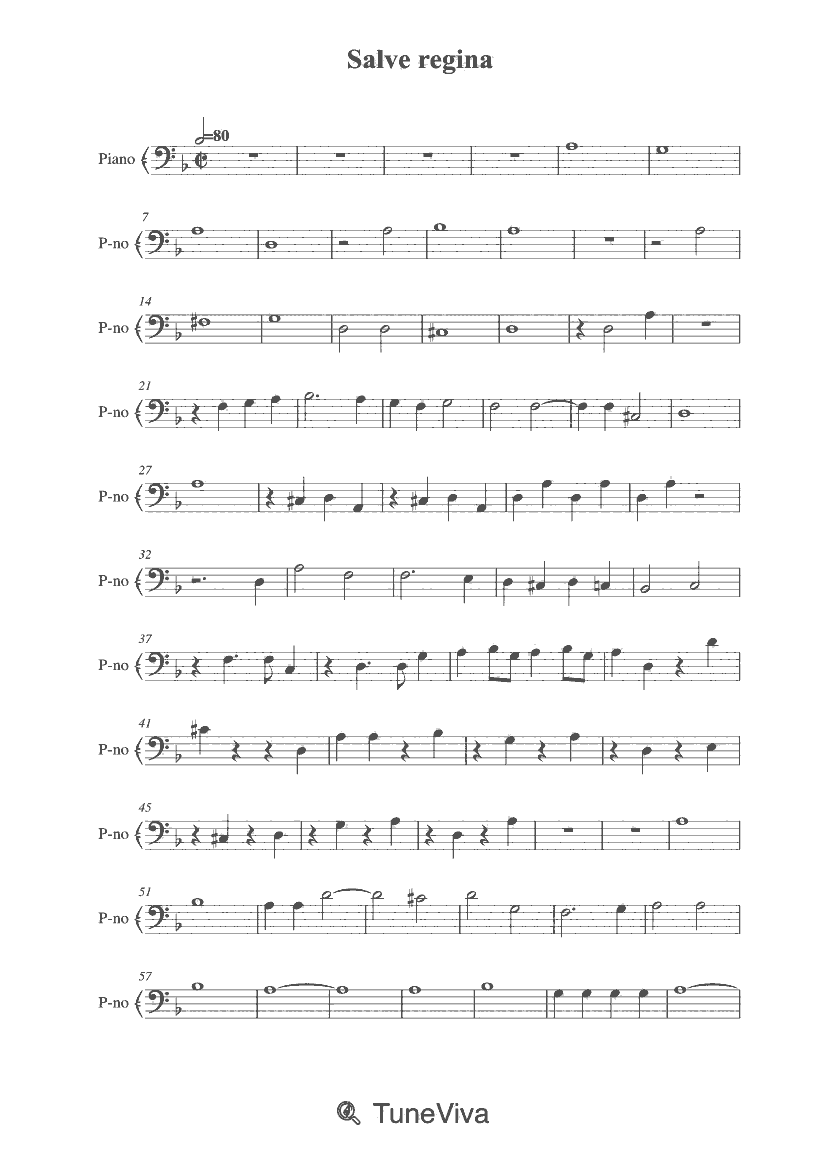
Diogo Dias Melgs
Piano · 6 min 8 sec
Open score
Sebastin Durn (1660-1716)
De nuestra señora a 8
Tiple [Soprano]; Alto; Tenor +4 parts · 4 min 0 sec
Open score
Michael Haydn edited Brian Marble
Violin; Viola; Violoncello · 6 min 6 sec
Open score
Jos de Nebra
Violin 1; Violin 2; Tiple 1 (Soprano) +7 parts · 4 min 47 sec
Open score
Salve Regina - Lotti
Soprano; Alto; Tenor +1 parts · 4 min 49 sec
Open score
Misc Traditional
Part_1; Part_2; Part_3 +1 parts · 11 min 28 sec
Open score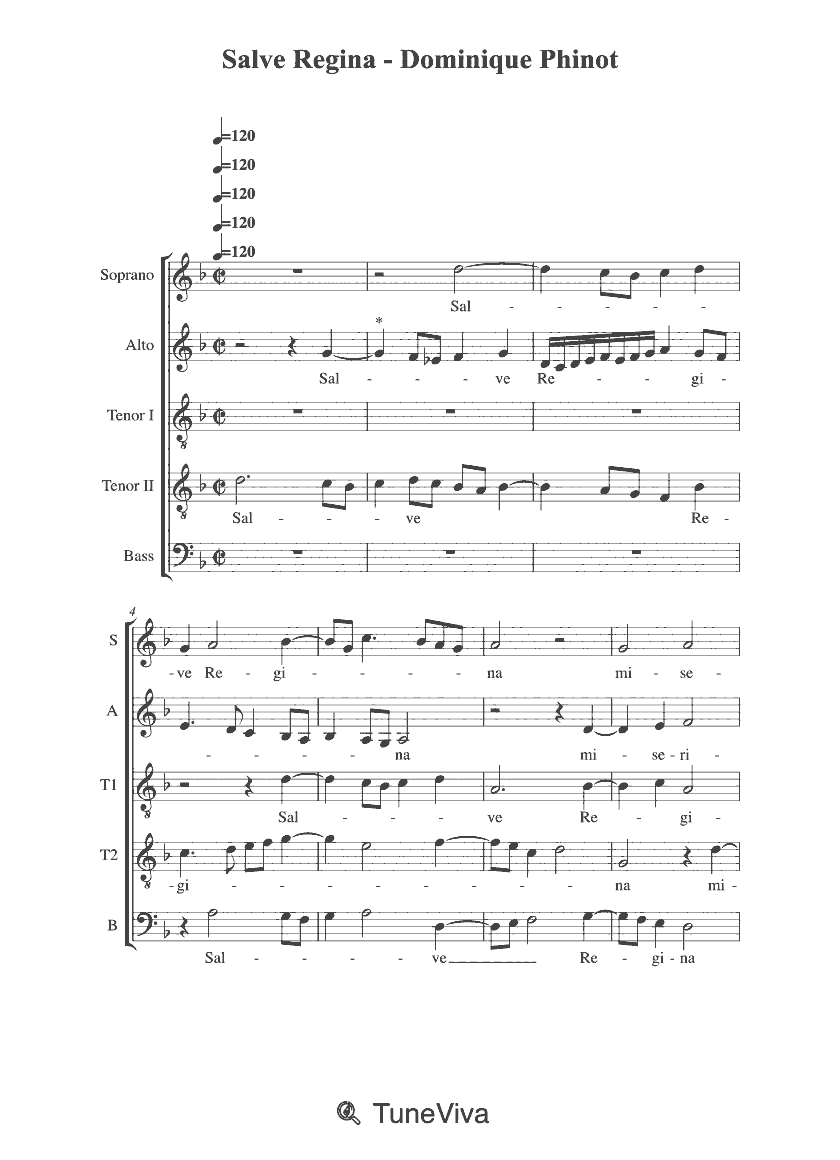
Dominique Phinot
Soprano; Alto; Tenor I +2 parts · Arr. (c. 1510 - c. 1556) · 5 min 52 sec
Open score
José de Torres
A duo a tres y a cuatroa duo los dos tiples a 3 los dos tiples y el tenor y a 4 como está
Tiple 1 (Soprano); Tiple 2; Contralto +2 parts · 5 min 56 sec
Open score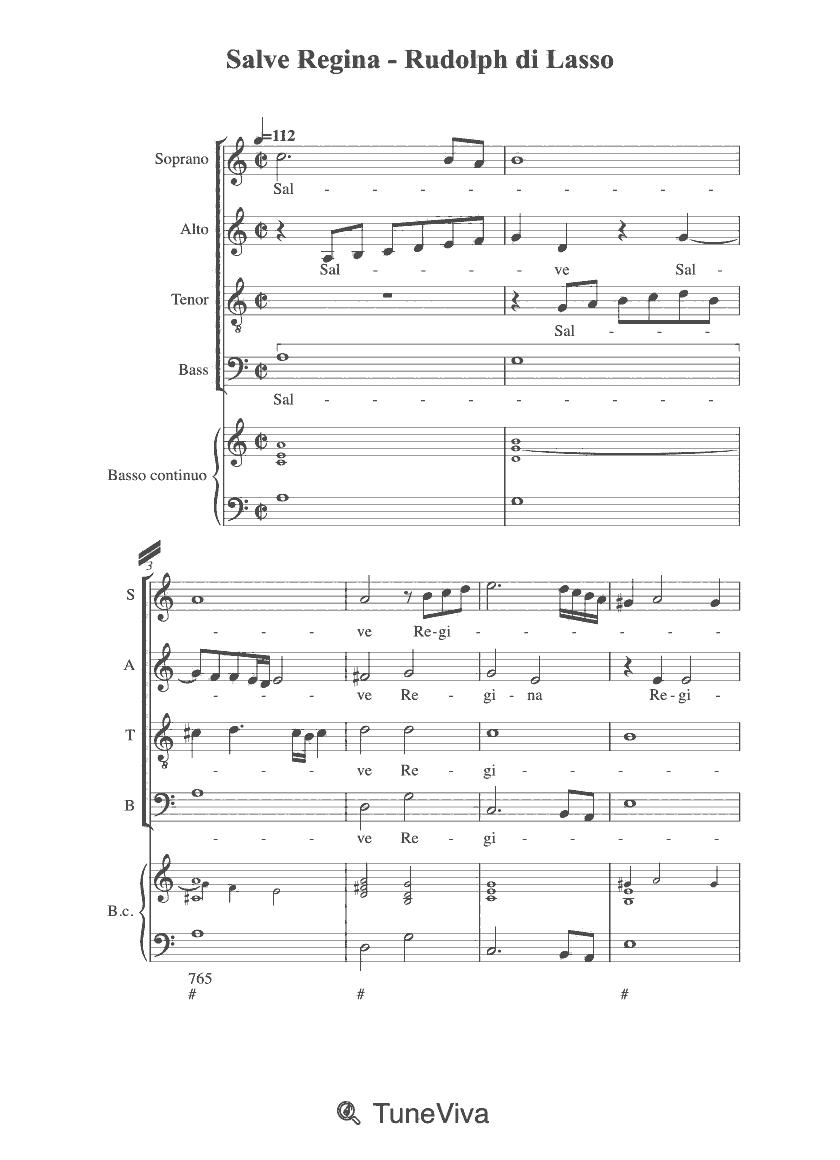
Rudolph di Lasso
Philomela Coelestis 99
Soprano; Alto; Tenor +2 parts · Arr. ed. Jeffrey Quick · 6 min 52 sec
Open score
P. E. Lange-Mller (1850-1926)
Op 65:3
S; A; T +1 parts · 2 min 28 sec
Open score
Robert Lucas Pearsall
Copyright CPDL
SOPRANO; ALTO; TENOR +1 parts · 22 min 5 sec
Open score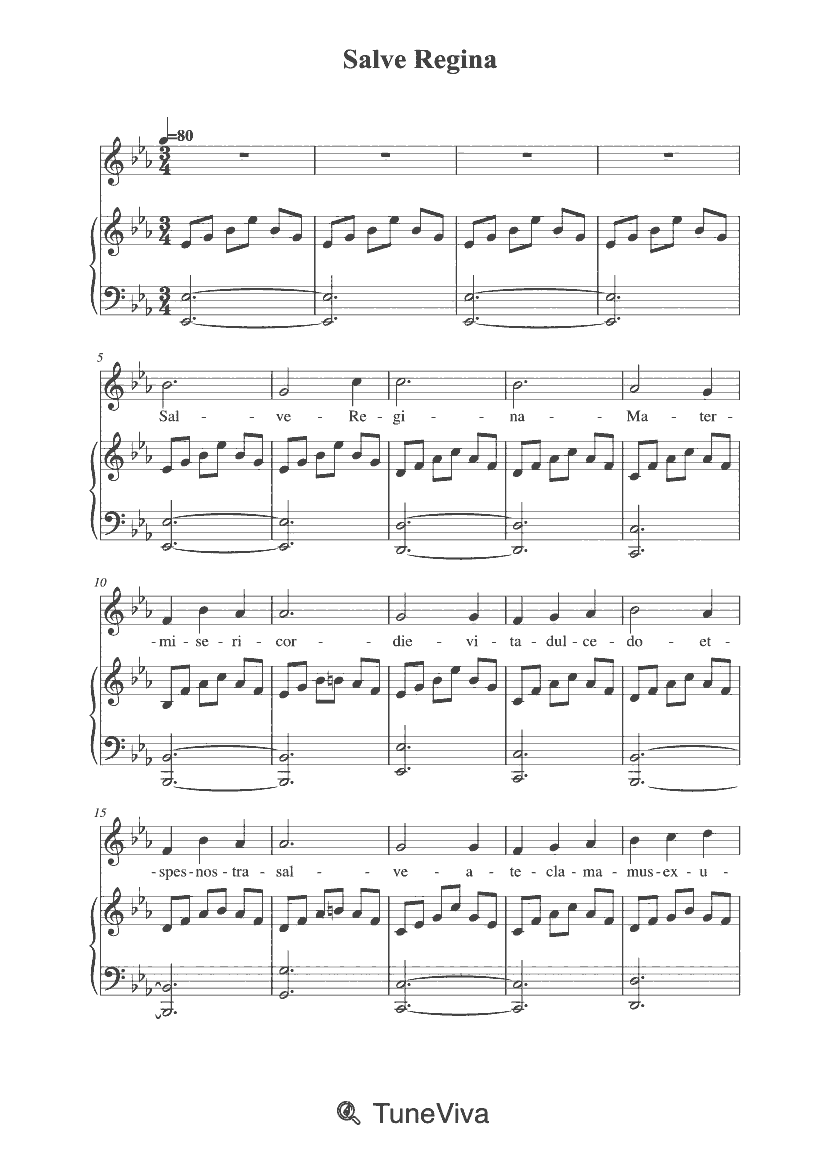
Padair Feldoguman
Voice; Piano · 2 min 52 sec
Open score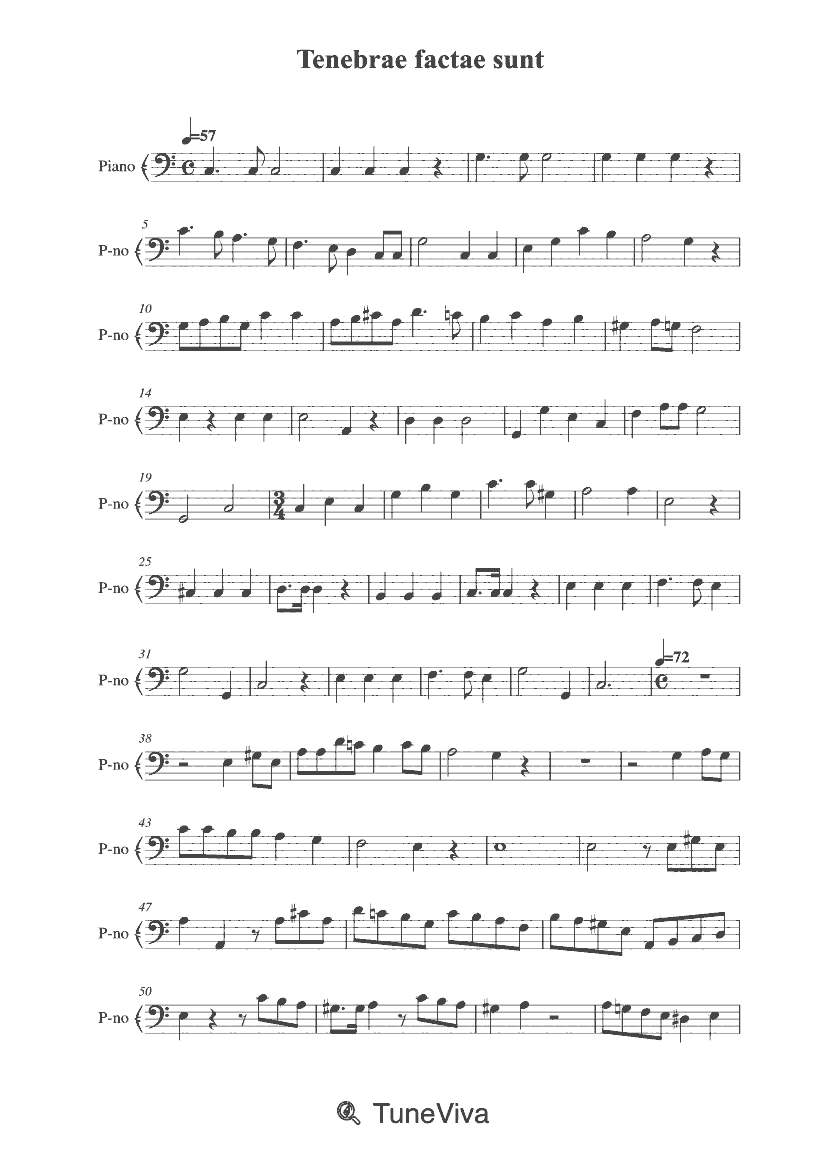
David Perez
Piano · 3 min 17 sec
Open score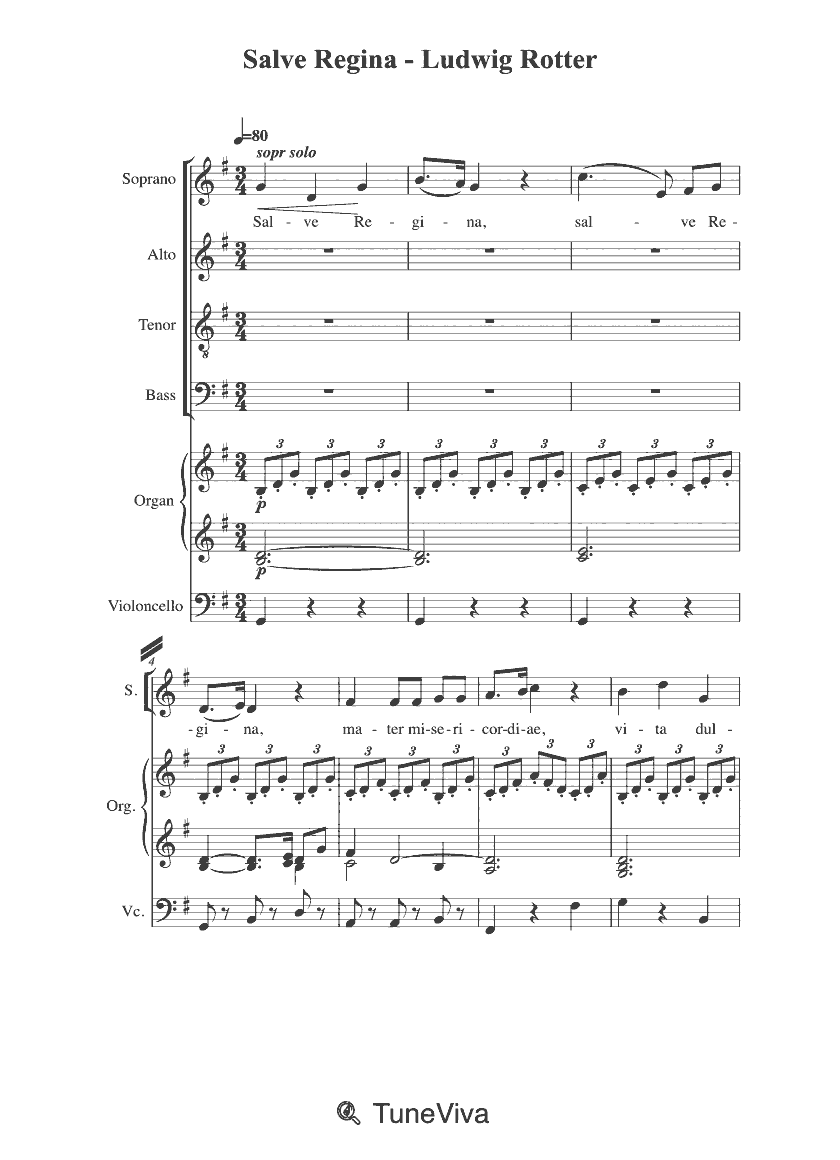
Ludwig Rotter (1816-1895) transcription Manfred Hl organ arr. BMarble
Copyright 2016 by The Choral Public Domain Library. Edition may be freely distributed duplicated performed or recorded.
Soprano; Alto; Tenor +3 parts · 3 min 9 sec
Open score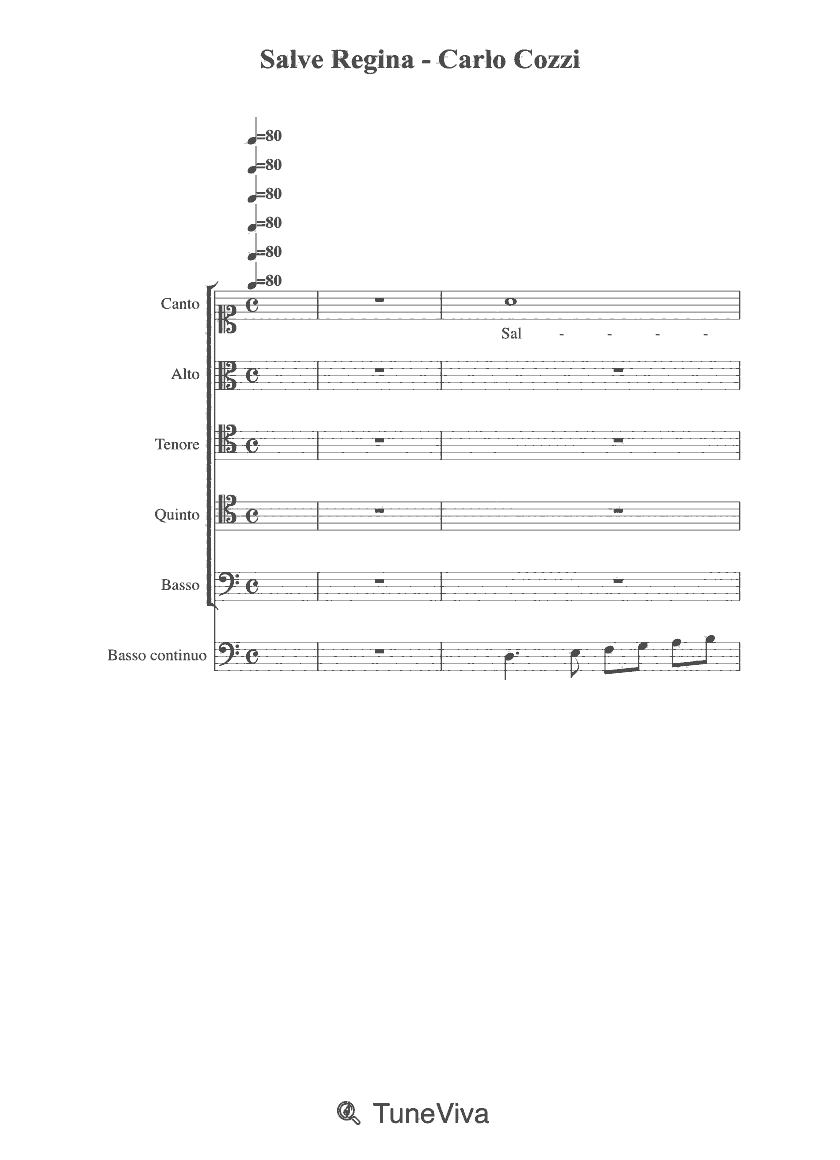
Carlo Cozzi(? - 1658)
Canto; Alto; Tenore +3 parts · 7 min 9 sec
Open scorePage 1 of 2
The name Salve Regina appears on scores that are not simply alternative editions of one composition. Among the versions shown are a three-part traditional setting, a larger setting by Johann Michael Haydn in D, MH 30, and a score labelled 'Meloda gregoriana'. Treat each as a separate piece and check its scoring before assuming it will match another version.
The Haydn setting lists two clarini, two violins, voice and organ, with an opening in 3/4. The traditional three-part setting lists three parts in 4/4 with no sharps or flats. A small ensemble may find the three-part texture more practical, while the Haydn score needs a larger group. Match the listed instruments and ranges to your players, and inspect the opening pages before committing.
Titles and part lists can be incomplete or misleading. Look at clefs, ranges, key signatures and the first few bars to confirm whether a score is a vocal chant, an organ piece, or a concerted setting for voices and instruments. The score labelled 'Meloda gregoriana', for example, lists a pipe-organ part, so its exact relationship to Gregorian chant needs checking in the notation.
The available records do not provide authoritative attribution for every version, and 'Salve Regina (Tr91)' is listed without a composer or an explanation of 'Tr91'. Historical context, liturgical use and completeness of a setting should be confirmed against the score itself or a reliable reference source rather than inferred from a title alone.
Score parts: Órgano de tubos. Catalogue duration 1 min 11 sec. Opening key signature: No sharps or flats. Opening tempo: 71 BPM.
Score parts: Part_1, Part_2, Part_3. Catalogue duration 21 min 3 sec. Opening key signature: No sharps or flats. Opening time signature: 4/4.
Score parts: 2 Clarini, 2 Violini, Voice, Organ, Violin 1, Violin 2. Catalogue duration 4 min 49 sec. Opening key signature: No sharps or flats; 2 sharps. Opening time signature: 3/4. Opening tempo: 100 BPM.
Salve Regina is a title used for multiple distinct pieces rather than a single fixed work. The scores listed under this title include a three-part traditional setting, Johann Michael Haydn's Salve Regina in D, MH 30, and a score labelled as a Gregorian melody. Each has its own scoring and musical shape, so they should be treated as separate choices rather than interchangeable versions of one piece.
The listing for Johann Michael Haydn's Salve Regina in D, MH 30 shows parts for two clarini, two violins, voice and organ, with an opening in 3/4 time. Those details describe that particular score. Check the first pages before planning a performance, since imported part lists can be incomplete or misleading.
A small ensemble may find the three-part traditional setting the more practical starting point, because its listing shows three parts rather than the seven parts shown for the Haydn setting. The Haydn score calls for voice, strings, clarini and organ, so it needs a larger group. Match the listed instrumentation and ranges to your players, and inspect the score before committing.
One score is labelled 'Meloda gregoriana', which points to a Gregorian melody, but its listed part is pipe organ rather than a vocal line. That may indicate an organ arrangement or a labelled melody; the listing alone does not prove how the chant is presented. Check the notation to see whether it is a single vocal line, an organ piece, or an arrangement.
Look at the scoring and texture. A single unaccompanied vocal line suggests chant, while a score with voice, strings, clarini and organ, such as the Haydn setting, is a concerted ensemble work. Key and time signatures also help: the traditional three-part setting opens in 4/4 with no sharps or flats, while the Haydn opens in 3/4. These details are starting points, not proof of genre.
The title 'Salve Regina (Tr91)' does not explain what Tr91 refers to, and no composer is named for that score. The listing describes a three-part piece in 4/4 with no sharps or flats. Treat the attribution and the meaning of Tr91 as unresolved until the score itself or an authoritative source clarifies them.