

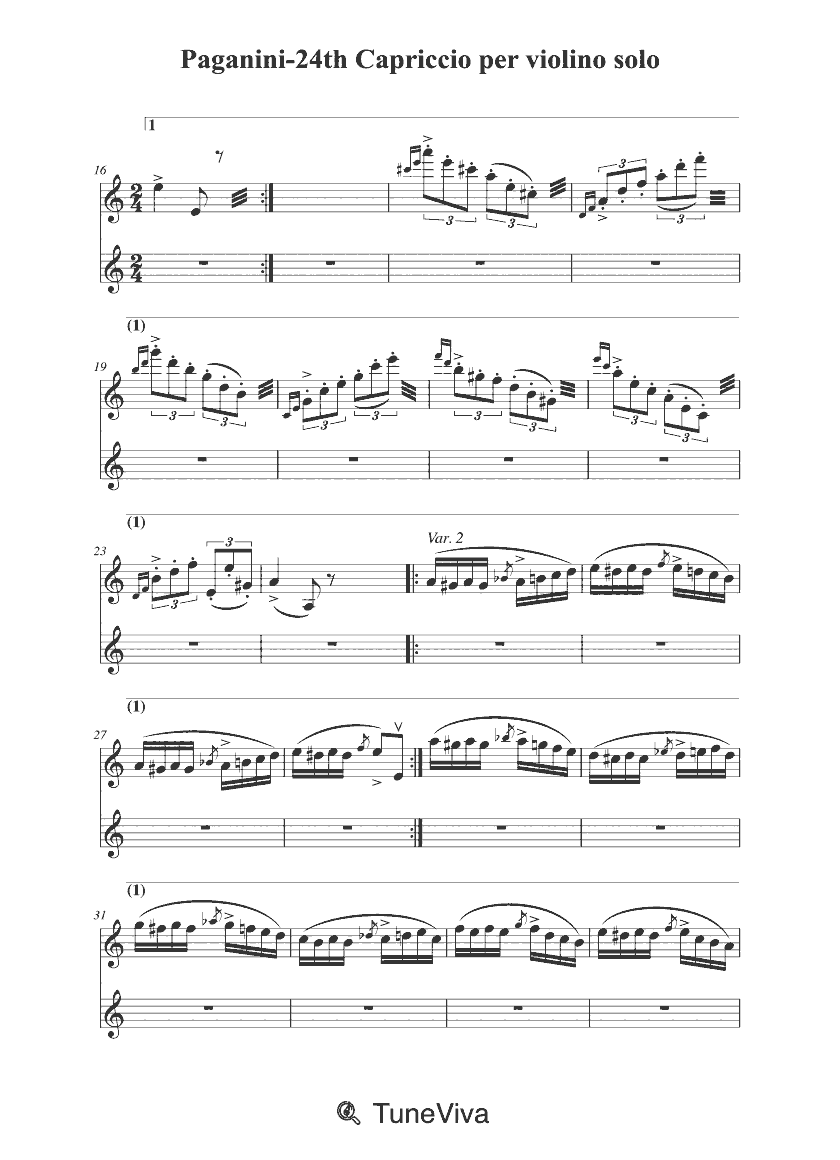
Caprice No. 24
Lá menor
classical
1 tracks
Paganini's catalogue on this site is almost entirely one instrument: 38 scores, about 133 minutes of music and 54,820 notated notes, with not a single entry carrying lyrics. Thirty-three are filed as classical and five are unclassified. The Caprice No. 24 is far ahead of everything else at 117,793 views, followed by the Fifth Caprice, while the rest of the page is a run through Op. 1 at roughly one caprice per file. Difficulty is recorded as 37 entries at index 0 and one at index 3, a scale that plainly does not measure what these pieces ask of a player.
Paganini was born in Genoa on 27 October 1782, the third of six children of a ship chandler, and was playing the violin by the age of seven. He studied in Parma with Alessandro Rolla and Ferdinando Paer, became first violin of the Republic of Lucca in 1801 and entered the service of Napoleon's sister Elisa Bonaparte in 1805. From 1809 he toured, and a concert at La Scala in 1813 made his name beyond northern Italy. A Vienna tour in 1828 opened the rest of Europe, and he was made a Knight of the Order of the Golden Spur in 1827. Chronic illness ended his concert career in 1834, a failed Paris casino two years later left him in financial ruin; he died in Nice on 27 May 1840.
The 24 Caprices, Op. 1, were probably written between 1805 and 1809 and were published in Milan by Ricordi in 1820, dedicated "agli artisti". No. 24 in A minor is a theme with eleven variations and a finale, and it became a set of variations for other composers: Liszt, Schumann, Brahms and Rachmaninoff all used it. Il Carnevale di Venezia, Op. 10, is a set of variations from 1829 on the Neapolitan tune "O Mamma, Mamma Cara" ("O mamma mia"), despite its Venetian title. The Duo Merveille, or Sonata a violino solo, is an earlier solo piece in C major built on double stops.
No entry is vocal, and the collection mixes original solo writing with arrangements: the Caprice No. 24 appears again in a version for double bass. Titles usually carry the key and opus number, but the most-viewed file is titled simply "Caprice No. 24", so it is worth opening before assuming the edition.
These pieces were written by a performer for his own hands, so the difficulties are practical rather than abstract: tenths, double stops, left-hand pizzicato, harmonics and bowing effects that imitate other instruments. Take the caprices below tempo and listen for intonation in the double stops before adding speed. In No. 24 the variations each isolate one device, which makes the piece a compact technical syllabus. Il Carnevale di Venezia is more theatrical, and the folk tune is meant to be heard plainly between the variations rather than buried under decoration.
The A minor caprice, Op. 1 No. 24: a theme, eleven variations and a finale, and by far the most-viewed file here.
A study in rapid string crossing and left-hand agility, and the second most-viewed score in the collection.
The hunting caprice: the title points to the horn calls and the quick, flying bowing that run through it.
Nicknamed the "Devil's Laughter" for its abrupt, leaping figures and wide registral jumps.
A short, relentless study in rapid figuration, often used as a technical test.
One of the more measured caprices, with a moderate tempo and clean shifting through the lower positions.
Variations of 1829 on the Venetian song "O mamma mia", Op. 10, written for Paganini's own concert programmes.
A solo violin sonata in C major, catalogued as MS 6 and also known as the Merveille de Paganini; it relies on double stops and left-hand pizzicato.
An arrangement of the A minor caprice for double bass, transposed and refingered; the arranger is not named.
A study built on a persistent trill, demanding evenness between the trilled note and the moving line.
Thirty-eight, totalling about 133 minutes of music and 54,820 notated notes. None of them includes lyrics.
Paganini wrote most of his music to play himself, and the catalogue reflects that: the caprices and the solo showpieces outweigh the concertos and chamber works.
A theme in A minor followed by eleven variations and a finale. It was published in 1820 as the last of Op. 1, and other composers have used its theme ever since.
No. It is an arrangement of the violin caprice for double bass, and the catalogue gives no arranger's name.
Catalog editions and arrangements attributed to Niccolò Paganini.
Lá menor


Per un violino solo


A Minor

24 Capricci per violino solo op.1 (1817)


