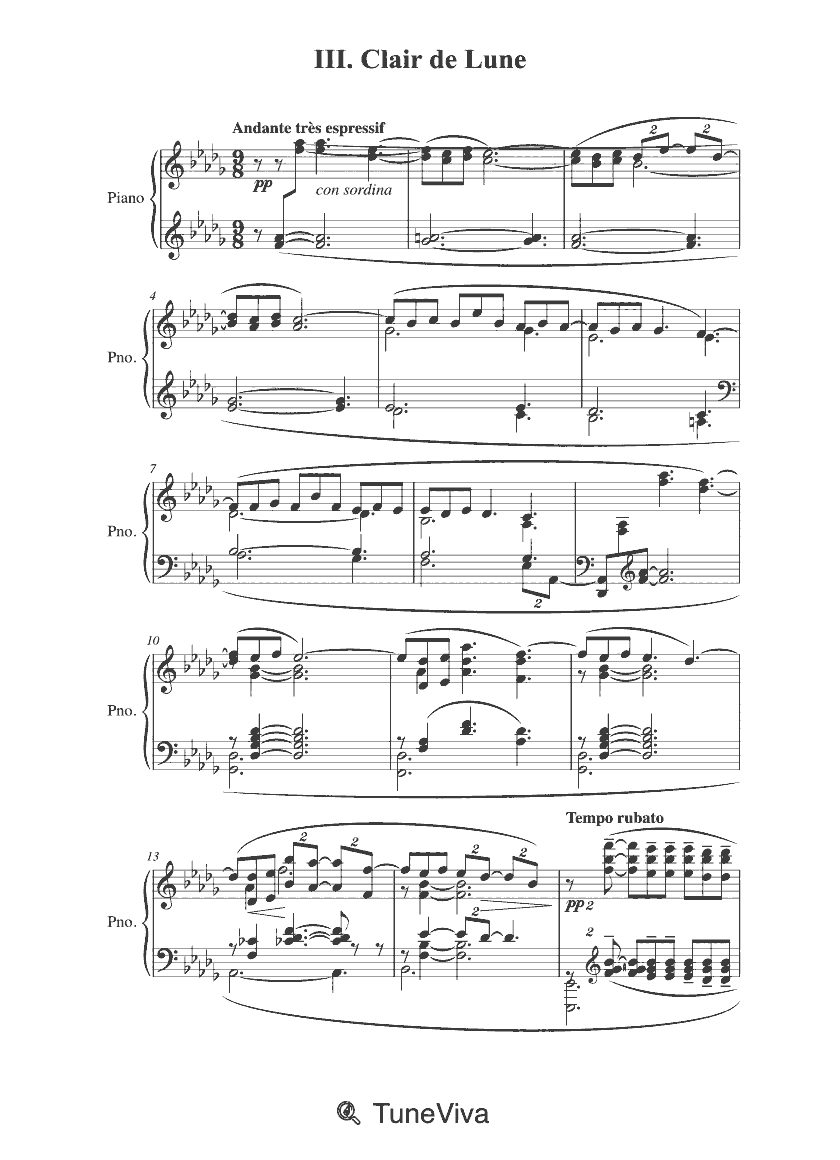
III. Clair de Lune
Claude Debussy
Follow the score, hear the music, then make it your own.
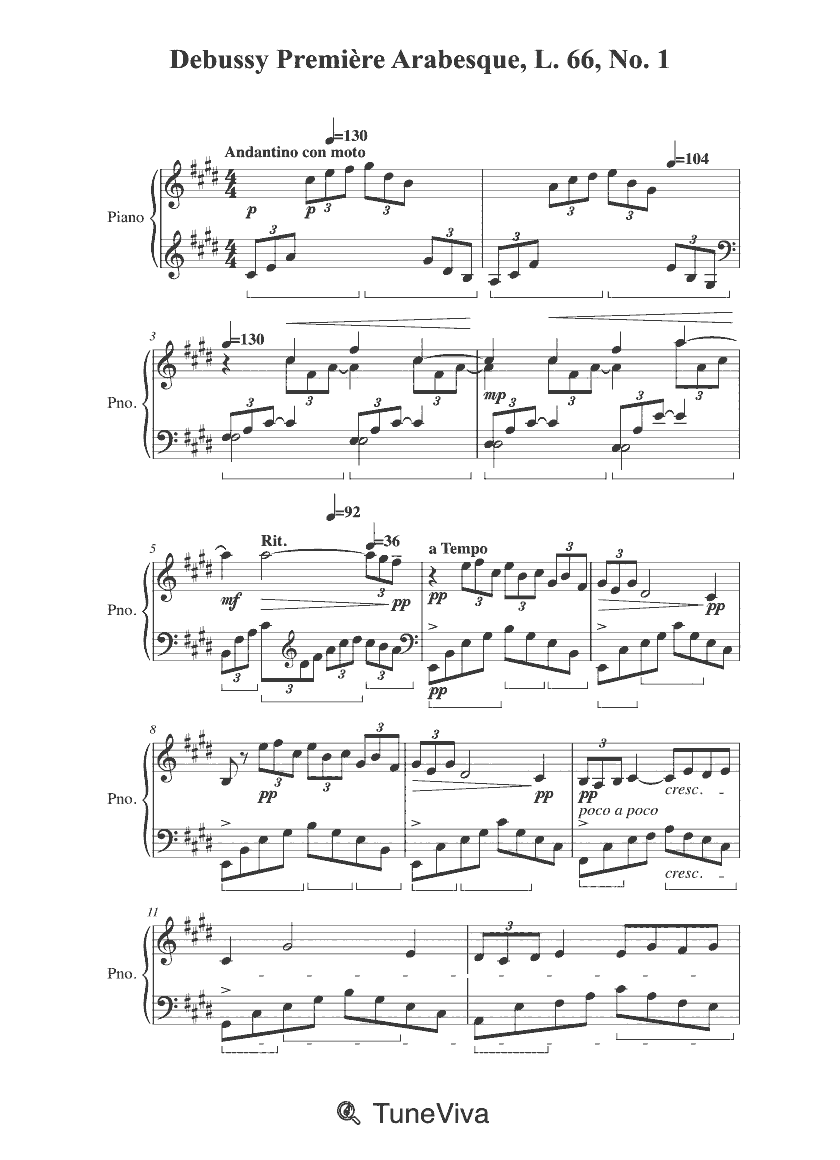
Debussy’s Première Arabesque is the first of his Deux Arabesques. This solo piano score opens in E major and common time with Andantino con moto. The flowing sound depends on the two hands sharing a pulse, especially when one plays a triplet while the other divides the beat into two.
Score parts: Piano. Opening key signature: 4 sharps. Opening time signature: 4/4. Opening tempo: 104 BPM. Estimated playback time: 4 min 13 sec. Listen while following the notation, adjust playback speed, or open this score in practice mode.
Find a beat where a triplet in one hand meets a pair of even eighth notes in the other. Tap six equal subdivisions. The triplet falls on the first, third and fifth taps, and the pair falls on the first and fourth. Once the hands hit those points consistently, count just the main beat and carry the pattern into the notes. Bring out the held melody notes above the moving part so that the rhythm exercise turns back into a phrase.
At Tempo rubato the signature changes from four sharps to three. Read the first few bars of that section without extending the rubato, so the accompanying pulse is clear before you let the melody breathe. Later, the four-sharp signature returns at Tempo I. Start one bar before that return and keep going for a few beats rather than beginning exactly where the familiar figure resumes.
It opens in E major with four sharps. The Tempo rubato section has three sharps, and the four-sharp signature returns at Tempo I.
Take the opening at an unhurried pace with a sense of motion. Give the triplets direction within the beat without making each note a separate accent.
One hand divides the beat into two even notes while the other divides the same span into three. Both hands start together and meet again at the next beat.
Claude Debussy
Claude Debussy