
Magnificat - Ton Royal
Maitrise de Notre Dame de Paris
Ton Royal
Voice; Organ · 3 min 34 sec
Open scoreMagnificat sheet music covers a title shared by many separate compositions rather than a single piece. The scores listed here show how varied those works are: a setting for voice and organ listed as 'Ton Royal' and linked in its listing to Louis XIII and the Maîtrise de Notre-Dame de Paris, a five-part score listed under Johann Sebastian Bach's name, and a Vivaldi setting for four voices with strings and continuo. Because the title alone identifies nothing, the composer, key and scoring of a given score are the quickest ways to work out which Magnificat you are looking at. Compare keys, vocal forces and instrumental parts in the listings below before choosing a score.
Scores 1–20 of 33
Maitrise de Notre Dame de Paris
Ton Royal
Voice; Organ · 3 min 34 sec
Open score
Johann Sebastian Bach
Sopran I; Sopran II; Alt +2 parts · 2 min 35 sec
Open score
Antonio Vivaldi
RV. 610 in Re minore
Soprano; Alto; Tenor +6 parts · 51 sec
Open score
Magnificat - Pitoni
Soprano; Alto; Tenor +1 parts · 6 min 15 sec
Open score
Giovanni Paola Colonna(1637-1695)
S 1; A 1; T 1 +7 parts · 21 min 38 sec
Open score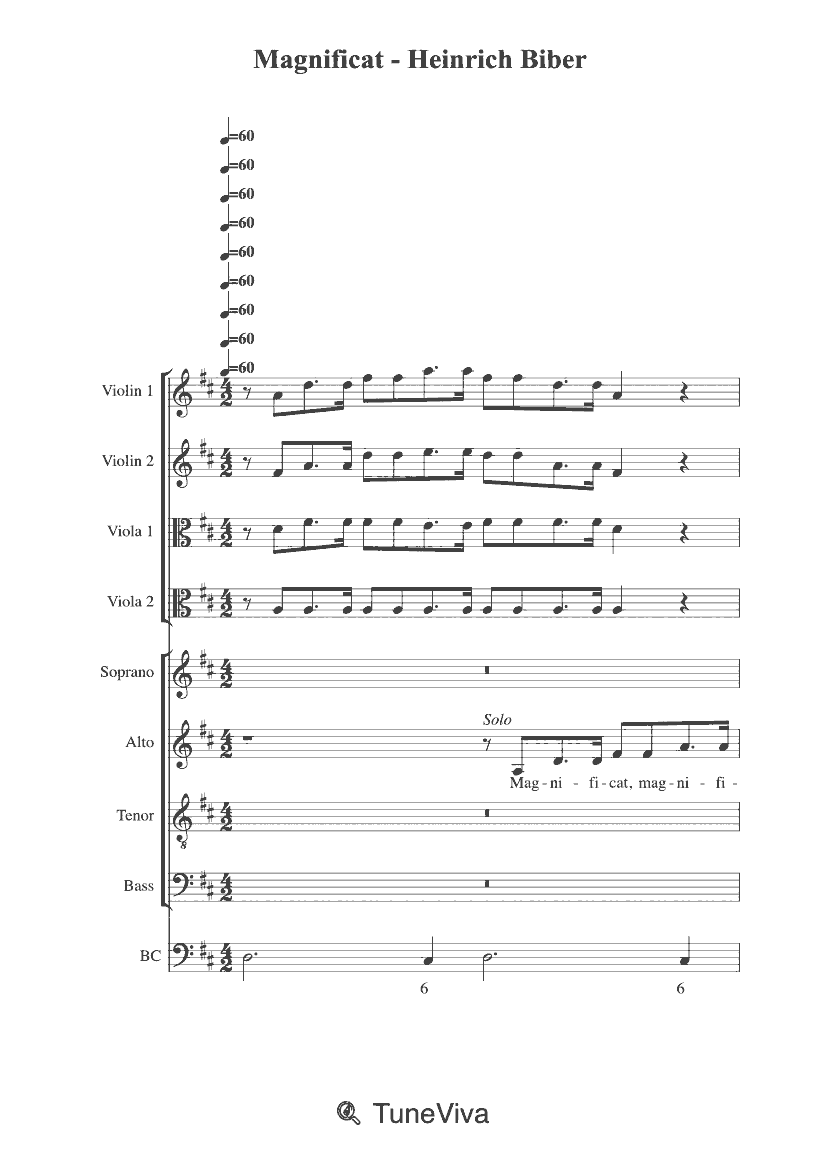
Heinrich Ignaz von Biber1644 - 1704
Vesperae longiores
Violin 1; Violin 2; Viola 1 +6 parts · 15 min 50 sec
Open score
Francesco Cavalli
Francesco Cavalli
Violino I; Violino II; Violoncino +9 parts · 20 min 20 sec
Open score
John Playford
Soprano; Tenor; MusicXML Part · 1 min 40 sec
Open score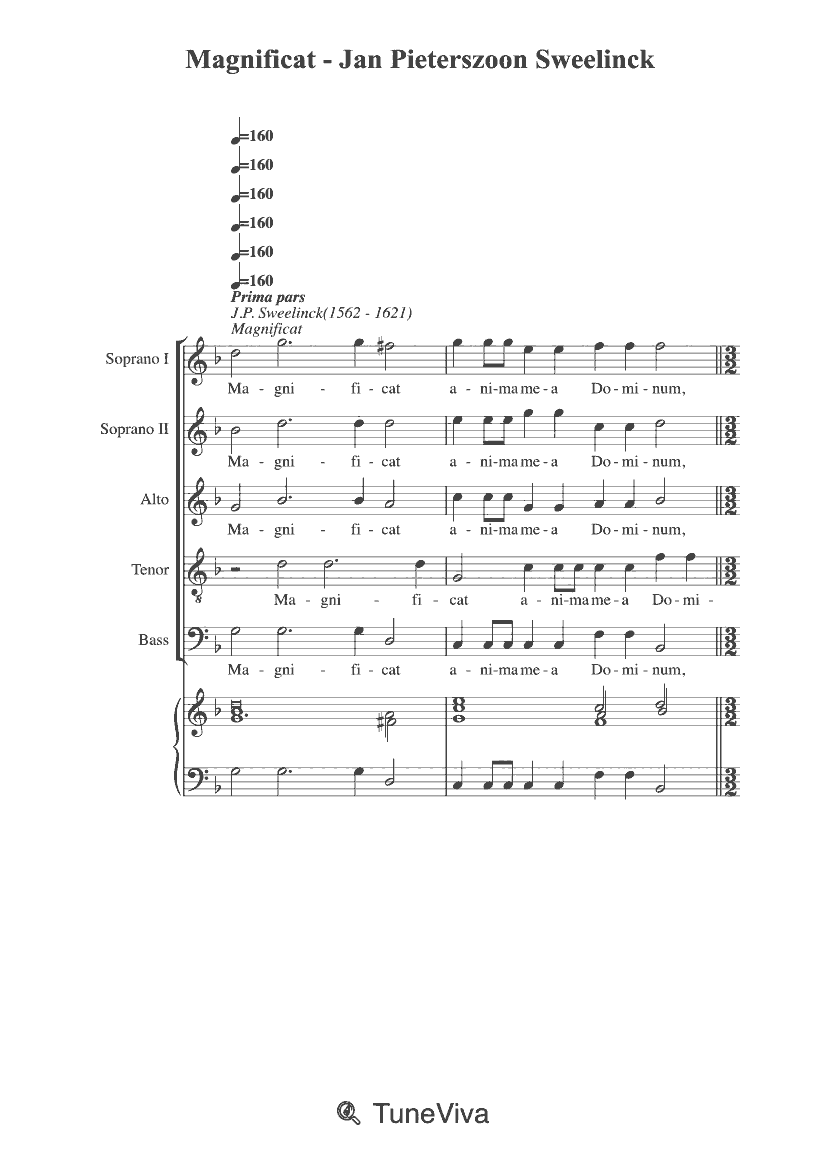
Magnificat - Sweelinck
Soprano I; Soprano II; Alto +3 parts · 10 min 24 sec
Open score
Misc Praise Songs
Part_1; Part_2; Part_3 +1 parts · 3 min 23 sec
Open score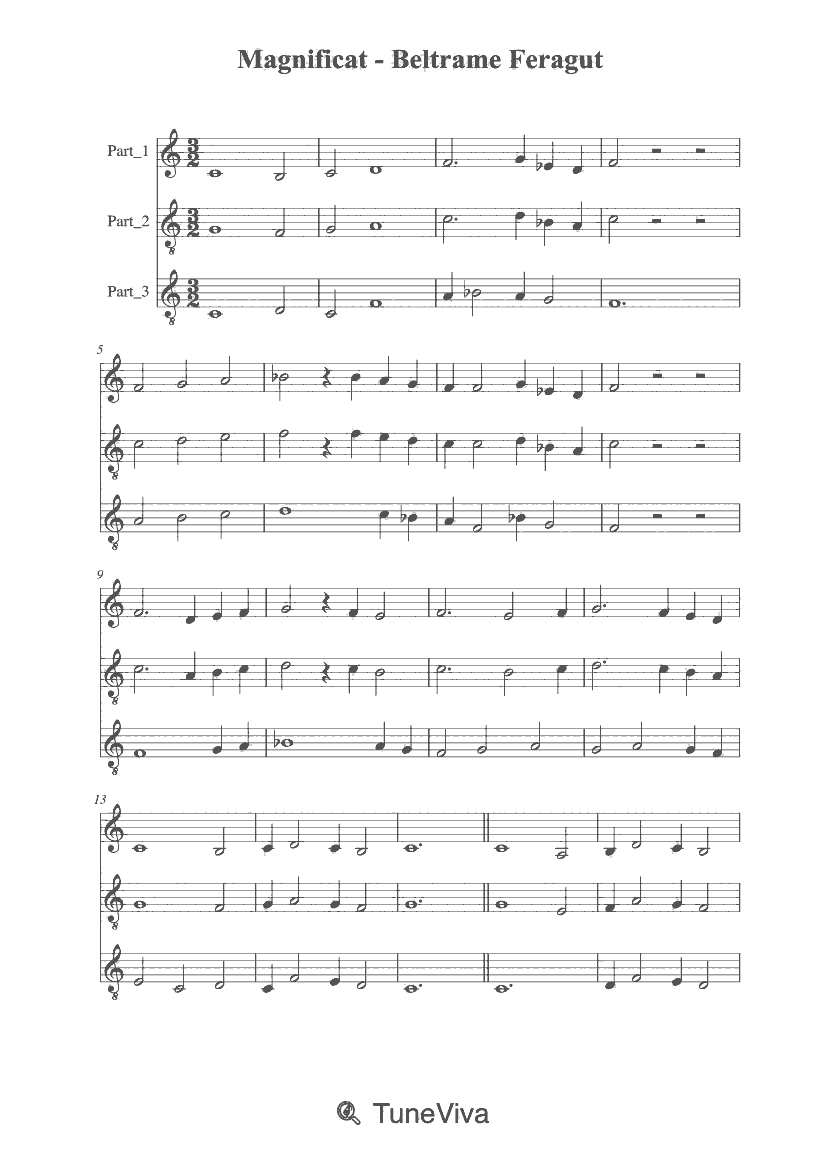
Beltrame Feragut
Part_1; Part_2; Part_3 · 10 min 24 sec
Open score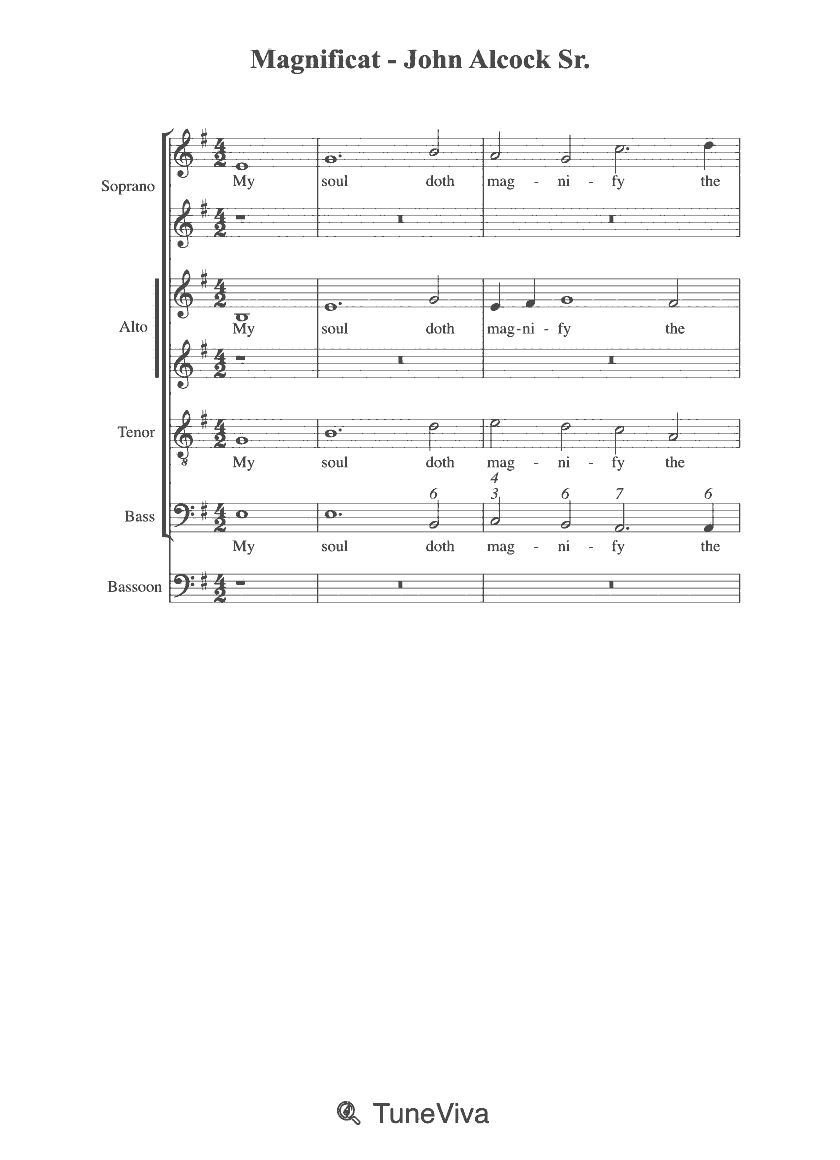
John Alcock sr.
Soprano; Alto; Tenor +2 parts · 10 min 58 sec
Open score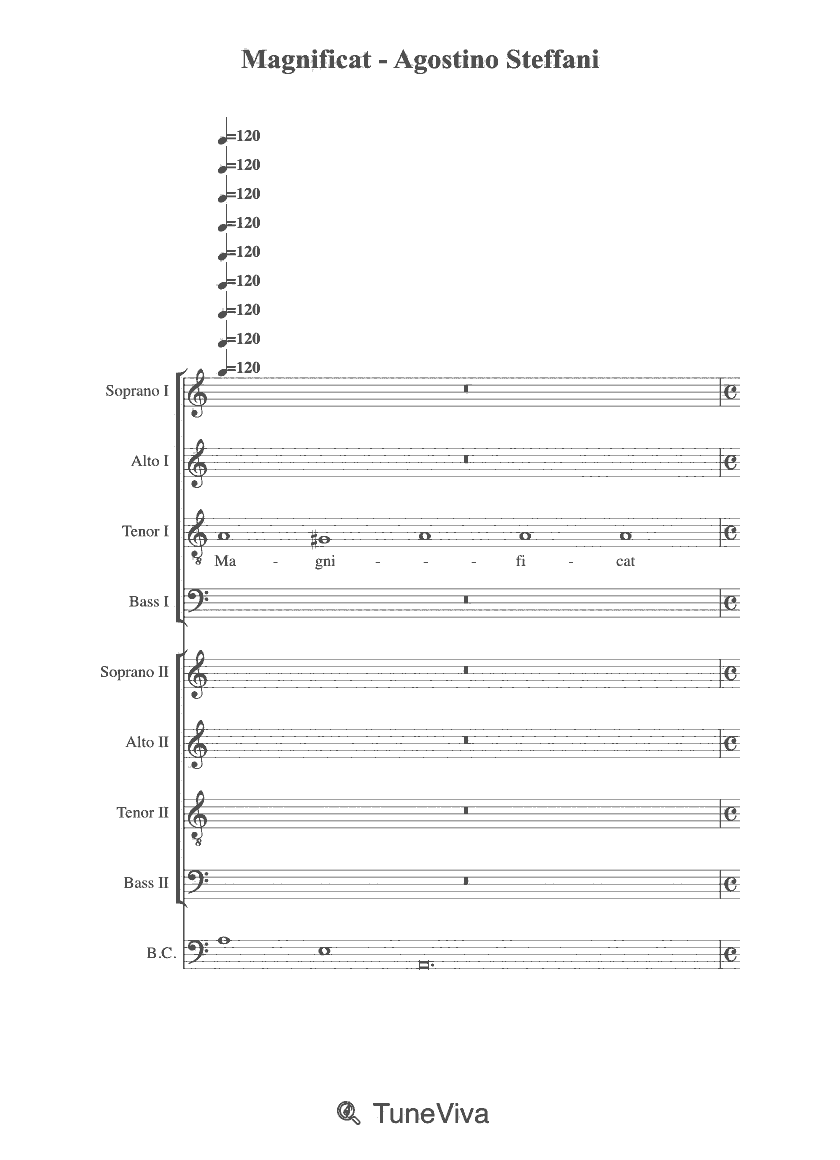
Agostino Steffano
Soprano I; Alto I; Tenor I +6 parts · 10 min 14 sec
Open score
Leone Leoni
Cantus; Altus; Tenor +2 parts · 6 min 32 sec
Open score
Hugo Distler
aus: Die Weihnachtsgeschichte Op. 10
Maria; Sopran; Alt +2 parts · 1 min 14 sec
Open score
Misc Praise Songs
Part_1; Part_2; Part_3 · 12 min 20 sec
Open score
John Farmer
Soprano; Tenor 1; Tenor 2 +1 parts · 1 min 39 sec
Open score
Misc Praise Songs
Part_1; Part_2; Part_3 · 9 min 50 sec
Open score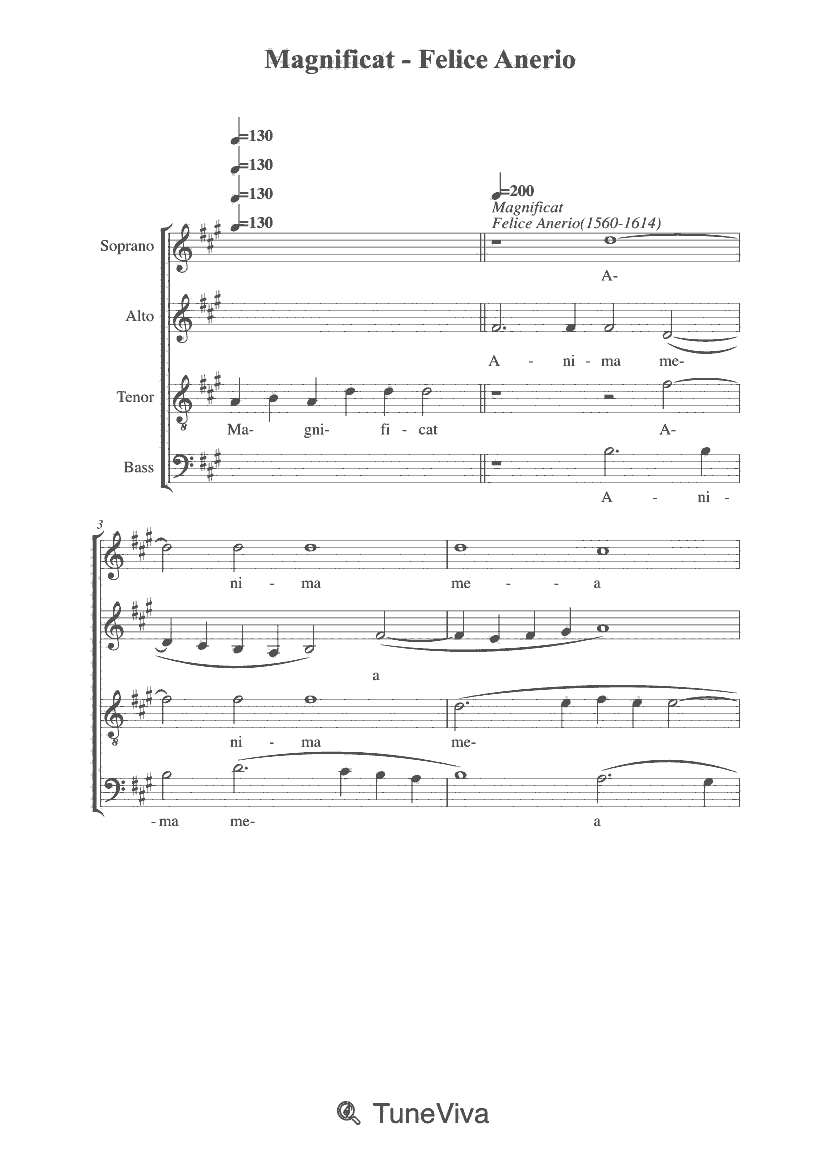
Magnificat - Anerio
Soprano; Alto; Tenor +1 parts · 12 min 33 sec
Open score
Giovanni Rovetta
Salmi concertati a cinque et sei voci con doi violini. Opera prima. Venetia M DC XXXXI
Violino 1; Violino 2; Canto +6 parts · 13 min 1 sec
Open scorePage 1 of 2
'Magnificat' is a shared title, so treat it as a starting point rather than an identification. The three listings here point to three different musical worlds: a French court-associated 'Ton Royal' setting for voice and organ, a Bach setting for five voices, and a Vivaldi setting with strings and continuo. If a listing's composer field is empty or ambiguous, use the key and the list of parts to narrow it down, and check any attribution against a reliable edition before you rely on it.
The listed details differ sharply between scores: the 'Ton Royal' entry opens with one sharp in 3/4 for voice and organ; the Bach entry opens with two sharps (D major) in 4/4 for Soprano I, Soprano II, Alto, Tenor and Bass; the Vivaldi entry opens with one flat (D minor) in 4/4 for four voices plus Violino 1, Violino 2, Viola, basso continuo and organ. Those fingerprints are more useful than the title when you are matching a score to a recording, a rehearsal plan or a programme note.
If you are planning a performance, decide first what forces you actually have. The Bach listing is purely vocal across five parts, which suits a choir able to divide sopranos. The Vivaldi listing assumes solo voices with a string group and continuo, including organ. The 'Ton Royal' listing is for voice and organ, a lighter texture that may suit a smaller ensemble. These are descriptions of the scores as listed, not guarantees that other movements or editions use the same forces.
Titles, part names and tempo values describe individual scores and can be incomplete or inaccurate; they do not confirm that a score is a complete work, an original instrumentation, or a particular edition. Note counts and durations in the listings refer to the files themselves and are not a measure of the work's length or scope. Difficulty is not graded here, so judge a score by reading it rather than by its label.
Score parts: Voice, Organ. Catalogue duration 3 min 34 sec. Opening key signature: 1 sharp. Opening time signature: 3/4. Opening tempo: 112 BPM.
Score parts: Sopran I, Sopran II, Alt, Tenor, Bass. Catalogue duration 2 min 35 sec. Opening key signature: 2 sharps (D major). Opening time signature: 4/4. Opening tempo: 82 BPM.
Score parts: Soprano, Alto, Tenor, Bass, Violino 1, Violino 2, …. Catalogue duration 51 sec. Opening key signature: 1 flat (D minor). Opening time signature: 4/4. Opening tempo: 66 BPM.
Listings under this title include a score attributed to Johann Sebastian Bach for five voices, a setting by Antonio Vivaldi for four voices with strings and continuo, and a 'Ton Royal' score linked in its listing to Louis XIII and the Maîtrise de Notre-Dame de Paris. Each is a separate composition that shares a title rather than a common musical text. Attributions printed on a score are worth checking against a reliable edition.
The score listed under Johann Sebastian Bach's name carries five vocal parts — Soprano I, Soprano II, Alto, Tenor and Bass — and opens with a two-sharp (D major) key signature in 4/4. Those details describe this particular score as listed, and they should not be assumed to apply to every movement or every edition of a Bach Magnificat.
The Vivaldi setting is listed with four voices — soprano, alto, tenor and bass — together with Violino 1, Violino 2, Viola, basso continuo and organ, opening in a one-flat signature in D minor. A continuo group including organ is part of the scoring shown here, alongside a two-violin string section.
Settings circulating under the Magnificat title vary in scoring, and the listings here reflect that. One entry is for voice and organ, another is set for five vocal parts with no instruments named in its part list, and a third combines four voices with strings, continuo and organ. A musician choosing music should therefore check the listed parts rather than assuming a choral layout.
Compare the key signature, time signature and list of parts, which differ clearly between the scores listed here: one sharp and 3/4 for voice and organ, two sharps and 4/4 for five voices, one flat and 4/4 for solo voices with strings and continuo. Those details let you match a score to a recording or a colleague's copy even when the title page is ambiguous.
One score listed here is set for voice and organ, so a purely organ-accompanied approach is represented in the catalogue. The other listings name string parts, continuo and, in one case, five independent vocal lines, and nothing in the listings confirms that those instrumental parts can be replaced by organ. Whether a keyboard reduction exists depends on the specific edition you obtain.